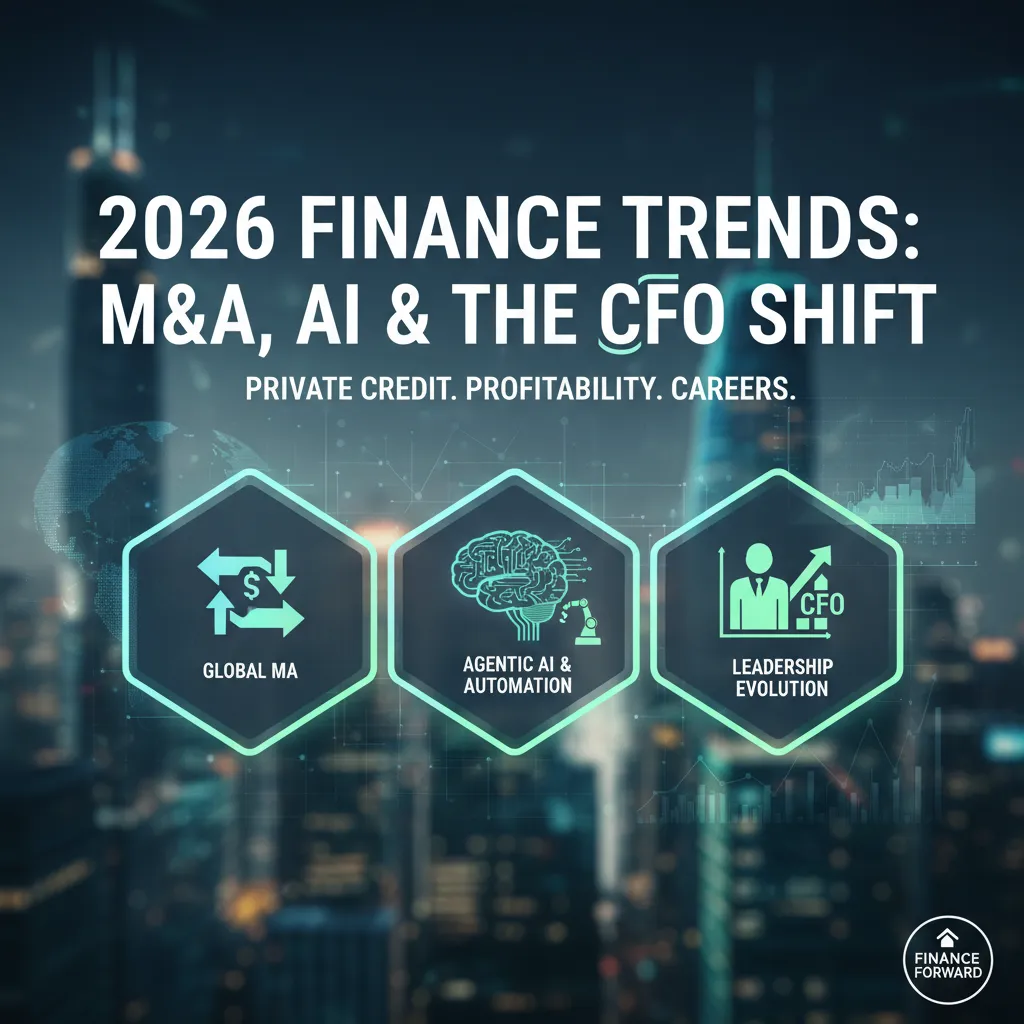
Last fall I caught myself refreshing deal headlines like they were sports scores—then realized I wasn’t actually chasing drama, I was chasing signals. Something was changing in global financial services: fewer “tiny” surprises, more big structural moves. In 2025 the numbers started telling a story (and, honestly, my group chat with a couple ex-bankers wouldn’t shut up about it): megadeals were back, private credit was everywhere, and AI stopped being a neat demo and started acting like a coworker. This is my field-note style outline of the finance trends I’m watching into 2026—messy, practical, and a little opinionated.
1) Megadeals Are Back (and I Felt It in My Inbox): global M&A trends
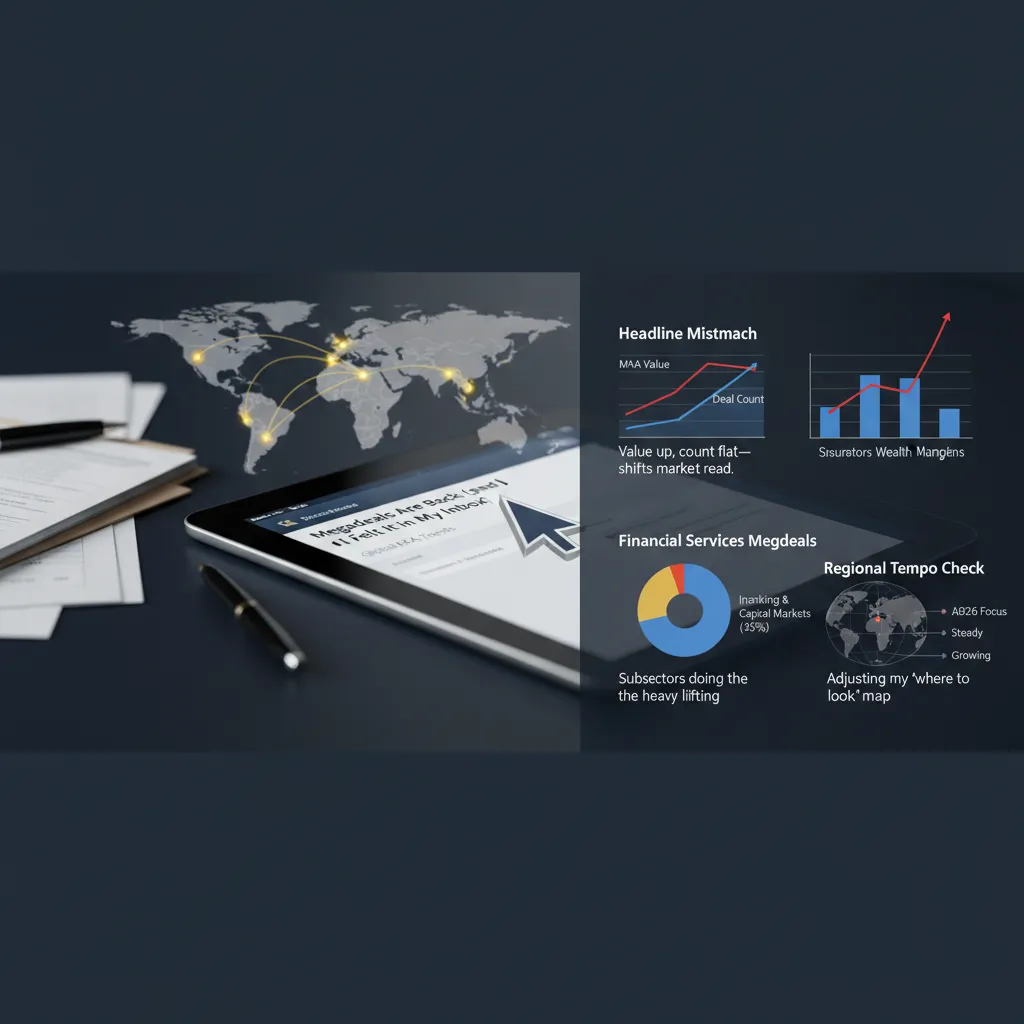
My inbox is usually the first place I notice a shift in global M&A trends. In late 2025, the tone changed: fewer “we’re exploring options” notes, more “we’re staffing a live process” threads. What stood out in the data too was the same mismatch I kept hearing about on calls: M&A value is up, but deal count is barely moving. That gap matters because it changes how I read the market. When value rises without a big jump in volume, it often means big players are doing big moves, while smaller deals stay cautious.
The headline mismatch: value up, count flat
In practical terms, I stop using deal count as my main “heat check.” A flat count can hide a very active market if a handful of megadeals are driving totals. For me, that signals:
- More concentration risk: fewer transactions shape the whole year.
- More financing complexity: larger deals need clearer rate and funding paths.
- More regulatory weight: big combinations attract longer reviews.
Where megadeals are coming from in financial services
In financial services M&A, the heavy lifting isn’t evenly spread. The subsectors that tend to power megadeals are:
- Banking & capital markets: scale plays, deposit bases, and platform consolidation.
- Insurance: balance sheet strength and distribution reach drive larger tie-ups.
- Asset & wealth management: AUM scale, fee pressure, and tech-enabled advice push consolidation.
I still see smaller, steady activity elsewhere, but the “value pop” usually comes from these lanes.
Regional tempo check: how I’d redraw my 2026 map
For 2026, I’d adjust my “where to look” map like this:
- Americas: faster decision cycles and more appetite for scale deals.
- EMEA: selective megadeals, with heavier policy and competition review.
- Asia Pacific: uneven pace—strong in specific hubs, cautious where growth is softer.
My tangent: why megadeals shape hiring and bonuses
People don’t say it out loud, but deal volumes vs megadeals changes hiring chatter and bonus expectations. A few huge mandates can lift fee pools for top teams, even if most bankers feel “busy but not flooded.” That’s when I hear the same line repeated:
“It’s not more deals—it’s bigger deals, and the staffing is tighter.”
2) Banking capital markets: consolidation, carveouts, and portfolio optimization strategy
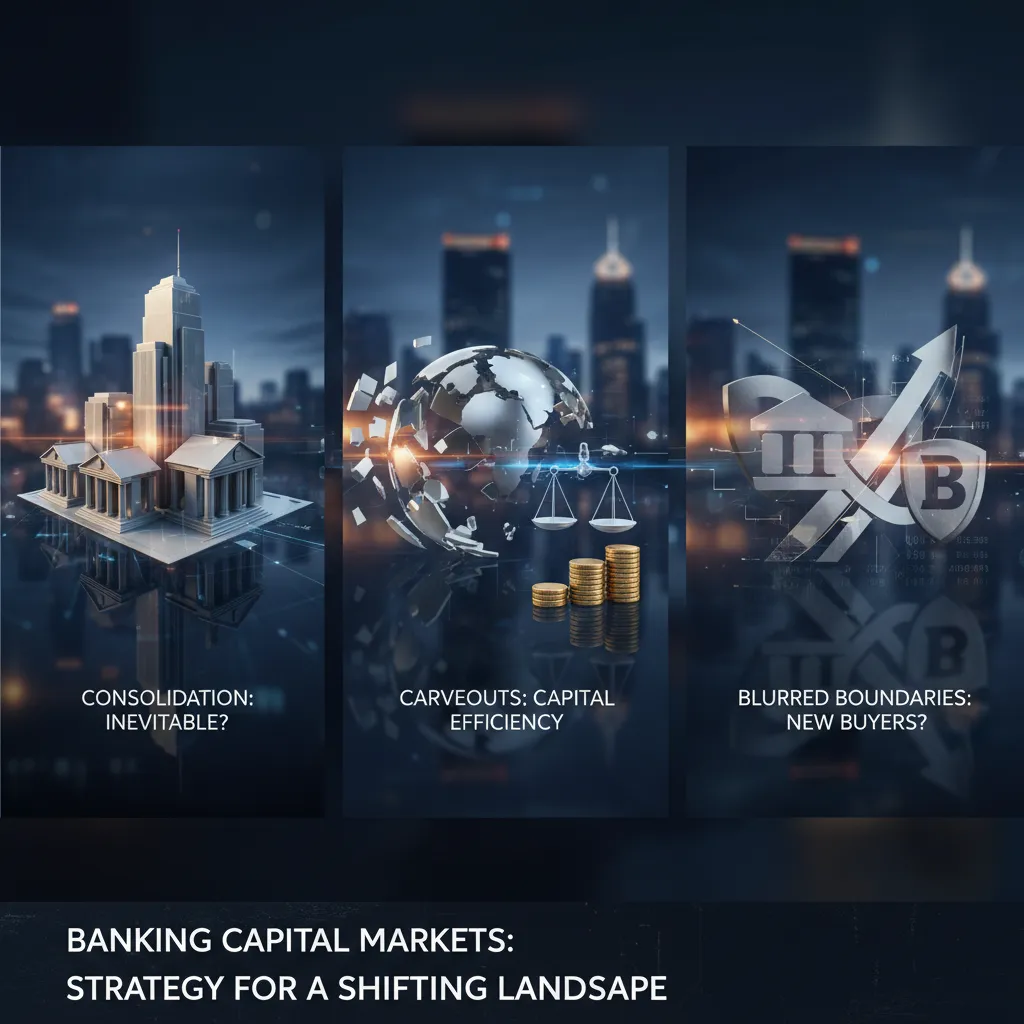
Why consolidation feels “inevitable” again
In the 2025–2026 finance trend cycle, I keep hearing leaders say, “We’re not planning to merge.” Yet consolidation still feels inevitable. The reason is simple: higher funding costs, tighter capital rules, and rising tech spend make scale matter again. When margins get squeezed, the fastest path to efficiency is often combining platforms, cutting overlap, and spreading compliance and AI costs across a bigger base.
“Nobody wants to be the next deal rumor—until the numbers force the conversation.”
Portfolio carveout optimization as a capital pressure-release valve
Another theme I see is portfolio optimization through carveouts, especially loan carveouts. Instead of selling the whole bank or exiting a market, banks can sell a slice of assets that consume a lot of capital or create volatility. This acts like a pressure-release valve: it improves capital efficiency, reduces risk-weighted assets, and can free up room to grow in core segments without raising new equity.
- What gets carved out: non-core loan books, legacy portfolios, or higher-risk concentrations
- Why now: capital efficiency requirements are stricter, and investors want cleaner stories
- How it helps: better ratios, simpler balance sheets, and more focused management time
Blurred boundaries: banks, insurers, and asset managers swap playbooks
In banking capital markets, the buyer universe is widening. Banks are using asset-manager style portfolio moves. Insurers are leaning into bank-like credit strategies. Asset managers are building origination and servicing capabilities. This blurring changes deal dynamics: a loan carveout might attract a bank, a private credit fund, an insurer, or a hybrid platform—often with different return targets and speed to close.
If I ran a mid-size bank in 2026
If I were running a mid-size bank, I’d sell first the assets that drain capital but don’t build relationships:
- Non-core commercial real estate exposures with weak cross-sell
- Small, scattered loan pools that add servicing cost
- Legacy portfolios with high compliance friction
What I’d never sell: my primary customer relationships, core deposits, and the data and servicing capabilities that power underwriting and AI-driven risk decisions.
3) Private credit growth: the quiet engine behind deals
One of the biggest finance trends I’m watching into 2026 is the steady rise of private credit. The headline number matters: private credit funds now sit at $2T+ in assets under management. In real deal terms, that changes who has leverage, how fast a process can move, and who shows up at the table.
Why $2T+ AUM changes negotiation dynamics
When that much capital is ready to deploy, sellers and sponsors are no longer limited to a small set of bank-led options. I see more situations where a private credit fund joins early, shapes the term sheet, and becomes a “must-please” stakeholder alongside the buyer, the seller, and the traditional lenders.
- More bidders stay in the game because financing is less dependent on bank appetite.
- Speed becomes a weapon since private credit can often underwrite with fewer committees.
- Covenants and pricing become a negotiation battleground, not an afterthought.
How alternative financing reshapes transaction structures
Across US and Europe banking deals, alternative funds are influencing structure, not just cost of capital. I’m seeing more creative mixes: unitranche-style packages, delayed-draw features for integration, and financing that is tailored to regulatory or balance-sheet constraints. In Europe especially, where bank lending standards can tighten quickly, private credit often becomes the “plan A,” not the backup.
My “coffee test”: if a deal pitch ignores private credit, I assume the pitch deck is already outdated.
Where the runway might be: under-financed niches
Even with $2T+ AUM, there are pockets of global financial services that still look under-served. When I scan for runway, I look for stable cash flows, clear collateral, and complexity that banks don’t love.
- Specialty insurance distribution and managing general agents with recurring commissions
- Wealth and RIA platform roll-ups needing flexible acquisition capital
- Payments and fintech infrastructure with contracted revenues but uneven profitability
- Non-bank lenders seeking warehouse lines and portfolio financing
4) agentic AI workflow meets core system modernization (aka: the timeline mismatch)
The shift I’m noticing in 2026 finance trends is that AI is moving past “chat” and into agentic AI workflows—systems that can take actions, not just answer questions. In finance and insurance operations, that looks like AI making bounded decisions in underwriting, claims, payments, and service ops: routing work, flagging exceptions, approving low-risk items, and escalating edge cases with a clear audit trail.
AI moves in months; core modernization moves in years
Here’s the timeline mismatch: core system modernization (policy admin, claims platforms, ERP, payment rails, data foundations) often takes years. But AI innovation cycles run in months. If I wait for the “perfect” platform, I lose learning time and I fall behind competitors who are already testing autonomous decision-making.
What I’m doing instead is piloting agentic AI in a way that respects today’s constraints:
- Start at the edges: use AI to triage, summarize, and recommend actions before it touches the system of record.
- Use thin integration: APIs, event streams, and RPA as a bridge while core upgrades are in flight.
- Design for controls: human-in-the-loop thresholds, approval limits, and logging from day one.
The CIO–CFO cadence that makes it real
In my experience, the unglamorous part is the most important: a steady CIO–CFO meeting cadence. Not a one-off steering committee, but a recurring working session that aligns risk, cost, and speed. We review model performance, exception rates, unit economics, and what needs to change in data, security, and process design.
“Agentic AI is a workflow change first, and a model choice second.”
Hyperscaler neutrality (my mildly biased take)
I’m increasingly willing to pay for hyperscaler neutrality now—portable architectures, open standards, and vendor-agnostic data layers—because lock-in regret is expensive. If agentic AI becomes embedded in finance operations, switching costs will rise fast. Flexibility today is an insurance policy for tomorrow.
5) FP&A trends value creation: from “cost police” to profitability margin management
In the 2025–2026 finance trends I’m seeing, FP&A is moving away from being the “cost police” and toward being a profitability guardian. That shift matters because leaders don’t win by cutting forever; they win by protecting margin while still funding growth. For me, that means profitability analysis becomes the center of the conversation, not an appendix.
FP&A as a profitability guardian: what I’d change in the weekly forecast meeting
I’d stop spending 30 minutes debating whether travel is up 3% or 5%. Instead, I’d run the meeting like a margin clinic:
- Start with margin bridges: price, volume, mix, churn, discounting, and delivery cost.
- Force “so what?” on every variance: what decision changes this week?
- Assign owners to the top 3 margin leaks, with dates and next actions.
“Forecasting is only useful when it changes behavior.”
Scenario planning that isn’t just “base, bad, worse”
Instead of three versions of the same story, I build scenarios that reflect different business moves:
- Capacity constraint: demand is strong, but delivery or hiring slows revenue.
- Price pressure: competitors discount; we respond with packaging and mix changes.
- Cash protection: we pause low-ROI spend and renegotiate vendor terms.
Each scenario has clear triggers (like pipeline conversion or renewal rates) so we know when to switch plans.
Financial planning automation: where I’d automate first (and keep humans in the loop)
I’d automate the boring, repeatable work first: data pulls, mapping, variance flags, and rolling forecast updates. A simple rule like if variance > 2% then flag saves hours. But I keep humans in the loop for pricing, one-time deals, and any assumption tied to customer behavior.
Tiny confession: I used to over-trust the model; now I stress-test assumptions like I’m paid per question—because in modern FP&A, the value is not the spreadsheet. It’s the judgment behind it.

6) geopolitical regulatory complexity + careers: what I’d tell my younger self
If I could talk to my younger self, I’d say this: regulatory framework compliance is not just “more rules.” It’s more variability, more exceptions, and more timing games. In 2026, geopolitics makes this sharper. The same deal can be “fine” in one country and blocked, delayed, or re-priced in another because of data rules, sanctions, tax changes, or local reporting deadlines.
Compliance is a moving target, not a checklist
I used to think compliance was a box to tick at the end. Now I treat it like a project plan with branches. The hard part is not reading the rule—it’s managing who it applies to, when it applies, and what exemptions exist.
- Variability: different definitions of “control,” “material,” or “beneficial owner.”
- Exceptions: thresholds, industry carve-outs, and transitional relief.
- Timing games: filing windows, audit cycles, and deal close dates that change outcomes.
CSRD twist: loosened in 2025, but ESG reporting isn’t “over”
Yes, the EU loosened some CSRD requirements in 2025. But that doesn’t end ESG reporting. It shifts it. Investors, lenders, and customers still ask for emissions, workforce, and supply chain data. Also, many companies still need CSRD-ready processes because subsidiaries, partners, or future growth can pull them back in.
“Even when rules soften, expectations rarely do.”
Careers: risk + analysis are rising (my 30-day upskill plan)
From what I’m seeing in finance trends 2025-2026, risk management career paths and financial analysis skills are gaining value. If I had 30 days, I’d do:
- Week 1: refresh accounting basics + read 10-K/annual reports daily.
- Week 2: build a simple scenario model (rates, FX, tariffs).
- Week 3: learn controls: SOX-style thinking, audit trails, evidence.
- Week 4: practice writing: one-page risk memo per case.
Wild card: a cross-border expansion plan that survives two regimes
I’d design a “two-rulebook” capability plan: one set for the home country, one for the target market, with shared data definitions. I’d keep a regulatory_change_log, map reporting calendars, and build a minimum ESG dataset that works under both regimes.
Conclusion: My 2026 finance trends “weather map” (and how I’ll use it)
When I step back and look at the 2025–2026 shift, I don’t see separate “trends.” I see one messy system where each part pushes on the others. Megadeals are back in the headlines, but they don’t happen in a vacuum—they lean on private credit when bank lending is tight, and they raise the stakes for regulatory shifts around antitrust, disclosure, and data. At the same time, agentic AI is changing how finance work gets done, which forces a rethink of controls, audit trails, and who is accountable when a model makes a call. And underneath it all, FP&A evolution is the glue: faster planning cycles, more scenario work, and more pressure to explain “why” in plain language.
So my 2026 finance trends “weather map” is simple: expect more motion, more crosswinds, and fewer clean lines between strategy, operations, and compliance. My practical takeaway is to act in threes—one move for deals, one for AI, and one for margins.
First, I’ll make one deal readiness move: tighten my data room basics before I need them—clean customer and product profitability views, clear revenue definitions, and a short list of value drivers I can defend. Second, I’ll run one AI workflow pilot that saves real time but stays safe—like an agent that drafts variance commentary from approved data, with human review and a logged prompt trail. Third, I’ll build one margin protection ritual: a weekly “leak check” on pricing, discounts, churn risk, and cost creep, so small issues don’t become quarter-end surprises.
Right now, finance in 2026 feels like flying with better instruments—real-time dashboards, smarter forecasts, faster close—but in more turbulent air, with policy changes, funding shifts, and tech risk all hitting at once.
Next quarter, I’m watching private credit terms, AI governance rules, and how quickly FP&A teams move from reporting to decision support. And what I’d love to be wrong about? That speed will keep beating control. What are you watching, and where do you think the turbulence will come from?
TL;DR: Megadeals are driving financial services M&A despite modest volume growth; private credit funds are reshaping deal funding; agentic AI workflow is moving toward autonomous decision-making; CFO finance leadership is becoming a tech-and-risk balancing act; FP&A trends value creation now hinge on scenario planning, profitability margin management, and faster capital allocation.