
Last spring I watched a “perfectly optimized” AI campaign crash and burn for a hilariously human reason: it learned the wrong lesson from one viral comment. That mess turned into my favorite reminder for 2025—AI is powerful, but only when I give it the right boundaries, signals, and feedback loops. In this post I’m not doing the usual ‘AI will change everything’ speech. I’m sharing 25 AI marketing hacks that I’d genuinely use again: the tiny workflow tweaks, the weird experiments, the ‘don’t do this in public’ drafts, and the boring dashboards that quietly raise conversion rates.
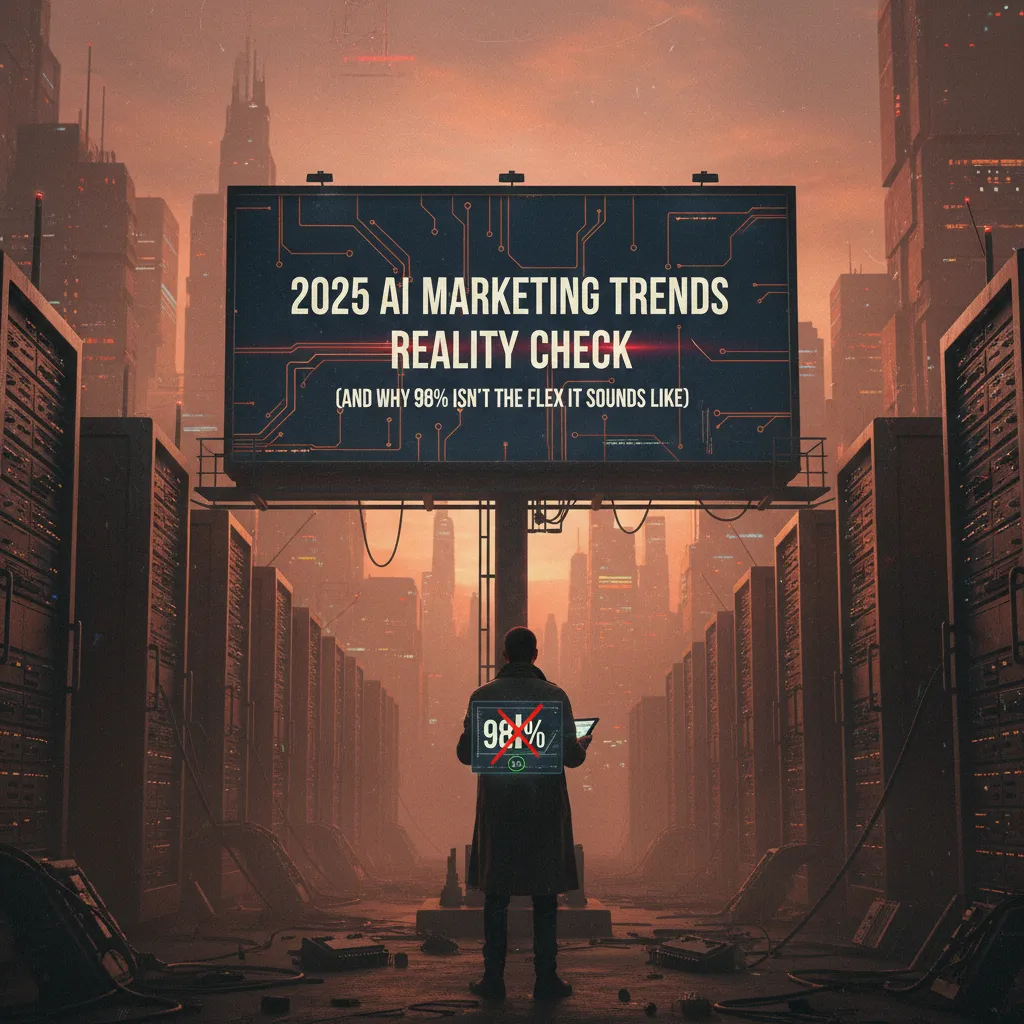
1) My 2025 AI Marketing Trends Reality Check (and why 98% isn’t the flex it sounds like)
Here’s my quick gut-check for 2025: when 98% of marketers use AI, “we use AI” stops being a competitive advantage. It’s like saying you use email. The edge shifts to using AI on purpose—with clear inputs, clear outputs, and clear limits.
Hack #1: Build a one-page AI Marketing Strategies scorecard
Before I touch any tool, I make a simple scorecard. It keeps my AI marketing work grounded and stops me from chasing shiny features.
| Inputs | Outputs | Risks |
|---|---|---|
| Audience, offer, brand voice, past winners | Ads, emails, landing copy, content briefs | Wrong claims, off-brand tone, privacy issues |
I also add one line for human checks: what I will review myself (facts, pricing, legal, positioning) before anything goes live.
Hack #2: Start with one KPI you can’t argue with
AI is great at generating options, but it needs a target. I pick one KPI that the team agrees matters—then I let AI chase it.
- CPA (paid acquisition)
- Pipeline (sales-qualified leads, revenue influence)
- Retention (repeat purchase, churn reduction)
Then I prompt AI with constraints like budget, audience segments, and what “good” looks like. If the KPI doesn’t move, the output was noise.
Hack #3: Keep a hallucination log (I treat errors like bugs)
I literally track wrong claims in a running doc so I stop repeating them. My hallucination log includes:
- The exact AI output
- What was wrong (fact, source, math, policy)
- What I changed in the prompt or process
My rule: if AI makes a claim that could change a decision, it needs a source or it doesn’t ship.
Tiny tangent: the best AI workflow I saw this year started as a messy Google Doc—just prompts, examples, and checks—not a fancy platform.
2) Hyper-Personalization Scale: the 202% CTA moment (plus my ‘creepy line’ test)
I used to think “personalization” meant adding a first name. In 2025, AI makes it easy to go deeper, but the real win is doing it without getting weird. My biggest jump came when I treated CTAs like a system, not a sentence—one test delivered a 202% lift in CTA clicks because the message matched the moment, not the person.
Hack #4: Map the journey in 5 steps, then assign one AI lever
- Awareness: AI topic clustering to match what they’re learning
- Intent: AI keyword + on-site search analysis to spot what they want
- Evaluation: AI-generated comparison blocks and FAQs (reviewed by me)
- Purchase: AI offer selection based on cart and plan fit
- Renewal: AI churn-risk flags + “next best feature” emails
Hack #5: Dynamic content personalization (swap one element at a time)
I only change one variable per test—headline or hero image or CTA—so I know what caused the lift. AI helps me draft variants fast, but the structure stays clean.
Hack #6: Personalized CTAs by segment, not individual
I write 6 CTA “styles,” then let AI match them to segments like “new visitor,” “returning,” or “pricing-page viewer.” Example styles:
- Direct: “Start free”
- Low-risk: “See a demo”
- Value: “Calculate ROI”
- Speed: “Launch in 10 minutes”
- Proof: “Read case studies”
- Guided: “Get my plan”
Hack #7: Real-time landing page personalization using first-party signals
I personalize based on first-party data: page path, product selected, email click source, account type, or content category viewed. No third-party guesswork, no “we saw you on another site” vibes.
Hack #8: My ‘creepy line’ test
“Would I say this personalization out loud to a customer?”
If the answer is no, I dial it back. A safe rewrite usually removes assumptions and keeps it contextual, like: “Based on what you viewed today…” instead of “We know your budget is…”.
3) Predictive Analytics Marketing: stop guessing, start ‘pre-bunking’ churn and conversions
In 2025, I use AI predictive analytics to stop reacting late. The goal is simple: pre-bunk churn before it happens and nudge conversions before leads go cold. Predictive models don’t replace my judgment—they help me focus it on the right people, at the right time.
Hack #9: Predictive Audience Targeting
I build two audiences: likely converters and likely churners. Then I write different offers for each. Converters get urgency and proof (demo, trial, case study). Churn-risk users get friction removal (training, setup help, plan fit check).
- Converters: “Book a 15-min walkthrough” + social proof
- Churners: “Let’s fix your setup” + success checklist
Hack #10: Use Market Data Analysis to spot “silent” demand shifts
I don’t rely only on ad metrics. I feed AI a weekly mix of signals: search terms, support tickets, win/loss notes, and on-site queries. This is where “quiet” changes show up first—new objections, new use cases, or a competitor creeping in.
When demand shifts, your dashboard often lies. Your customers don’t.
Hack #11: Make a “conversion recipe” doc (so AI doesn’t chase vanity clicks)
I keep a one-page doc that defines which signals matter most. This prevents overfitting on cheap engagement.
- Recency: last visit, last product action
- Frequency: sessions, feature usage, repeat reads
- Intent: pricing views, comparison pages, demo starts
score = (recency*0.4) + (intent*0.4) + (frequency*0.2)
Hack #12: Forecast content topics with AI, then I sanity-check with sales calls
I let AI suggest topics based on trend data and customer language, but I still listen to sales calls. If reps hear the same question 10 times, that’s a content priority—even if search volume looks “meh.”
Hack #13: Build a weekly “what changed?” ritual
Every week, AI flags anomalies (drop in activation, spike in cancellations, new keyword clusters). I decide what’s real, what’s noise, and what action we take.
4) Marketing Automation Daily: the unsexy hacks that buy back your week
AI marketing automation is not glamorous, but it’s the fastest way I know to get hours back without losing control. The trick is to automate the repeatable parts, then add simple rules so the AI can’t “get creative” with my budget.
Hack #14: Automated Performance Reporting
I keep one dashboard that emails me the “3 numbers that matter” every Monday. Not 40 charts—just the metrics that drive decisions.
- Revenue (or pipeline) from paid + email
- ROAS (or CAC/CPA)
- Spend vs. budget pacing
My rule: if a number doesn’t change what I do today, it doesn’t belong in the Monday email.
Hack #15: Real-Time Bid Optimization (with guardrails)
I let the algo adjust bids, but only inside a sandbox. I set hard limits so AI helps, not hurts.
- Min ROAS (example: 2.5)
- Max CPA (example: $60)
- Daily spend cap per campaign
If performance drops below guardrails, I trigger an alert and pause rules (not “wait and see”).
Hack #16: Build an “automation ladder”
I don’t jump straight to full auto-actions. I climb in steps:
- Alerts (notify me when ROAS/CPA shifts)
- Recommendations (AI suggests budget or creative changes)
- Auto-actions (AI executes within limits)
Hack #17: Chatbots/Virtual Assistants for triage
I use AI chatbots for FAQ and lead routing, then hand off to humans for edge cases. My bot’s job is to sort, not “close.”
- Answer top 20 questions
- Collect email + intent
- Route to sales/support based on rules
Hack #18: “Failure modes” checklists
I keep a simple checklist for when automation spikes spend at 2 a.m.:
- Pause campaigns + automation rules
- Check tracking (pixel/UTM) and conversion lag
- Review change history (bids, budgets, audiences)
- Restore last known good settings
IF spend > 1.3x daily cap OR CPA > max_CPA THEN pause + alert
5) AI Content Creation: how I ship more without sounding like a toaster manual
In 2025, AI helps me publish faster, but only if I treat it like a junior assistant, not a ghostwriter. My rule: AI can speed up thinking, but my voice has to stay human.
Hack #19: Use AI for “ugly first drafts” (structure, not voice)
I prompt AI to build an outline, key sections, and rough bullets. Then I rewrite the actual sentences myself. This keeps the content clear without turning it into generic “best practices.”
Prompt I use:
Create a blog outline with 6 sections, each with 3 bullets, for [topic]. Keep it practical and specific.
Hack #20: Build a brand-voice “patch kit”
I keep a simple doc that I paste into every AI prompt. It’s my guardrails.
- 12 phrases I always use (my natural wording)
- 12 phrases I never use (corporate filler like “leverage synergies”)
- 5 spicy opinions I’m willing to repeat (so my content has a point of view)
This is how I make AI marketing content sound like me, not a template.
Hack #21: Generate 10 ad variations, then rewrite 3 like a real person
I ask AI for 10 angles (fear, speed, proof, curiosity, comparison). Then I pick the best 3 and rewrite them “like a human who pays rent”—shorter, sharper, and more honest.
- AI gives me volume and options
- I add specificity: numbers, constraints, real outcomes
Hack #22: Repurpose one pillar into 7 assets
One strong piece becomes a mini-campaign. I use AI to draft versions, then I edit for clarity and tone.
- Social post
- Short video script
- Sales enablement one-pager
- FAQ
- Webinar outline
- Landing page copy
Hack #23: Voice Search AI—rewrite pages into question-first sections
People talk differently than they type. I ask AI to turn headings into questions and answer them fast.
Example format:
Q: “What is [topic]?”
A: One clear sentence, then details.

6) Campaign Optimization AI: creative testing, budget moves, and the ‘don’t trust green arrows’ rule
In 2025, AI makes campaign dashboards look “better” fast. Lots of green arrows, lots of confidence. But I’ve learned the hard way: optimization is not the same as growth. My goal is to use AI to run cleaner tests, rotate smarter offers, and move budget without breaking what already works.
Hack #24: Dynamic Ads Real-Time (rotate offers by business reality)
Most platforms push you to optimize for click-through rate. I use AI to rotate ads based on what matters to the business:
- Inventory: push products that are in stock, pause low-stock items.
- Margin: prioritize higher-profit bundles when CPA is similar.
- Seasonality: swap angles and visuals when demand shifts, not when CTR dips.
I keep the rule simple: CTR is a signal, not the goal. If AI finds cheap clicks on low-margin items, I override it.
Hack #25: Campaign Optimization (an experiment backlog so AI doesn’t create chaos)
AI testing gets messy when everything changes at once. I keep a small backlog and run tests like a checklist:
- Hypothesis: “Shorter hooks will improve 3-second view rate.”
- Metric: pick one primary metric (CPA, MER, ROAS, lead quality).
- Duration: set a fixed window (often 7–14 days) and don’t touch it.
My rule: I don’t scale spend until the model survives a boring week—no promos, no viral spikes, no holiday lift. If performance holds when nothing exciting is happening, then it’s real.
Influencer Tracking AI + Budget Allocation Effective
I treat influencer content like paid creative: tag it, score it, learn from it. I track creator, hook style, product shown, and audience comments, then feed winners into my ad library.
Finally, I protect learning: I shift 10–20% of spend into a learning budget and don’t raid it when results wobble. That’s how AI keeps improving instead of chasing yesterday’s green arrows.
7) Ethical Considerations AI: the guardrails that keep you employable
In 2025, the fastest way to lose trust (and your job) is to use AI like it’s a magic trick. I treat ethics as a marketing hack because it protects performance long-term: fewer complaints, fewer refunds, fewer “what were you thinking?” meetings.
Privacy-first: First-Party Data is a library book
My simplest rule is to treat First-Party Data like a library book: I track what I “borrowed,” why I needed it, and when I “return” it. That means clear retention rules. If a data point doesn’t help the customer experience anymore, it gets deleted. I also keep a small internal log of what data feeds each AI workflow, so I can answer privacy questions without guessing.
Monthly AI red-team: I try to break my own rules
Once a month, I run an “AI red-team” moment where I try to make my personalization fail. I test for bias (who gets better offers), creepiness (does it feel like stalking), and false claims (does it promise results we can’t prove). If I feel even slightly uncomfortable reading the output out loud, I tighten the prompt, reduce data inputs, or add a human review step.
Disclosure that prevents support chaos
When AI helps generate customer-facing copy, I add an internal note in our ticketing or CRM system. Support teams hate surprises. This small disclosure helps them match tone, explain intent, and spot errors quickly. It also creates a paper trail if we need to audit what happened later.
A “no-go” list: AI doesn’t get to be Sherlock Holmes
I keep a strict no-go list: sensitive traits, medical assumptions, and financial inference. Even if the model can guess, it doesn’t get permission to. I’d rather be slightly less “personalized” than accidentally discriminatory or invasive.
My final test is a wild card scenario: if a journalist screenshots our chatbot reply, would I still be proud of the answer? If not, it doesn’t ship. That mindset keeps my AI marketing effective, compliant, and employable.
TL;DR: AI marketing in 2025 is less about flashy tools and more about repeatable loops: better first-party data, sharper prompts, real-time adjustments, and ethical guardrails. Use these 25 hacks to personalize at scale, automate the unsexy work, and optimize bids/creative without losing your voice.