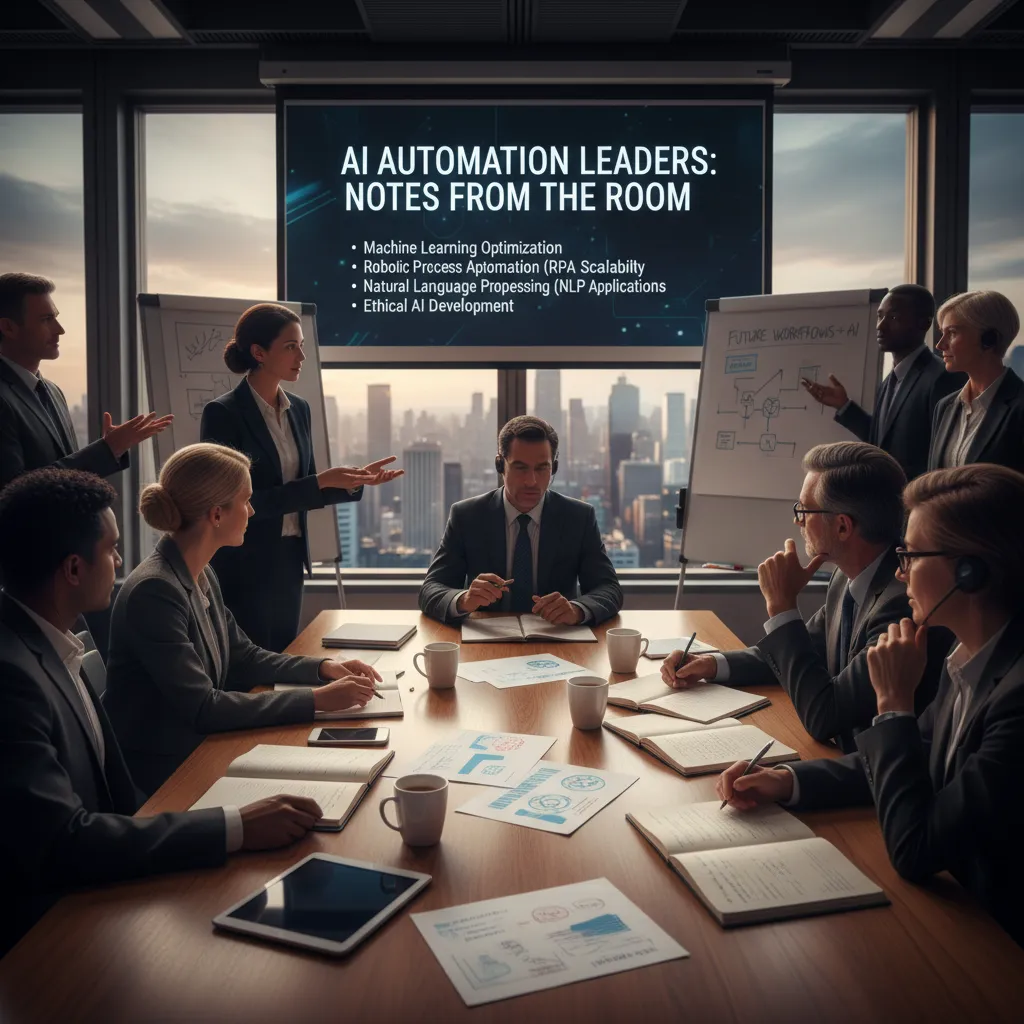
Last fall I sat in the back row of an “automation leaders” panel with a lukewarm coffee and a slightly cynical heart. Ten minutes in, my cynicism melted: not because the leaders were cheerleading AI, but because they were arguing—politely, but like it mattered—about the unglamorous stuff (process maps, change management, ugly data). One exec joked that their biggest AI breakthrough was finally agreeing on what “done” means. That’s the energy I want to bottle here: a practical, human read on AI Automation Leaders, the AI Automation Companies they rely on, and the leadership trends that seem to be hardening into 2026.
1) The moment I realized “AI” was just ops in disguise
Walking into the panel, I expected more sci‑fi talk: agents, prompts, and big “future of work” claims. Instead, the vibe was refreshingly practical—less sci‑fi, more spreadsheets (in a good way). In the Expert Interview: Automation Leaders Discuss AI, the leaders kept circling back to the same point: most “AI automation” wins come from solid operations work—clean inputs, clear steps, and ownership—before any model ever helps.
Less magic, more process
What stood out was how often the conversation sounded like classic ops: mapping workflows, removing handoffs, and measuring cycle time. Even when someone said “AI,” the next sentence was usually about data quality, exception handling, or who approves what. That’s when it clicked for me: AI isn’t replacing operations—it’s exposing where operations were weak.
The “definition of done” argument that saved a project
I’ve lived this. On one automation project, we were weeks in and still arguing about why results “weren’t right.” The bot was doing what we asked, but nobody agreed on what “done” meant. One person wanted a ticket created, another wanted the ticket routed, and a third wanted the customer notified.
We paused and wrote a shared checklist. It was boring—and it saved the project. We defined “done” as:
- Record created with required fields
- Routed to the correct queue
- Confirmation sent and logged
- Exceptions flagged for human review
“If you can’t agree on ‘done,’ you can’t automate.”
Why RPA still shows up in every serious roadmap
The panelists didn’t treat Robotic Process Automation (RPA) as old news. They treated it as the dependable layer that keeps showing up because it works. RPA is still the fastest way to connect messy systems, handle repetitive clicks, and stabilize a process while teams modernize APIs and data pipelines. In real enterprise AI automation, RPA often becomes the “glue” between tools that were never designed to talk.
The not-so-clean takeaway: people math beats model math
My messiest lesson matched the room’s: automation fails more from people math than model math. The hard parts are adoption, training, incentives, and ownership. If the process crosses five teams, the model can be perfect and the rollout can still fail. The leaders kept stressing the same operational basics: clear roles, clear metrics, and a plan for exceptions—because that’s where automation breaks first.

2) The stack nobody admits they’re building: RPA + process mining + copilots
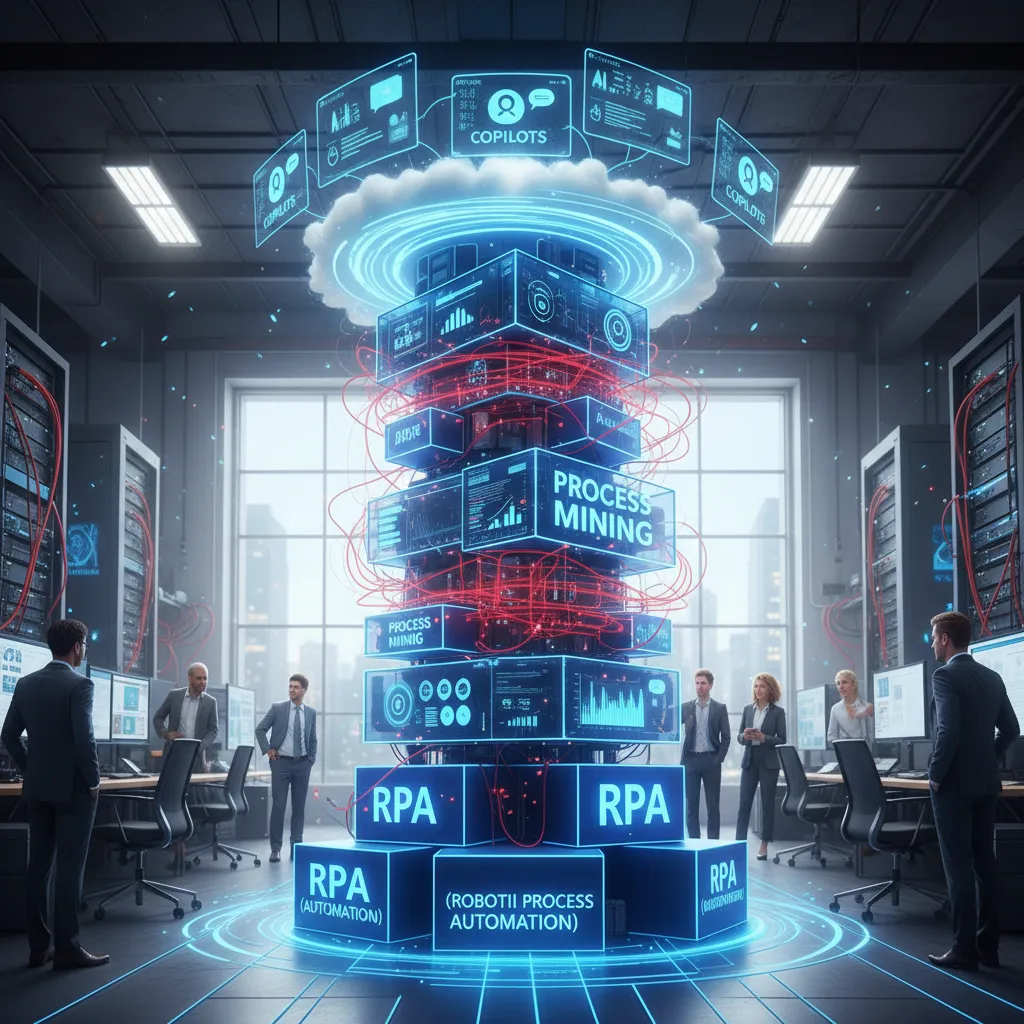
In the interview, one theme kept coming up in different ways: most teams say they want one platform, but they end up building a stack. I’ve seen this in every “AI automation” program I’ve been close to. And honestly, that’s not a failure. It’s just reality.
Why “one platform” is mostly a myth (and why that’s okay)
When leaders talk about a single automation platform, they usually mean “one contract” or “one dashboard.” But the work spans too many layers: systems of record, APIs, documents, inboxes, and human approvals. RPA is good at UI steps, process mining is good at truth-finding, and AI copilots are good at guiding people through messy decisions. Expecting one tool to do all of that well is how projects stall.
My practical takeaway: pick a primary platform, but design for integration from day one. The “stack” is not a dirty word; it’s how automation leaders ship.
Process mining as the flashlight: finding where bots break
RPA bots don’t usually fail because the bot is “bad.” They fail because the process is not stable. Process mining products act like a flashlight: they show the real path work takes, not the path in the SOP. In the interview, leaders described using mining to spot rework loops, handoff delays, and the hidden variants that cause exceptions.
- Where do cases bounce back? That’s often where a bot will get stuck.
- Where do humans override? That’s a signal the rule is unclear or the data is missing.
- Where does cycle time spike? That’s usually a handoff or queue problem, not an “AI problem.”
AI copilots as the new UI: people keep their jobs, but the interface changes
The most useful framing I heard: copilots are becoming the new user interface for work. People still own the outcome, but they stop clicking through five systems to get there. Instead, they ask, confirm, and approve. That’s why “AI copilots platform” conversations are really about workflow, not chat.
“We’re not removing the human. We’re removing the swivel-chair.”
My rule of thumb: automate the decision after you automate the data handoff
I try to keep it simple: first automate the movement of clean data between systems (often with RPA + APIs). Then use process mining to prove it’s stable. Only then do I automate the decision with AI. If the handoff is broken, the smartest model just makes faster mistakes.
3) The ‘big iron’ reality: compute, clouds, and who pays the bill
In the room, the most honest AI talk wasn’t about prompts or “innovation.” It was about compute, cloud contracts, and the simple question: who is paying for this? The interview made it clear that AI automation leaders are learning a new kind of operational math—one where speed, scale, and invoices are tied together.
NVIDIA GPU power: H100/Blackwell is really a time-to-value debate
When leaders brought up NVIDIA H100s and the newer Blackwell line, it didn’t sound like tech bragging. It sounded like a schedule problem. Faster GPUs mean shorter training and tuning cycles, quicker experiments, and fewer weeks stuck waiting for results. In other words, the “best GPU” conversation is often a proxy for time-to-value.
If a model takes half the time to run, teams can ship automation sooner, prove ROI earlier, and reduce the hidden cost of people waiting around. That’s why GPU choices show up in business reviews, not just engineering meetings.
Cloud gravity: AWS, Azure, Google—picked by org muscle, not benchmarks
Another theme from the discussion: cloud decisions are rarely won by a benchmark chart. They’re won by organizational muscle—existing security patterns, procurement rules, data location needs, and which platform the company already knows how to run.
- AWS often wins where teams already have strong cloud ops and cost controls.
- Azure can be the default when Microsoft identity, security, and enterprise agreements are already in place.
- Google Cloud shows up when data teams are deep in GCP tooling and want tight analytics + AI workflows.
What I heard was practical: leaders choose the cloud that lets them move with the least internal friction.
AWS SageMaker and Bedrock: when “managed” beats “perfect”
We also talked about Amazon AWS SageMaker and Bedrock in a very grounded way. “Managed” services aren’t always the most customizable, but they can be the fastest path to a stable, secure deployment. For automation leaders, that trade is often worth it—especially when compliance, monitoring, and access control matter more than squeezing out the last 3% of model performance.
“The model is only part of the system. The platform is what makes it usable.”
A small provocation
Here’s the uncomfortable thought I left with: your AI roadmap might just be a procurement strategy wearing a hoodie. If you can’t get GPUs, can’t get budget approval, or can’t pass security review, the roadmap doesn’t matter. The winners are designing plans that match how their company actually buys, governs, and operates technology.
4) Industry detour: Manufacturing Outlook and the readiness gap
In the interview, one idea kept landing with me: in manufacturing, AI automation isn’t a question of if—it’s a question of who owns it. Plants don’t fail because the model is “not smart enough.” They fail because no one has clear responsibility for data, change control, uptime risk, and day-to-day adoption. If AI sits between IT, OT, engineering, and quality with no single owner, it becomes a pilot that never graduates.
Why “98% exploring AI” doesn’t equal deployed wins
We heard a familiar stat: almost everyone is exploring AI, but far fewer have repeatable deployments. From what I’ve seen, that gap usually comes from basics, not ambition:
- Data reality: sensor gaps, messy historian tags, missing labels, and unclear definitions of “good” vs “bad.”
- Integration friction: models that don’t connect cleanly to MES/SCADA/CMMS, so insights never become actions.
- Operational trust: if operators can’t explain the recommendation, they won’t use it during a real shift.
- Governance: no agreed process for retraining, validation, and rollback when conditions change.
“Exploring” is easy. Owning the workflow, the risk, and the results is the hard part.
The uncomfortable 20%: what “fully prepared” probably means
The interview hinted that only a small slice is truly ready. To me, that “fully prepared” 20% likely has:
- Named ownership: a plant-level product owner with authority across IT/OT.
- Clean pathways: reliable data pipelines and a standard way to deploy models at the edge or in the cloud.
- Clear KPIs: scrap, OEE, downtime, energy, and schedule adherence tied to financial impact.
- Change management: training, SOP updates, and a feedback loop from the floor.
What I’d pilot first in a plant (and what I’d avoid)
If I had to start tomorrow, I’d pick use cases that are measurable, repeatable, and close to existing workflows:
- Predictive maintenance (start with one asset class): trigger work orders in the CMMS, not just dashboards.
- Quality inspection with vision: focus on one defect type and build a strong labeling process.
- Scheduling support: recommend sequences based on constraints, but keep humans in control early on.
What I’d avoid at first: fully autonomous line control, “one model for the whole plant,” and anything that depends on perfect master data. Those are real goals—but they’re not the first wins that build trust.
5) The company roll-call (and my slightly biased scorecard)
In the interview, a handful of names kept popping up as the “usual suspects” in AI automation. I’m not listing them as winners—just as the companies people reach for when they need to ship something. To keep myself honest, I sort them into four buckets: platform, tooling, orchestration, and gets-stuff-done services.
The quick tour (who shows up where)
- Platforms: OpenAI, Microsoft (Azure OpenAI), Google (Vertex AI), AWS (Bedrock). These came up as the “foundation layer” where teams start with models, security, and scaling.
- Tooling: LangChain, LlamaIndex, Pinecone, Weaviate. These were mentioned as the practical building blocks—connectors, retrieval, and the stuff that makes prototypes feel real.
- Orchestration: UiPath, Automation Anywhere, Microsoft Power Automate. These show up when the conversation turns from “cool demo” to “how does this run every day?”
- Gets-stuff-done services: Accenture, Deloitte, IBM Consulting (and similar partners). In the room, these were framed as the fastest path when you need process mapping, change management, and delivery muscle.
My “kitchen test” scorecard
I use a simple test I call the kitchen test: can a new hire understand the workflow in 30 minutes? Not the model details—the workflow. Where data comes from, what triggers the run, what “done” looks like, and how errors get handled.
| Bucket | Kitchen test score (my bias) | Why it passes/fails fast |
|---|---|---|
| Orchestration | High | Clear steps, logs, approvals, and owners. |
| Platforms | Medium | Strong guardrails, but workflows can be hidden in code. |
| Tooling | Medium–Low | Flexible, but easy to build “mystery systems.” |
| Services | Depends | Great if they document; risky if knowledge stays in meetings. |
One reminder I keep relearning
Vendor logos don’t equal a strategy.
I’ve learned that the hard way. A stack can look impressive and still fail basic questions like: Who owns the prompt changes? Where do we store feedback? What happens when the model is wrong? If your “AI automation leaders” plan is mostly a slide of tools, you don’t have a plan yet—you have a shopping list.

6) Executives AI 2026: optimism, accountability, and the ethics speed bump
In the expert interview with automation leaders, I heard a steady theme: executives are still bullish heading into 2026, even when the value is hard to prove on paper. The optimism is not blind. It is practical. Leaders see AI as a new layer of capacity—like adding a night shift that never sleeps. Even when a pilot does not show clean ROI, they still notice the work moving faster, the backlog shrinking, and teams asking better questions. In the room, that “momentum effect” mattered as much as the spreadsheet.
Why leaders stay bullish when proof is messy
One reason is that AI benefits often show up in small places first: fewer handoffs, fewer status meetings, faster drafts, quicker triage. Those gains are real, but they are spread across teams, so they are hard to capture in one budget line. Another reason is competitive pressure. Several leaders framed it as risk management: if peers are learning faster, waiting feels like falling behind. That is why 2026 planning sounds confident, even when measurement is still catching up.
The ethics speed bump nobody budgets for
Ethical AI frameworks came up in a familiar way: everyone nods, then the budget moves on. In the interview, leaders agreed that governance is not a “nice to have.” It is the cost of operating. Yet it often gets treated like a policy document instead of a working system—data checks, model monitoring, access controls, audit trails, and clear ownership. I left with a simple lesson: if we do not fund ethics, we are not doing ethics; we are doing hope.
My two-metric dashboard: time saved and risk reduced
When ROI is fuzzy, I use a two-metric dashboard. First, time saved: hours returned to employees, cycle time reduced, and fewer manual steps. Second, risk reduced: fewer compliance misses, fewer customer-impacting errors, and better traceability. This keeps the conversation honest. AI is not only about growth; it is also about control, safety, and consistency.
A closing thought experiment
Here is the question I cannot shake: what if your best employee is an AI agent you cannot promote? You cannot motivate it with a title, and you cannot hold it accountable in the human sense. So accountability shifts to us—leaders, builders, and operators. Going into 2026, I believe the winners will be the teams that pair optimism with ownership: they will scale AI, measure it in human terms, and budget for the ethics work that makes speed sustainable.
TL;DR: Automation leaders aren’t chasing magic models—they’re stitching together RPA, process mining, copilots, and enterprise platforms. Winners pair strong compute (NVIDIA H100/Blackwell) with real workflows (ServiceNow, UiPath, Appian). Manufacturing interest is massive (98% exploring AI) but readiness is lagging (20%). By 2028, expect AI agents in 58% of business functions daily—if governance and value proof keep pace.