
The first time I realized AI was changing leadership wasn’t in a keynote—it was on a Tuesday, staring at a dashboard that finally stopped arguing with itself. Our weekly ops review used to be a ritual of “whose spreadsheet is right.” Then an AI agent started flagging the same three bottlenecks before anyone spoke. I felt relieved… and a little threatened (which, if I’m honest, is the point). This post unpacks what actually moved the needle in leadership operations: where AI delivered, where it didn’t, and why execution discipline mattered more than the model choice.
CEOs more optimistic—yet personally on the hook
I keep hearing the same private question from peers: “What if my AI bet flops?” The source material, How AI Transformed Leadership Operations: Real Results, makes it clear why that fear is rational: AI programs now touch revenue, customer experience, and risk controls at the same time. When outcomes move from “interesting pilot” to “core operating system,” the CEO’s name is attached—publicly and legally.
“What if my AI bet flops?”
From curiosity to accountability
CEO AI adoption used to be about curiosity: demos, vendor meetings, and a few experiments in marketing or support. Now it is accountability. I feel that shift every time a board member asks not if we are using AI, but where it is used, who owns it, and how we prove it is safe and effective. That is why I block time for AI operations leadership the same way I block time for cash, hiring, and customer retention. If I don’t, the work still happens—just without clear direction.
Sidebar: the “pragmatist CEO” schedule (7 hours/week)
I’ve found that seven hours a week is enough to turn AI leadership into a habit, not a hobby. Here is the rhythm I use:
- 2 hours reviewing AI performance dashboards (quality, cost, speed, incidents)
- 2 hours with functional leaders on workflow changes and adoption blockers
- 1 hour risk and governance check (privacy, security, model drift, approvals)
- 1 hour customer impact review (support, churn signals, NPS comments)
- 1 hour learning time (one paper, one vendor update, one internal demo)
What I track in leadership operations
Optimism is easy to say; leadership results are harder. In my own AI operations priority for 2026, I track three things that connect directly to CEO accountability:
- Growth: pipeline lift, conversion changes, retention, and new product revenue tied to AI-enabled offers.
- Productivity gains shaping priorities: hours saved are only real if they reappear as faster cycle times, more customer touches, or fewer handoffs.
- Explainability in plain English: I ask teams to describe AI decisions without jargon—what data was used, what the model recommended, and what humans can override.
If my leaders can’t explain an AI outcome simply, I treat it as an operational risk—not a technical detail.

Operations leads AI adoption (because the work is visible)
In 2026, I don’t treat AI in operations like a slogan. Operations is where waste shows up first because the work is visible: handoffs between teams, queues that grow overnight, and rework that nobody wants to own. When leadership asks, “Where should we start with AI adoption?” I point to the places where time leaks are easy to measure—cycle time, backlog size, and how often a task bounces back for fixes.
Why operations becomes the AI priority
In leadership operations, the “real work” is often hidden inside routine steps: approvals, scheduling, and exception handling. These steps look small, but they create friction everywhere. AI helps because it can see patterns across tickets, emails, and forms, then route work faster and more consistently than manual triage.
“If you can’t see the work, you can’t improve it. Operations makes the work visible.”
My “boring wins” list (small changes, big compounding effects)
The biggest results I’ve seen came from simple workflow automation—not flashy demos. These were the wins that made leaders trust AI because the impact was obvious within weeks.
- Approvals: AI pre-filled requests, checked policy rules, and flagged missing info before a manager ever saw it.
- Scheduling: AI suggested meeting times based on constraints, priorities, and time zones, cutting the back-and-forth.
- Exception handling: AI grouped “non-standard” cases, suggested next steps, and escalated only what truly needed a human.
None of this changed our strategy. It changed our throughput. And that’s where compounding happens: fewer delays today means fewer emergencies tomorrow.
Resource allocation: stop optimizing departments, start optimizing flow
A turning point was when we stopped asking, “Which department is overloaded?” and started asking, “Where does the end-to-end process stall?” With AI process automation, we could see demand patterns and shift capacity to the constraint—sometimes by reassigning people, sometimes by changing rules, and sometimes by removing steps entirely.
| Old focus | New focus |
|---|---|
| Department efficiency | End-to-end cycle time |
| Local KPIs | Shared flow metrics |
| More handoffs | Fewer touchpoints |
A candid misstep: AI made the mess faster (and louder)
I also learned the hard way: automating a messy process just makes the mess faster. We automated an intake workflow that had unclear rules and inconsistent data. The AI routed work quickly—straight into the wrong queues. Complaints spiked, and the noise forced us to finally fix the process definition first. Only then did automation deliver clean, repeatable results.
AI investments surge CEOs—spending vs. usage gap
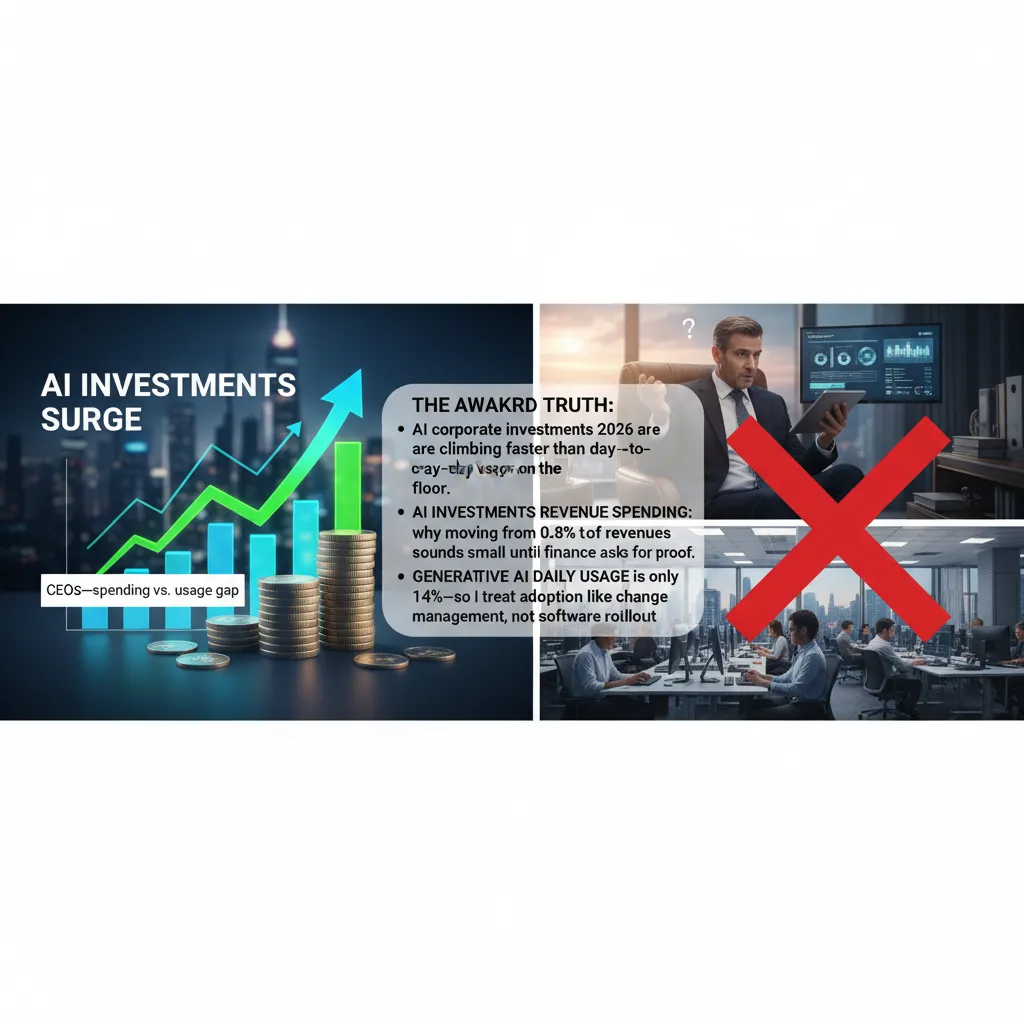
I keep seeing the same pattern in 2026: AI corporate investments are rising faster than day-to-day usage on the floor. In leadership ops, that creates an awkward moment. The board hears “AI-first,” finance approves new spend, and then frontline teams still run work the old way. The gap is not about tools. It is about habits, trust, and clear reasons to change.
The awkward truth: spending is up, usage is not
From what I have seen in “How AI Transformed Leadership Operations: Real Resultsundefined,” leaders are funding AI like it is a sure bet. But daily workflows do not shift automatically. People keep using what feels safe: email, spreadsheets, and manual reviews. So the investment looks bold, while the usage looks quiet.
Why 0.8% to ~1.7% of revenue becomes a big deal
On paper, moving AI spend from 0.8% to around 1.7% of revenues sounds small. In a finance meeting, it does not feel small at all. That delta becomes a line item that needs proof: faster cycle times, fewer errors, better customer response, or lower cost per transaction. If I cannot connect AI to a measurable operational result, the next budget round gets harder.
- Spending is easy to approve when the story is exciting.
- Value is harder because it shows up in daily behavior, not in slide decks.
- Proof requires baseline metrics before the tool goes live.
Generative AI daily usage is only 14%—so I manage it like change
The number that keeps me grounded is this: generative AI daily usage is only 14%. That tells me adoption is not a software rollout problem. It is a change management problem. I treat it like any other operating model shift: role clarity, training, manager coaching, and simple rules for when AI is allowed, required, or banned.
“If we want daily usage, we have to redesign the day.”
A small behavior hack: “What did the model miss?”
One practical trick I stole and now use often: we end key meetings with one question—“What did the model miss?” It keeps humans in the loop and makes AI a partner, not an authority.
- We review the model output.
- We name gaps, risks, and missing context.
- We log fixes as prompts, data needs, or policy updates.

Execution discipline determines success (not hype)
In our leadership operations work, I learned a simple truth from How AI Transformed Leadership Operations: Real Results: the teams that win with AI are not the loudest. They are the most disciplined. Hype fades fast. Execution habits compound.
My rule: if we can’t name the operational KPI, we’re not allowed to call it an “AI initiative.”
I stopped approving “AI projects” that were really just demos. If we can’t name the operational KPI, we’re not allowed to call it an AI initiative. This rule forced clarity and protected our time.
- Define the KPI first (cycle time, cost per case, SLA compliance, forecast accuracy).
- Set a baseline before the model touches the workflow.
- Assign an owner who is accountable for the metric, not the tool.
AI governance for business transformation: lightweight guardrails
We needed AI governance, but we refused to build a slow approval maze. The goal was business transformation with guardrails that don’t strangle experimentation. We used a “thin layer” approach: a few rules that everyone could remember and follow.
“Fast experiments are good. Uncontrolled experiments in production are not.”
| Guardrail | What it protects |
|---|---|
| Model + prompt versioning | Repeatable results and audit trails |
| Data access by role | Security and privacy |
| Human review thresholds | Quality in high-risk decisions |
Data quality: the unglamorous fix that stopped hallucinations
Our AI agents were “hallucinating” basic facts because our source data was messy, duplicated, and outdated. The fix wasn’t a fancier model. It was data quality work: clean inputs, clear definitions, and a single source of truth for key fields. Once we tightened that, outputs became reliable enough for daily leadership operations.
Reliable output = trusted data + clear rules + feedback
Wild-card scenario: treat your AI agent like a new hire
I ask leaders to imagine the AI agent as a new employee. What onboarding, permissions, and feedback loops would you give them?
- Onboarding: teach “how we work” with examples of good and bad answers.
- Permissions: least-privilege access, time-boxed where possible.
- Feedback loops: capture corrections, route edge cases, and retrain prompts monthly.
Roles, org charts, and the awkward politics of AI
In “How AI Transformed Leadership Operations: Real Resultsundefined,” the biggest lesson for me wasn’t a model choice—it was the org chart. AI changes who owns decisions, who owns risk, and who gets credit. That’s where the awkward politics show up.
Chief AI Officer: helpful leader or “shadow IT” risk
I’ve seen the Chief AI Officer (CAIO) role help most when the company is moving fast and needs one accountable owner for AI priorities, safety, vendor choices, and value tracking. It works best when the CAIO is not building a separate tech empire, but acting like an orchestrator across IT, data, security, legal, and operations.
It becomes a shadow IT problem when the CAIO team buys tools, builds bots, and deploys workflows without shared standards. Then you get duplicate platforms, unclear access rules, and “mystery automations” that break audits.
When AI sits outside the normal controls, it doesn’t feel innovative—it feels ungoverned.
Chief Data Officer: the quiet kingmaker
The Chief Data Officer (CDO) is the quiet kingmaker because data quality and reliable outputs aren’t negotiable anymore. In practice, I’ve watched AI projects fail for boring reasons: missing fields, messy definitions, and no lineage. The CDO’s influence shows up in the basics—clean master data, clear metrics, and permissioning that matches real work.
No consensus on reporting lines (and I’ve seen both outcomes)
There’s still no single “right” reporting line. I’ve watched AI teams thrive under the COO because operations can turn pilots into standard work: training, SOPs, controls, and adoption. I’ve also watched teams stall under “innovation” groups where success is measured by demos, not cycle time, error rates, or cost-to-serve.
My rule of thumb: if the goal is operational results, anchor AI close to the leaders who own process performance.
Preparing operations teams to scale: the three skills I hire for
To scale AI in operations, I now hire for these skills more than “AI enthusiasm”:
- Process thinking: mapping work end-to-end, spotting handoffs, and designing controls.
- Data literacy: knowing what a good dataset looks like and asking “where did this number come from?”
- Calm skepticism: testing outputs, logging exceptions, and refusing to automate confusion.
AI approaching takeoff phase: from pilots to enterprise value
In the source, How AI Transformed Leadership Operations: Real Results, the pattern is clear: AI is leaving the “interesting pilot” stage and entering the “run the business” stage. I’ve learned that pilots are useful for learning, but they rarely change outcomes on their own. The takeoff phase starts when we stop treating AI like a side project and start treating it like an operating capability that leadership can rely on every week.
What AI front-runners do differently
The front-runners don’t win because they have the fanciest model. They win because they industrialize the boring parts. They standardize data inputs, clean up handoffs, and build repeatable workflows for things like meeting prep, status reporting, risk tracking, and customer follow-ups. In my experience, this is where strategy becomes real: not in a slide deck, but in the daily routines that make AI outputs consistent enough to trust.
Why enterprise integration tilts competition—fast
Competitive dynamics change when AI moves from isolated pilots to enterprise-level integration. A pilot can make one team faster. Integration makes the whole system smarter. When AI is connected across functions—sales, support, finance, and operations—leaders stop arguing about whose numbers are right and start acting on a shared view. That speed compounds. Decisions get made earlier, issues surface sooner, and teams spend less time reconciling reports and more time fixing problems.
My litmus test: does AI improve trust?
Efficiency is nice, but it is not my main goal. My litmus test is whether AI improves business trust, especially in customer relationships. If AI helps us respond with clearer timelines, fewer errors, and more consistent follow-through, trust goes up. If it creates “black box” answers, shaky claims, or overconfident summaries, trust goes down—even if we saved time. The best implementations I’ve seen use AI to support human accountability: better context, better documentation, and fewer dropped commitments.
Conclusion: fewer Monday morning surprises
As I look at AI operations priorities for 2026, the biggest shift is mindset: we are moving from experiments to enterprise value. And the best “real result” I saw wasn’t a KPI on a dashboard. It was simpler than that—fewer leadership surprises on Monday mornings. When AI is integrated well, leaders walk into the week with clearer signals, cleaner handoffs, and fewer hidden fires. That is what takeoff feels like.
TL;DR: AI is becoming an operations priority in 2026 because leaders are chasing measurable returns: spending is expected to rise from 0.8% to ~1.7% of revenue, adoption is up to 72%, and 92.1% report results. The winners treat AI as an operating system—clear KPIs, governance, strong data quality, and workforce adoption—not a side project.