
I still remember the first time an exec told me, “We need an AI strategy by Friday.” I nodded, opened a blank doc…and promptly realized we didn’t even agree on what “customer” meant in our data warehouse. That little embarrassment became my compass: before we chase shiny AI and data science, we need a Data Governance Strategy, a sane operating model, and a roadmap that survives real life (budget meetings, security reviews, and the one person who always asks about ROI). This guide is my practical, slightly opinionated take on AI and Data Science strategy for 2026—built for people who have to ship, not just slide-deck.
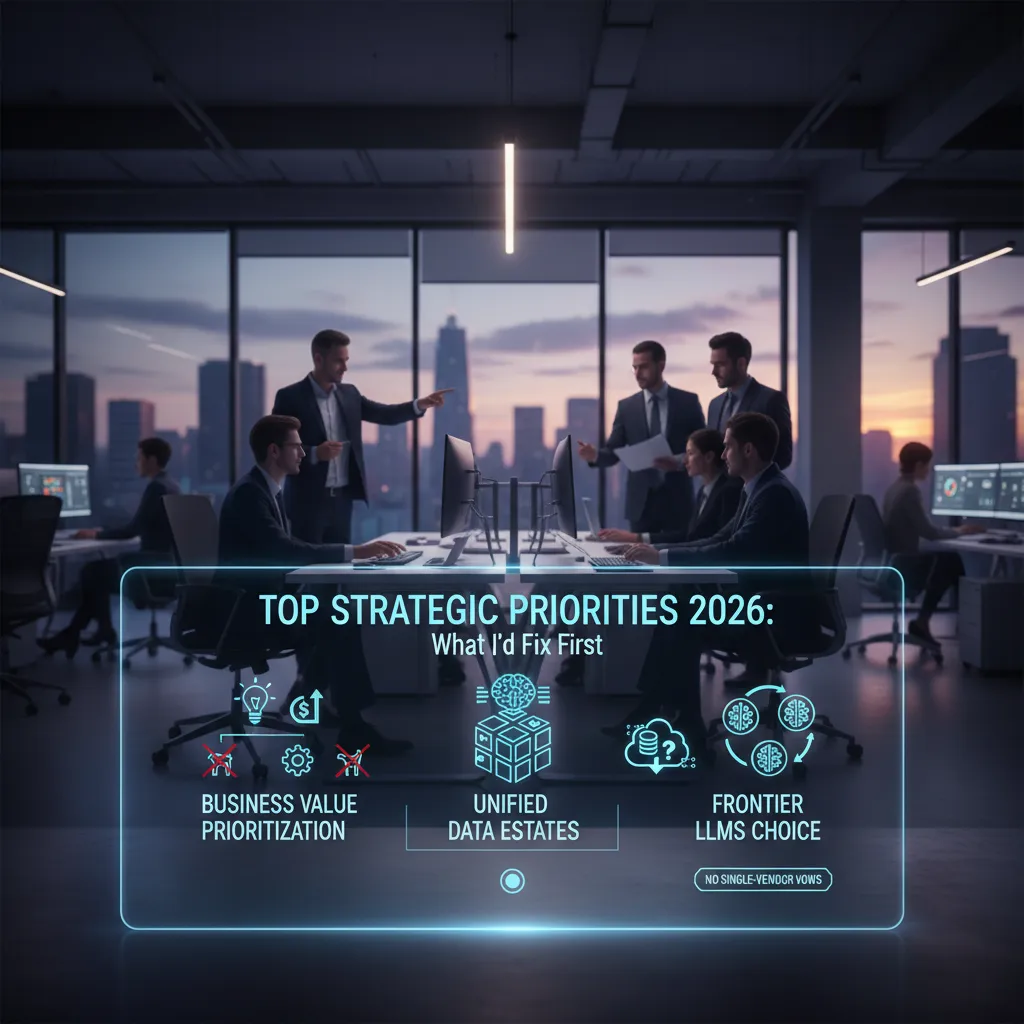
Top Strategic Priorities 2026: What I’d Fix First
When I build a practical Data + AI strategy for 2026, I don’t start with shiny demos. I start with the boring fixes that make AI reliable at scale. I’ve seen too many teams buy tools, ship a chatbot, and then wonder why results are messy. My rule is simple: fix the inputs, then scale the outputs.
1) Business Value Prioritization (and killing a pet project)
First, I list every AI and analytics use case on the table—support automation, forecasting, fraud, sales enablement, internal search, agent workflows, and more. Then I rank them by impact vs. feasibility. This is straight from the “Complete Data Science AI Strategy Guide” mindset: strategy is a set of choices, not a wish list.
- Impact: revenue lift, cost reduction, risk reduction, customer experience
- Feasibility: data readiness, integration effort, compliance, time-to-value
- Decision: pick the top few and kill at least one “pet project” that drains time
“If everything is a priority, nothing is.”
2) Unified Data Estates are non-negotiable
I treat a unified data estate as table stakes. Without shared definitions, “AI Agents Scale” turns into agents making stuff up faster. If one system defines “active customer” differently than another, your model will learn confusion—and your agents will confidently repeat it.
What I fix first:
- Shared business definitions (metrics, entities, time windows)
- Clear ownership for key datasets and pipelines
- Basic data quality checks (freshness, completeness, duplicates)
3) Keep frontier LLM choice flexible (no single-vendor vows)
In 2026, model performance and pricing will keep shifting. I design for switching: abstraction layers, prompt/version control, and evaluation harnesses. That way I can move between frontier LLMs based on cost, latency, quality, and data controls—without rewriting the whole product.
LLM = select_model(cost, quality, latency, policy)
4) Quick gut-check: adoption capacity
Here’s the hard lesson I learned: having a model is not the same as having adoption. I ask: do we have the people, training time, and workflow changes to make this stick? If not, I narrow scope until we do.
Wild card analogy: strategy is meal prep
Strategy is like meal prep—if your ingredients (data) are chaotic, dinner (AI) is chaos too. Clean ingredients, simple recipes, repeatable results.
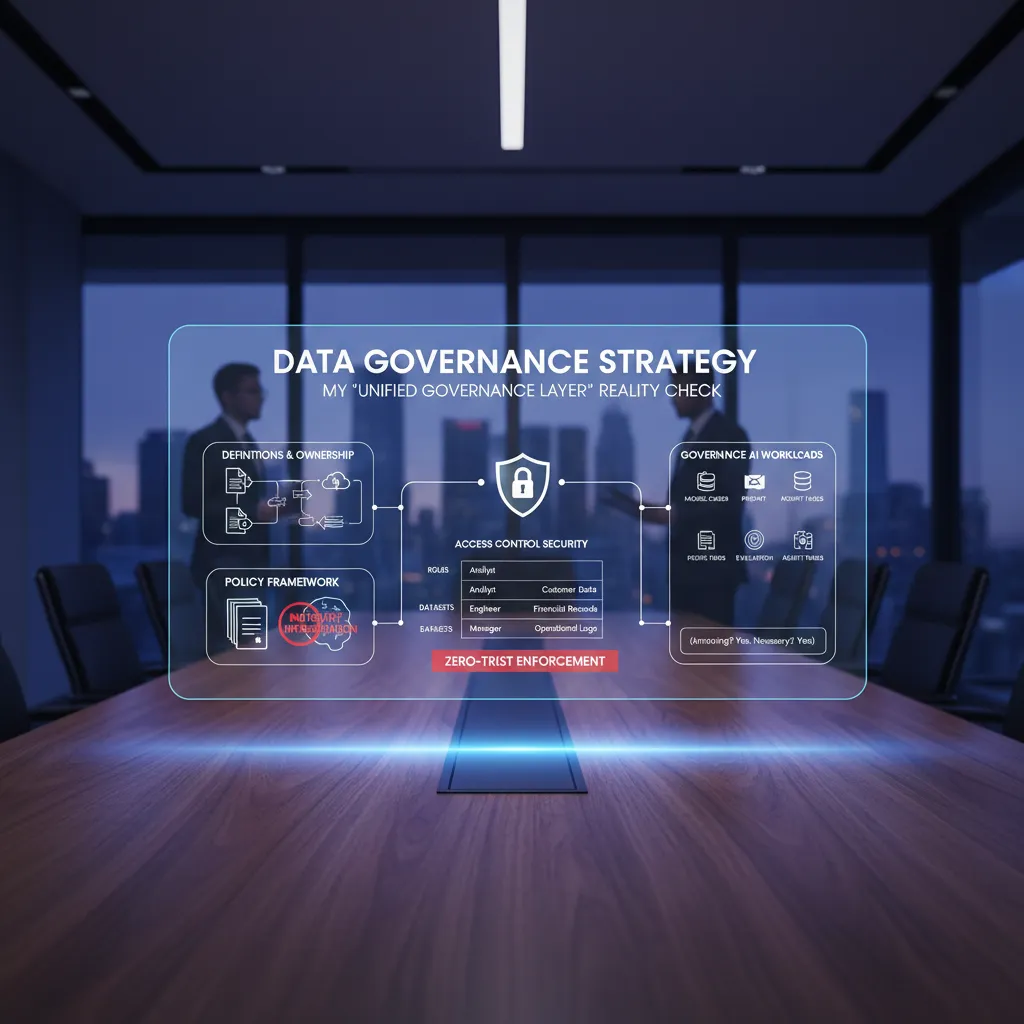
Data Governance Strategy: My ‘Unified Governance Layer’ Reality Check
In my early data science days, I treated governance like a speed bump. In 2026, I see it differently: governance is the only way to move fast twice—once to ship, and again to scale without rework. My reality check is simple: a “unified governance layer” is not a tool you buy. It’s a set of rules, owners, and proof that your data + AI strategy can survive audits, incidents, and growth.
What I mean by a Unified Governance Layer
I start with four basics that every team can understand and every system can enforce:
- Definitions: one shared glossary for metrics, entities, and “what counts.”
- Ownership: a named person (or team) for each dataset and key metric.
- Lineage: where data came from, how it changed, and where it goes.
- Policy framework: rules AI can’t creatively interpret.
When I say “policy framework,” I mean policies written in plain language, then translated into enforceable controls. If a policy can’t be tested, it’s not a policy—it’s a suggestion.
Access control is where strategy becomes real
This is the part I used to avoid. Now I begin here: I map roles to datasets, then enforce Zero-Trust security across tools (warehouse, BI, notebooks, feature store, and model endpoints). I keep it boring on purpose:
- Least-privilege access by default
- Row/column-level controls for sensitive fields
- Time-bound access for projects and incidents
- Consistent identity across platforms (no “shadow accounts”)
Governance for AI workloads (not just data)
Modern AI governance has to cover the full workflow, not only tables. I require:
- Model cards (purpose, training data notes, limits, known risks)
- Prompt logs for production LLM features (with redaction rules)
- Evaluation that tracks quality, bias checks, and drift
- Audit trails for who changed what, when, and why
Yes, it’s annoying. Yes, it’s necessary.
Synthetic data policies: add them early
Someone will propose synthetic customer records the minute compliance joins the meeting. So I set rules upfront: what “synthetic” means, allowed use cases, re-identification risk checks, and labeling requirements. I even add a simple tag like data_classification = "synthetic" so it can’t quietly mix with real customer data.
AI and Data Science: From ‘Agentic AI Hype’ to AI Agents Applications
In 2026, I treat “agentic AI” as two tracks: Agentic AI progression (what I can ship this quarter) and agentic AI hype (what might work in five years). Shippable now usually means narrow scope, clear tools, and strong guardrails: an agent that drafts, routes, checks, and escalates. The five-year bet is the “do everything” agent that plans across teams, negotiates tradeoffs, and rarely needs humans. I plan for the first, and I prototype the second without betting the business on it.
What’s shippable now vs. a five-year bet
- Shippable now: tool-using agents with constrained actions (search, ticket update, invoice lookup), human approval steps, and measurable success metrics.
- Five-year bet: long-horizon autonomy, deep reasoning across messy systems, and reliable self-correction without curated data or oversight.
I build Domain Expert Agents, not one “all-knowing” chatbot
Instead of a single chatbot for everything, I design Domain Expert Agents that map to real workflows. For a finance close agent, I focus on reconciliations, variance notes, and checklist completion. For a support triage agent, I focus on categorization, suggested replies, and next-best actions. This keeps prompts simpler, permissions tighter, and evaluation clearer.
Multi-Modal Data is the hidden blocker
Most projects stall because the agent can’t “see” the same inputs humans use. I push for multi-modal data: text (tickets, policies), tables (billing history, usage), and images (screenshots, scanned forms). I also insist on open formats (CSV/Parquet, JSON, PNG) so data can move between tools without rework.
Governance for AI model training and operations
I bake in governance early, not after a failure. My baseline includes:
- Evaluation sets that reflect real edge cases, not just happy paths.
- Drift checks on inputs (new ticket types) and outputs (tone, accuracy).
- “Stop-the-line” criteria when quality drops (e.g., billing errors above a threshold).
Hypothetical: Support Agent escalates a billing edge case
How it should behave: It detects a mismatch between invoice totals and usage, cites the exact rows it used, asks one clarifying question, and escalates with a structured summary:
Issue: Invoice total ≠ usage sum

Evidence: Invoice #1842, lines 3–7; usage table 2026-01-01..01-15

Action: Escalate to Billing Ops; hold refund promise
How it shouldn’t behave: It guesses the cause, promises a refund, or edits the invoice record without approval. In my strategy, agents can recommend actions, but high-risk changes require human sign-off.
AI Factories Infrastructure: How I’d Build the ‘Boring’ Engine
When I say AI Factory, I’m not talking about a fancy lab. I think of it like a factory floor: repeatable pipelines, tests, and release gates—not artisanal one-off notebooks that only one person can run. In 2026, the teams that win are the ones that can ship reliable models every week, not the ones with the most clever demos.
My “factory floor” mindset: pipelines over notebooks
I start by turning the messy middle into a standard path: data comes in, features get built, models train, evaluations run, and only then do we deploy. Every step needs automation and checks, the same way software teams use CI/CD.
- Repeatable training runs with versioned data and configs
- Tests for data quality, leakage, and basic model sanity
- Release gates so nothing ships without passing metrics and review
How I map the AI infrastructure stack
I map the stack end-to-end so there are no “mystery boxes” in production. My baseline looks like this:
- Data platform (lake/warehouse + governance-ready datasets)
- Feature store for classic ML and an embedding store for RAG and search
- Orchestration to schedule and retry pipelines
- Model registry to track versions, approvals, and rollbacks
- Monitoring for quality, drift, latency, and user feedback
- Cost controls (budgets, alerts, and usage caps)
Generative AI resource planning is painfully practical
GenAI strategy gets real the moment you price it. I plan for GPUs, quotas, and procurement lead times. I also insist on a budget line that doesn’t vanish in Q3. If you don’t reserve capacity (or at least plan burst options), your “AI roadmap” becomes a queue of blocked projects.
Governance operating model: who does what when things break
I set clear agreements early, because production AI is a team sport:
- Who approves models and prompts for release
- Who owns incidents (and the on-call rotation)
- Who can ship changes, and what requires review
Tiny tangent: the first time I saw inference costs spike overnight, I finally understood why FinOps folks sound stressed.
Now I treat cost like a first-class metric, right next to accuracy and latency, with alerts that trigger before the bill does.
Data Strategy Roadmap: My Quarter-by-Quarter ‘No Drama’ Plan
When I build a data + AI strategy for 2026, I start with four simple Data Strategy Pillars: governance, architecture, AI delivery, and adoption. Then I schedule the work by quarters. This keeps the plan calm, repeatable, and easy to explain to leaders and teams.
My opinion: the roadmap should be boring to read and exciting to live.
My four pillars (the checklist I reuse)
- Governance: clear ownership, policies, and decision rights.
- Architecture: reliable pipelines, storage, and integration patterns.
- AI delivery: models/agents that ship, with guardrails and measurement.
- Adoption: training, change management, and workflows people actually use.
Quarter-by-quarter plan
Q1: Strengthen foundations
I focus on the basics that prevent future chaos: shared definitions (business glossary), lineage (where data comes from and how it changes), and access (roles, approvals, and least-privilege). I also pick a small set of “gold” datasets and make them trustworthy first.
Q2: Operationalize governance + ship the first agents
This is where governance becomes real: data owners run a simple cadence, exceptions are logged, and quality rules are enforced. In parallel, I deliver the first AI agents or copilots on narrow tasks (support triage, sales research, invoice matching) with human review and clear success metrics.
Q3: Scale what works
I expand the patterns: more domains onboarded, more reusable features, and a standard release process for AI delivery. I also harden security and privacy controls so scaling doesn’t increase risk.
Q4: Optimize
I tune performance and cost, retire unused datasets, and simplify workflows. This is also when I renegotiate SLAs, improve self-service, and reduce manual steps across the data lifecycle.
Real-time monitoring from day one
- Data quality: freshness, completeness, and accuracy checks.
- Drift: model/agent behavior changes and prompt failures.
- Cost: pipeline spend, warehouse usage, and LLM token costs.
- User feedback loops: thumbs up/down, comments, and “why” tags.
A small learning track (so we don’t panic-hire)
I keep a lightweight Learn AI Resources track: short internal demos, a shared prompt library, and monthly “show-and-tell.” The goal is steady skill growth, not chasing every new tool.

Conclusion: A People-First AI Strategy 2026 That Survives Monday
As I wrap up this practical data + AI strategy guide for 2026, I keep coming back to one simple idea from The Complete Data Science AI Strategy Guide: the best AI programs are built like good teams, not like science projects. For me, that means a Unified Data Estate that reduces duplicate pipelines, governance guard rails that make decisions safe and repeatable, and flexible models that can change as the business changes. When those three pieces work together, you get room for creativity without chaos—and you stop rebuilding the same “one-off” solution every quarter.
I think about the Friday-deadline story I shared earlier. The real fix wasn’t writing faster code or pushing the model harder. The fix was boring, but powerful: we aligned definitions (“customer,” “active,” “churn”), clarified ownership, and agreed on who could approve changes. Once the data and decisions had a home, the work sped up on its own. That’s what “strategy” looks like in real life: less hero work, more shared clarity.
If you only take one action from this guide, I recommend a recurring ritual: a monthly use-case council. Not a long meeting, not a status parade—just a consistent checkpoint where leaders and builders review value, risk, and adoption, not just model accuracy. I like to ask three questions: Are we saving time or making money? Are we creating new risk (privacy, bias, security, compliance)? And are people actually using the output in their daily workflow? If the answer to the last question is “no,” the model is not “done,” even if the metrics look great.
Here’s my gentle warning: if your AI strategy ignores people, incentives, and training, the best tech will still stall. Teams need time to learn new tools, managers need new ways to measure work, and frontline users need clear reasons to trust the system. Adoption is not a launch event—it’s a habit you build.
My final wild card for 2026: imagine your AI agents as interns—brilliant, fast, and very literal. They can draft, summarize, and automate, but they still need supervision, clear policies, and defined boundaries. Give them the right data, the right rules, and the right human owners, and your strategy won’t just look good on paper—it will survive Monday.
TL;DR: In 2026, I build AI Strategy around governed data estates, flexible LLM choices, and a people-first approach: tighten governance (lineage, policies, zero-trust), scale high-quality AI agents, and invest in “AI factories” so use cases move from pilot to production without chaos.