

I didn’t learn leadership from a keynote. I learned it the day I tried to “be decisive” in a meeting, bulldozed two quieter teammates, and walked out feeling weirdly victorious… until my calendar filled with follow-up damage control. That’s when I started collecting leadership tips like a magpie—short, shiny lessons I could actually use. This post is my curated set of 39, organized into a few buckets that match how leadership shows up in real life: in your nervous system, your spreadsheets, your Slack threads, and your awkward one-on-ones. Expect a couple tangents (because leadership is basically a long tangent), plus a few 2026-ready skills like responsible AI integration and hybrid team playbooks.
1) Personal Leadership: the mirror, not the megaphone
I used to think leadership meant being the loudest voice in the room. Then I had an “oops” moment: I confused confidence with clarity. I delivered a strong-sounding plan, but my team left with three different interpretations. The next week was full of rework, awkward follow-ups, and “Wait, I thought you meant…” messages. That’s when I learned a core lesson from 39 leadership tips every professional should know: personal leadership starts with the mirror, not the megaphone.
My ‘oops’ moment: confidence isn’t clarity
Honest reflection fixed it. I replayed the meeting like game film: What did I actually say? What did I assume people knew? Where did I skip steps? I started asking one simple question after key conversations: “What did you hear me commit to?” If the answers didn’t match, the issue wasn’t their listening—it was my leadership communication.
Self-awareness habits (no hour-long journaling required)
I’m not against journaling, but I needed habits I could keep on busy days. Two that worked:
- Micro check-ins: before a meeting, I pause for 10 seconds and name what I’m bringing in (rushed, defensive, excited). After the meeting, I ask: “Did I help or add noise?”
- Peer mirrors: I pick one trusted person and ask for a quick read: “When I push hard, how does it land?” Their outside view keeps me honest.
Leadership goals I can measure without turning into a robot
I track outcomes that matter to the team, not vanity metrics:
- Fewer surprises: risks surfaced earlier, fewer last-minute escalations.
- Faster decisions: clear owner, clear deadline, clear “why.”
- Cleaner handoffs: fewer dropped details between teams.
A tiny coaching practice: name the emotion before the agenda
This felt awkward at first, but it works. I’ll say: “I’m feeling concerned about timing, and I want to align on next steps.” Naming the emotion lowers the temperature and makes the agenda easier to hear.
Quick tips (1–10)
- Show up prepared.
- Listen twice as much as you talk.
- Ask, “What am I missing?”
- Narrate trade-offs (time vs. quality vs. scope).
- Keep promises small and frequent.
- Confirm decisions in one sentence.
- Separate facts from stories.
- Own your part first.
- Invite pushback early.
- End meetings with clear owners and dates.

2) Emotional Intelligence in the wild (not the textbook)
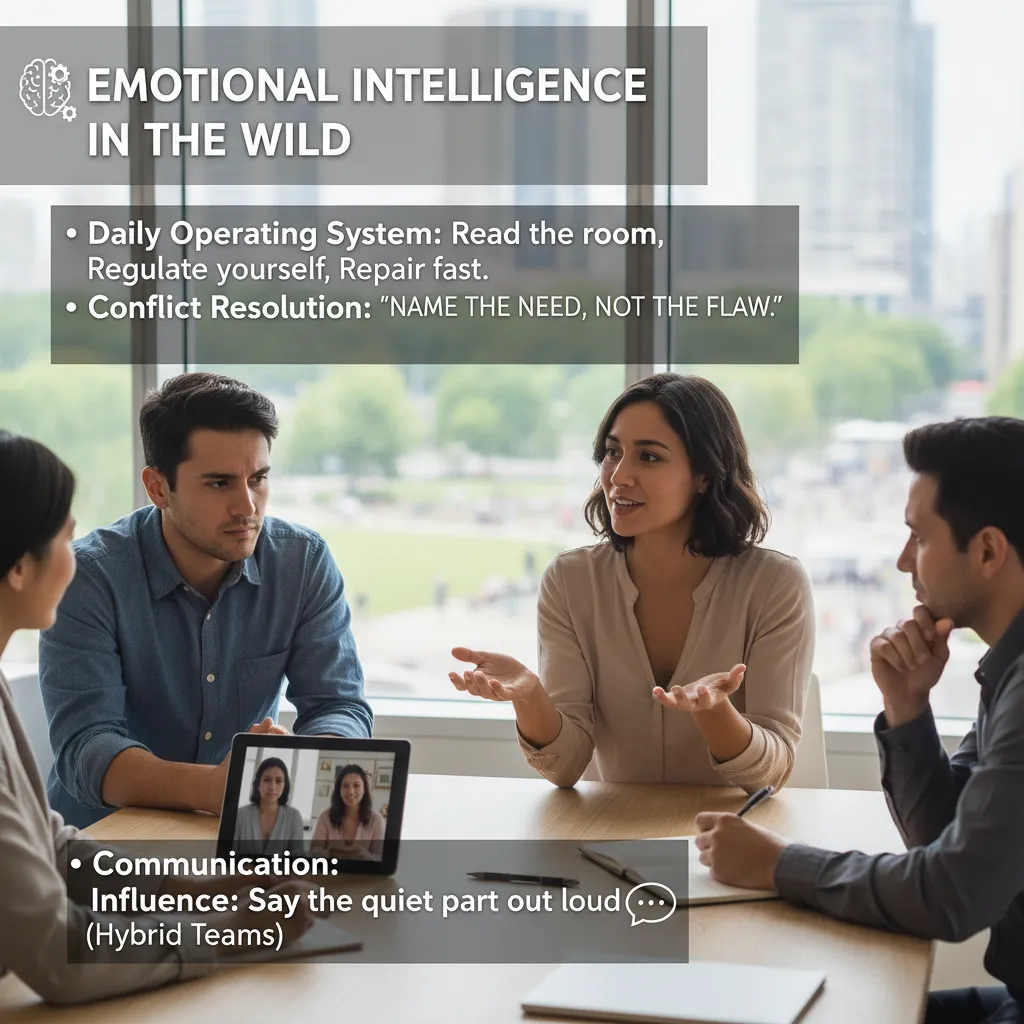
Most leadership advice makes Emotional Intelligence sound like a workshop topic. In real life, it’s my daily operating system. When I’m at my best, I do three things on repeat: read the room, regulate myself, and repair fast. Reading the room means noticing energy shifts: who got quiet, who is talking over others, and what people are not saying. Regulating myself means I don’t let my stress become the team’s stress. Repairing fast means I don’t wait a week to “circle back” after a tense moment—I fix it while it’s still small.
Conflict resolution: “Name the need, not the flaw.”
This is the conflict resolution tip I wish I’d learned sooner: name the need, not the flaw. When I focus on flaws, people defend themselves. When I name needs, people can help solve the problem.
Instead of: “You’re careless with details.”
Try: “I need the final version to be double-checked before it goes out.”
Communication influence: say the quiet part out loud
In hybrid team meetings, context leaks. Some people hear hallway updates, others only see a calendar invite. I’ve learned to say the quiet part out loud: what changed, why it matters, and what “good” looks like. I’ll also name the tension kindly: “I think we’re optimizing for speed, but we may be trading off quality—are we okay with that?” That one sentence often prevents weeks of confusion.
A two-sentence apology template (and why it works)
When I miss the mark, I use a simple two-sentence apology. It works because it combines ownership with a clear next step.
I’m sorry for [specific impact]. Next time, I will [specific behavior change].
Example: I’m sorry I cut you off and shut down your point. Next time, I’ll pause and ask you to finish before I respond.
Quick tips (11–18) I use to build Emotional Intelligence
- Validate feelings before solving: “That makes sense.”
- Ask better questions: “What would success look like to you?”
- Reflect back what you heard: “So the risk is timeline, not effort?”
- Don’t weaponize urgency; urgency is not a personality.
- Protect psychological safety: no public shaming, ever.
- Separate intent from impact; manage the impact.
- In tense moments, slow down your voice before your words.
- End hard talks with clarity: owner, next step, and deadline.
3) Systems Thinking: stop fixing symptoms (I learned this late)
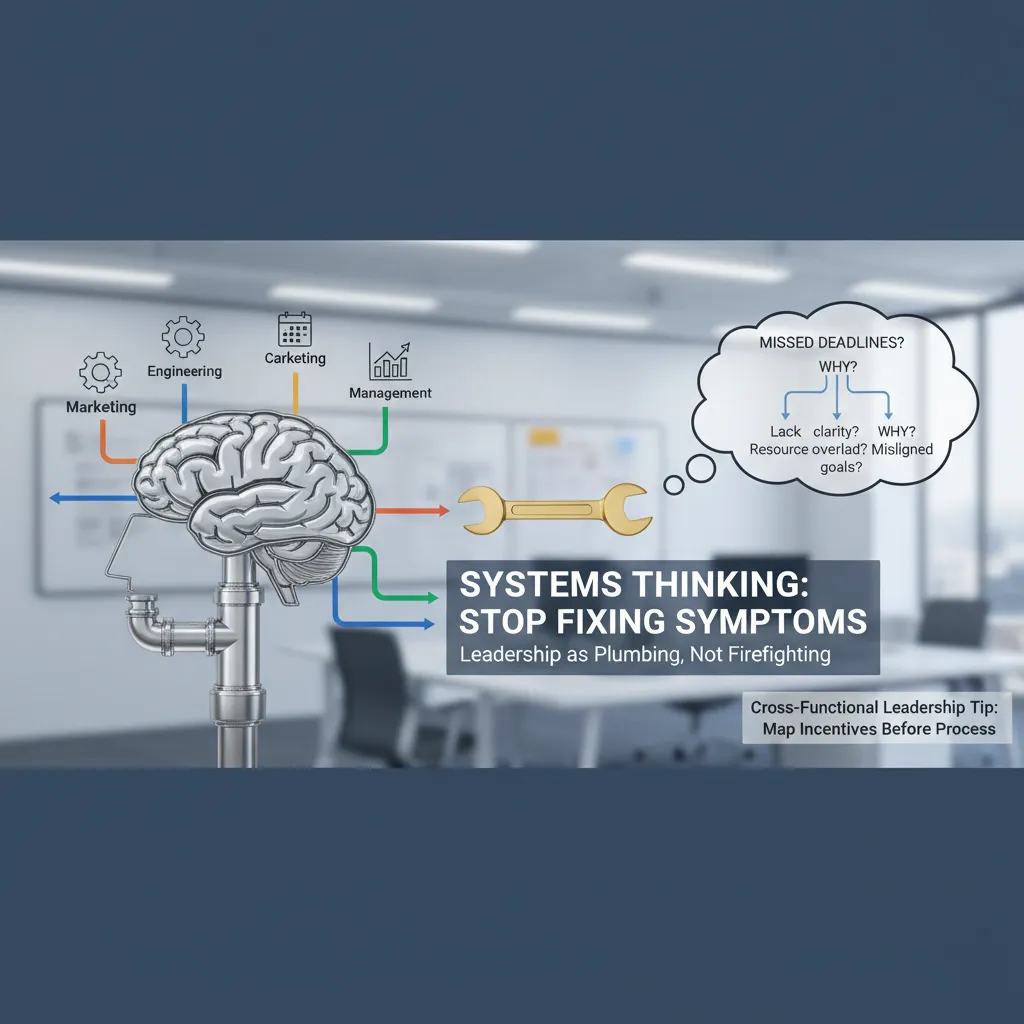
For years, I led like a firefighter: rush in, put out the flame, move on. It felt productive, but the same fires kept coming back. The leadership skill I learned late is systems thinking: seeing how work flows, where it gets stuck, and why the same problems repeat.
My favorite metaphor: leadership as plumbing, not firefighting
In a healthy system, problems don’t “explode” every week. Like plumbing, good leadership is mostly invisible: clear pipes, steady pressure, and quick fixes at the source. Firefighting is loud and heroic. Plumbing is quiet and reliable. I now aim for reliable.
A mini “5 Whys” walkthrough: missed deadlines in cross-functional work
Missed deadlines are a classic symptom in cross-functional leadership. Here’s how I run a simple 5 Whys:
- Why did we miss the deadline? Handoff from Team B arrived late.
- Why was Team B late? They prioritized a different request.
- Why did they prioritize that? Their KPI rewards urgent tickets, not project milestones.
- Why are KPIs set that way? Leadership measures “response time” more than “delivery.”
- Why do we measure response time? Because we never agreed on what success looks like for shared work.
Notice the shift: the “problem” isn’t the person or the team. It’s the system—metrics, incentives, and unclear agreements.
Cross-Functional Leadership tip: map incentives before you map the process
Before I draw a workflow diagram, I ask: What is each team rewarded for? If incentives conflict, the process map is just a pretty picture. I’ve seen deadlines improve simply by aligning goals, ownership, and what gets celebrated.
Strategic Thinking: pick a constraint to protect and say it out loud
Most projects fail because we pretend we can protect everything. I now state one constraint clearly: time, quality, or scope. For example: “We protect quality; if we slip, we slip.” That single sentence reduces hidden trade-offs and last-minute chaos.
Quick tips (19–26) I use to fix the system, not the symptom
- 19) Document decisions and the “why,” not just the “what.”
- 20) Reduce handoffs; combine steps where possible.
- 21) Create feedback loops (weekly review of blockers + root causes).
- 22) Make ownership explicit: one name per deliverable.
- 23) Standardize intake so “urgent” has a real definition.
- 24) Track cycle time, not just busy activity.
- 25) Avoid hero culture; reward prevention, not rescues.
- 26) Fix recurring issues with a small system change, then measure.
4) Data Fluency + Sound Judgment: the anti-vibes toolkit
One of the biggest leadership goals I set for myself was to stop making “vibes-based” calls. I still trust instinct, but I want it tested. Data fluency and sound judgment are the toolkit that keeps me honest—especially when a dashboard looks confident but hides messy reality.
Data fluency for non-analysts: what I ask before I trust a dashboard
I’m not a full-time analyst, so I use a simple checklist before I repeat a metric in a meeting. I ask: What decision is this metric meant to support? Where does the data come from? What’s missing? and what changed recently (definitions, tracking, product, pricing)? I also ask for the denominator. “Sign-ups are up” means nothing until I know “up compared to what” and “out of how many visitors.”
“If we can’t explain how a number is made, we shouldn’t use it to judge people.”
Decision making: my “two numbers and a story” rule
In leadership meetings, I push for clarity with a rule I learned the hard way: two numbers and a story. One number is the outcome (what happened). One number is the driver (why it happened). Then the story connects them in plain language. Example: “Retention dropped 3 points. Support wait time rose 18%. The story: new onboarding created confusion, so tickets spiked and customers churned.” It’s simple, but it forces real thinking.
Predictive analytics (lightweight): leading indicators beat quarterly surprises
I try not to wait for quarterly results to tell me we’re in trouble. I track leading indicators: pipeline quality, activation rate, time-to-first-value, repeat usage, and customer complaints by theme. These aren’t perfect predictions, but they give me earlier signals so I can adjust staffing, messaging, or process before the quarter ends.
AI literacy: what I expect every manager to know in 2026
By 2026, I expect managers to understand the basics: what a model can and can’t do, how prompts shape outputs, and why hallucinations happen. I also expect comfort with privacy, bias, and “human-in-the-loop” review. What I’m still learning: how to measure AI impact beyond time saved, and how to set good guardrails without slowing teams down.
Quick list of tips (27–33)
- Define success metrics before you start work, not after.
- Run pre-mortems: “If this fails, why did it fail?”
- Document assumptions so you can revisit them later.
- Ask for trend + context, not single-point numbers.
- Use leading indicators alongside lagging results.
- Sanity-check with humans: sales, support, ops, and customers.
- When data conflicts, pause decisions and fix the measurement.
5) Hybrid Team leadership & Virtual Coaching (where good intentions go to die)
Hybrid work taught me a hard truth: the “in-room advantage” is real. The people sitting together hear side comments, read body language, and get pulled into decisions faster. If I don’t design meetings to fight that bias, my best intentions turn into quiet exclusion. So I run hybrid meetings like a product: I plan the experience for the remote person first, then I make the room follow it.
Hybrid Team reality: design meetings to remove the in-room advantage
I use one shared agenda doc, one decision log, and one facilitator. If some people are in a conference room, I still ask everyone to join the call from their own laptop (even if they’re sitting together). It feels awkward for five minutes, then it becomes fair. I also build in “remote-first” moments: chat-first brainstorming, silent writing, and round-robin input so the loudest voice doesn’t win.
Hybrid Playbooks: rules for cameras, chat, docs, and decisions
Hybrid teams need a simple playbook. Mine covers: when cameras are expected (and when they’re not), what chat is for, where docs live, and how decisions get made and recorded. The key is to revisit it quarterly, because tools change, teams change, and old rules become friction.
“If it isn’t written down, it didn’t happen.”
Virtual Coaching that doesn’t feel like surveillance
Virtual coaching can easily feel like monitoring. I keep it short, specific, and opt-in where possible. Instead of “I noticed you were quiet,” I try: “In the next client call, can you ask one clarifying question in the first 10 minutes?” I also ask permission: “Want feedback on how that landed?” That one sentence changes the tone from judgment to support.
Safe Experimentation: tiny tests beat giant reorganizations
When collaboration is messy, I run small experiments: a two-week async standup, a new meeting template, or a “no-meeting morning.” Then I measure with simple signals: fewer pings, faster decisions, clearer ownership. If it works, we keep it. If not, we stop without drama.
Quick list of tips (34–39)
- Tip 34: Write it down (decisions, owners, deadlines).
- Tip 35: Rotate facilitation so power doesn’t stick to one seat.
- Tip 36: Rotate airtime: call on people, don’t wait for volunteers.
- Tip 37: Over-communicate context before asking for output.
- Tip 38: Protect deep work with clear “no-ping” blocks.
- Tip 39: Default to async updates; use meetings for decisions.
Conclusion: My leadership development plan (and yours)
After working through these leadership tips, I stopped treating them like rules carved in stone. They aren’t commandments—they’re reps. I got better when I treated leadership like a practice schedule: show up, do the work, review what happened, and try again. That mindset took the pressure off “being a natural leader” and put the focus on building leadership skills through small, repeatable actions.
A simple way to set leadership goals (microlearning style)
When I tried to improve everything at once, I improved nothing. What worked was a simple system for leadership goals: I pick three tips and practice them for 30 days, then swap them out. For one month, I might focus on clearer expectations, faster feedback, and better meeting habits. The next month, I rotate in coaching questions, delegation, and conflict repair. This microlearning approach keeps the plan realistic, and it gives me enough time to notice patterns—especially the moments when I’m tired, rushed, or stressed (which is when my real leadership shows up).
Succession planning, even on small teams
I used to think succession planning was only for big companies. Now I see it as basic team care. My rule is: document what only I know. If I’m the only person who understands a process, a client history, or a decision path, that’s a risk. I also build stretch assignments so others can practice leading: running a project kickoff, owning a stakeholder update, or mentoring a new hire. It’s not about replacing me—it’s about making the team stronger and more resilient.
Wild-card scenario: it’s 2026 and AI drafts your feedback
Here’s my responsible AI check: if my AI assistant drafts feedback, do I send it? Only after I read it, verify facts, remove any private details, and make sure it sounds like me. If I wouldn’t say it face-to-face, I don’t ship it. AI can help with structure, but I’m still accountable for clarity, fairness, and tone.
My invitation to you: choose one tip that feels mildly uncomfortable. That’s usually the right one. Practice it for 30 days, track what changes, and then pick the next rep.
TL;DR: Leadership development isn’t one big transformation—it’s 39 small decisions: practice self-awareness, lead with emotional intelligence, use systems thinking, communicate clearly in hybrid teams, and build judgment with data fluency + responsible AI integration.