

I started my Monday by watching an AI demo that promised “autonomous finance operations.” Ten minutes later I was still reconciling a rogue vendor invoice the old-fashioned way—coffee, spreadsheets, mild panic. That contrast is basically where Finance AI news lives right now: genuinely powerful breakthroughs (generative AI, voice AI, agentic AI) mixed with very real constraints (regulatory compliance, data foundations, AI governance). In this post I’m collecting the updates that feel like they’ll matter in 2026—and the ones I’m side-eyeing until they survive a quarter-end close.
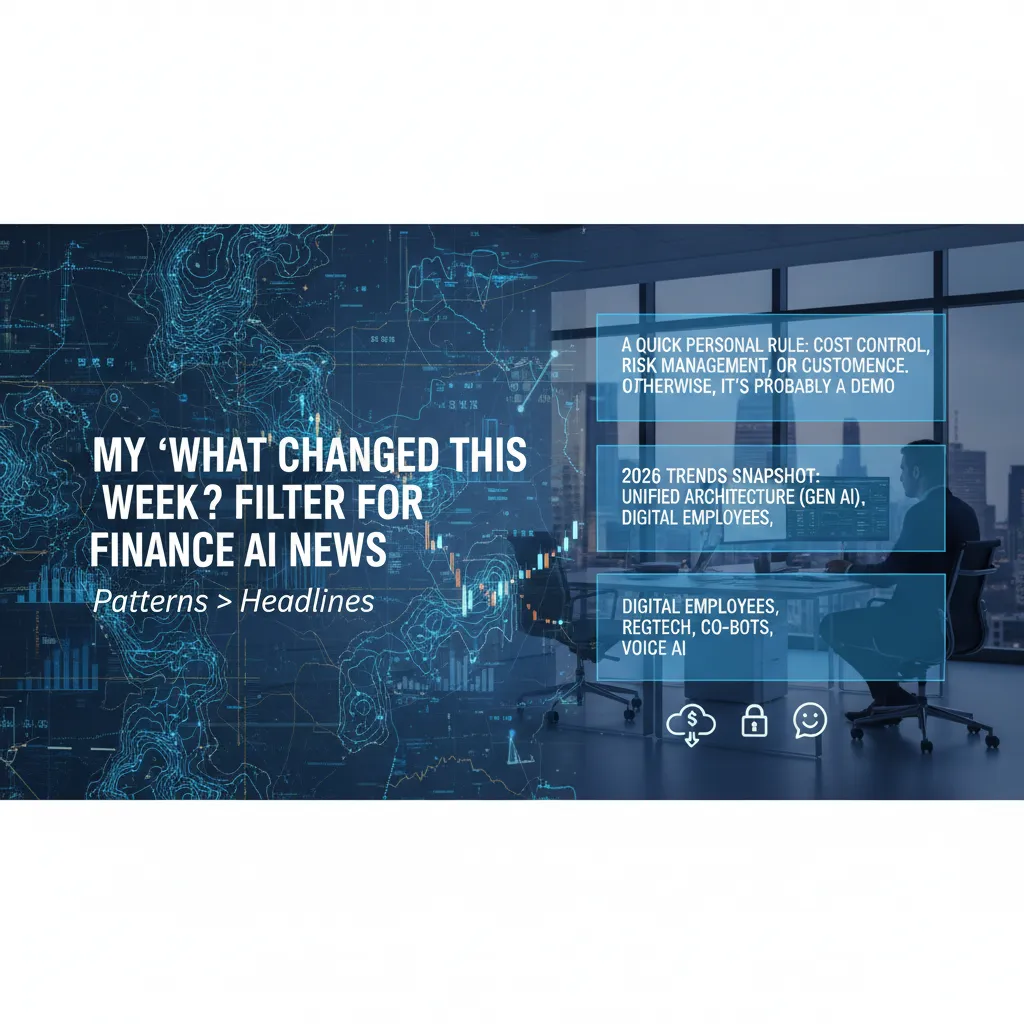
My “what changed this week?” filter for Finance AI news
I track Finance AI news like a weather report. I’m not trying to remember every headline. I’m watching for patterns: what keeps showing up, what is fading, and what is moving from pilot to production. When I read “Finance AI News: Latest Updates and Releases,” I look for signals that a bank could actually use next quarter, not just a shiny launch.
My quick rule: does it change cost, risk, or experience?
I use a simple filter. If a story does not touch cost control, risk management, or customer experience, it’s probably a demo. Demos are fine, but they don’t change a balance sheet or an audit outcome.
- Cost control: automation that reduces manual review, call time, or rework.
- Risk management: better monitoring, clearer model governance, fewer false positives.
- Customer experience: faster answers, fewer handoffs, more consistent service.
2026 trends snapshot I keep seeing
Week to week, the same themes keep stacking up. In 2026, I expect the winners to build a unified architecture around generative AI instead of scattered tools. That means shared data controls, shared prompts and policies, and one place to measure quality.
- Digital employees: task-focused agents that handle routine work (intake, triage, follow-ups).
- RegTech: AI that supports compliance evidence, monitoring, and reporting.
- Co-bots: AI copilots for analysts, underwriters, and ops teams—human-led, AI-assisted.
- Voice AI: more natural phone and branch support, plus better call summaries and routing.
Mini-tangent: the most underrated KPI is “time-to-explain”
My favorite metric is time-to-explain: how fast you can justify an AI decision to audit. If a model flags a transaction or declines a loan, can you produce the reason, the data used, and the policy link in minutes—not days?
In banking, speed matters—but explainable speed is what survives audit.
Generative AI gets less chatty and more useful (finally)
In the latest Finance AI News updates, I’m seeing a clear shift: generative AI in banking is moving away from long, friendly chat replies and toward structured decision support. That matters in 2026 banking because teams don’t need another “assistant” that talks a lot—they need systems that help them decide, document, and act with less risk.
From conversation to decision support
When GenAI is designed as a decision layer, it becomes practical. The best deployments I’ve reviewed focus on:
- Next-best actions (what to do next, based on policy + context)
- Policy rewriting (turning messy guidance into clear internal rules)
- Risk identification (flagging gaps, exceptions, and missing controls)
Where I’ve seen it click: regulatory change → workflow change
The moment GenAI “clicked” for me was watching it summarize regulatory updates into one question: “What must we change in the workflow?” Instead of a generic summary, the model produced a structured output: impacted process steps, required evidence, owners, and deadlines. That’s the difference between reading a regulation and actually implementing it.
“Summaries are nice. Workflow deltas are what move the bank.”
A practical hypothetical: AP exception policy drafting
Here’s a simple example I expect to become common in finance operations. A bank wants to tighten accounts payable (AP) exception handling:
- GenAI drafts an AP exception policy using the bank’s templates and past audit findings.
- Compliance edits the draft (the “redlines” that show real intent).
- The model learns from those redlines, so the next draft matches compliance expectations faster.
In practice, the output is less “creative writing” and more controlled documentation with traceable edits.
The quiet requirement nobody puts in the press release
None of this works without clean data foundations. If your policies are outdated, your process maps are missing, or your exception codes are inconsistent, GenAI will amplify the mess. The most useful systems I’m seeing start with tight data access, clear taxonomy, and strong governance—then add GenAI on top.
Digital employees and agentic AI: the “new coworker” I’m still vetting
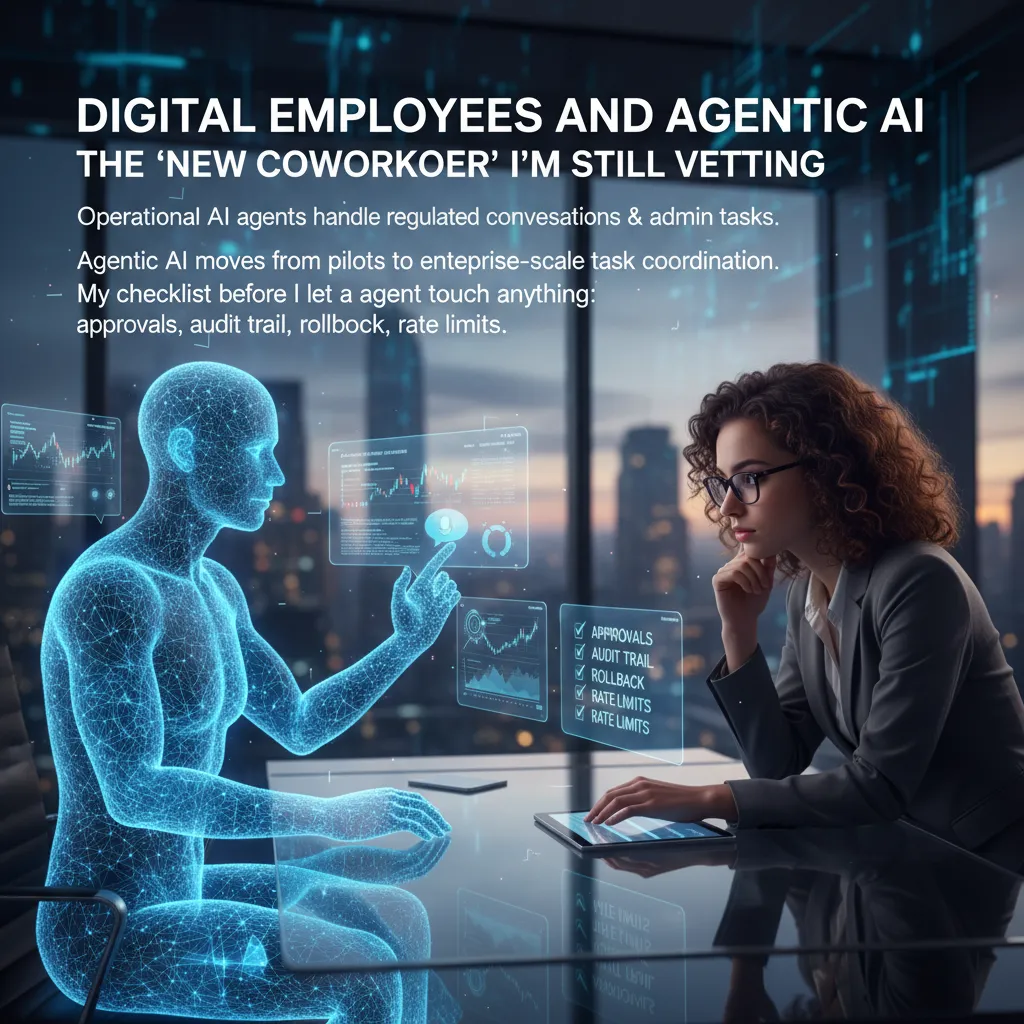
In the latest Finance AI News updates, I keep seeing the same shift: “digital employees” are no longer just chatbots. They are operational AI agents that can handle regulated conversations (think disclosures, complaint intake, and basic servicing) and also take on the admin work that slows teams down—case notes, form filling, ticket routing, and follow-ups.
From pilots to enterprise coordination (useful and scary)
What feels new for 2026 banking is agentic AI moving from small pilots to enterprise-scale task coordination. Instead of answering one question, an agent can plan steps, call tools, and hand off work across systems. That’s the useful part: fewer dropped tasks, faster turnaround, and more consistent service. The scary part is the same thing: if the agent makes a wrong assumption, it can repeat that mistake at speed.
My checklist before an agent touches anything
Before I let an agent act like a “coworker,” I vet it like one—only with stricter controls. Here’s the minimum I look for:
- Approvals: clear gates for high-risk actions (sending messages, changing account data, issuing refunds).
- Audit trail: every step logged—prompt, tool calls, data used, and final output.
- Rollback: a way to undo changes and restore the prior state quickly.
- Rate limits: caps on messages, transactions, and retries to prevent runaway behavior.
A quick story: the 17-email loop
I once watched an automation loop email a client 17 times because a status flag never updated. Nobody meant harm, but it looked terrible and created real compliance risk. That moment made my rule simple: agents need boundaries, not just good intentions.
“If an AI agent can act, it can also over-act. Controls are not optional in banking.”
When I review “digital employee” rollouts, I now ask one practical question: what stops it when something goes wrong?

Responsible AI and AI governance: the part that decides who sleeps at night
When I read Finance AI News updates on new banking models, one theme keeps repeating: the winners in 2026 won’t just ship AI fast—they’ll ship AI safely. In banking, “responsible AI” is not a slogan. It’s the difference between steady growth and a headline you can’t undo.
Responsible AI is a competitive advantage
I see three practical levers that turn responsibility into performance:
- Bias mitigation: test outcomes across customer groups, not just overall accuracy.
- Explainability: make it clear why a model flagged fraud or changed a credit limit.
- Ethical oversight: set a review step for high-impact use cases, especially when humans may over-trust the model.
In finance, trust compounds—so does risk.
AI governance basics I wish were boring (but aren’t)
Governance sounds like paperwork until something breaks at 2 a.m. The basics I rely on are simple:
- Model inventory: a living list of every model, owner, data sources, and where it runs.
- Approvals: clear gates for moving from test to production, with sign-off for compliance and risk.
- Monitoring: track drift, false positives, and customer impact—not just uptime.
Regulatory compliance is tightening
Across the releases and commentary in Finance AI News, the direction is clear: regulators expect stronger controls for AI used in credit, fraud, and trading decisions. That means better documentation, audit trails, and proof that models behave as intended over time. If your bank can’t explain a decision, you may not be able to defend it.
Practical move: write an AI incident runbook before you need it
I recommend drafting a short “AI incident runbook” now. Keep it actionable:
- Trigger thresholds (e.g., drift, complaint spikes, loss limits)
- Who to page and who can shut the model off
- Rollback steps and customer communication templates
- Post-incident review checklist
Even a one-page runbook beats guessing under pressure.
Voice AI in financial services: from call center to financial coaching
In the latest Finance AI News updates, I keep seeing the same shift: voice AI in banking is moving from “answer the phone faster” to “help me manage my money better.” The best part is that it’s starting to sound less like a script and more like a real conversation—most days.
Voice AI for customer support that doesn’t sound like a robot (most days)
Modern voice assistants in financial services are getting better at natural speech, accents, and messy real-life questions. When I call about a card dispute or a fee, I don’t want a menu maze. I want a system that can understand intent, pull the right account context, and hand off to a human when it’s stuck.
- Faster resolution for common tasks (balance, payment status, card lock)
- Smoother handoffs with call summaries so I don’t repeat myself
- Consistent answers across phone, app, and chat
Voice biometrics + speech analytics: convenience meets fraud detection
Voice biometrics authentication is showing up more in banking AI trends for 2026 because it can reduce friction while spotting fraud. Instead of endless security questions, my voice can help confirm it’s me—while speech analytics listens for risk signals like stress patterns, unusual phrasing, or sudden changes in behavior.
But I only trust it with clear rules: opt-in enrollment, strong encryption, and limits on how long voiceprints are stored.
Hands-free financial coaching: the future I want, with the privacy policy I demand
I’m excited by hands-free financial coaching: “Can I afford this trip?” “How much did I spend on food last month?” “Set a safe weekly budget.” Voice AI can turn banking data into simple guidance, in the moment, without opening an app.
“Help me make better choices—without turning my life into training data.”
Odd analogy: voice AI is like a good teller
To me, voice AI is like a good teller—it hears what you mean, not just what you say. If I ask, “Why is my balance low?” it should connect the dots: bills, subscriptions, and timing—not just read numbers back to me.
Financial forecasting, cash flow, and the CFO guide to not getting surprised
In the latest Finance AI News cycle, one theme keeps showing up: financial forecasting gets better when we stop waiting for month-end. With real-time feeds from payments, deposits, card spend, and treasury systems, machine learning models can refresh forecasts daily (or even hourly). That speed matters in 2026 banking, where rate moves, fraud spikes, and customer churn can hit fast.
Real-time + machine learning (with a reality check)
I like ML forecasting because it finds patterns humans miss, but I never let the model run without guardrails. Models can “learn” one-off events and treat them like rules. So I add a reality check: business context, policy changes, and known one-time items.
- Data freshness: late feeds create false confidence.
- Explainability: I need to know why the forecast moved.
- Human overrides: documented, not ad hoc.
Cash flow predictions: small accuracy gains, big decisions
Cash flow is where tiny improvements change behavior. If I can tighten the forecast by even a few points, I can reduce idle cash, avoid emergency borrowing, and time payables without damaging vendor trust. In banking, better cash flow prediction also supports liquidity planning and intraday funding.
“A 2–3% improvement in cash accuracy can be the difference between calm operations and a scramble.”
Scenario planning: three ugly scenarios beat one sunny baseline
Instead of one optimistic baseline, I run three ugly scenarios. Not to be negative, but to avoid surprises. I pressure-test revenue, credit losses, and funding costs, then map actions to each case.
- Demand drop + higher delinquencies
- Funding stress + deposit outflows
- Ops shock (vendor outage, fraud wave, compliance hit)
Why this ties back to cost control
Cost control is dominating finance leadership agendas, and AI forecasting supports it directly: earlier variance signals, faster re-forecasting, and clearer “stop/spend” triggers. When I can see cash and risk turning in near real time, I can cut costs with intent—not panic.
Conclusion: the weirdly comforting future of Finance AI news
After tracking this week’s Finance AI news and the latest product releases, my main takeaway is simple: AI technologies aren’t replacing finance teams; they’re reshaping where judgment lives. The work is still human, but the “first draft” is increasingly machine-made—whether that draft is a forecast, a risk flag, a reconciliation match, or a customer response. In 2026 banking, the real skill shift I see is moving from doing every step by hand to knowing when to trust, when to challenge, and how to prove what the system did.
The connective tissue across all the updates I’m watching is also consistent: data foundations + responsible AI + measurable operational efficiency. Every strong announcement seems to start with cleaner pipelines, better controls, and clearer ownership of data. Then it adds guardrails—model monitoring, bias checks, access controls, and audit trails. And finally it lands on outcomes that a bank can defend: fewer manual touches, faster close cycles, lower fraud losses, better service levels, and more reliable compliance reporting. That’s why the future feels weirdly comforting: the best AI trends are not “magic,” they’re repeatable process improvements with receipts.
One wild-card scenario I can’t stop thinking about is this: auditors may soon ask for your model’s changelog the same way they ask for bank recs. Not just “what model are you using,” but “what changed, when, who approved it, what tests passed, and what controls were in place.” In other words, AI governance could become as normal—and as expected—as month-end documentation. If that happens, the winners won’t be the banks with the flashiest demos; they’ll be the ones with the cleanest evidence.
What I’m watching next week is practical: new RegTech releases, any fresh NVIDIA survey updates that hint at where budgets are moving, and whether voice AI can pass the “angry customer” test without escalating risk. If it can, that will be a quiet but major milestone for AI trends shaping 2026 banking.
TL;DR: 2026 trends in financial services point to GenAI embedded in workflows, digital employees doing regulated tasks, voice AI reshaping customer support, and tougher AI governance. The winners will rebuild data foundations, automate compliance responsibly, and measure risk management as carefully as ROI.