
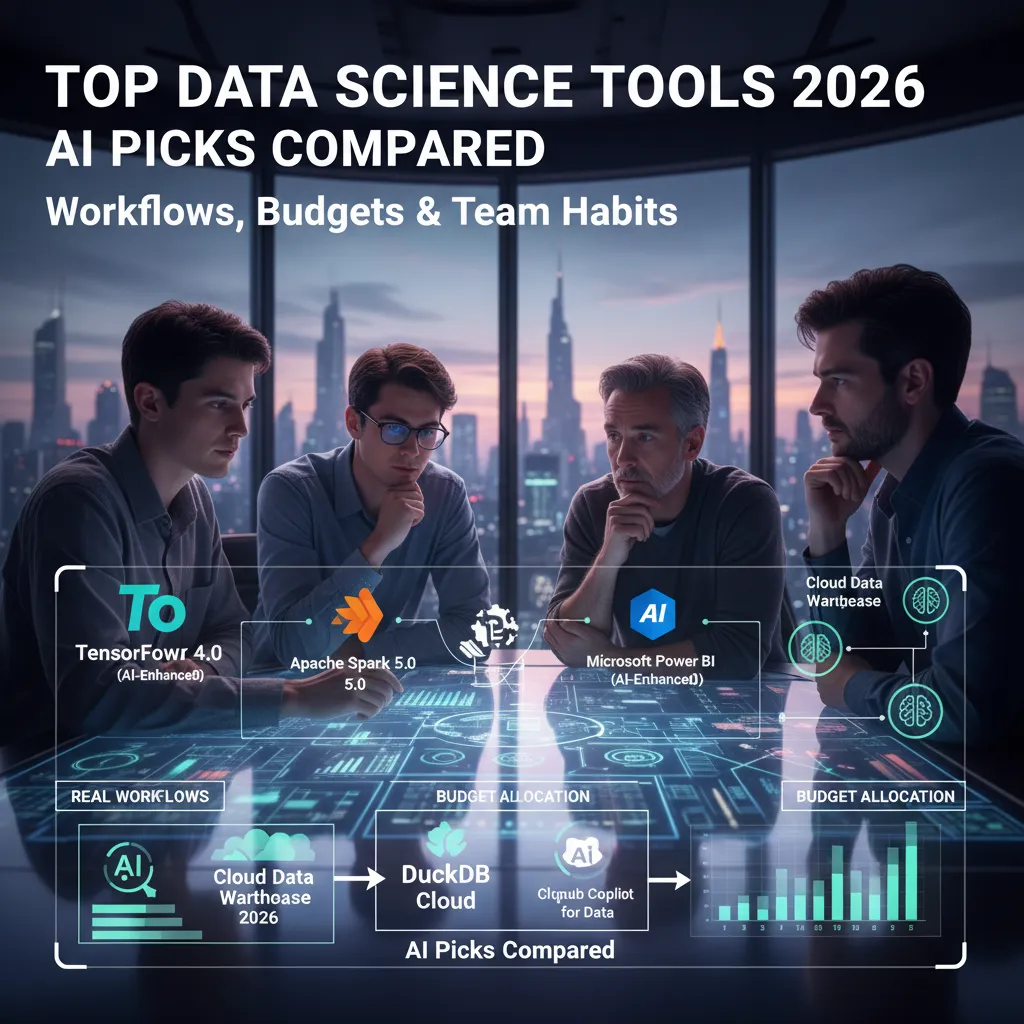
Last winter I tried to “simplify” my stack. I ended up with three notebooks, two BI dashboards, one runaway cloud bill, and a sticky note that literally said: “STOP ADDING TOOLS.” That mini-meltdown is why I started comparing AI data analysis tools the way I compare backpacks: not by the marketing copy, but by what survives a real commute—messy data, shifting deadlines, and teammates who just want the chart by 4pm.
My slightly chaotic rubric: Matching Tools to Workflows
When I compare options for Top Data Science Tools 2026: AI Picks Compared, I borrow a simple idea from “Top Data Science Tools Compared: AI-Powered Solutions”: I start with the workflow, not the tool. I map the work in order, then match tools to each step: data preparation tools → deep data analysis → modeling → model deployment platforms → business reporting. This keeps me from buying a “one-click AI” promise that only covers one slice of the job.
My quick “pain inventory” with teams
Before we shortlist anything, I ask one question: what breaks first?
- Cost: compute bills, seat licenses, hidden add-ons
- Latency: slow queries, slow training, slow dashboards
- Collaboration: messy handoffs, no versioning, unclear ownership
- Compliance: access control, audit logs, data residency
This “pain inventory” is boring on purpose—and it saves time.
The demo trap I fell into
I once picked a platform because the demo looked amazing: auto-features, shiny charts, instant predictions. Then I spent two weeks fighting permissions—roles, workspace rules, and who could see what—instead of building predictive analytics models. That experience made me treat security and governance as first-class requirements, not a checkbox at the end.
My 5 decision buckets
- Solo analyst: fast notebooks, simple data prep, low setup
- BI-heavy business users needing insights: strong reporting, semantic layer, easy sharing
- ML-heavy research: flexible experimentation, GPUs, tracking, reproducibility
- Production MLOps: CI/CD, monitoring, model registry, rollback
- Data engineering at scale: pipelines, orchestration, streaming, governance
Wild-card analogy: the kitchen test
Choosing a data science platform is like choosing a kitchen. Great knives matter (modeling), but you still need a fridge (storage) and a sink (cleaning). If one piece is missing, the whole workflow slows down.

Deep data analysis: TensorFlow, Spark, Arrow (and my patience)
When I need neural network development that won’t buckle, I reach for TensorFlow. It’s my go-to when I’m building predictive analytics models that must scale beyond my laptop—think larger training runs, repeatable pipelines, and fewer “it worked locally” surprises. In my tool comparisons for 2026, TensorFlow still earns its spot because it handles the hard parts of deep learning without making me reinvent the basics.
Apache Spark becomes non-negotiable when the dataset is too big to “just sample” without regret. If I’m staring at logs, events, or customer data that won’t fit in memory, Spark’s distributed processing is what keeps the project moving. And when I’m shuffling data between systems, Apache Arrow makes data movement feel less like hauling furniture—fast interchange, fewer conversions, and less time wasted on glue code.
My quick litmus test
- Real-time analytics streaming: Spark shows up early (structured streaming, near-real-time transforms).
- Batch jobs + feature engineering: Spark shows up everywhere (joins, aggregations, wide tables).
- Model training at scale: TensorFlow takes over when the features are ready.
- Moving data across tools: Arrow reduces friction between Python, Spark, and ML stacks.
Mini tangent: the “framework” isn’t always the problem
I’ve watched teams blame a framework when the real culprit was data science collaboration—three people editing the same notebook like it’s a shared grocery list.
When that happens, even the best AI-powered data science tools feel slow. Clear ownership, version control, and shared datasets beat endless tool switching.
Concrete workflow I actually use
- Ingest data (files, warehouse, or streams)
- Spark transforms for cleaning and feature building
- Arrow for interchange between components
- Train in TensorFlow
- Push to model deployment platforms
ingest → Spark transforms → Arrow interchange → TensorFlow training → deployment
Automated ML solutions: DataRobot vs H2O.ai (the ‘less heroics’ lane)
When a business question smells like churn, propensity, or demand forecasting, I look at AutoML before I reach for a fancy architecture. In my experience, these are the cases where speed, repeatability, and clear baselines matter more than custom deep learning. This is the “less heroics” lane: ship something solid, measure it, then improve.
DataRobot: automation that covers the whole pipeline
With DataRobot, the big draw is end-to-end automation. I can feed in a dataset, set the target, and let the platform run hundreds of model configurations—then rank them so I don’t have to play “guess the algorithm” at midnight. It’s not just model training; it’s the workflow around it: feature handling, validation choices, and a guided path to deployment-style outputs. For teams that want a managed, opinionated experience, this can reduce tool sprawl fast.
H2O.ai Driverless AI: open-source-friendly, stakeholder-ready results
H2O.ai Driverless AI feels more open-source-friendly in spirit, and it’s built for distributed, in-memory machine learning when data gets large. What I like is the leaderboard-style presentation: stakeholders weirdly love seeing models “compete,” and it makes trade-offs easier to explain. It also fits well when you want strong performance without locking every step behind a black box.
My caution: automation can hide leaky features
My honest warning: machine learning automation can accidentally reward leaky features (signals that won’t exist at prediction time). So even when the platform is confident, I keep a manual review checkpoint:
- Scan top features for “future info” (refund flags, post-event timestamps)
- Re-check train/test splits and time-based validation
- Confirm the scoring dataset matches real production inputs
Hypothetical scenario: retail team, no MLOps
Imagine a retail team with three analysts and no MLOps. Using AutoML, they can ship a baseline churn or demand model in weeks instead of quarters, then use the early lift to justify better data pipelines later.

Business users needing insights: Power BI integration, ThoughtSpot, and the spreadsheet reality
When I’m picking data science tools for business users needing insights, I start with one question: where do people already work every day? If the answer is Microsoft 365, Power BI is my default recommendation. Not because it has the flashiest AI feature, but because Power BI integration with Teams, Excel, SharePoint, and Azure cuts friction more than any new feature ever will. Adoption is a tool feature, too.
Power BI: the “already in the building” advantage
In most orgs, the fastest path to reliable dashboards is the path with the fewest new logins and the least new training. Power BI fits that reality. I also like that it supports a clear semantic layer (when teams actually use it), which is where consistent definitions can live.
ThoughtSpot: search-style analytics for busy teams
ThoughtSpot shines when teams want search-style analytics without learning a dashboard tool like it’s a second job. If your stakeholders keep asking, “Can I just type the question?”, ThoughtSpot’s approach can reduce back-and-forth and speed up exploration—especially for non-technical users who don’t want to build visuals from scratch.
The spreadsheet reality (and why handoffs break)
Confession: I still start many analyses in Excel, then “graduate” them to BI. That handoff is where things usually break—definitions, not formulas. The spreadsheet might say “Active Customer,” the dashboard says the same words, and everyone assumes they match. They often don’t.
Spreadsheet workflows aren’t going away. Tools like Excel Copilot and Coefficient are quiet heroes for teams who can’t migrate this quarter, because they improve the workflow people already trust.
Practical tip: define one metric dictionary before you build dashboards—otherwise business intelligence software becomes a disagreement amplifier.
- Pick Power BI when Microsoft is the operating system of the business.
- Pick ThoughtSpot when “search first” beats “dashboard first.”
- Respect spreadsheets, but standardize metric definitions early.
Laptop-speed SQL and modern plumbing: DuckDB analytics + Cloud data warehouses
DuckDB analytics is my favorite “why is this so fast?” moment of 2026. When I’m exploring data, I often start with big local files—Parquet, CSV, even a folder full of exports—and I can run real SQL without spinning up a cluster or waiting on a remote job queue. It feels like getting warehouse-style analytics on a laptop, which is exactly why it keeps showing up in “Top Data Science Tools 2026” lists.
My rule: local-first for exploration, warehouse-first for shared truth
I use a simple rule that keeps teams calm: local-first for quick exploration and prototyping, warehouse-first for the version everyone depends on. DuckDB is perfect for “let me check this idea in 10 minutes.” But when the data stops fitting on a laptop—or governance gets serious—cloud data warehouses like Snowflake and BigQuery become the backbone. They handle access control, auditing, scheduled pipelines, and consistent definitions across teams.
Trying to do both in one place is where arguments begin. If you treat a warehouse like a scratchpad, costs and confusion rise. If you treat a laptop workflow like the source of truth, you get broken dashboards and “which file is correct?” debates.
SQL optimization still beats “bigger instances”
Even with AI-powered solutions and auto-scaling, SQL query optimization still matters. In practice, good partitioning and sensible joins beat “just add compute” more often than we admit. I’ve learned to be strict about selecting only the columns I need, filtering early, and joining on clean keys.
One day I realized my cloud bill was basically a poorly written
SELECT *. I deserved that.
- Use DuckDB for fast local analytics, feature checks, and reproducible notebooks.
- Use Snowflake/BigQuery for governed datasets, shared metrics, and production reporting.
- Optimize SQL: partition by common filters, avoid wide scans, and keep joins intentional.

AI coding tools and environments: GitHub Copilot adoption + Anaconda + Watson Studio
GitHub Copilot: adoption is real, and I feel it
In the source comparison, GitHub Copilot adoption is real (62%), and that matches what I see in day-to-day data science work. When I’m building pipelines, cleaning data, or wiring up model training, the boilerplate disappears: imports, helper functions, tests, and repetitive pandas code show up fast.
But Copilot still struggles with tricky notebook context. In Jupyter, it can miss earlier cells, forget a dataframe’s shape, or guess column names with confidence. I treat AI coding tools like a junior pair programmer—fast, eager, and occasionally confident in the wrong direction.
My rule: accept suggestions for speed, but verify anything that touches data logic, metrics, or joins.
Anaconda: boring, essential, and relationship-saving
Anaconda is my “boring but essential” pick for Python data science. The package sprawl is real in 2026: one project wants the newest PyTorch, another needs an older NumPy, and a third breaks if you upgrade scikit-learn. Conda environments keep those worlds separate, which saves time and, honestly, saves relationships on teams.
- Reproducibility: same environment across laptops and CI
- Less dependency pain: isolate conflicts instead of fighting them
- Faster onboarding: new teammates can run the notebook sooner
IBM Watson Studio: managed platform, open source flexibility
IBM Watson Studio is a solid pick when I need a managed data science platform across clouds, but still want open source frameworks. It’s useful for governed projects where teams need shared workspaces, controlled access, and repeatable deployments without hand-rolling infrastructure.
Tiny habit that helps (more than any tool)
Copilot can’t remember your tribal knowledge, so I keep two small files in every repo:
requirements.lock(or a pinned conda export)data_assumptions.md(definitions, filters, edge cases)
Conclusion: build a stack you can explain to Future You
I keep a sticky note on my monitor that says: fewer tools, clearer responsibilities. In 2026, with so many AI-powered options, that note matters more than ever. The best stack is the one where each tool has a job, the handoffs are clean, and the workflow still makes sense when I’m defending it in a meeting—or debugging it at 2 a.m.
If you want a simple starting point, I recommend “starter stacks” based on how you work. For a BI-first persona, I start with a warehouse + a BI layer + a light notebook option: think BigQuery or Snowflake, Power BI or Tableau, and Jupyter/Colab for quick checks. The optional wild card is an AI assistant like ChatGPT to speed up SQL drafts and documentation. For an ML-first persona, I lean on Python with PyTorch or scikit-learn, tracked in MLflow, deployed with a simple API layer; the wild card is Weights & Biases when experiments get messy. For a data-engineering-first persona, I start with dbt + Airflow (or a managed orchestrator) + a warehouse; the wild card is DuckDB for fast local work and reproducible demos.
I also remind myself that “best” changes with constraints: team skill, compliance needs, data gravity (where the data already lives), and the reality that spreadsheets still run many businesses. If your stakeholders live in Excel, your stack must respect that, not fight it.
My practical move is a 30-day trial plan: pick one success metric (time-to-insight or model lift), one cost metric (compute or license spend), and one collaboration metric (handoff time, review cycles, or reproducibility). Then decide with evidence, not vibes.
Your toolchain should feel like a well-tuned band—different instruments, one tempo.
TL;DR: If you’re doing deep data analysis and neural network development, TensorFlow still feels like the safest bet. If your day is mostly business intelligence software and quick answers, Power BI (and ThoughtSpot) win on speed-to-insight. For machine learning automation, DataRobot (and H2O.ai Driverless AI) are the “set up the pipeline and breathe” options. For laptop-first analytics, DuckDB is the 2026 surprise MVP. For scale, pair Apache Spark/Arrow with cloud data warehouses like Snowflake or BigQuery. And yes—GitHub Copilot is everywhere (62% adoption), but it’s not magic inside sprawling notebooks.