
Last week I watched a smart VP derail a perfectly good planning meeting because an “AI agent” demo looked like magic… until someone asked who owned the data. The room went quiet in that very modern way—half excitement, half dread. That’s basically the vibe of Leadership AI news right now: flashy agentic systems on one side, sober leadership questions on the other. In this post, I’m not trying to predict the future with certainty. I’m trying to give you the kind of key insights I wish someone had handed me before my calendar filled up with “AI progress updates” and “governance check-ins.”
1) Major trends I can’t unsee in Leadership AI news
Reading Leadership AI News lately, I keep seeing the same pattern: the biggest “AI progress” stories aren’t always flashy launches. They’re the quieter shifts that change how work actually gets done—especially inside agentic SaaS.
My “three-tab test” for agentic workflows
I use a simple rule when I evaluate a process: if an idea needs 3 browser tabs and 2 spreadsheets to work, it’s begging for agentic workflows. That’s not a joke—it’s a signal. When people bounce between a CRM, a doc, a dashboard, and a spreadsheet “tracker,” the real product is the workflow, not any single tool.
- Tabs usually mean context switching (and lost details).
- Spreadsheets usually mean “the system can’t coordinate itself.”
- Copy/paste usually means the work is ready for an agent to orchestrate.
Reasoning + continuous learning: the quiet engines
Another trend I can’t unsee in Leadership AI news coverage is how much momentum is coming from reasoning advances and continuous learning. Better reasoning makes agents less brittle: they can handle messy inputs, incomplete info, and multi-step tasks without falling apart. Continuous learning (done safely) is what turns “one-off automation” into a system that improves as the business changes.
In practice, this looks like agents that can:
- plan steps before acting,
- check their own work,
- adapt when a policy, price, or process changes.
From “software as tool” to “software as coworker” (and why it’s messy)
The new paradigm feels like moving from software as tool to software as coworker. Tools wait. Coworkers take initiative. That’s powerful—and messy—because it forces leadership questions: Who approves actions? What’s the escalation path? What’s logged? What’s reversible?
“If the system can act, the system needs boundaries.”
Tangent (but relevant): “pilot” as the corporate comfort blanket
I also notice how often the word pilot shows up in Leadership AI News updates and releases. “We’re piloting an agent.” “We’re piloting copilots.” Pilot became a comfort blanket because it lowers risk and avoids hard decisions. But it’s wearing thin. If a pilot never graduates into a real workflow with owners, metrics, and guardrails, it’s not a pilot—it’s a pause button.
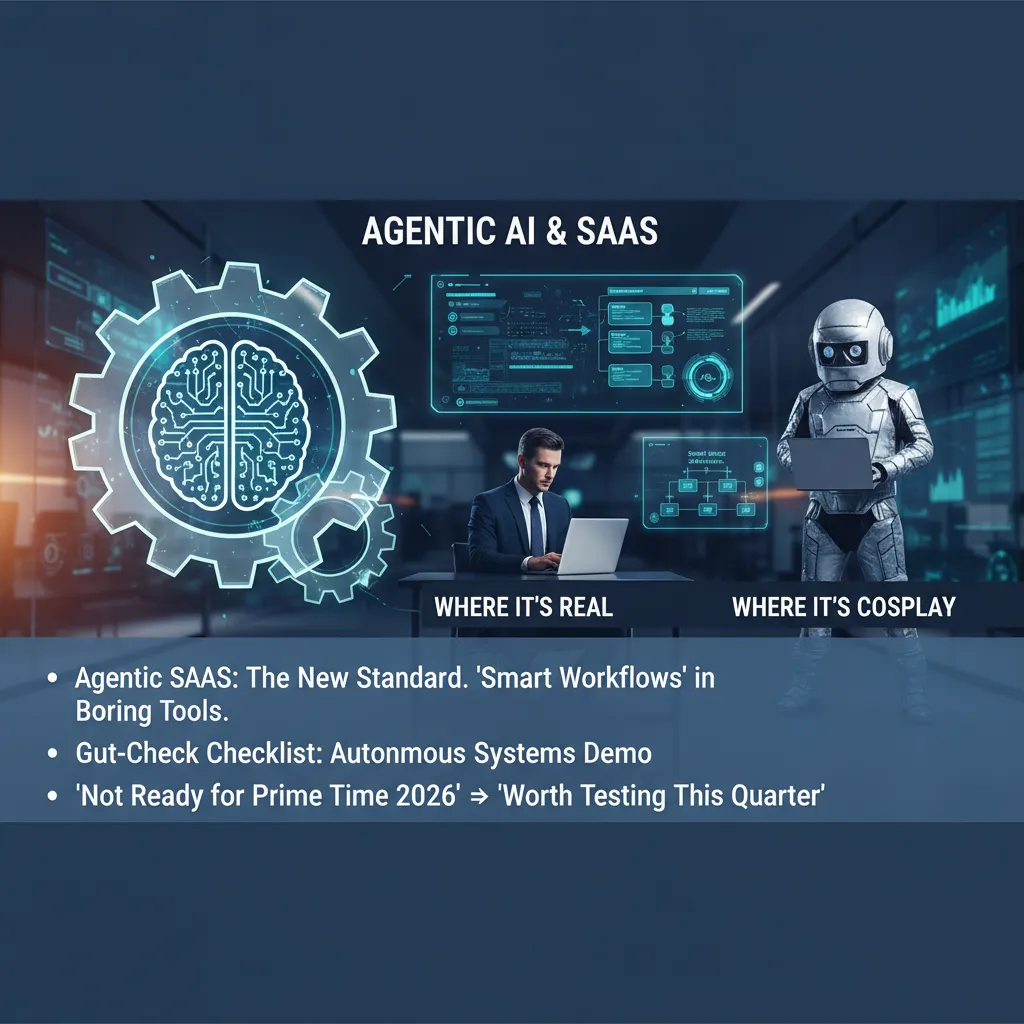
2) Agentic AI and agentic SaaS: where it’s real vs. where it’s cosplay
In this week’s Leadership AI News updates, I keep seeing “agentic” used as a magic word. But in practice, agentic AI is only real when it can take action across steps, handle exceptions, and leave a clear trail of what it did. Everything else is often just a chatbot with a new label.
Agentic SaaS is becoming the new standard (quietly)
The most useful agentic SaaS features aren’t flashy demos. They show up as smart workflows inside boring tools we already use: ticketing systems, CRMs, invoicing, HR portals, and security dashboards. Instead of “Ask AI anything,” it’s “AI noticed X, did Y, and asked for approval on Z.” That’s the shift I’m watching: automation that is embedded, not bolted on.
My gut-check checklist before I believe an autonomous demo
When a vendor shows an “autonomous systems” demo, I run a quick checklist:
- Clear scope: What can the agent do, and what can’t it do?
- Real integrations: Is it using live systems (CRM, email, billing), or a sandbox?
- Permissioning: Can I set roles, limits, and approval gates?
- Audit trail: Do I get logs of actions, prompts, and data touched?
- Fallback behavior: What happens when it’s unsure—ask, pause, or guess?
- Safety + compliance: Does it respect retention, PII rules, and policy?
“Not ready for prime time in 2026” can still mean “test this quarter”
Some agentic AI products won’t be stable enough for full automation next year. But that doesn’t mean they’re useless. I’m seeing value in narrow pilots: internal workflows, low-risk queues, and “draft mode” outputs. Testing now helps me learn where the model fails, what data is missing, and which approvals are needed before scaling.
Mini scenario: the support agent that saves time… then triggers a compliance fire drill
Imagine I deploy an agent to handle customer-support refunds. It reads a ticket, checks the order, and issues a refund automatically. Time saved is real. Then it replies with a helpful summary that includes personal data pulled from a prior thread, and it logs that data into a shared channel for “visibility.” Now I have a compliance issue: wrong audience, wrong retention, wrong controls.
Agentic wins come from controlled autonomy: tight scope, strong permissions, and logs you can trust.
3) Software moats are wobbling (and leadership metrics need to catch up)
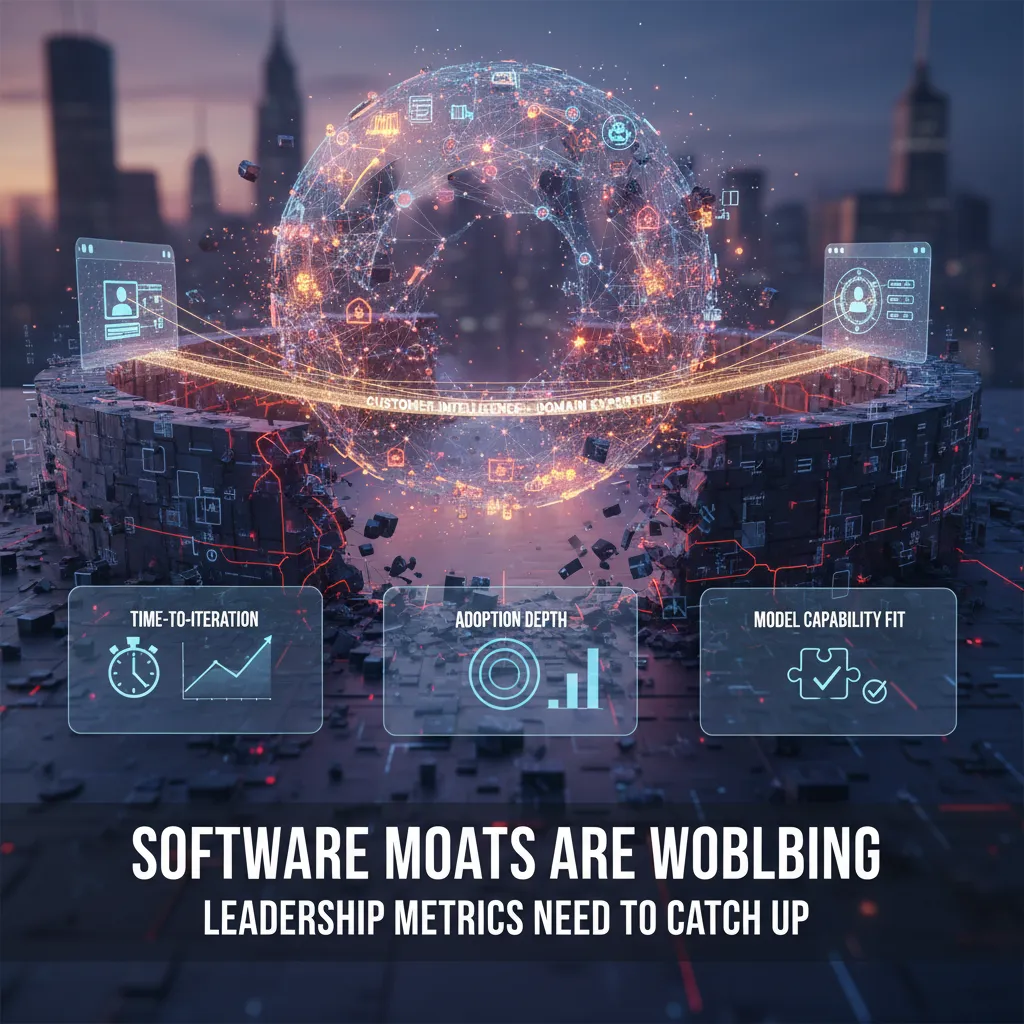
In this week’s Leadership AI News updates, I kept seeing the same pattern: AI features ship fast, copy fast, and spread fast. That’s when it clicked for me—traditional software moats like switching costs are getting weaker. If an agent can learn a new workflow in minutes, “we’re hard to replace” stops being a strong story. I’ve had to rewrite my own product defensibility talk track because the old version assumed users would stay put once they were set up.
AI makes “switching” feel smaller
AI doesn’t remove migration pain, but it shrinks it. Agents can translate prompts, recreate reports, and even rebuild basic automations. When customers can get 80% of the value quickly, they become more willing to try alternatives. That changes how I think about retention: it’s less about lock-in and more about daily usefulness.
Where value accrues now: customer intelligence + domain expertise
The moat I trust more is customer intelligence plus domain expertise—a fancy way to say: know your users better than your rival. Not just their job titles, but their real constraints: what breaks at month-end, what approvals slow them down, what “good” looks like in their world. AI makes features cheaper; it does not make deep context free. The teams that win will be the ones who can turn messy customer signals into better defaults, better workflows, and better outcomes.
“If your advantage is a feature, assume it’s temporary. If your advantage is understanding, it compounds.”
The leadership metrics I’d actually track
I still care about ROI, but I’m tired of ROI theater—numbers that look clean and fall apart in real conversations. The metrics I’d put in front of leadership are:
- Time-to-iteration: how quickly we ship, learn, and adjust. I like measuring days from insight → change in production.
- Adoption depth: not “active users,” but how much of the workflow is actually running through the product (and how often).
- Model capability fit: are we using the right model for the job—accuracy, latency, cost, and safety—based on what customers truly need?
A small confession about dashboards
I used to worship dashboards. Now I’m suspicious of any metric that can’t survive a messy QBR. If a number can’t be explained with real customer stories, support tickets, and a few uncomfortable edge cases, I treat it as a hint—not the truth.
4) Executives, AI leaders, and the weird politics of the Chief AI Officer
In this week’s Leadership AI News updates, I keep seeing one title pop up more often: Chief AI Officer. The role is rising fast, but the reporting lines are still a choose-your-own-adventure. In one company, the CAIO reports to the CEO. In another, it sits under the CTO. In a third, it’s tucked into product, risk, or even HR. That tells me something simple: most orgs still don’t agree on whether AI is a technology, a business change, or a governance problem. It’s all three, and that’s where the politics start.
Why the reporting line matters more than the title
When the CAIO reports into IT, the work can become tool-focused: model selection, platforms, vendor deals. When it reports into the business, the work can become outcome-focused: revenue, retention, cycle time. When it reports into risk or legal, the work becomes guardrails: privacy, compliance, model risk. None of these are wrong, but each one shapes what “success” looks like.
- CEO line: faster decisions, but higher expectations and more visibility.
- CTO/CIO line: stronger engineering alignment, but risk of “AI as a project.”
- COO/product line: clearer workflows and adoption, but harder technical trade-offs.
- Risk/legal line: safer rollout, but slower experimentation.
My take on “new leadership”: technical enough to ask better questions
I don’t think modern AI leadership means writing code. I think it means being technical enough to ask better questions and spot weak answers. For example:
- What data is this model trained on, and what data is it not seeing?
- Where will the agent act, and what permissions does it need?
- How do we measure quality beyond “it seems fine”?
- What happens when the model is wrong—who owns the outcome?
“If you can’t explain the failure mode, you’re not ready to automate the workflow.”
Data leadership is having a quiet glow-up
Another pattern I’m noticing: the Chief Data Officer role is starting to look… actually useful. Agentic SaaS lives or dies on clean data, clear definitions, and access rules. If your data is messy, your AI strategy becomes a demo strategy. Suddenly, data governance isn’t boring—it’s the foundation.
Quick aside: the “AI evangelist” job title
I’ve seen AI evangelist on a job description and I still don’t know if that’s brave or chaotic. If it means helping teams learn, ship, and adopt responsibly, great. If it means hype-first messaging with no operational plan, that’s how you end up with a shiny pilot and zero impact.
5) AI governance that doesn’t kill momentum (my ‘seatbelt’ approach)
In this week’s Leadership AI News, I keep seeing the same pattern: teams want to ship agentic SaaS features fast, but leaders worry about safety, privacy, and brand risk. My view is simple: AI governance should work like a seatbelt. A seatbelt doesn’t stop you from driving. It lets you drive faster safely. Bad governance parks the car.
My seatbelt analogy: speed with protection
When I say “seatbelt,” I mean governance that is built into the workflow, not bolted on at the end. If every release needs a long approval chain, people will route around it. If checks are lightweight and clear, teams will use them—and you’ll get safer scaling of AI.
What responsible scaling looks like (in practice)
- Measurement: I track a small set of signals: task success rate, hallucination rate, escalation-to-human rate, and user-reported issues. For agentic systems, I also measure tool failures and “near misses” (when the agent almost took a bad action).
- Access control: Agents should earn privileges. Start with read-only access, then allow limited actions with guardrails (spend limits, approved tools, scoped data). Log everything.
- Human-agent teams: I design “human in the loop” where it matters: high-impact actions, sensitive data, and edge cases. Humans set goals and review exceptions; agents handle the repeatable work.
A lightweight governance cadence I’d start tomorrow
- Weekly risk review (30 minutes): top incidents, new tools connected, prompt changes, and any policy exceptions.
- Monthly model refresh: evaluate model/version changes, rerun key tests, update system prompts, and refresh red-team scenarios.
- Quarterly value audit: compare cost vs. outcomes, confirm adoption, and remove agents that don’t deliver measurable value.
Wild card thought experiment: audit agents like revenue
What if regulators audited your agentic systems the way finance audits revenue?
If that happened, I’d want evidence ready: who approved access, what the agent did, why it did it, and how we tested it. In practice, that means strong logs, clear ownership, and simple controls that keep momentum while proving responsible AI governance.
6) Sector spotlight: primary care, plus a closing note on staying sane
Why primary care is my “stress test” for agentic SaaS
When I scan Leadership AI News for signals, I keep coming back to primary care. If autonomous agents can earn trust here, they can earn it almost anywhere. Primary care is high volume, high emotion, and full of messy context: symptoms that don’t fit neat boxes, patients who are scared, and clinicians who are already overloaded. That makes it the perfect stress test for agentic workflows, because the cost of a wrong step is not just a bad metric—it’s a human outcome.
In this sector, “agentic” can’t just mean faster scheduling or auto-filled notes. It has to mean safer decisions, clearer handoffs, and fewer dropped balls. Trust is the product.
How I evaluate an AI pilot in a high-stakes domain
If I’m advising on an AI pilot in primary care, I start with three questions that I can explain to a clinician in plain language.
- Consent: Do patients know when AI is involved, what data is used, and what the AI is allowed to do? I look for simple consent language, not legal fog.
- Explainability: Can the system show why it suggested an action in a way a nurse or doctor can quickly verify? I want sources, timestamps, and “what changed” summaries, not just a confident answer.
- Escalation paths: When the AI is unsure, where does it route the case? I check for clear thresholds, human override, and audit trails—especially for triage, medication questions, and abnormal labs.
I also ask for “receipts”: logs of decisions, prompts, and outcomes. If we can’t review what happened, we can’t improve it.
The emotional side: staying sane as an AI leader
The fatigue is real. Every week brings a new model, a new agent framework, a new “must-have” feature. To stay steady, I keep a “not now” list. It’s not a rejection; it’s a boundary. If a trend doesn’t reduce risk, improve patient experience, or make clinicians’ days easier, it goes on the list until we have capacity.
Closing note
The new paradigm isn’t about predicting the one winning vendor. It’s about building learning loops: small pilots, clear safeguards, measurable outcomes, and fast iteration—while keeping receipts so we can prove what worked, what failed, and why.
TL;DR: Leadership AI is shifting from chatbot curiosity to agentic systems in real workflows. By 2028, Gartner expects 40% of generative AI interactions to use autonomous agents, but 2026 is still about responsible scaling, AI governance, data leadership, and building human-agent teams that actually create business value—without betting the company on a demo.