
The first time I saw “AI” change an ops team’s day-to-day, it wasn’t glamorous. It was a Tuesday 8:12 a.m. backlog meeting where somebody said, “We don’t argue about the forecast anymore.” We argued about everything else—capacity, suppliers, overtime, quality holds—but not the forecast. That tiny shift (less debate, more decisions) was the giveaway: AI wasn’t a pilot anymore; it was becoming an operating habit. Since then I’ve started tracking AI adoption like I track cycle time: where it shows up, where it breaks, and what it actually saves.
1) From AI Pilots to an Operations Priority (2026)
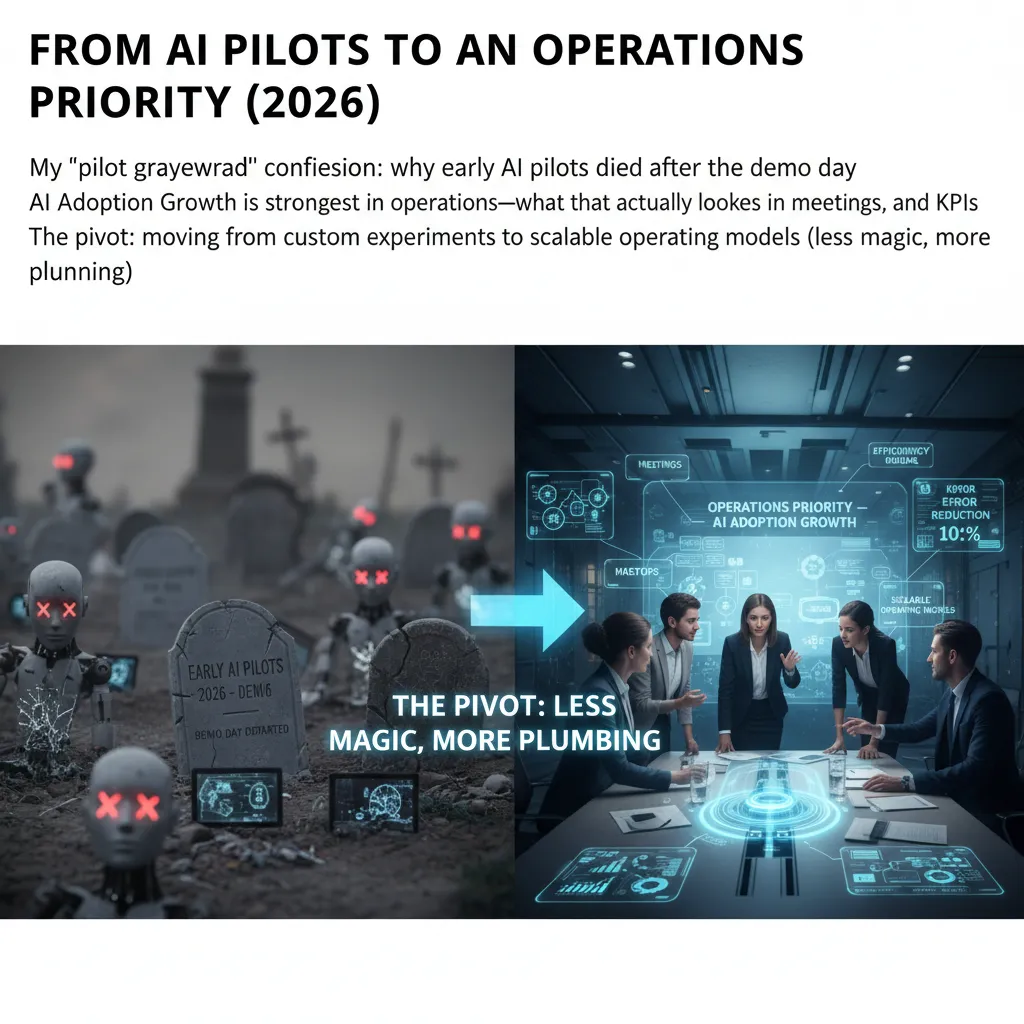
My “pilot graveyard” confession
I have a pilot graveyard. In the early days, I ran AI pilots that looked amazing on demo day and then quietly died. The pattern was always the same: we built a clever model, showed a dashboard, got applause, and then reality hit. No one owned the workflow change. The data feed broke. The team didn’t trust the output. And the pilot never made it into the daily operating rhythm. In “How AI Transformed Operations: Real Results,” the message is clear: AI only counts when it changes how work moves.
“If it doesn’t survive the handoff from demo to daily work, it’s not transformation—it’s theater.”
Why AI adoption is growing fastest in operations
By 2026, I’m seeing AI adoption growth show up strongest in operations because operations has the clearest feedback loop: time, cost, quality, and service. In meetings, this looks like fewer debates about opinions and more reviews of exceptions. In handoffs, it looks like AI-generated summaries, auto-filled tickets, and routing that reduces back-and-forth. In KPIs, it looks like tighter cycle times, higher first-time-right rates, and fewer “where is this stuck?” escalations.
Instead of asking, “Can AI do this task?” we ask, “Where does work stall, and what signal can AI add?”
The pivot: less magic, more plumbing
The big shift is moving from custom experiments to scalable operating models. That means standard inputs, clear owners, and repeatable deployment—not one-off prompts living in someone’s browser. I now spend more time on boring things: data definitions, access controls, audit trails, and training. That “plumbing” is what turns AI from a side project into an operations priority.
A quick gut-check checklist: where AI belongs first
- Throughput: forecasting volume, balancing queues, reducing rework, spotting bottlenecks early.
- Service delivery: faster triage, better routing, consistent responses, clearer status updates.
- Execution: next-best action suggestions, checklist compliance, risk flags before deadlines slip.
Wild-card thought: AI as a new shift supervisor
I treat AI like a new shift supervisor: helpful, inconsistent, and in need of coaching. It can watch the floor, notice patterns, and nudge the team—but it still needs rules, feedback, and accountability. When I set it up that way, AI stops being “magic” and starts becoming part of how operations actually runs.
2) Productivity Gains Without the Hype: Where AI Actually Saves Time
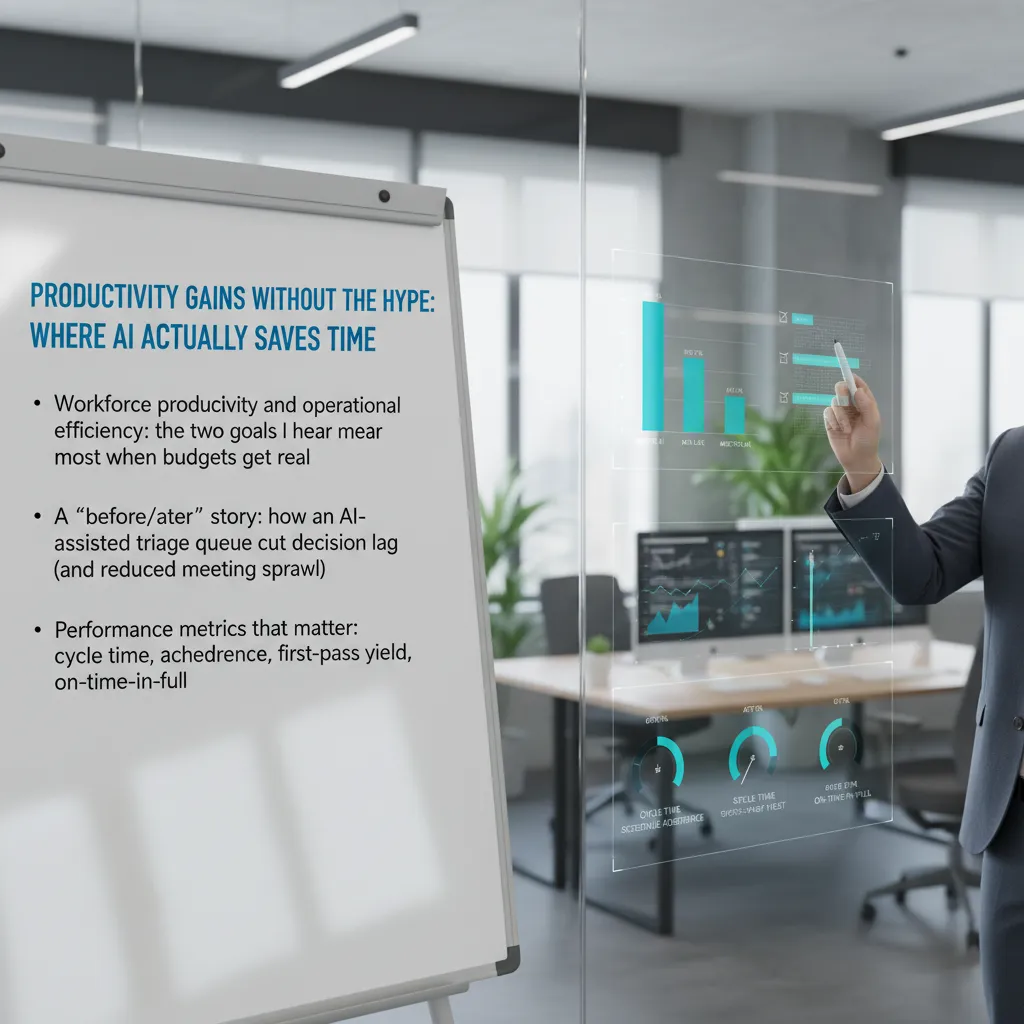
When I talk to operations leaders and the budget conversation gets real, I hear the same two goals again and again: workforce productivity and operational efficiency. Not “AI innovation.” Not “digital transformation.” Just time back, fewer handoffs, and fewer fires. In How AI Transformed Operations: Real Results, the wins that stuck were the ones tied to daily work: faster decisions, cleaner queues, and less meeting sprawl.
A before/after story: AI-assisted triage that cut decision lag
Before we used an AI-assisted triage queue, our intake looked “organized” but acted like a traffic jam. Requests came in through email, chat, and tickets. People spent hours sorting, asking for missing info, and scheduling meetings just to decide who should do what. The real delay wasn’t the work—it was the decision lag.
After we added AI triage, the flow changed. The model didn’t “run operations.” It did the boring parts: classify the request, flag missing fields, suggest priority based on rules, and route it to the right owner. The biggest surprise was cultural: once the queue was clearer, we stopped holding recurring meetings just to “get aligned.”
“AI didn’t replace judgment. It removed the noise so judgment could happen faster.”
Metrics that actually show productivity gains
I track outcomes that operations teams already respect. These are the numbers that tell me if AI is saving time or just adding a new tool:
- Cycle time: how long work takes end-to-end, not just “time in progress.”
- Schedule adherence: whether plans hold when reality hits.
- First-pass yield: how often work is right the first time (less rework = real speed).
- On-time-in-full (OTIF): delivery performance without excuses.
The uncomfortable bit: AI exposes bad process design
Here’s the part people don’t like: AI can make weak processes more visible. If your intake form is vague, your priorities conflict, or your approvals are unclear, the model will surface that mess fast. The gain is part tech and part humility: you fix the process so the automation has something solid to amplify.
Tiny tangent: I automated the wrong step once
I once automated a handoff step because it looked slow. It worked perfectly—and made the real bottleneck louder. We pushed more volume into a downstream approval that was still manual and unclear. Lesson learned: automate where it reduces constraint, not where it just feels repetitive.
3) Manufacturing Signal: Predictive AI Hits the Factory Floor
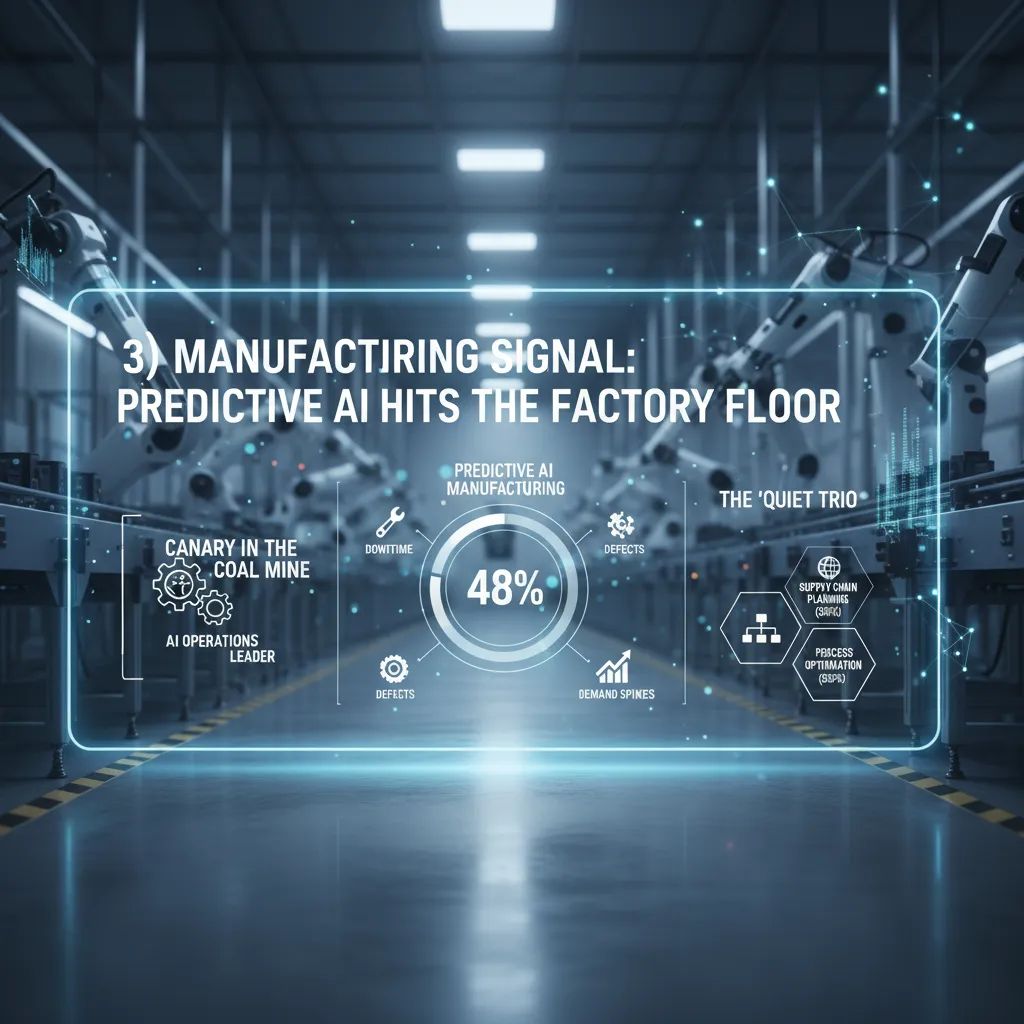
When I look for proof that AI Operations is real (not just talk), I look at manufacturing first. Factories are the canary in the coal mine because they run on tight timing, thin margins, and physical limits. If an AI model is wrong, you don’t just get a bad dashboard—you get scrap, missed shipments, or a stopped line. That pressure is actually good news: it forces teams to build AI that works in the real world, with clear metrics and fast feedback.
Predictive AI is already mainstream on the floor (48%)
In the source material, predictive AI in manufacturing shows up at 48%. That number matters because prediction is where operations teams feel value quickly. In practice, the “predictions” are not abstract. They are the daily risks that cost money:
- Downtime: early warning that a motor, pump, or bearing is trending toward failure
- Defects: signals that quality is drifting before parts fail inspection
- Demand spikes: alerts that orders are rising faster than the plan can handle
I’ve learned that predictive AI works best when it’s tied to a decision. A prediction without an action is just noise. A prediction with a work order, a parts pull, or a schedule change becomes operations.
The “quiet trio” that compounds: planning (35%) + optimization (36%)
Prediction gets the headlines, but two other AI uses quietly stack value over time: supply chain planning (35%) and process optimization (36%). Together with predictive maintenance, they form a compounding loop:
- Planning reduces surprises in materials and capacity.
- Optimization tightens cycle time, energy use, and throughput.
- Prediction prevents the failures that break both plans and processes.
Even small gains add up when a line runs every day. That’s why manufacturing is such a strong signal for AI Operations maturity.
94% adoption means the question is “how well?”
The source notes that 94% of manufacturers use some form of AI. So the debate isn’t “should we try AI?” It’s “are we using it well enough to trust it at 3 a.m.?”
Imagine a night shift where the line usually stops at 3 a.m. for an unplanned jam. This time it doesn’t—because the model flagged vibration changes hours earlier, maintenance swapped a part during a scheduled micro-break, and the planner already had the spare in stock.
4) Cloud ERP as the Unsexy Superpower (and Why It Matters for AI Integration)
Cloud ERP is not trendy. It doesn’t get the same attention as chatbots or shiny AI demos. But in my experience, it’s the unsexy superpower that makes AI operations work in the real world. If you want reliable AI integration, you have to stop feeding models with Franken-data—those stitched-together exports, spreadsheets, and “temporary” databases that never go away.
What the numbers say (and why I believe them)
In the source material, the operational wins tied to cloud ERP are clear and practical. The top outcomes were:
- Simplify IT infrastructure (49%)
- Reduce costs (49%)
- Improve agility (48%)
Those aren’t abstract benefits. They’re the exact conditions AI needs: fewer systems to connect, fewer exceptions to handle, and faster changes when the business shifts.
The day my “single source of truth” had five versions
I still remember the moment it clicked for me. We were in a meeting talking about “the” customer record—our so-called single source of truth. Then someone asked a basic question: “Which revenue number are we using?”
Within ten minutes, we had five versions of the same metric. One from finance, one from sales ops, one from the data warehouse, one from a regional system, and one from a spreadsheet someone trusted “because it’s always been right.” That’s when I realized AI wasn’t our first problem. Data integration was.
AI can’t create clarity from chaos. It will only automate the confusion faster.
Practical linkage: Cloud ERP + AI workflows
When cloud ERP is solid, AI workflows stop being fragile. Instead of building custom bridges between disconnected tools, I can connect AI to standardized processes like purchasing, inventory, billing, and workforce planning.
- Faster resource allocation: AI can recommend staffing, reorder points, or budget shifts using consistent ERP data.
- Fewer manual reconciliations: less time spent matching invoices, correcting entries, and explaining why numbers don’t tie out.
My opinionated aside (because it’s true)
If your ERP upgrades are always “next year,” your AI timeline is fiction. You can prototype AI on messy data for a while, but you can’t scale AI operations on a foundation you keep postponing.
5) Leadership Shift & Preparing Teams: The Real Bottlenecks
Leadership shift: when AI is “owned by IT” but lived by operations
In the source story, the biggest operational wins didn’t come from a fancy model. They came when leadership treated AI as an operations change, not an IT install. I’ve watched AI projects stall the moment they’re “owned by IT” on paper, while the daily work sits with planners, supervisors, schedulers, and frontline teams. IT can build and secure the system, but operations has to trust it, use it, and handle the messy edge cases. If leaders don’t shift ownership to the people who run the workflow, the project becomes a dashboard that nobody checks.
AI preparedness: the skills I underestimated
I used to think “AI readiness” meant hiring a data scientist and buying a tool. What I underestimated were the practical skills that make AI operations work:
- Process mapping: knowing the real steps, not the ideal steps in a slide deck.
- Data literacy: understanding what the data means, where it’s missing, and what “good enough” looks like.
- Exception handling: deciding what happens when the model is wrong, uncertain, or the world changes.
These are not technical “nice-to-haves.” They are the difference between AI that helps and AI that creates more tickets, more workarounds, and more blame.
The barriers that keep showing up
The same blockers repeat across teams, and the source material calls them out clearly: lack of talent (33%) and cross-department collaboration (31%). I see this as a leadership issue more than a hiring issue. If operations, IT, data, and finance don’t share goals and definitions (like what counts as an on-time order, or a valid exception), the model becomes a debate instead of a tool.
A low-drama playbook that actually works
When I want real results from AI in operations, I keep it simple:
- Train by workflow, not by tool: “How do we handle late shipments?” beats “Click here to run the model.”
- Pair SMEs with data folks: one person who knows the work, one who knows the data, sitting together weekly.
- Define exception paths: a short rule like
if confidence < 0.7, route to human review.
Informal aside: the best AI champion I met was a scheduler who hated meetings. They didn’t sell AI with hype—they just kept asking, “Will this reduce rework on Tuesday?”
6) AI Infrastructure, Physical AI, and the Next Operating Shifts
When I look at where AI operations is heading, I follow the money trail first. The 2026 capital spending estimate for AI hyperscalers is projected to hit $527B. That number is not just a tech headline—it is a signal to every operations leader. It means faster chips, bigger data centers, cheaper compute over time, and more “AI-ready” tools baked into the platforms we already use. In plain terms: the infrastructure wave is making AI less of a special project and more of a default setting for daily work.
Physical AI is moving from pilots to normal work
In the source report, one stat keeps sticking with me: 58% of companies are already using some form of physical AI today, and it is projected to reach 80% within two years. That includes robots, computer vision, sensors, and smart equipment that can “see” and “measure” the real world. For operations, this is where AI stops being only dashboards and starts becoming action—spotting defects on a line, tracking inventory automatically, improving safety checks, and reducing downtime with better signals.
Where enterprise agents will earn trust first
I also think the next operating shift will come from enterprise agents and AI workflows—what many people call digital coworkers. Trust will not start with big strategic decisions. It will start with repeatable tasks where the cost of being wrong is low and the value of speed is high. The first wins I expect are ticket triage in IT and ops support, planning support that turns messy inputs into clear schedules, and maintenance workflows that summarize logs, suggest likely causes, and trigger the right work order.
The report highlight I keep bookmarking
Another line from the research is hard to ignore: six in ten+ IT leaders say AI’s biggest impact will be on operations. That matches what I see in real teams. The best results come when AI is tied to throughput, quality, cost, and reliability—not when it is treated like a side experiment.
I’ll close with the analogy I use to keep expectations healthy. Operations is a kitchen. AI is the prep cook, not the restaurant critic. It chops, sorts, labels, and sets up the station so the team can move faster and make fewer mistakes. The real shift is not “AI replaces people.” The shift is that well-run operations will start to feel like they have an extra set of hands—steady, consistent, and always ready for the next order.
TL;DR: Operations is shaping the next wave of AI adoption in 2026: fewer pilots, more execution discipline. Manufacturing is already deep in predictive AI (48%), supply chain planning (35%), and process optimization (36%), with 94% using some AI. Cloud ERP is a practical enabler (49% simplify IT, 49% cut costs, 48% improve agility). The winners will pair AI workflows with leadership shift, team preparedness, and clear performance metrics—while planning for big AI infrastructure spending ($527B) and the rise of physical AI (58% today, 80% soon).