
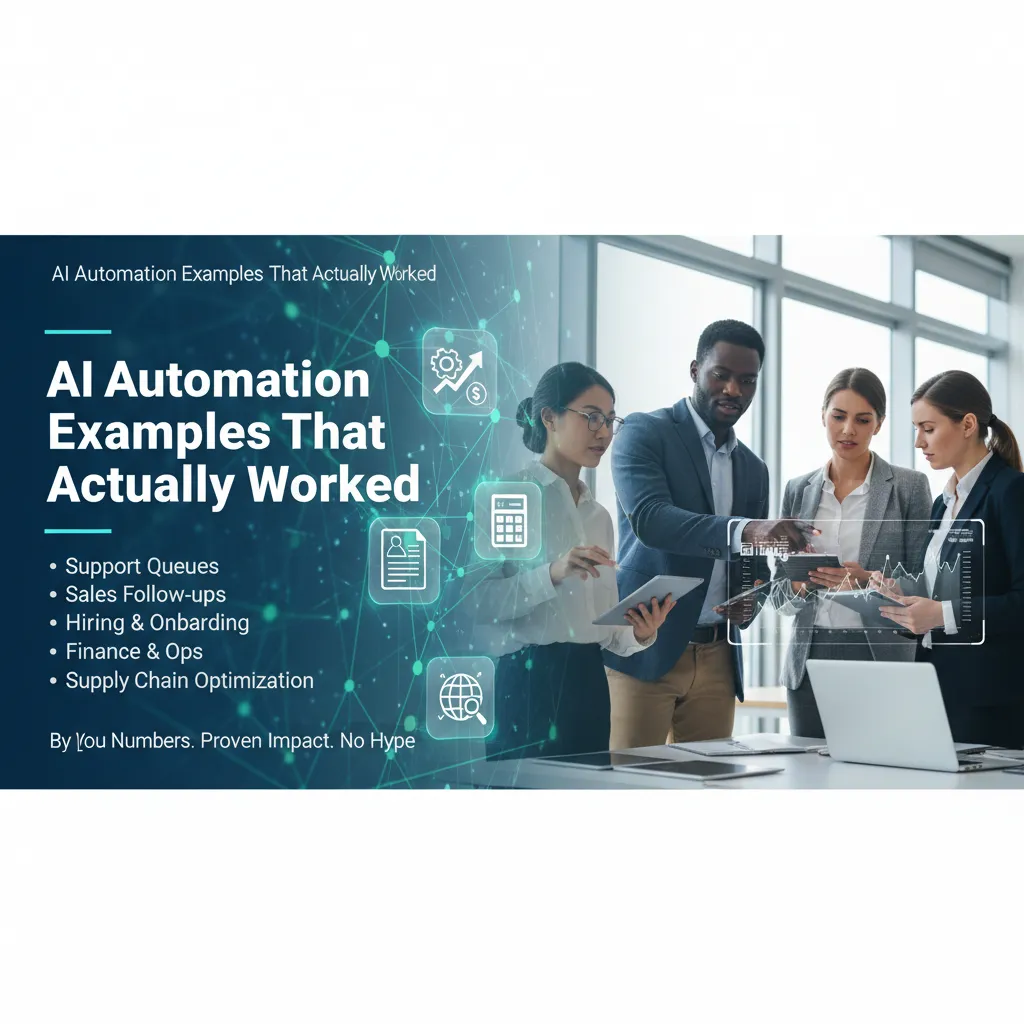
Last year I watched a support inbox hit 600+ tickets on a Monday morning, and the team did that quiet thing people do when they realize the week is already lost. We didn’t “add a chatbot” as a shiny side quest—we rebuilt the workflow like we were redesigning a kitchen: put the knives where your hands naturally go, label the drawers, and stop pretending everyone remembers where the whisk is. That’s the lens for this post: AI as an operations remodel, not an AI Transformation poster on the wall.
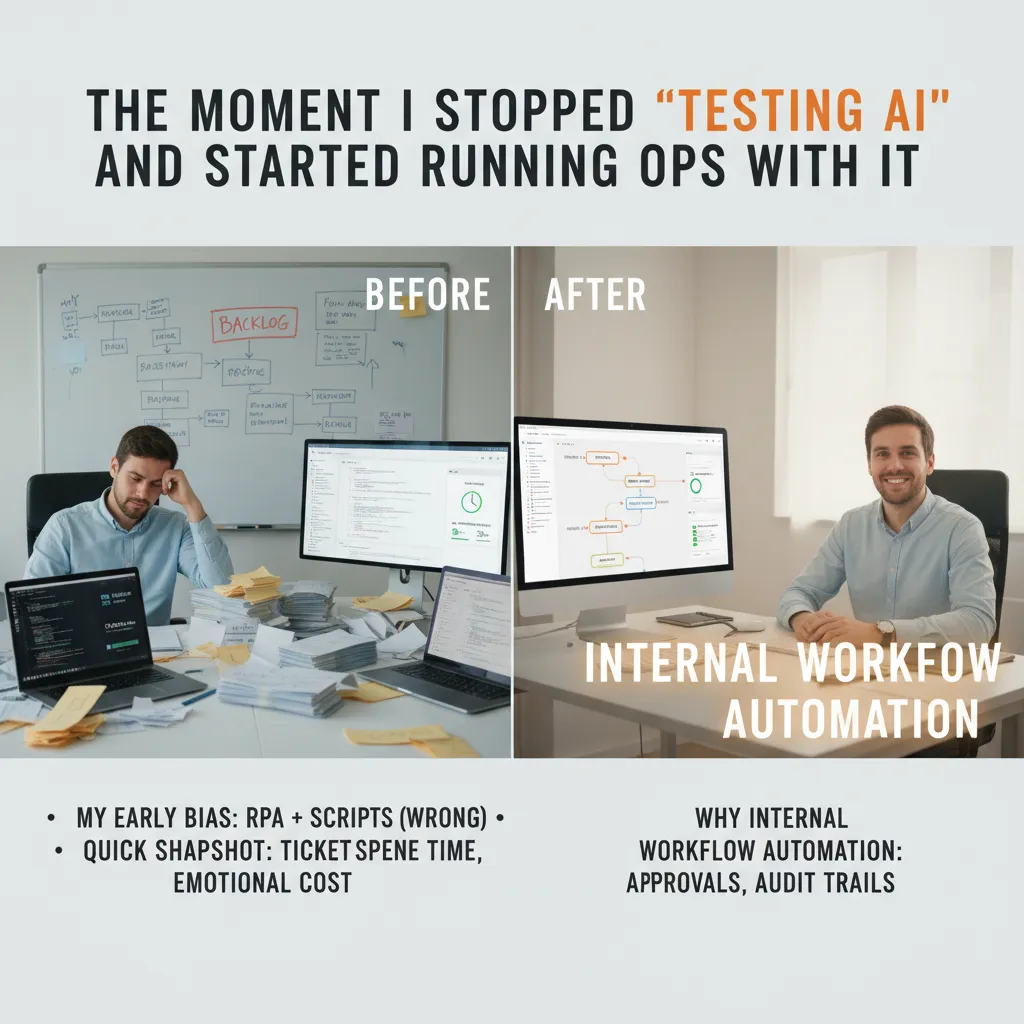
1) The moment I stopped “testing AI” and started running ops with it
My early bias (and why it failed)
At first, I treated AI automation like a side project. I assumed automation ops was basically RPA + a few scripts, and the rest was just “prompting better.” I was wrong. In practice, the bots worked… until the real world showed up: missing fields, unclear owners, and tickets that didn’t fit the happy path.
Before/after: what actually changed
In the source story, “How AI Transformed Automation Operations: Real Resultsundefined,” the shift happened when I stopped building one-off bots and started using AI to run internal workflow automation. Here’s the snapshot I track now:
| Metric | Before (firefighting) | After (workflow-led) |
|---|---|---|
| Ticket backlog | Growing daily | Stable and prioritized |
| Response time | Hours to days | Minutes to first action |
| Emotional cost | Constant context switching | Calmer, predictable handoffs |
Why workflow automation beat “clever bots”
The breakthrough wasn’t a smarter prompt. It was adding the boring parts: routing, approvals, and audit trails. AI became the layer that reads a request, tags it, assigns it, and asks for missing info—without me babysitting every edge case.
AI was great at triage, but it needed a real workflow to land decisions safely.
Wild-card analogy: AI as a new shift supervisor
I started treating AI like a new shift supervisor: amazing at sorting the queue and escalating risks, but terrible at office politics. It won’t negotiate ownership for you.
- Key Takeaway: if a workflow has no owner, AI will amplify the mess instead of fixing it.
2) Customer Support Chatbots: the 70% wake-up call (Customer Service + Customer Support)
When I first tested AI chatbots in customer support, the real win wasn’t “better answers.” It was better routing and fewer duplicate tickets. Once the bot could recognize intent and attach the right context, agents stopped getting the same issue three times from three channels.
What “70% resolved” looks like in real life
In day-to-day operations, “AI chatbots resolving up to 70% of support queries” usually means: password resets, order status, simple billing questions, and policy lookups get handled end-to-end. The bot also pre-fills forms and gathers details before a handoff.
- Works best: clear, repeatable questions with known steps.
- Fails fast: edge cases, account-specific disputes, or vague “it’s not working” messages.
Sentiment analysis as an early-warning system
One of the most useful automation examples that actually worked was sentiment analysis. If a message trends angry (caps, threats to cancel, repeated “still waiting”), I route it to a priority queue. That simple move helps catch churn risks early, before the customer posts publicly or leaves.
A tiny script corner (intents, fallbacks, handoffs)
{

"intents": ["reset_password","track_order","refund_status"],

"fallback": {"max_turns": 2, "action": "ask_clarifying_question"},

"handoff": {

"triggers": ["negative_sentiment","billing_dispute","unknown_intent"],

"send_to": "human_agent",

"include": ["chat_history","customer_id","detected_intent"]

}

}
Success story: “good enough” beats “perfect”
Bank of America’s Erica is a reminder that a chatbot doesn’t need to be magical. It needs to be reliable, fast, and clear about limits—then hand off smoothly when confidence drops.
3) Sales Follow-Ups that don’t feel spammy: where the 20–35% lift comes from
In my experience, sales follow-ups only feel “spammy” when they’re blind. The biggest change I saw after applying ideas from How AI Transformed Automation Operations: Real Results was learning the difference between nagging and timely. Nagging is sending the same “just checking in” message on a fixed schedule. Timely is showing up when a lead’s behavior says, “I’m paying attention.”
AI nudges + lead scoring: who gets a human vs. an automated check-in
Instead of treating every lead the same, AI-driven lead scoring helps me prioritize. When a lead hits certain signals (pricing page visits, reply intent, demo time on site), the system nudges a rep. When signals are weaker, it sends a short, helpful check-in that doesn’t demand a reply.
- High score: human follow-up within hours, with context
- Medium score: automated “resource + question” email
- Low score: pause outreach, retarget later
Why the 20–35% conversion bump comes from sequencing, not volume
The lift (often 20–35%) doesn’t come from sending more messages. It comes from sending the right message next. Sequencing matters because context changes fast: a lead who downloaded a checklist needs a different follow-up than someone who asked about pricing.
“Automation works best when it reacts to intent, not a calendar.”
Success story: U.S. Bank’s predictive lead scoring
A standout example is U.S. Bank, which used predictive lead scoring to drive a 260% conversion boost and move deals 25% faster. That’s the power of routing attention to the right prospects at the right time.
The “three-touch rule” as an adaptive workflow
Instead of 3 touches in 7 days, I model it like this:
- Touch 1: triggered by interest (page view/download)
- Touch 2: only if engagement continues (open/click/revisit)
- Touch 3: human outreach when score crosses a threshold

4) HR Hiring automation: faster Time-To-Hire, better candidate experience (surprisingly)
My skeptical take
I used to worry that AI screening would feel cold. And honestly, it can—if you treat it like a wall between you and people. But when I looked at real automation results, the better setups used AI to remove waiting, not remove humans. That shift changed my mind.
Time-To-Hire drops 40–50% (where the time actually disappears)
In the source material on how AI transformed automation operations, the biggest win wasn’t “magic hiring.” It was cutting the dead time. With AI resume screening plus a chatbot, teams reported 40–50% faster Time-To-Hire because:
- Resumes get triaged in minutes, not days.
- Chatbots handle FAQs (salary range, location, process) 24/7.
- Scheduling becomes automatic instead of endless email threads.
- Candidates get instant status updates, so fewer drop off.
Unilever: screening + personalized onboarding
Unilever is a strong success story here. They used AI to support early screening and then paired it with more personalized onboarding. The best part: humans stayed focused on interviews, culture fit, and final decisions—where judgment matters most. AI handled the repeatable steps that usually slow everything down.
A practical checklist I follow
- Bias checks: test outcomes by role, gender, and background signals.
- Audit logs: keep records of why candidates were advanced or rejected.
- Clear candidate messaging: I tell applicants up front what AI does (and doesn’t) do.
- Human override: make it easy for recruiters to review edge cases.
Small tangent: one sentence can beat a template
The best recruiting email I ever got was one line:
“Are you open to a 10-minute chat this week if I share the salary range first?”
It felt human, direct, and respectful. AI helped draft it—but a recruiter chose it, sent it, and owned the tone.
5) Predictive Maintenance: the unsexy hero of automation operations
Predictive maintenance is where AI feels like a sixth sense—until you realize it’s just math + sensors + discipline. In automation operations, that “sense” matters because downtime is rarely dramatic. It’s usually a slow drift: heat, vibration, wear, and then a surprise stop at the worst time.
What worked in the Siemens-style approach
In the source material, Siemens is a clear example of using AI to reduce equipment failures and maintenance costs. The reason teams buy in is simple: the model doesn’t replace technicians—it helps them plan. When alerts are tied to real signals (not vague “AI says so”), maintenance can schedule work, order parts earlier, and avoid emergency callouts.
Anomaly detection vs forecasting (quick primer)
- Anomaly detection: “This looks different from normal.” Great when you don’t have many labeled failures. It flags unusual vibration, temperature spikes, or cycle-time changes.
- Forecasting: “This will likely fail in X days.” Useful when you have history and consistent patterns, like bearing wear over time.
I’ve found anomaly detection is often the fastest first win, while forecasting becomes realistic after you’ve cleaned data and collected enough run-to-failure examples.
Real-time data hygiene: models believe bad sensors
If your sensors lie, your model will confidently lie back. Before tuning algorithms, I focus on basics:
- Calibrate sensors and track drift
- Fix missing timestamps and unit mismatches
- Label maintenance events consistently (what failed, when, why)
Key Takeaway: start with one failure mode you can name (like “motor overheating” or “bearing vibration”), not “all the things.”

6) Supply Chain Intelligence: Demand Forecasting, inventory, and the domino effect
When I look at Supply Chain Intelligence, I don’t see one big “AI brain.” I see dozens of tiny decisions—each one stopping the next domino from falling. Forecast a little better, reorder a little earlier, route a little smarter, and suddenly the whole system feels less fragile.
Demand forecasting + inventory: the Walmart-style win
In the source, Walmart’s demand forecasting and inventory optimization stand out because the goal is simple: less waste and fewer stockouts. When forecasts improve, planners don’t have to overbuy “just in case,” and stores don’t run empty on fast movers. The real result isn’t only numbers—it’s calmer planning cycles and fewer emergency orders.
Logistics optimization: Coca-Cola as a supply chain management success story
Coca-Cola’s AI-driven logistics optimization is a clean example of Supply Chain Management automation that actually matters. Instead of treating delivery as fixed, AI helps choose better routes and timing based on real conditions. That means fewer late deliveries, better truck use, and less fuel waste—small gains that add up across thousands of runs.
Warehouse automation shout-out: inVia Robotics (and what I’d validate)
inVia Robotics is often linked to a “5x productivity” claim. If I were validating that, I’d check:
- Baseline definition: 5x compared to what process and staffing?
- Pick accuracy: speed is useless if errors rise.
- Peak weeks: does performance hold during surges?
- Integration time: how long to connect WMS and workflows?
A quick “what if” domino scenario
One storm hits. One container is delayed. Without help, everything downstream slips. With AI-assisted monitoring, the system flags the risk early, suggests an alternate port, reroutes inventory to higher-demand stores, and updates reorder points automatically. That’s the domino effect—stopped before it spreads.
7) Finance + Expense Control: Expense Categorization, Fraud Detection, and calmer audits
In the source material, the biggest “quick win” area I keep seeing is expense control. When AI helps sort spend in real time, I get fewer gray-area receipts, faster month-end closes, and fewer “who approved this?” moments. It’s not flashy, but it removes daily friction and makes finance feel calmer.
Expense Categorization: the boring backbone
Expense categorization automation is the boring backbone that makes dashboards trustworthy. I’ve watched teams move from messy, manual coding to consistent categories by training models on past transactions, merchant names, and policy rules. The result is cleaner reporting and fewer reclasses at close.
- Auto-tagging by merchant + description + amount patterns
- Policy hints (travel, meals, software) to reduce misc. buckets
- Exception queues for anything low-confidence
Auditing meets fraud detection (and why adversaries matter)
Fraud detection is where automation gets real. The source points to eBay’s AI flagging fraudulent listings as a cautionary tale: once you automate detection, bad actors try to “game” the system. In expense control, that can look like split receipts, vague merchant names, or timing tricks.
“Automation works best when you assume someone will try to beat it.”
Approval workflows: auto-approve vs human checkpoint
I’ve had the best results with a simple rule: let AI auto-approve low-risk, repeatable spend, but force a human checkpoint when risk rises.
- Auto-approve: small amounts, known vendors, matched policy
- Human review: new vendors, out-of-policy categories, odd timing
- Escalate: repeated exceptions or suspicious patterns
Adjacent success story: faster due diligence
For a nearby example of finance workflow automation, the source mentions Nextoria cutting deal closure time by 35% using AI workflows for due diligence. Different process, same lesson: structured checks + smart routing reduce cycle time without losing control.
8) Conclusion: My cheat sheet for AI Automation Examples (and what I’m watching for 2026)
After reviewing the real results in How AI Transformed Automation Operations: Real Results, my cheat sheet is simple: I start with value first, then data, then automation depth—not the other way around. If a workflow is “cool” but doesn’t move a business outcome, I treat it like a demo, not an AI automation example that actually worked.
My next step is picking one North Star metric and sticking to it. In the examples that delivered, the teams didn’t measure everything at once. They chose what mattered most: support deflection, sales conversion, recruiting time-to-hire, operations downtime, or planning forecast accuracy. Once that metric was clear, the automation design got easier, because every decision had a scoreboard.
Then I run what I call the Sunday night test. If the workflow breaks when one person is offline—because only they know the prompt, the spreadsheet, the hidden rule, or the “one weird step”—it’s not automated yet. Real AI automation in operations should survive vacations, sick days, and handoffs without drama.
Looking toward agentic AI in 2026, I’m watching for more autonomy: agents that can monitor signals, decide the next action, and coordinate across tools. That could mean faster incident response, smarter scheduling, and better end-to-end process automation. But I still want approvals in the loop for high-risk moves—money, customer promises, security changes, and anything that can create a mess at scale.
AI transformation is less about replacing people and more about giving them fewer dumb decisions.
That’s the real win: fewer repetitive choices, clearer ownership, and teams spending time on judgment, not busywork.
TL;DR: AI Automation Examples that deliver real results tend to share the same bones: a clear handoff to humans, tight feedback loops, and real-time data. Expect up to ~70% support deflection with AI chatbots, 20–35% lift from sales follow-ups, and 40–50% faster time-to-hire when HR hiring is automated—plus big wins in predictive maintenance and supply chain intelligence.