

I once lost a deal because I waited “until tomorrow” to reply—then watched a competitor swoop in with a three-line email and a calendar link. It stung, but it also rewired my brain: speed is a feature, not a personality trait. Since then, I’ve collected sales tips the way some people collect coffee mugs—most are fine, a few are gimmicks, and some quietly change your whole morning. This post isn’t a dump of 63 tips. It’s the ones I’d tape to my monitor in 2026, plus the weird little mental models I use when my pipeline feels like a leaky boat.
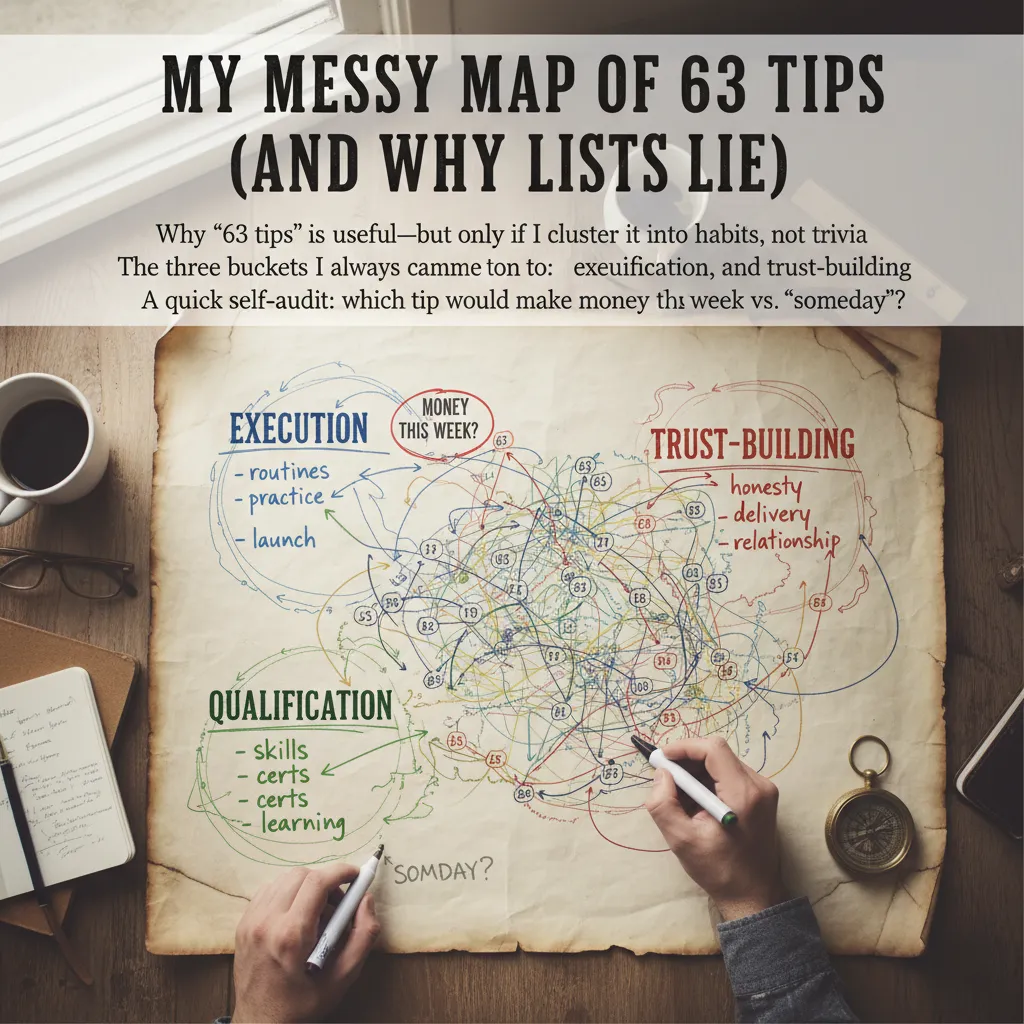
My messy map of 63 tips (and why lists lie)
I like the idea of 63 sales tips because it gives me options. But lists also lie. They make sales improvement look like trivia: collect enough “smart” lines and you win. In real life, I don’t need 63 new ideas—I need a few habits I can repeat when I’m busy, tired, or behind quota.
So when I pulled notes from “63 Sales Tips Every Professional Should Know”, I stopped treating each tip like a separate rule. I clustered them into a messy map. Same tips, fewer mental tabs open.
The three buckets I always come back to
- Execution: the doing. Follow-ups, clean next steps, tight calendars, and fast turnaround. If I’m honest, most “new tactics” fail because I didn’t execute the basics.
- Qualification: the filtering. Clear ICP, real pain, budget, timeline, and decision process. This is where I protect my time and stop “hope deals” from eating my week.
- Trust-building: the relationship. Listening, honest expectations, proof, and consistency. Trust is what makes a prospect tell me the real objection instead of the polite one.
A quick self-audit I run every Monday
I ask myself one question: Which tip would make money this week vs. which one is a “someday” improvement? Then I pick one habit per bucket and keep it small.
- This week: What action creates pipeline or moves a deal stage in the next 5 days?
- Someday: What sounds good but needs a perfect week to happen?
“A tip that doesn’t show up on my calendar isn’t a tip. It’s a wish.”
Why sales tips are like gym cues
Sales tips remind me of gym coaching: “keep your back straight,” “breathe,” “full range.” Simple words, hard consistency. The cue isn’t magic—the repetition is. That’s why I keep my map messy and practical, not pretty and complete.
Sales planning time management: the week I stopped “winging it”
For years, my “plan” was a mix of sticky notes and good intentions. Then I had one messy week where I missed follow-ups, forgot a warm lead, and spent Friday night fixing it. That was the week I stopped winging it and started treating sales planning time management like a real skill.
My one-page work plan ritual (signed & dated)
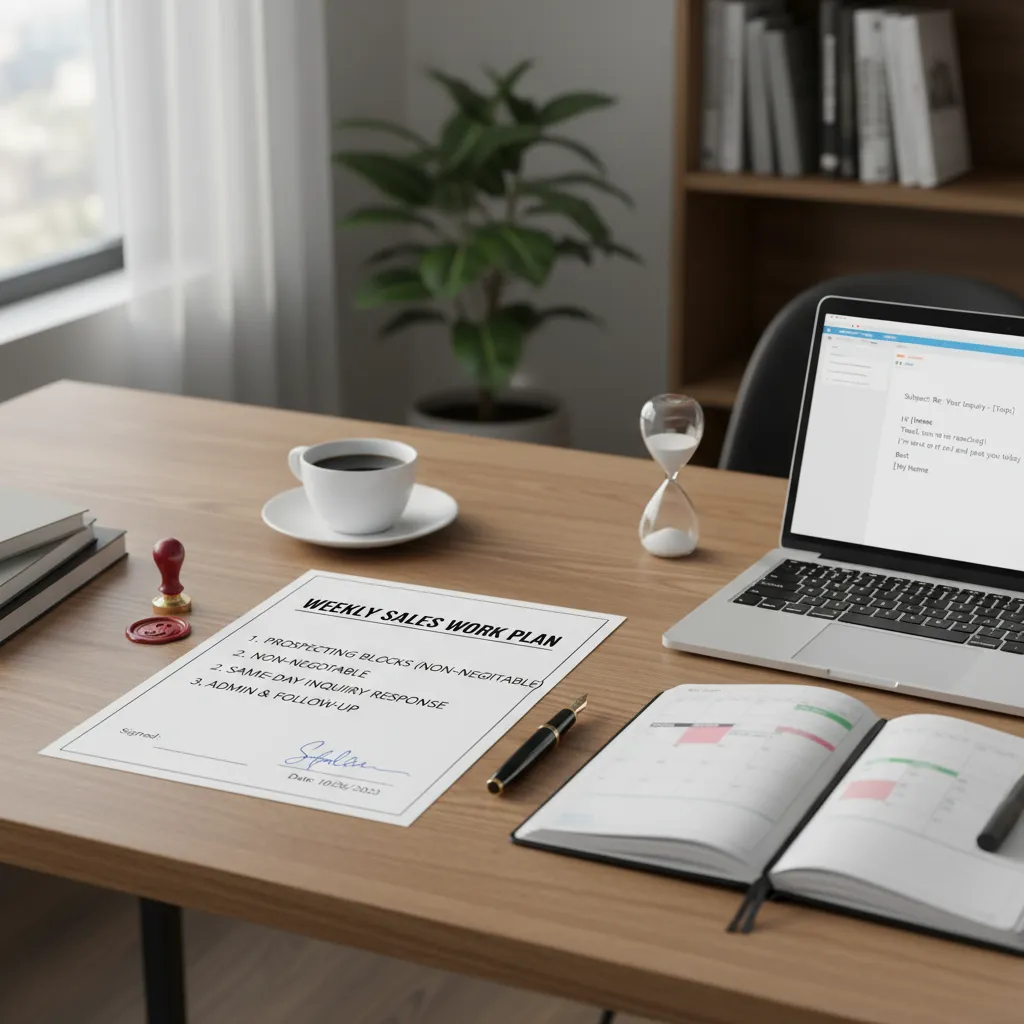
Every Monday, I write a one-page work plan. No fancy deck. Just the key outcomes, top accounts, and the few actions that move deals forward. Then I sign and date it—yes, like a contract with myself. It sounds dramatic, but it stops me from rewriting the plan midweek to match my mood.
- 3 outcomes I want by Friday
- 10 priority contacts (names, not “prospect more”)
- Daily minimums: calls, emails, follow-ups
Weekly prospecting blocks I defend like meetings
I schedule prospecting as non-negotiable calendar blocks. If someone asks for that time, I offer the next slot—just like I would for a client call. This is the only way I keep my pipeline healthy in 2026.
“If it isn’t on my calendar, it isn’t real.”
Same-day responses: my “or it didn’t happen” rule
I respond to inbound inquiries the same day. Not “within 24 hours.” Same day. To make it easy, I use a tiny template:
Subject: Quick follow-up

Hi [Name]—thanks for reaching out. Two quick questions so I can help fast:

1) What are you trying to solve right now?

2) When do you want this in place?

I can do a 10-min call [two times].
Mini-tangent: why I prospect best after lunch
Gurus love 8 a.m. prospecting. I tried it. My brain was busy “warming up,” and I sounded flat. Right after lunch, I’m alert, I’ve already handled admin tasks, and I can focus on quality outreach. The lesson: pick the time you actually execute, then protect it.
Selling qualification tips: I ask “authority” early (without being weird)
Decision maker authority: the exact phrasing I use
I bring up authority in the first 10 minutes, but I keep it normal. I don’t ask, “Are you the decision maker?” I ask about the process, not the person. My go-to lines are:
“When you’ve bought something like this before, who else usually weighs in?”
“Just so I don’t build the wrong proposal—who needs to sign off on this?”
“If we find a fit, what are the next steps on your side?”
These questions feel like planning, not pressure. They also help me avoid the classic trap: doing great discovery with someone who can’t move the deal forward.
Sales process qualification: my 4-question checkpoint
Before I build a proposal, I run a quick checkpoint. If I can’t answer these, I pause and go back to discovery:
- Authority: Who approves budget and who influences the choice?
- Problem: What pain are we solving, and what happens if nothing changes?
- Timing: What date or event is driving action?
- Path: What are the exact steps from “today” to “yes”?
This habit came straight from the “63 Sales Tips Every Professional Should Know” mindset: qualify early so you don’t waste cycles later.
Lead scoring methodologies: a lightweight model for CRM chaos
When the CRM is messy, I use a simple score out of 10:
- Fit (0–3): industry, use case, size
- Authority clarity (0–3): do we know the approver and influencers?
- Urgency (0–2): deadline, active project, real trigger
- Process clarity (0–2): steps, stakeholders, timeline
If a lead is under 6, I don’t “push harder.” I ask better questions.
Hypothetical scenario: two identical leads
Two leads want the same product and have the same budget. Lead A is “bigger,” but says, “Send a quote and we’ll see.” Lead B is smaller, but says, “My director signs, legal reviews, and we decide by the 20th.” I pick Lead B. The buying journey is clearer, so my proposal lands with the right people at the right time.
Active listening empathy: the unsexy skill that closes deals
Most “sales tips” sound exciting: new scripts, new tools, new hacks. The habit that actually moves deals for me is quieter: active listening with empathy. It’s not soft. It’s practical. When I listen well, buyers tell me the real problem, the real risk, and the real reason they might say no.
My “three beats of silence” trick
When a prospect finishes a thought, I count three beats in my head before I speak. It keeps me from pitching too soon. In those three beats, people often add the detail that matters most: budget limits, internal politics, or what they tried before. If I jump in early, I steal that information from myself.
“Silence is where the buyer does the work for you.”
Emotional intelligence sales: noticing the shift
I watch for the moment they move from curious to cautious. The signs are simple: shorter answers, slower pace, fewer questions, or a sudden “Yeah, but…” That’s my cue to stop explaining and start exploring. I’ll ask one calm question like: “What feels risky about this?” Then I go back to listening.
Objection handling framework I actually use
When an objection shows up, I don’t fight it. I run a small loop:
- Label: “Sounds like timing is the concern.”
- Clarify: “Is it budget timing, team bandwidth, or approval?”
- Confirm: “So the main issue is onboarding during Q4, right?”
- Offer options: “We can start smaller, delay kickoff, or adjust scope.”
I keep the language plain and let them correct me. That correction is gold.
Personalization: the one detail I mirror back
I always mirror back their success metric, not their job title. Titles are generic. Metrics are personal. I’ll say: “You mentioned cutting response time from 2 days to same-day.” That tells them I heard what matters. It also keeps the conversation anchored to outcomes instead of features.
Virtual selling skills in 2026: camera-on isn’t the point
In 2026, virtual selling is normal. But I’ve learned the goal isn’t “camera on.” The goal is trust. Some buyers love video, some hate it, and some are calling from an airport. I focus on making remote calls feel real without turning them into a performance.
Virtual selling remote: my “real call” checklist
- Start with context: “What would make this call useful for you?”
- Confirm time: “Do you still have 20 minutes?” (It lowers pressure.)
- Share a simple agenda in one sentence, then ask for edits.
- Use names and pauses: I stop talking every 30–60 seconds to invite input.
- Screen share only when it helps, not as a crutch.
- End with next steps that are specific: owner + date + deliverable.
Product knowledge (technical): how I stay sharp
Remote selling punishes fuzzy product knowledge. I keep my edge with a weekly routine: one webinar, one competitor check, and one call review.
- Webinars: I watch with a notepad and write 3 “buyer questions” I expect next week.
- Competitor research: I track pricing pages, release notes, and review sites for patterns.
- Call analysis: I listen for where deals stall and label it: timing, risk, or unclear value.
AI-powered outreach: where I use it (and where I refuse)
I let AI help with drafts, account research, and tightening subject lines. I refuse to let it pretend to be me. If I wouldn’t say it on a call, it doesn’t go in an email. I also won’t send fake “personal” lines based on weak signals.
My rule: AI can speed up thinking, but it can’t replace accountability.
Wild card: the “digital handshake” follow-up
My best follow-up feels like holding a door open, not a shove. I send a short note with one helpful asset, one clear next step, and an easy out:
Recap + 2 bullets + link + “Want me to draft the plan, or should I close the loop?”

Data driven insights: turning dashboards into decisions (not guilt)
I used to open my sales dashboard like it was a report card. If the numbers were down, I felt bad. If they were up, I relaxed. That mindset made me slow. Now I treat sales analytics reporting as a weekly coaching tool: it should tell me what to do next, not what to feel.
Sales analytics reporting: the 5 numbers I look at weekly (and the one I ignore on purpose)
- New qualified meetings booked (not “calls made”).
- Pipeline created this week (new dollars added).
- Stage conversion rate (where deals stall).
- Average sales cycle for deals currently moving.
- Next-step coverage: deals with a dated next meeting on the calendar.
The number I ignore on purpose: total pipeline. It can hide weak deal quality and make me feel safe. I’d rather know if my pipeline is moving.
Data driven decisions: how I use leading indicators to fix the month before it’s over
Lagging indicators tell me what happened. Leading indicators tell me what will happen if I keep going. Mid-month, I check two leading signals: meeting volume and stage movement. If meetings are low, I block time for outbound and ask for referrals. If stage movement is flat, I tighten discovery and push for a clear next step.
I also run a quick rule in my head:
If stage 2 → 3 conversion drops, fix discovery before adding more leads.
Data storytelling skills: a simple narrative arc for exec buyers (problem → proof → plan)
When I share data with exec buyers, I keep it simple:
- Problem: what’s costing time, money, or risk.
- Proof: one chart or metric that shows the gap.
- Plan: the next 2–3 steps, owners, and timeline.
Dashboards don’t close deals. Clear decisions do.
Mini confession
I used to “report” instead of “learn.” Then I had a bad quarter where my forecast looked fine—until it didn’t. That’s when I got honest: the dashboard wasn’t the problem. My interpretation was. Now I use data to spot friction early and act fast.
Conclusion: Future of selling = craft + character
When I look back at all 63 habits in Sales Tips 2026: 63 Habits I’d Actually Keep, the through-line is simple: consistency beats charisma—and that’s good news. Charisma is hard to copy and easy to fake. Consistency is learnable. It’s the daily craft: clear notes, clean next steps, honest timelines, and follow-ups that respect the buyer’s time. In modern B2B sales, the people who win aren’t always the loudest in the room; they’re the ones who show up, do the work, and keep their word.
My trusted advisor approach in one sentence is this: I help the buyer make a good decision, even if that decision isn’t me. That one line changes how I follow up. Instead of “Just checking in,” I send something useful: a short recap, a risk I noticed, a simple comparison, or a clear question that moves the deal forward. It also changes my timing. I don’t chase attention; I earn it by being helpful, specific, and steady.
If you want a tiny challenge that actually sticks, do this: pick three tips from the list, practice them for 14 days, then review the results with a coach (or a manager, or a peer you trust), and repeat. Keep it small on purpose. In sales, big change usually comes from small habits done long enough to become automatic. That’s how sales skills turn into sales character.
One final wild card to end on: if your pipeline were a garden, what are you watering—and what’s just weeds? Some deals grow because you’re adding value, building trust, and staying consistent. Others only grow because you keep feeding them time. In 2026, I think the future of selling belongs to people who can tell the difference, prune fast, and invest deeply where there’s real fit.
TL;DR: Reply faster than feels polite (63% of buyers expect same-day). Write the plan, protect prospecting time, qualify like a skeptic, sell outcomes not price, and use data + empathy to become a trusted advisor—especially in virtual selling.