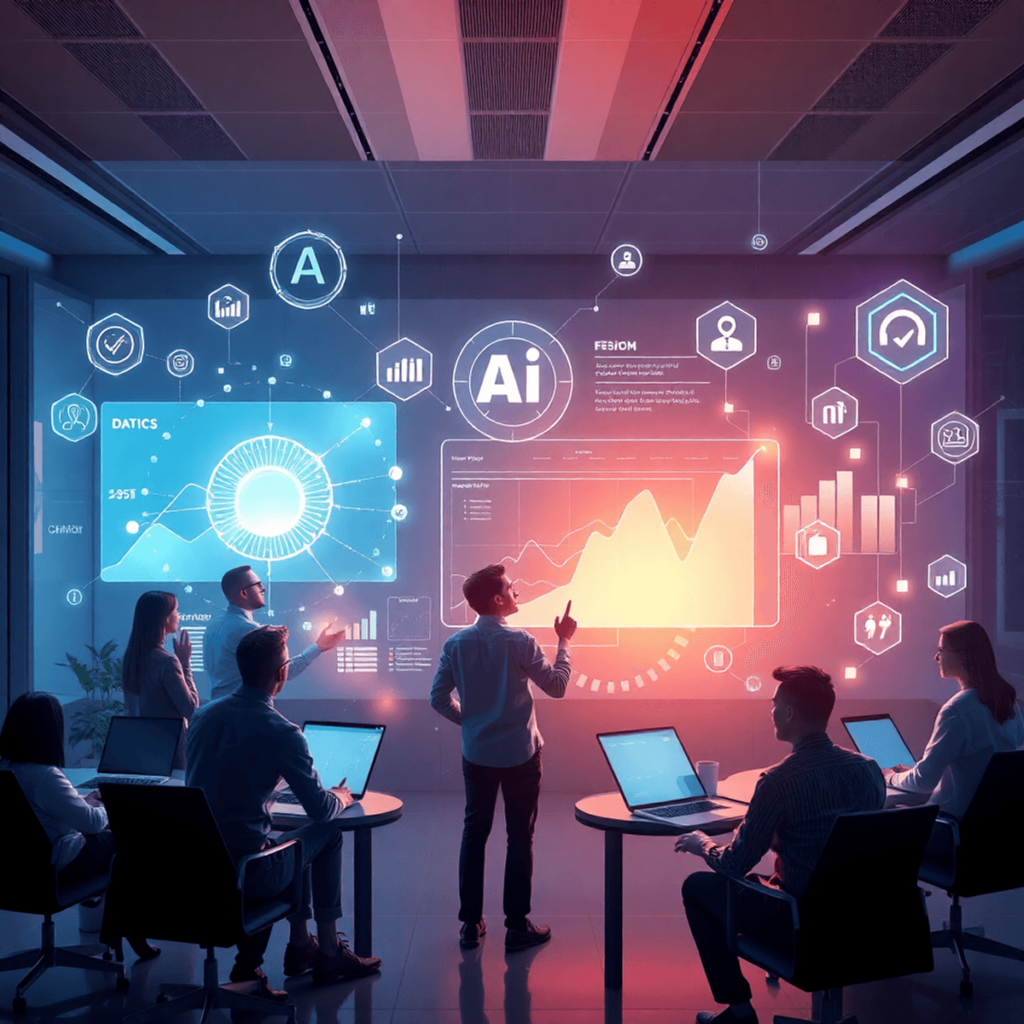

The world of product development is changing rapidly, thanks to the latest AI advancements in 2026. Artificial intelligence is no longer just an extra tool; it’s now a crucial part of driving innovation in design, engineering, and software processes. These technologies are improving creativity, making complex simulations more efficient, and managing product lifecycles seamlessly.
This article is your go-to source for the latest Product AI news and updates from top companies. It showcases groundbreaking solutions that are pushing the limits of what’s possible in 2026’s product ecosystem. By sharing these insights, we aim to empower professionals to stay ahead in an industry that’s increasingly driven by AI.
Figma’s AI Integration for Design Enhancement
Figma has introduced an exciting new feature: AI agents that can write directly into design files. These AI agents work seamlessly with design elements, revolutionizing the way designers work. By using existing components, variables, and tokens in a project, the AI can intelligently modify and create assets right on the canvas.
Key features of Figma’s AI integration include:
- Utilization of existing design elements: The AI understands how components are structured and makes changes that align with the overall design style.
- Modifications via variables and tokens: Adjustments to colors, typography, spacing, and other design tokens happen automatically, ensuring consistency.
- Customizable AI “skills”: Users can customize the behavior of the agent by selecting or programming specific skill sets that guide the actions of the AI. This flexibility ensures that the AI can support various design needs, from quick prototyping to detailed refinement.
The impact on designers manifests in multiple ways:
- Enhanced creative workflows arise as routine tasks become automated, allowing more focus on innovation and concept development.
- Maintaining design system consistency is simplified since the AI follows predefined rules embedded in variables and component libraries, reducing manual errors.
- Faster iteration cycles occur because changes are intelligently applied across related assets without requiring extensive manual adjustments.
This integration is a significant step toward integrating intelligent automation directly into design platforms. Figma’s approach empowers teams to scale their creativity while maintaining brand integrity through consistent application of design principles powered by adaptable AI skills.
Synopsys and Ansys 2026 R1: Transforming Engineering with AI
Using Generative AI for Faster Design Exploration
The 2026 R1 release of Synopsys and Ansys is a major development in engineering, as it integrates AI capabilities into the product development process. This integration aims to streamline workflows and empower engineers to utilize generative AI for quicker and more efficient design exploration.
Key Features of the Synopsys Ansys Integration
Some key features of this integration are:
- Generative AI speeding up design iterations: Generative AI algorithms automate the generation of multiple design variants based on initial parameters. This accelerates the exploration phase by quickly producing innovative solutions that meet predefined criteria without manual intervention.
- Automation of preprocessing tasks: Preprocessing tasks such as mesh generation, boundary condition setup, and parameter tuning are labor-intensive. The AI automates these steps, reducing human error and freeing engineers to focus on higher-level decisions.
- Early system-level insights: By simulating early-stage designs using AI models, teams gain critical system-level feedback far sooner than traditional methods allow. This insight helps identify potential issues or optimization opportunities during initial development phases.
- Unified workflows for seamless collaboration: Combining Synopsys’s semiconductor expertise with Ansys’s multiphysics simulation tools creates an integrated environment where software, hardware, and systems engineers collaborate fluidly. Data flows seamlessly between stages, improving accuracy and reducing turnaround time.
These advancements enable product teams to tackle complex engineering challenges by incorporating intelligence directly into design automation. The combination of product expertise, generative AI, and system-level insights is changing how products develop from idea to reality.
Advanced Digital Twin Technologies
The Synopsys Ansys integration delivers a seamless convergence of tools that unify workflows across the product development lifecycle. This cohesive engineering environment leverages generative AI and design automation to provide system-level insights early in the process, driving more informed decisions.
Key advancements in digital twin technology emphasize the fusion of real-world data with virtual models, creating simulations that mirror actual operating conditions with unprecedented fidelity. These enhanced digital twins enable engineers to validate designs under realistic scenarios, resulting in improved accuracy and reliability.
Key Features of Advanced Digital Twin Technologies
- Expanded functionalities include multi-physics simulations that capture complex interactions between mechanical, electrical, thermal, and fluid dynamics aspects of a product.
- Real-time data integration from sensor inputs allows continuous updating of digital twins, ensuring models remain synchronized with their physical counterparts throughout a product’s lifecycle.
- High-fidelity simulations benefit from GPU acceleration, dramatically reducing computation times while increasing model complexity.
- NVIDIA Omniverse support enables collaborative virtual environments where multiple stakeholders can interact with the digital twin simultaneously, facilitating cross-disciplinary design reviews and iterative improvements.
These technologies empower engineering teams to:
- Predict performance issues before physical prototyping
- Optimize maintenance schedules through predictive analytics
- Explore innovative design alternatives efficiently
The result is a significant leap forward in simulation realism and accuracy that supports the demands of modern product development.
Safety Analysis Tools Integration
The Synopsys Ansys integration creates a seamless environment where safety verification workflows become more cohesive and efficient. This unified approach bridges the gap between system-level safety engineering and chip-level safety collaboration, fostering a collaborative ecosystem for engineers working across different domains of product development.
Key aspects include:
- Unified workflows that allow safety engineers to share data, models, and analysis results effortlessly, reducing redundancies and ensuring consistency throughout the product development lifecycle.
- Generative AI-driven design automation, which accelerates safety verification tasks by automatically generating test cases, identifying potential failure modes, and suggesting corrective actions based on system-level insights.
- Enhanced communication channels between teams working on hardware and software safety components, enabling real-time updates and integrated reporting.
- Tools designed to support regulatory compliance by maintaining traceability of safety requirements from concept through validation, simplifying audit processes.
Integration of these sophisticated tools enables faster detection of safety issues early in the engineering process, minimizing costly redesigns later. The synergy of Synopsys and Ansys capabilities empowers engineers to build safer products with improved reliability and adherence to industry standards.
New AI-Powered Platforms and Features
The Synopsys Ansys integration delivers unified workflows that enhance the entire product development lifecycle by combining strengths from both companies’ engineering tools. This synergy introduces generative AI capabilities designed to streamline design automation and deliver deeper system-level insights early in the process.
Key components include:
- Ansys GeomAI platform: A breakthrough tool enabling conceptual design exploration through AI agents. These agents interact dynamically with design parameters, generating innovative solutions rapidly while adhering to engineering constraints. The platform supports iterative design cycles, empowering engineers to evaluate multiple concepts efficiently before committing to detailed development stages.
- Agentic mechanical simulation features: Embedded within Ansys’ simulation software, these agent-based functionalities assist in debugging preprocessing issues. By autonomously identifying anomalies and suggesting corrective actions, these intelligent assistants reduce manual troubleshooting time and improve accuracy in simulation setups.
Together, these innovations foster cohesive engineering processes by integrating generative AI-driven design exploration with advanced simulation debugging tools. The combined Synopsys and Ansys suite creates a more responsive environment where product teams can accelerate innovation while maintaining rigorous quality controls. This approach exemplifies the shift toward AI-powered platforms that not only automate routine tasks but also augment expert decision-making across complex engineering domains.
Other Notable Product AI Updates in 2026
PTC’s Enhanced Application Lifecycle Management Tools with AI
PTC has introduced significant advancements in its Application Lifecycle Management (ALM) tools by embedding AI functionality tailored to software-driven product development. These enhancements focus on optimizing the complex processes involved in managing the full lifecycle of product applications, from initial design through deployment and maintenance.
Key improvements include:
- Intelligent Requirement Analysis: AI algorithms automatically analyze and categorize requirements, identifying inconsistencies or potential conflicts early in the development cycle. This reduces manual review time and improves accuracy in capturing stakeholder needs.
- Predictive Risk Assessment: Embedded machine learning models assess historical project data to predict potential risks such as delays, budget overruns, or technical bottlenecks. Project managers gain actionable insights for proactive decision-making.
- Automated Change Impact Analysis: When modifications occur, the AI system evaluates downstream effects across dependent components and systems. This enables teams to understand ramifications quickly without exhaustive manual tracing.
- Enhanced Collaboration Tools: Natural language processing facilitates improved communication between cross-functional teams by summarizing discussions, flagging unresolved issues, and suggesting relevant documentation or expertise resources.
These AI-driven capabilities within PTC ALM tools streamline workflows and elevate the precision of managing complex software products. They foster agility by enabling continuous alignment between evolving requirements and engineering execution. As a result, organizations can accelerate innovation cycles while maintaining high standards of quality and compliance.
The integration of advanced AI extends beyond automation—it empowers teams to handle increasing complexity inherent in modern product ecosystems. PTC’s approach exemplifies how lifecycle management platforms evolve into intelligent assistants that not only track progress but also anticipate challenges and recommend solutions systematically.
Cisco’s Innovations in Critical Infrastructure with AI
Cisco has made significant progress in using AI technologies to improve critical infrastructure. They are focusing on creating intelligent infrastructure solutions that are designed to be resilient, efficient, and scalable.
1. AI-Driven Network Optimization
Using machine learning models, Cisco’s AI systems analyze network traffic patterns in real-time to predict congestion and automatically redirect data flows. This proactive approach reduces downtime and improves the reliability of communication networks that are vital for utilities, transportation, and emergency services.
2. Predictive Maintenance and Fault Detection
Cisco incorporates AI sensors and edge computing into infrastructure components to continuously monitor their operational health. By doing so, they can identify potential failures early on before they lead to disruptions, thereby minimizing expensive outages and maintenance costs.
3. Cybersecurity Enhancement through AI
As cyber threats targeting critical systems continue to rise, Cisco utilizes advanced AI algorithms to detect unusual behavior across extensive networks. These algorithms enable automated gathering of threat intelligence and response actions, effectively safeguarding infrastructure against evolving attacks without requiring manual intervention.
4. Smart City and IoT Integration
Cisco’s platform facilitates the large-scale deployment of connected devices in urban areas. Through AI analytics, data from sensors monitoring traffic flow, energy consumption, and public safety is processed to optimize city operations and allocate resources efficiently.
These innovations demonstrate Cisco’s strategic focus on integrating AI into critical infrastructure systems. This approach strikes a balance between ensuring smooth operations while also being flexible enough to tackle new challenges as they arise.
Adobe Experience Cloud Continuous Updates with AI
Adobe Experience Cloud continues to evolve through frequent updates that embed cutting-edge AI learning modules and optimization tools. These enhancements empower businesses to deliver personalized, data-driven customer experiences more efficiently.
1. Advanced AI Learning Modules
Adobe integrates sophisticated machine learning frameworks designed to analyze user behavior, predict trends, and automate decision-making processes. These AI models continuously refine themselves by ingesting vast amounts of interaction data, enabling marketers to tailor campaigns with greater precision.
2. Optimization Tools for Campaign Performance
New optimization features leverage AI algorithms to dynamically adjust targeting, content placement, and budget allocation in real time. This reduces manual oversight while maximizing return on investment across digital channels.
3. Seamless Integration Across Marketing Workflows
The updates ensure smooth interoperability between analytics, content management, and customer journey mapping tools within the Experience Cloud ecosystem. AI-powered insights flow effortlessly across these components, offering unified visibility into campaign effectiveness.
4. Enhanced Automation Capabilities
Automation driven by AI extends beyond simple task execution to intelligent orchestration of multi-channel marketing strategies. This includes automated content generation, personalized messaging at scale, and adaptive audience segmentation based on evolving consumer signals.
Adobe’s commitment to embedding advanced AI functionality aligns with broader industry movements seen in Lenovo AI PCs offering intuitive computing experiences, and PTC ALM tools enhancing software-driven product development through lifecycle management innovations. These developments collectively push the boundaries of how artificial intelligence augments creativity, efficiency, and strategic decision-making in product design and customer engagement environments.
Industry Trends and Impact of Embedding Advanced AI in Product Development
The landscape of product development is rapidly shifting due to industry trends in product AIs that emphasize deeper integration within design and engineering workflows. These trends reflect a move beyond isolated AI tools toward holistic ecosystems where artificial intelligence operates as a core enabler across multiple stages of product creation.
1. Seamless AI Integration Across Domains
Advanced AI systems are now embedded directly into design tools, simulation platforms, safety verification suites, and lifecycle management applications. This convergence fosters an environment where data flows uninterrupted between disciplines, enabling engineers and designers to make informed decisions faster.
2. Acceleration of Innovation Cycles
By automating repetitive tasks such as preprocessing, design exploration, and debugging, AI reduces manual bottlenecks that traditionally extended product timelines. Generative AI models propose novel concepts in early phases, while real-time simulation enhancements provide immediate feedback, compressing iteration loops significantly.
3. Collaboration Enhancement Through Intelligent Agents
AI-powered agents facilitate smoother communication by synthesizing complex datasets into actionable insights accessible to diverse teams. Integrated safety analysis tools unify chip-level and system-level engineers on shared platforms, reducing misalignment risks. Customizable AI “skills” adapt to team-specific workflows, supporting personalized collaboration dynamics.
4. Data-Driven Decision Making at Scale
Digital twins enriched with real-world data deliver predictive analytics that inform risk assessments and performance optimization prior to physical prototyping. GPU acceleration combined with platforms like NVIDIA Omniverse ensures simulations maintain high fidelity without sacrificing speed, empowering stakeholders to base choices on robust virtual testing.
The embedding of advanced AI creates a paradigm shift where human creativity merges with machine intelligence, fostering environments where innovation thrives through synthesis rather than silos. This transformation not only elevates product quality but also cultivates agile teams equipped for the complexities of modern engineering challenges.
Conclusion
The future of product development with AIs is being reshaped by the transformative capabilities of advanced AI technologies. These tools are no longer supplementary but foundational elements driving innovation in design, engineering, and product management. Companies integrating AI at every stage—from conceptualization and simulation to lifecycle management—are setting new standards for efficiency, creativity, and precision.
Key impacts include:
- Revolutionizing workflows: AI accelerates complex processes such as design exploration and safety verification, enabling teams to focus on higher-level problem-solving.
- Enhancing collaboration: Intelligent agents facilitate more seamless communication across disciplines, breaking down traditional silos in product development.
- Improving consistency and quality: Automated customization and AI-driven validation help maintain design system coherence while reducing human error.
- Driving continuous innovation: Persistent updates and evolving AI capabilities ensure that products remain competitive and adaptive to market demands.
Staying informed about these ongoing advancements is essential for professionals aiming to leverage AI innovations effectively. Awareness of new releases, integration strategies, and emerging platforms empowers teams to harness the full potential of AI-enhanced product development.
Embracing this transformative wave unlocks opportunities for creating smarter, faster, and more reliable products that meet the complex challenges of today’s markets. The landscape of product creation and management will continue to evolve rapidly as AI technologies mature, making proactive engagement with these trends a critical advantage for all stakeholders in the product ecosystem.