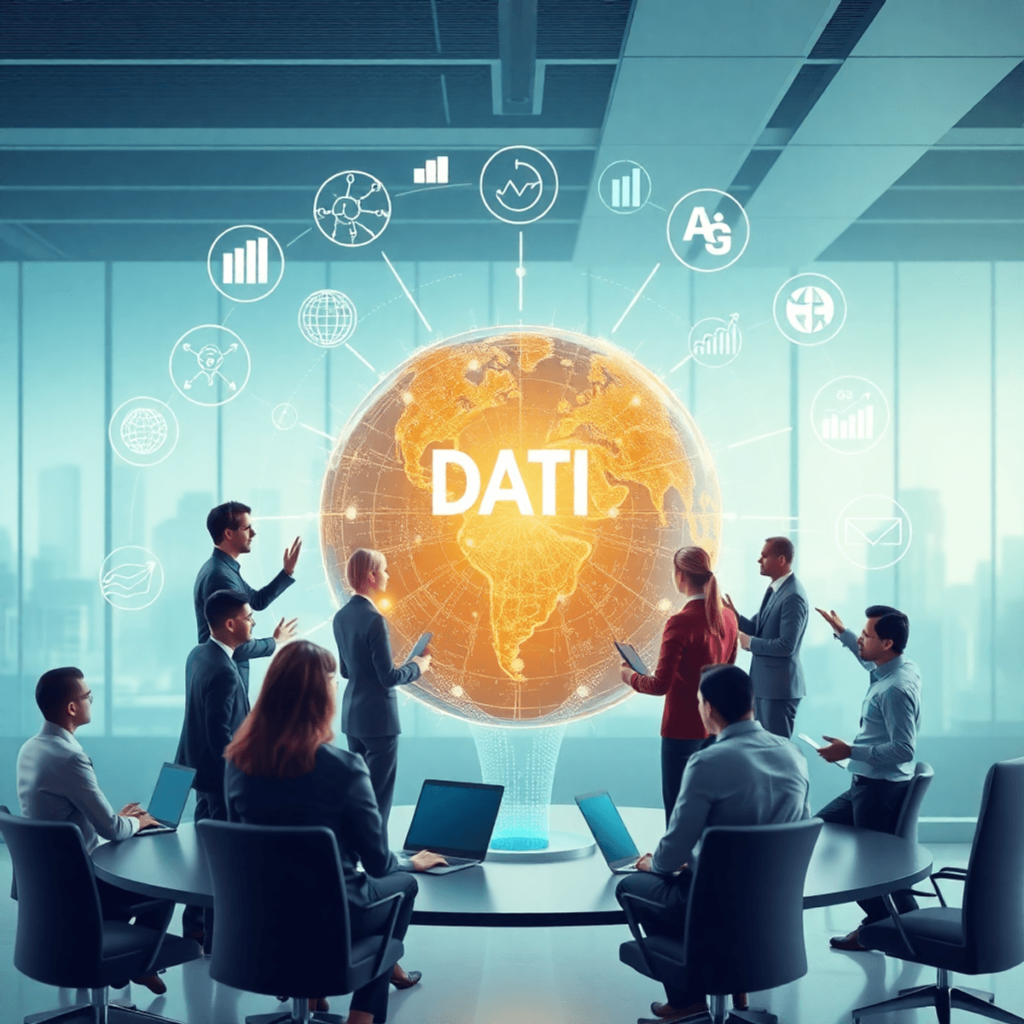

Data science has become a crucial part of decision-making in various industries. It helps organizations understand and use large amounts of data to improve their strategies and operations. As businesses strive to gain an edge over their competitors, enhance their processes, and foster innovation, the role of data science continues to evolve.
One significant advancement in this evolution is the integration of Artificial Intelligence (AI) into data science. AI takes traditional data science to the next level by automating complex tasks, revealing intricate patterns, and enabling real-time analysis. This transformation revolutionizes how businesses handle data—how they collect it, interpret it, and put it to use.
Integrating AI into data science brings several key benefits:
- Increased efficiency: By automating repetitive tasks, organizations can streamline their operations and allocate resources more effectively.
- Better accuracy: AI algorithms have the potential to improve the precision of predictive models and insights, leading to more reliable decision-making.
- Quicker decisions: With real-time data processing capabilities powered by AI, businesses can make faster and more informed choices.
As industries face growing demands for speed and accuracy, combining AI with data science becomes crucial. This integration has the potential to unlock new levels of performance and value for organizations across various sectors.
AI-Driven Enhancements in Core Data Science Operations
AI integration has transformed the fundamental activities within data science, changing how tasks are performed and decisions are made. Three main areas that benefit greatly from this change are: automation, predictive analytics, and real-time data processing.
Automation of Routine Tasks
AI automates repetitive, rule-based tasks that traditionally consumed valuable time and resources. This includes data cleaning, feature engineering, and report generation—processes that once required manual intervention but now run seamlessly through intelligent algorithms. Automation accelerates workflows by reducing human error and freeing data scientists to focus on complex problem-solving and strategic analysis.
- Robotic Process Automation (RPA) combined with AI handles large volumes of structured data efficiently.
- Automated data preprocessing pipelines prepare datasets faster for modeling.
- Workflow orchestration tools powered by AI trigger subsequent tasks based on previous outputs without human input.
These capabilities lead to faster cycle times in project delivery and improved operational consistency across teams.
Predictive Analytics Powered by AI
Predictive analytics uses machine learning and statistical models to predict future outcomes based on past and current data. AI improves these models by capturing complex patterns that traditional methods can’t, leading to more accurate insights.
Key impacts include:
- Better demand forecasting using detailed models tailored to specific product-location combinations.
- Enhanced risk assessment through dynamic scenario simulations.
- Identification of emerging trends before they become obvious through conventional analysis.
AI-powered predictive analytics drive business strategies by providing actionable foresight, allowing organizations to anticipate market shifts, optimize resource allocation, and mitigate risks proactively.
Real-Time Data Processing for Immediate Decision-Making
The ability to process streaming data instantly changes the way decisions are made. AI systems take in continuous flows of information from various sources such as sensors, transactions, logs, or social media feeds and analyze them immediately. This removes delays caused by batch processing and enables quick responses to changing situations.
Real-time capabilities include:
- Instant anomaly detection to flag operational issues as they occur.
- Dynamic pricing adjustments based on live market demand.
- Rapid fraud detection by continuously analyzing transactional patterns.
Implementing real-time AI-driven processes creates flexibility in operations, empowering businesses to make confident decisions during uncertain times with up-to-date information.
Incorporating automation streamlines routine work; predictive analytics sharpens forecasting accuracy; real-time processing equips enterprises with timely insights. These improvements are essential for modern data science operations transformed by AI.
Key Operational Transformations Enabled by AI
AI has reshaped core operational metrics in data science, delivering measurable improvements across multiple dimensions.
Demand Forecasting and Inventory Management
- Demand prediction accuracy improves by 10-20% through the use of fine-grained predictive models. These models analyze historical and causal data tailored specifically to product-location combinations.
- Enhanced forecasting accuracy leads directly to inventory cost reduction, minimizing overstock and stockouts.
- Better demand insights enable companies to increase revenue by aligning supply with actual market needs more precisely.
Supply Chain Optimization
- AI automates complex workflows within supply chains, enabling continuous process optimization.
- Real-time adjustments improve supply chain resilience, helping businesses adapt rapidly to disruptions or demand fluctuations.
- Sustainability benefits arise from optimized resource utilization and waste reduction driven by AI-powered decision-making.
Predictive Maintenance Using FMEA Models
- Integration of AI with Failure Mode and Effects Analysis (FMEA) models predicts equipment failures before they occur.
- This proactive approach reduces unplanned downtime, leading to significant maintenance cost savings.
- Improved maintenance scheduling extends asset lifecycles and enhances overall operational reliability.
Quality Assurance Enhancements
- Computer vision systems powered by AI detect defects faster and with greater precision than traditional manual inspections.
- Anomaly detection algorithms identify outliers in production data that might indicate quality issues or process deviations.
- These capabilities bolster quality assurance processes, reducing the risk of defective products reaching customers.
Customer Service Automation
- Deployment of AI-powered chatbots provides 24/7 customer support, handling routine inquiries and freeing human agents for complex issues.
- Automated customer interactions improve response times and consistency, contributing to higher satisfaction rates.
- Operational costs decline as businesses rely less on large call centers without sacrificing service quality.
The operational transformations enabled by AI are not just incremental improvements—they represent a fundamental shift in how data science integrates with everyday business functions. These advances translate into tangible benefits like cost savings, revenue growth, higher product quality, and stronger customer relationships.
Industry-Specific Applications Demonstrating AI’s Impact on Data Science
Data science powered by AI has reshaped industry operations with tailored solutions that address unique challenges. One of the most notable applications is in manufacturing, where Overall Equipment Effectiveness (OEE) monitoring benefits significantly from AI and modern cloud-native architectures.
1. Real-Time OEE Monitoring
Traditional OEE measurement often relied on periodic manual data collection or batch processing. AI enables continuous, real-time monitoring of key performance indicators such as availability, performance efficiency, and quality rate. This is achieved by integrating sensors and IoT devices with scalable cloud platforms that ingest and analyze vast streams of operational data instantly.
2. Scalable Cloud Architectures
Cloud-native infrastructures provide the elasticity needed to handle fluctuating workloads in production environments. They allow seamless scaling of data ingestion, storage, and machine learning model execution without downtime. This architecture supports complex analytics pipelines that deliver predictive insights directly to operators and management dashboards.
3. Impact on Production Efficiency
Real-time insights into equipment status help identify bottlenecks, track utilization rates, and predict failures before they cause downtime. AI-powered analytics optimize scheduling and maintenance windows, reducing unplanned stoppages. Companies report improved throughput and higher asset utilization resulting from these capabilities.
4. Enhanced Equipment Utilization
Fine-grained data analysis enables precise adjustment of machine parameters to maximize output quality without sacrificing speed. Predictive maintenance models reduce unnecessary part replacements and extend machinery life cycles. These improvements translate into cost savings and more sustainable manufacturing practices.
AI integration in data science extends beyond manufacturing into sectors like retail, healthcare, logistics, and cybersecurity—each leveraging domain-specific data streams processed via advanced infrastructure to unlock new value. The fusion of AI-driven analytics with robust cloud-native systems marks a turning point where operational intelligence becomes both immediate and actionable across industries.
The Rise of Autonomous Agents in Data Science Operations
The emergence of autonomous agents signifies a significant change in how businesses manage intricate processes. These specialized AI-powered entities function on their own, overseeing tasks that previously needed constant human oversight. Their abilities span various fields, such as:
1. Customer Service
Autonomous agents handle inquiries, resolve issues, and escalate cases when necessary, providing seamless 24/7 support without human intervention.
2. Security Operations
AI agents continuously monitor networks, detect threats, and initiate automatic responses to mitigate risks faster than traditional methods.
This new wave of automation is reshaping how workflows are organized. Instead of having separate AI tools for specific functions, autonomous agents serve as intelligent coordinators. They bring together data inputs, trigger actions across different systems, and adapt dynamically to changing conditions within the enterprise environment.
Transforming Data Science Operations with Embedded AI
Integrating AI deeply into data science operations brings about a transformation in how organizations function:
- AI becomes an essential part of decision-making processes, constantly improving models based on fresh data.
- Autonomous workflows eliminate manual bottlenecks by automating routine checks, investigating anomalies, and generating reports.
- Enterprise automation scales flexibly as these agents work together across departments, speeding up innovation cycles.
The era of autonomous agents demonstrates how AI evolves from being a mere assistant to taking on active management roles within data science ecosystems. By adopting this strategy, businesses can achieve greater responsiveness and resilience by distributing intelligence throughout their operational framework instead of confining it to isolated teams or tools.
Measurable Outcomes from Integrating AI into Data Science Operations
Integrating AI into data science operations generates tangible results that reshape business performance and strategic capabilities. The benefits span multiple dimensions, driving operational efficiency improvements, cost savings, and innovation acceleration.
Higher Efficiency and Risk Management
- Automation of complex workflows reduces manual intervention, accelerating task completion and minimizing human error.
- AI-powered predictive models improve accuracy in forecasting risks such as market fluctuations, equipment failures, and supply chain disruptions.
- Real-time anomaly detection systems identify irregularities faster, enabling proactive responses that mitigate potential losses.
- Enhanced data integration from diverse sources supports comprehensive risk assessments rooted in richer contextual insights.
Enhanced Customer Experiences
- Personalized recommendations fueled by AI analytics lead to more relevant product offers and tailored services.
- Chatbots and virtual assistants deliver instant support, reducing wait times and increasing customer satisfaction.
- Continuous monitoring of customer interactions provides actionable feedback loops that refine service quality.
- Dynamic pricing strategies powered by machine learning adapt to demand patterns, improving value perception.
Sustainability Achievements Across Sectors
- AI optimizes resource utilization by analyzing consumption patterns, reducing waste and energy usage.
- Predictive maintenance lowers environmental impact by extending asset lifecycles and preventing unnecessary replacements.
- Supply chain optimization enhances logistics efficiency, cutting emissions through smarter route planning and inventory management.
- Regulatory compliance is streamlined with automated reporting tools that ensure adherence to environmental standards.
These outcomes demonstrate how AI-driven data science operations create a competitive edge by transforming raw data into strategic assets. Businesses benefit not only through direct cost savings but also through the ability to innovate rapidly in response to changing markets. The integration fosters a culture where continuous improvement thrives on data-backed decision-making and sustainable practices.
Conclusion
The future of AI in data science looks promising with continuous growth, thanks to fast technological advancements and increasing applications. Improvements in machine learning algorithms, natural language processing, and autonomous agents will further integrate AI into essential data science tasks. This will lead to more advanced automation, better predictions, and smarter decision-making processes.
Here are some trends we can expect to see:
- More specialized AI agents that can handle complex tasks on their own in various industries.
- Growth of real-time analytics systems, enabling immediate insights and quick reactions to changing business situations.
- Clearer understanding of AI models, building trust and encouraging wider acceptance in data-driven organizations.
- Stronger emphasis on ethical AI practices ensuring fairness, responsibility, and sustainability in data science applications.
Companies that invest in these evolving AI technologies will unlock new levels of operational efficiency, competitive advantage, and innovation potential. The continued fusion of AI with Data Science is reshaping how organizations use data — not just as a resource but as a strategic asset that drives measurable business value.
By staying informed about these developments, you can confidently navigate the future landscape and position your data science operations at the forefront of technological progress.