
I didn’t learn “money stress” from a spreadsheet—I learned it in a parking lot, staring at a surprise car repair estimate and doing the kind of financial gymnastics that makes you swear you’ll “be better next month.” That was the month I realized my budget was fine… until life showed up. Since then I’ve kept a running list of the finance tips that actually hold up when rising costs hit, deadlines pile on, and you still want a life you enjoy. This post turns that list into a practical 2026 financial guide—part checklist, part pep talk, part “I can’t believe I used to do that.”
1) My “financial goals” reset: stop winging it
For a long time, my “financial goals” were basically vibes: save more, spend less, invest someday. In 2026, I’m done winging it. The biggest shift was treating money goals like real appointments—because if it’s not scheduled, it’s optional.
Write goals like a calendar invite (specific, dated, slightly bossy)
I now write goals the same way I’d write a meeting request: clear, measurable, and with a deadline. Not “build an emergency fund,” but “$5,000 emergency fund by Sept 30”. The date matters because it forces a monthly number and a plan.
- Specific: exact amount or action
- Dated: a deadline I can’t ignore
- Slightly bossy: written like a command, not a wish
“$5,000 emergency fund by Sept 30.”
“Pay off $1,200 credit card by June 15.”
“Increase 401(k) to 10% by March payroll.”
The 3-bucket method I actually stick to
To keep my plan simple, I use three buckets. This is the only “personal finance system” that hasn’t fallen apart after two weeks.
- Stability (bills/cash): rent or mortgage, utilities, groceries, minimum payments, and a starter cash buffer.
- Progress (debt/saving): extra debt payments, emergency fund growth, sinking funds (car repairs, travel, annual bills).
- Future (investing): retirement accounts, index funds, long-term investing goals.
When I get paid, I “fill” Stability first, then Progress, then Future. If I’m short, I don’t pretend—I adjust Progress and Future, not my rent.
My 15-minute monthly financial health check-in
I do a quick check-in once a month on the same day as my rent/mortgage reminder. It’s a tiny habit that keeps me from drifting.
- Check balances (checking, savings, credit cards).
- Confirm bills cleared and no surprise charges.
- Update my three buckets for the next month.
- Pick one “calendar invite” goal to push forward.
Wild-card exercise: write future “financial regrets” now
This one stings, which is why it works. I list the regrets I don’t want to have later. Mine is simple: “I waited too long to increase savings.” Seeing that sentence makes my next action obvious—and it keeps my 2026 financial goals real, not random.

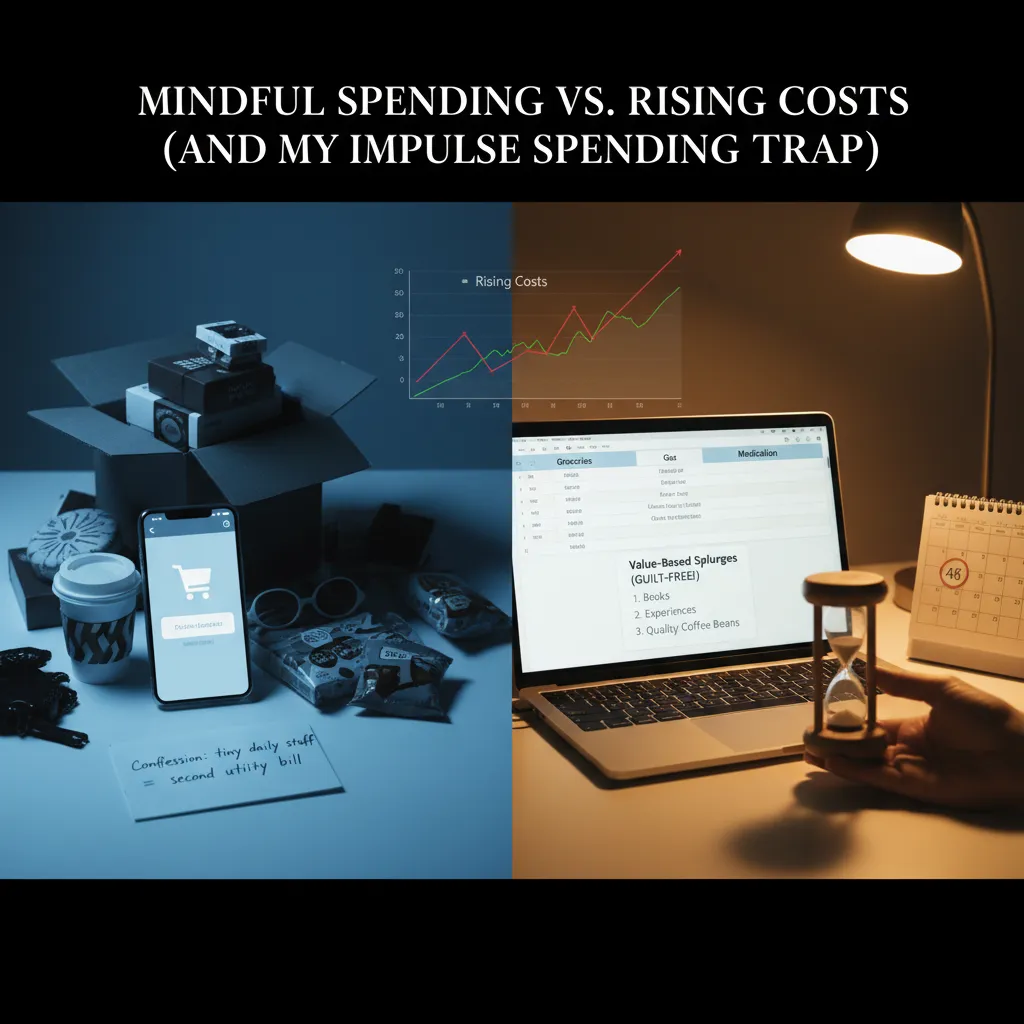
2) Mindful spending vs. rising costs (and my impulse spending trap)
In my 2026 financial outlook, I’m not pretending rising costs aren’t real. Groceries, insurance, and basic services keep climbing. But I also had to admit something: my budget didn’t break because of one huge mistake. It leaked.
My confession: the “tiny daily stuff” adds up fast
My impulse spending is rarely a big purchase. It’s the small, daily choices that feel harmless: a coffee here, a quick delivery fee there, an app upgrade I “needed,” a snack run because I was tired. When I finally looked at my statements, those little hits had quietly become a second utility bill.
That’s why mindful spending matters more when inflation is high. If costs rise and I keep leaking money, I’m basically paying higher prices and funding my own bad habits.
My “48-hour cart rule” (for almost everything)
One of the simplest personal finance tips I use now is my 48-hour cart rule. If it isn’t groceries, gas, or medication, I add it to my cart and walk away for two days. No checkout. No “treat yourself” logic.
- If I still want it after 48 hours, I ask: What problem does this solve?
- If it’s just boredom or stress, I delete it.
- If it’s real, I buy it on purpose, not on impulse.
It sounds small, but it stops the “one-click” spending that wrecks a monthly budget.
Replace shame with a value-based spending list
I used to try to fix overspending with guilt. It never worked. Now I use a value-based spending list: three things I’m allowed to splurge on, guilt-free, because they actually improve my life.
- Health (gym, therapy, better groceries)
- Learning (books, courses that build my career)
- Time (tools or services that give me hours back)
Everything else has to earn its spot.
Micro-tangent: joy isn’t the enemy—unplanned joy is
Joy isn’t the enemy. Unplanned joy is.
I still want fun. I just plan for it like it’s a meeting. I set a weekend “fun number” in my budget, and I spend it freely. That way, I’m not fighting myself—I’m directing my money where I actually want it to go.
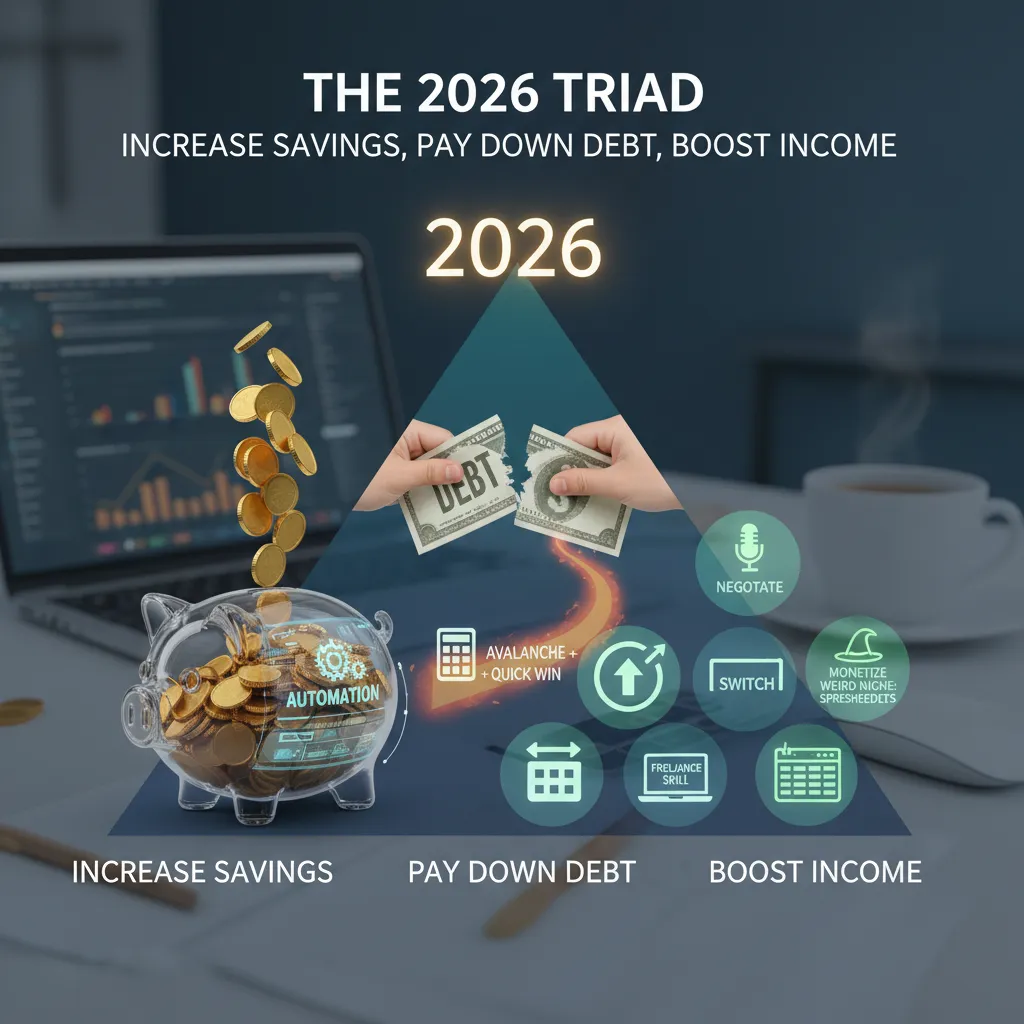
3) The 2026 triad: increase savings, pay down debt, boost income
If I could go back, I’d stop treating savings like leftovers. In 2026, I’m treating it like a bill I owe my future self. Automation is my blunt instrument: the money moves before I can “accidentally” spend it. When rates are still high and prices feel sticky, the goal isn’t perfection—it’s reliable progress.
Increase savings (without relying on willpower)
I set one default rule: payday equals transfer day. Even small amounts add up when they’re consistent.
- Auto-transfer to a high-yield savings account the same day you get paid.
- Start with a “too easy to fail” number (like 1%–3%), then raise it after each raise or bonus.
- Keep a separate buffer for bills so you don’t raid savings when timing gets weird.
Pay down debt (it’s emotional math)
Debt payoff looks logical on paper, but it’s really motivation management. I like a hybrid: avalanche (highest APR first) plus a few quick-win micro-debts to keep momentum. That mix helps me stay in the game long enough for the math to work.
- List balances, APRs, and minimums.
- Pay minimums on everything.
- Attack the highest APR, but knock out one tiny balance early if you need a win.
My rule: if a small debt can be cleared in 30–60 days, I’ll sometimes clear it first—then go right back to the highest APR.
Boost income (without burnout)
Boosting income doesn’t have to mean working 80-hour weeks. In my experience, the fastest wins come from leverage: negotiating, switching roles, or selling one skill. I once monetized a weird niche—spreadsheets. People will pay for clarity.
- Negotiate: bring numbers (results, revenue, time saved).
- Switch: job changes often reset your pay ceiling.
- Freelance one skill: writing, design, analysis, tutoring, ops.
- Monetize a niche: templates, audits, coaching, small retainers.
If interest rates stay annoying for 12 more months
Here’s the spoiler: cash flow becomes king. High APR debt costs more, emergency funds matter more, and variable expenses hurt faster. The triad works because it protects your monthly breathing room: automate savings, reduce interest drag, and widen income so you’re not one surprise bill away from a setback.
4) Investing without drama: asset allocation and a calmer investment strategy
For a long time, I treated investing like a contest. I chased “best” funds, tried to time dips, and refreshed market news like it was a scoreboard. In 2026, my outlook is simpler: I stopped trying to win investing and started trying to stay invested. The truth is, boring is a feature. A calm plan beats a clever plan you can’t stick with.
Do a quick asset allocation gut-check
Before you tweak anything, I do one fast test: How would I react to a 20% drop? If my honest answer is “I’d sell,” then my mix is too spicy. That’s not a character flaw—it’s a signal that my asset allocation doesn’t match my real risk tolerance.
- If a 20% drop makes you panic-sell, consider more bonds/cash and less stock exposure.
- If a 20% drop feels uncomfortable but doable, your mix may be close.
- If you wouldn’t blink, you might be able to take more risk—but only if your time horizon supports it.
Rebalance on a schedule, not on headlines
I used to rebalance when the news got loud. That’s basically letting fear and hype drive my portfolio. Now I rebalance on a schedule—my favorite is the birthday rule: once a year, around my birthday, I check my target percentages and nudge things back into place.
This helps me do the right behavior automatically:
- Review current allocation vs. target allocation.
- Move money from what grew too much into what fell behind.
- Keep changes small and rule-based.
Ask the “advisor question,” even if you DIY
Even when I’m managing my own investing, I borrow a financial-advisor-style question:
“What job is this dollar supposed to do?”
Some dollars are for growth (long-term retirement). Some are for stability (near-term goals). Some are for sleep-at-night money (emergency fund). When I label the job, I stop mixing timelines and I make fewer emotional moves.
If you want a simple reminder, I keep this in my notes:
Goal + Time horizon + Risk tolerance = Asset mix I can stick with
5) Tax advantaged moves I wish I’d made sooner (retirement accounts + health savings)
For years, maxing retirement accounts felt impossible. I told myself I’d “do it later” when I made more. What finally changed things was treating my retirement contribution like a bill I owe Future Me. Just like rent or utilities, it became non-negotiable. Once it was automated, I stopped debating it every month.
My simple target: 12–15% (including the match)
A guideline that helped me was aiming for 12–15% of my salary going toward retirement savings, including any employer match. That number gave me a clear goal without needing a perfect plan. If I couldn’t hit it right away, I worked up to it in steps.
“I don’t try to ‘find’ money for retirement. I decide the percentage first, then build my spending around what’s left.”
Use tax advantaged accounts on purpose
Once I understood how much taxes quietly eat, I started using tax advantaged accounts more strategically. Here’s the order I wish I’d followed sooner (your situation may vary):
- 401(k) or 403(b) up to the employer match (free money is hard to beat).
- HSA (if eligible with a high-deductible health plan).
- IRA (Traditional or Roth, depending on income and tax goals).
- Back to the 401(k) to increase contributions toward my target.
The HSA deserves special attention. If you qualify, it can be a powerful “health savings” tool because it can offer a triple benefit: contributions may reduce taxable income, growth can be tax-free, and qualified medical withdrawals can be tax-free. I used to ignore it because it felt like “another account.” Now I see it as part of my long-term plan.
The tiny habit that made it easy
The most effective move I made was small: I bumped my 401(k) contribution by 1% every time I got a raise. I barely noticed the change in my paycheck, but over a few years it added up fast. If you want a simple rule, try:
new_contribution_rate = old_rate + 1%
It’s not flashy, but it’s consistent—and consistency is what made the biggest difference for me.
6) The grown-up stuff: estate numbers, financial services, and asking for help
If your finances got complicated fast, that’s not a character flaw—it’s just adulthood (and paperwork). The moment you add a partner, a house, kids, a side business, or aging parents, money stops being “budgeting” and starts being “systems.” In my 2026 financial outlook, I’m treating this part like basic maintenance: not exciting, but it keeps everything else from breaking at the worst time.
The one estate number I want you to remember for 2026
Here’s the headline number I’m keeping on my radar: the federal estate tax exemption is $15M per individual / $30M per couple starting Jan 1, 2026. Most people won’t come close to that, but I still think it matters because it shapes planning conversations, especially if you own a business, have real estate, or expect an inheritance. Even if you’re nowhere near those figures, I like to have my basics in place: updated beneficiaries, a simple will, and a clear list of accounts and passwords stored safely. That’s the grown-up version of “being organized.”
How I think about hiring a financial advisor
When I consider financial advisors, I interview them like I’m hiring for a long-term project—not buying a product. I want to know how they get paid, what they do when markets drop, and what they don’t handle. I also ask how they measure success: is it just investment returns, or does it include taxes, insurance choices, and planning for big life changes? The best fit, in my experience, is someone who can explain decisions in plain language and put recommendations in writing so I can review them later.
Financial services trends I’m watching in 2026
My quick scan of finance trends in financial services is simple: more automation, more personalization, and more reasons to read the fine print. Apps are getting better at auto-saving, auto-investing, and nudging you toward “smart” defaults. At the same time, offers are getting more tailored—sometimes helpful, sometimes designed to sell you something you don’t need. In 2026, I’m slowing down before I click “accept,” checking fees, lockups, and what happens if I want to move my money later.
Most of all, I’m reminding myself that asking for help is a financial skill. If you’re stuck, get a second set of eyes—an advisor, a CPA, an estate attorney, or even a trusted friend who’s good with details. The goal isn’t to know everything. It’s to build a money life that can handle real life.
TL;DR: Set clear financial goals, practice mindful spending, automate saving and debt payoff, invest with sensible asset allocation, and maximize tax advantaged retirement accounts—using 2026 data to stay calm amid rising costs.