Last winter, I watched a “simple” invoice bot melt down because a vendor changed a PDF template. We fixed it the old way—patches, regex, a lot of sighing. Two months later we tried an AI-augmented approach: the same workflow, but the system could *recognize* what changed, ask a clarifying question, and route exceptions before they hit the queue. The surprising part wasn’t that it worked—it was how it changed my day. Less whack‑a‑mole, more steering. That’s what this post is about: not hype, but the slightly messy, very real results of AI transforming automation operations.
1) The day I stopped babysitting bots (AI automation value)
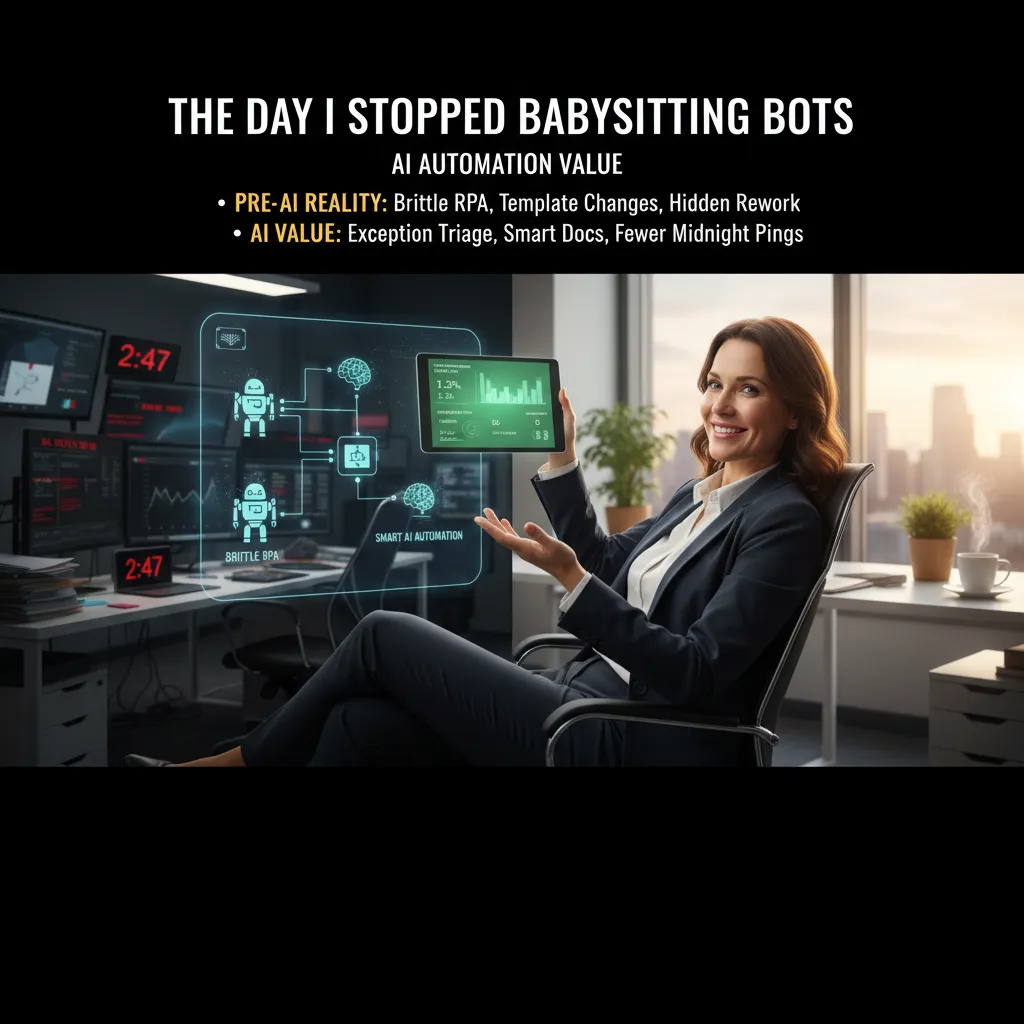
Before we got serious about AI automation value, my “automation operations” job was mostly babysitting. Our RPA bots were brittle. One vendor would change a PDF template, a portal button would move, or a column name would shift, and the bot would fail in a way that looked small but caused big delays.
Worse, our dashboards stayed green. The bot technically “ran,” so the status looked fine. But behind the scenes, analysts were doing manual rework: copying fields, fixing mismatched totals, and re-uploading documents. The work didn’t disappear—it just moved into hidden corners.
What changed when AI entered the workflow
The biggest shift was exception triage. Instead of dumping every failure into one queue, the system started grouping issues by cause and confidence. It could tell the difference between “missing page,” “new layout,” and “data conflict,” and route each case to the right person with context.
We also added smarter document understanding. The automation stopped depending on one rigid template and started extracting meaning across variations. That alone cut the “template change panic” that used to hit every month.
And yes, the midnight pings dropped. Not to zero, but enough that I could finally sleep without my phone on loud.
The ops metrics I track now (small, realistic, useful)
- Exception rate: exceptions per 100 transactions
- Handoff time: minutes from bot stop to human start
- Rework minutes: time spent fixing “completed” items
- Compliance flags: missing approvals, mismatched IDs, policy breaks
The human part mattered more than I expected
When analysts started trusting the system, they stopped building shadow spreadsheets “just in case.” That trust came from transparency: showing why the AI made a call, and making it easy to override with a reason.
AI in ops feels like switching from paper maps to GPS… until the GPS sends you into a lake, so you still learn the roads.
That’s how I think about it now: AI handles the routing, but we still keep operational judgment close.
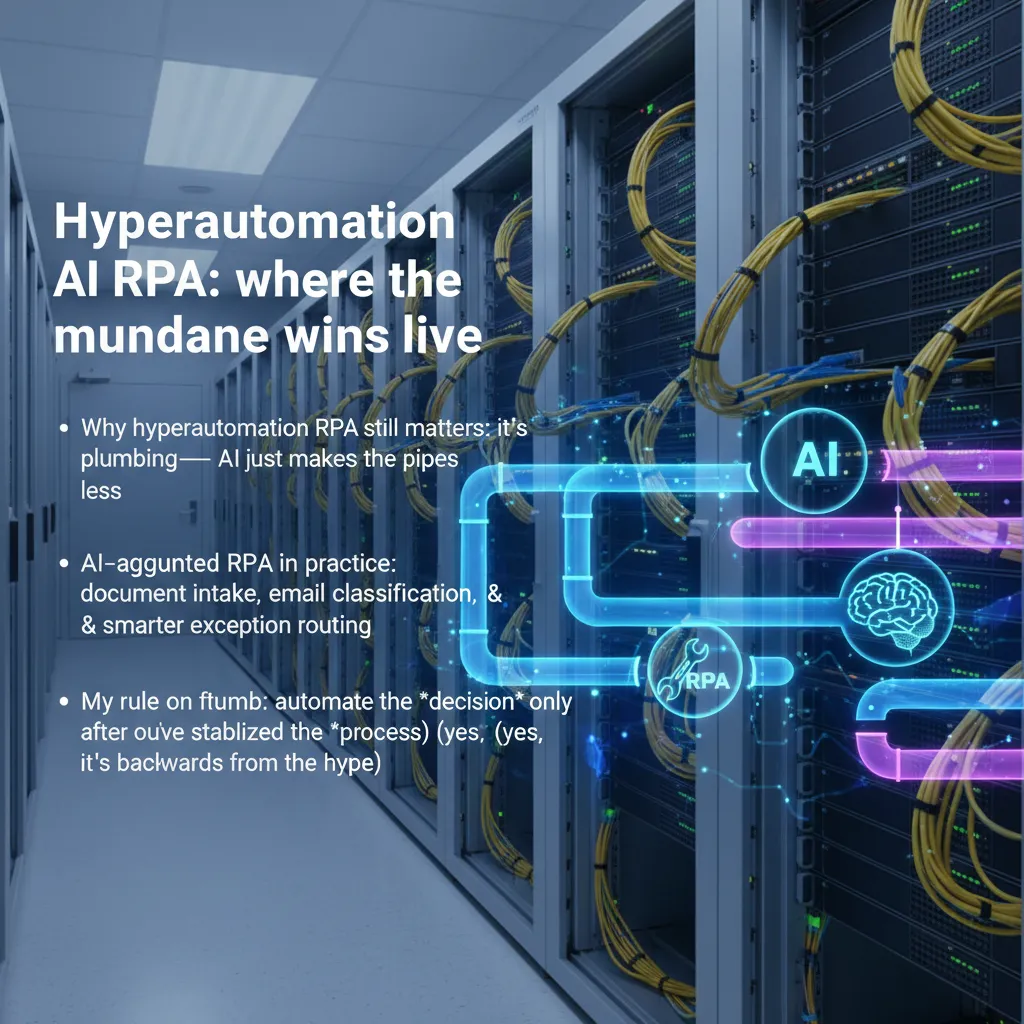
2) Hyperautomation AI RPA: where the boring wins live
In 2026, I still see hyperautomation and RPA delivering the most reliable ops wins. It’s not flashy, but it’s the plumbing. AI doesn’t replace the pipes—it just makes them leak less. In the source story (“How AI Transformed Automation Operations: Real Resultsundefined”), the biggest gains came from tightening the everyday handoffs, not chasing a fully autonomous dream.
Why RPA still matters (even with AI everywhere)
Most operations work is repetitive: moving data, checking fields, routing tasks, logging actions. RPA is built for that. When I add AI on top, I’m usually improving inputs and exceptions, not rewriting the whole workflow.
- Document intake: OCR + AI extraction to pull invoice numbers, totals, and vendor names.
- Email classification: AI tags messages (invoice, dispute, change request) so bots start the right flow.
- Smarter exception routing: AI suggests who should handle edge cases based on history and rules.
My rule of thumb: stabilize the process first
Here’s my unpopular take: automate the decision only after you’ve stabilized the process. Yes, it’s backwards from the hype. If the steps are messy, AI just makes you fail faster. I start with clear inputs, clear owners, and clear “done” states. Then I let AI help with judgment calls.
“If you can’t explain the workflow to a new hire, you shouldn’t ask a model to run it.”
The low-key lesson: boring engineering is sexy again
AI-augmented RPA breaks in new ways, so I treat automation like software:
- Version control for bot scripts and prompts
- Test data that covers normal cases and weird cases
- Rollback plans when a model update changes behavior
Example workflow: AP invoice
- AP invoice arrives via email or portal
- Validation checks PO match, totals, tax, vendor ID
- Human-in-the-loop handles edge cases (missing PO, duplicate, unclear line items)
- Audit trail logs every touch: bot actions, AI suggestions, human approvals
3) Low code democratization: the “good chaos” phase
In 2026, the biggest ops shift I saw was low-code democratization. AI automation stopped being “a platform team thing” and became something ops managers, analysts, and coordinators could build in a week. That speed was real—and it matched what I pulled from How AI Transformed Automation Operations: Real Results: teams moved faster when the builders were closest to the work.
What I saw: faster builds, plus a tiny zoo
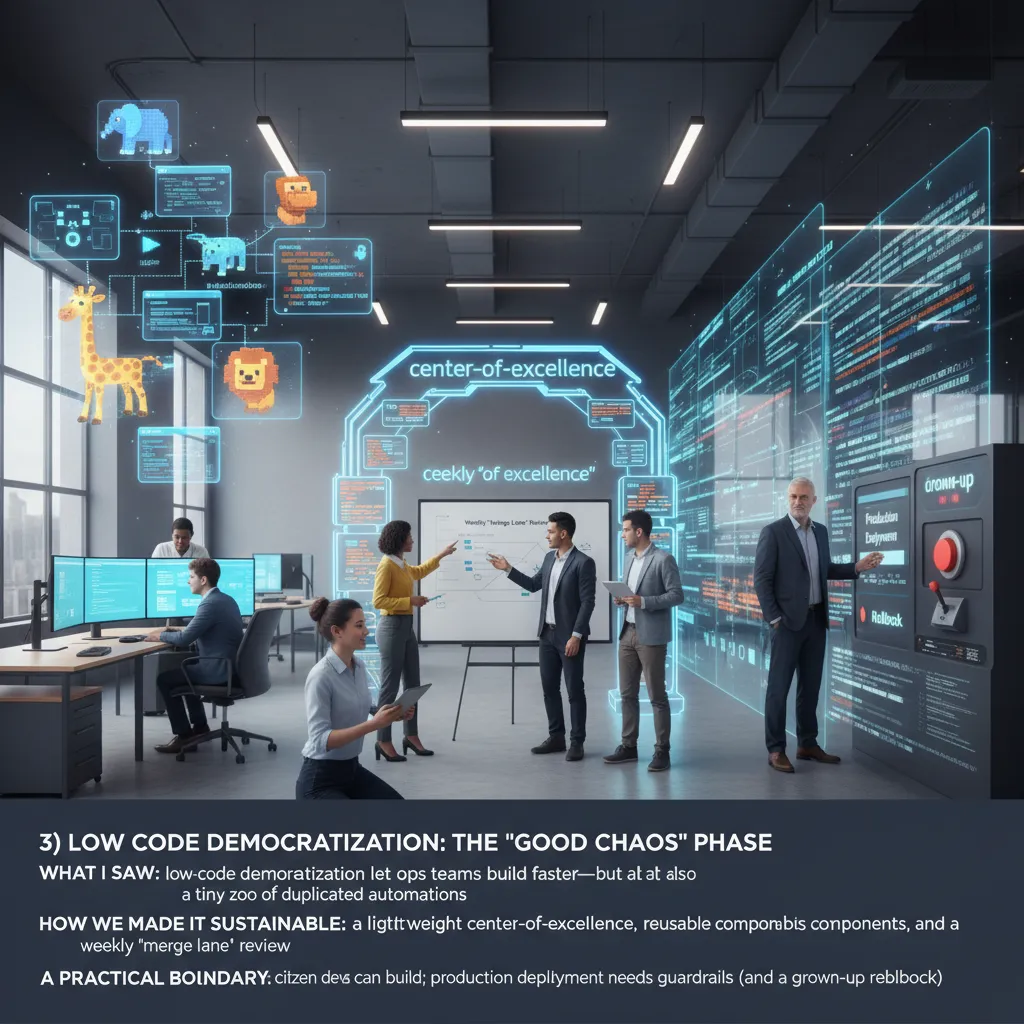
The downside showed up fast: we created a small zoo of duplicated automations. Three teams built three “invoice follow-up” flows. Two versions used different prompts. One wrote to the CRM, one didn’t. Nothing was “wrong,” but the sprawl made support and reporting messy.
How we made it sustainable
We didn’t fix it with heavy process. We fixed it with a lightweight center-of-excellence and a simple weekly rhythm.
- Reusable components: shared connectors, prompt templates, logging blocks, and approval steps.
- Weekly “merge lane” review: 30 minutes to de-duplicate, rename, and decide what becomes a shared standard.
- One place to find things: a short catalog with owner, purpose, inputs/outputs, and last updated date.
A practical boundary: build freely, deploy with guardrails
My rule became: citizen devs can build; production deployment needs guardrails. That meant versioning, access control, and a grown-up rollback plan. Even a basic rollback note helped:
Rollback: disable Flow v3, re-enable Flow v2, replay failed items from queue
Quick scenario: great until compliance asks for logs
A sales ops lead built an AI lead-gen flow plus an AI email marketing flow. It worked—pipeline moved. Then compliance asked for message logs, consent proof, and who approved the copy. We had results, but no audit trail. After that, we made logging a reusable component and required it for production.
When non-technical teams can build, they finally own the process pain—and they fix it.
4) Agentic AI platforms: my “wait… it can do that?” moment
My “wait… it can do that?” moment came when I stopped thinking about AI as a chatbot and started seeing it as a goal-seeking teammate with tools. In our automation operations work, that shift mattered. A chatbot answers. An agentic AI platform can take a goal like “stabilize the service,” then pull logs, check runbooks, open a ticket, and ask for approval before it changes anything.
How I explain agentic AI to a colleague
I describe it like this: less chat, more doing. The agent has access to approved systems (monitoring, ITSM, knowledge base, CI/CD) and follows guardrails. It doesn’t just suggest steps—it can execute multi-step workflows and keep a clear audit trail.
Where I’ve seen real ops value
- Incident triage: It groups alerts, spots likely root causes, and drafts the first response with context.
- Knowledge search: It finds the right runbook or past incident faster than manual searching, especially during noisy outages.
- Workflow execution with approvals: It can run a playbook end-to-end (restart, scale, rollback) but pauses at “human check” gates.
“The win wasn’t magic. The win was fewer handoffs and faster, consistent steps under pressure.”
The trap: shaky data modernization makes agents risky
Here’s the part that can hurt: if your enterprise data modernization work is weak—messy CMDB, outdated runbooks, missing ownership—agents can hallucinate confidently. In ops, confident wrong answers are worse than “I don’t know.” I’ve learned to treat data quality, permissions, and source-of-truth alignment as agent readiness, not “nice to have.”
Operating models are being reinvented
Agentic AI platforms push new ways of working:
- Agent supervisor to review decisions, tune guardrails, and handle exceptions
- Workflow designer to turn tribal knowledge into safe, repeatable flows
- New SLAs for “agent-handled” vs “human-escalated” work, plus clearer escalation paths
Wild card: the 70% night shift
If an agent handles 70% of night tickets, humans don’t disappear—they get time back. I’d use that reclaimed time for problem management, cleaning up runbooks, reducing alert noise, and fixing the repeat offenders that keep waking everyone up.
5) Physical AI market & robotics: the next ops frontier (and a little intimidating)
In the source story, the biggest shift wasn’t another dashboard or chatbot. It was AI leaving the screen and showing up in warehouses, plants, and fleets. That’s why the physical AI market matters to automation ops: once sensors, robots, and edge models are in the loop, ops teams stop “optimizing clicks” and start optimizing movement, time, and risk.
Why this matters for automation ops
Physical AI changes what “automation” means. Instead of routing tickets faster, we can reduce pick errors, shorten changeovers, and catch failures before they become downtime. In practice, it forces tighter links between IT, OT, and service ops—because a model that’s wrong in the real world can break equipment or hurt someone.
Manufacturing AI gains: where the money is
From what I’ve seen in real ops results, the wins come from boring goals: uptime, throughput, and quality. Clever demos don’t pay the bills if the line still stops. The best manufacturing AI programs treat models like maintenance assets: monitored, versioned, and tied to clear KPIs.
- Predictive maintenance that reduces unplanned stops
- Vision inspection that catches defects early
- Energy optimization that trims peak usage without hurting output
Autonomous vehicles & robotics connect field ops
Autonomous vehicles revenue is not just about “self-driving.” It’s also about service operations: dispatch, remote assist, parts logistics, and compliance. Robotics does the same inside facilities—moving goods, scanning inventory, and supporting safer workflows—so field operations and service desks share one operational picture.
My skepticism (and why it’s still exciting)
I’m bullish, but cautious. LLMs are hitting diminishing returns for many ops tasks. Robotics progress feels less like magic and more like an engineering grind: calibration, edge cases, safety, and integration.
A grounded takeaway
Start by mapping processes that touch the physical world:
- Inventory counts, location accuracy, shrink
- Maintenance triggers, work orders, spare parts
- Safety checks and incident reporting
6) Risk, compliance, and the unglamorous checklist I now swear by
In our 2026 AI automation ops push, the biggest “surprise” wasn’t model quality—it was risk and compliance. In the source story (How AI Transformed Automation Operations: Real Results), the wins stuck only after we treated governance like part of the build, not a late-stage review.
What broke first: retention, audit trails, and silent model changes
Three things failed fast. First, data retention: we didn’t have a clear rule for how long prompts, outputs, and decision logs should live. Second, audit trails: we could not reliably answer “who approved this automation and when?” Third, model changes without sign-off: a vendor update and a “small” prompt tweak changed outcomes, but our process didn’t require formal approval.
AI risk governance in plain language
I now keep governance simple enough that ops teams actually follow it:
- Who can deploy: only named owners with a change ticket and a rollback plan.
- What gets logged: input source, model/version, prompt/version, output, confidence, and the final action taken.
- How exceptions are reviewed: weekly review of overrides, escalations, and any policy flags, with a documented decision.
Safety metrics I actually track
Accuracy is not enough. These are the three metrics that tell me if automation operations are safe and stable:
- False-positive escalations: how often the system panics and routes normal work to humans.
- Policy violations: any output that breaks data handling, access rules, or regulated language.
- Automation reversal rate: the percent of automated actions we undo later (refunds, reopens, rework).
Healthcare AI as a warning and a promise
Healthcare AI usage is both. It’s a warning because sensitive data makes mistakes expensive. It’s a promise because it forces better habits: tighter access, clearer logs, and stronger review. I borrow those habits even when I’m not in a regulated domain.
Personal rule: if we can’t explain it to audit in 10 minutes, it’s not ready for production.
7) Conclusion: AI’s next act is ops (2026 AI trends & what I’m betting on)
Looking back at the real results in How AI Transformed Automation Operations: Real Results, the biggest shift wasn’t “more bots.” It was a mindset change: we moved from bot babysitting to systems thinking. AI didn’t magically make operations calm overnight. It made ops more strategic—because we finally had better ways to spot patterns, predict failures, and reduce the messy edge cases that used to eat our time.
My three bets for 2026 AI automation trends are simple. First, I’m betting on enterprise data modernization. If your data is scattered, stale, or locked in silos, AI will only automate confusion faster. Clean pipelines, shared definitions, and reliable event logs are still the foundation of AI operations. Second, I’m betting on choosing agentic AI platforms carefully. Agents can plan and act, but that also means they can create new risk. I want platforms that show their steps, support human approval, and make it easy to test changes. Third, I’m betting on standardized governance early—before scale. The teams that win will treat prompts, policies, access, and audit trails like real production assets, not side notes.
I also want to be honest about jobs. AI does shift work. Some tasks shrink, some disappear, and new ones show up fast. In my experience, the people who learn workflows + AI become the glue: they translate business intent into automation, keep exceptions under control, and help teams trust the system.
If I were starting Monday morning, I’d pick one process, measure it brutally, and map where exceptions happen. Then I’d add AI only where it reduces exceptions or speeds decisions without adding risk. Once it’s stable, I’d scale the pattern across similar workflows.
In the end, the best ops automation feels invisible—like clean water from a tap; you only notice when it’s gone.
TL;DR: AI transformed automation operations by shifting work from brittle scripts to resilient, exception-aware systems. In 2026 AI trends, the biggest wins come from hyperautomation + AI-augmented RPA, low-code democratization, and agentic AI platforms—paired with serious AI risk governance and compliance planning. The market signals are loud: AI growth is accelerating, physical AI is coming fast, and operating models must be reinvented to capture AI automation value.