
A few months ago I watched a “simple” month-end close turn into a three-day scavenger hunt: a missing invoice, a spreadsheet someone renamed, and an audit question that landed at 4:57 p.m. That week pushed me to stop collecting shiny demos and start comparing AI finance tools the way we really use them—under time pressure, with messy data, and with someone inevitably asking, “Can you prove why the model said that?” This post is my human, slightly opinionated rundown of the platforms that keep coming up in 2026 conversations.
1) My “Week-from-Hell” test for AI Finance Tools
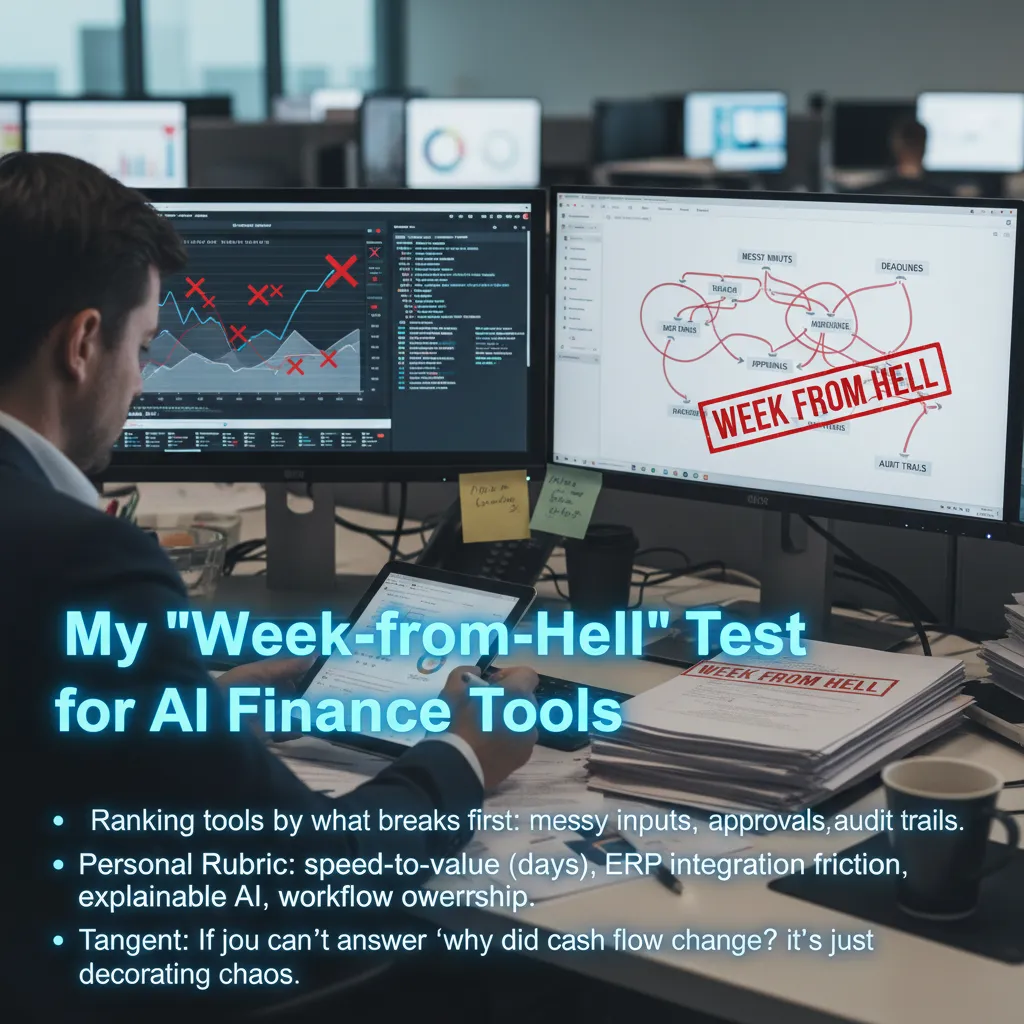
When I compare AI finance tools, I don’t start with feature lists. I start with what breaks first in real life: messy inputs, tight deadlines, approval chains, and the audit trail nobody remembers until month-end. My “Week-from-Hell” test is simple: I recreate the kind of week where the data is late, the numbers don’t tie, and leadership still wants answers.
My personal rubric (what I score first)
I rank tools using four checks that come up again and again in AI-powered finance software comparisons:
- Speed-to-value: Can I get a useful output in days, not quarters?
- ERP integration friction: How painful is it to connect to the ERP, map accounts, and keep it stable?
- Explainable AI: Can the tool show drivers, assumptions, and logic—not just a number?
- Workflow ownership after go-live: After implementation, does Finance own it, or do I need IT/consultants for every change?
A quick tangent on “explainable”
If a tool can’t answer “why did cash flow change?” in plain English, it’s not helping—it’s just decorating chaos.
I’m not looking for perfect predictions. I’m looking for clear cause-and-effect: timing shifts, working capital moves, one-time payments, and forecast assumption changes that I can defend in a meeting and in an audit.
Mini-scorecard categories I’ll use
To keep the comparison consistent, every tool in my 2026 shortlist gets scored in these buckets:
- Predictive Analytics: forecast quality, scenario planning, driver-based modeling
- Compliance Tools: controls, permissions, audit logs, evidence capture
- No-code Customization: rules, dashboards, workflows without heavy engineering
- Real-time Analysis: refresh speed, live variance views, alerting
Wild-card thought experiment
If my CFO asked for a forecast revision in 20 minutes, what survives? The winner isn’t the tool with the most charts—it’s the one that can ingest messy updates, route approvals, explain changes, and leave a clean audit trail.
And to be clear: I’m not crowning one “best platform.” I’m matching tools to jobs.
2) No-code Automation & AI Reconciliation: where StackAI fits
I like starting my 2026 finance tools shortlist with no-code automation because it’s the fastest way to AI-enable real workflows without waiting for a backlog miracle from engineering. When the close is tight, the best tool is the one the finance team can actually change on their own—without breaking controls.
Why StackAI stands out for finance workflows
StackAI fits this lane because it lets me build finance workflows with auditability and seamless integrations. That matters for repeatable close tasks (like daily cash checks, accrual support, and variance notes) and for exception handling when something doesn’t match and a human needs to step in. In the “Top Finance Tools Compared: AI-Powered Solutions” view of the market, this is the sweet spot: automation that still respects finance rules.
Where AI reconciliation actually helps
AI reconciliation is most useful when it reduces the boring, error-prone matching work while leaving a clean trail behind. I’ve seen it help with:
- Matching transactions across bank feeds, ERP entries, and subledgers
- Flagging anomalies (duplicates, odd timing, unusual amounts)
- Producing an audit trail so later questions have clear evidence
The “oops” I made (so you don’t)
I once automated a reconciliation flow before defining the approval path. The result was fast chaos: items moved quickly, but nobody knew who owned the final sign-off. Lesson learned: map the process first (owners, thresholds, approvals), then automate.
Key features I check for
- ERP integration (and stable connectors)
- Data consolidation across sources into one view
- Role-based access controls for reviewers vs. preparers
- Logging that doesn’t vanish (timestamps, changes, decisions)
When I skip no-code automation
If your data is scattered and ownership is unclear, I pause. Otherwise, you’ll just automate confusion at scale—and the close will feel “faster” while getting less reliable.
3) Predictive Analytics for Financial Forecasting (DataRobot + Planful)
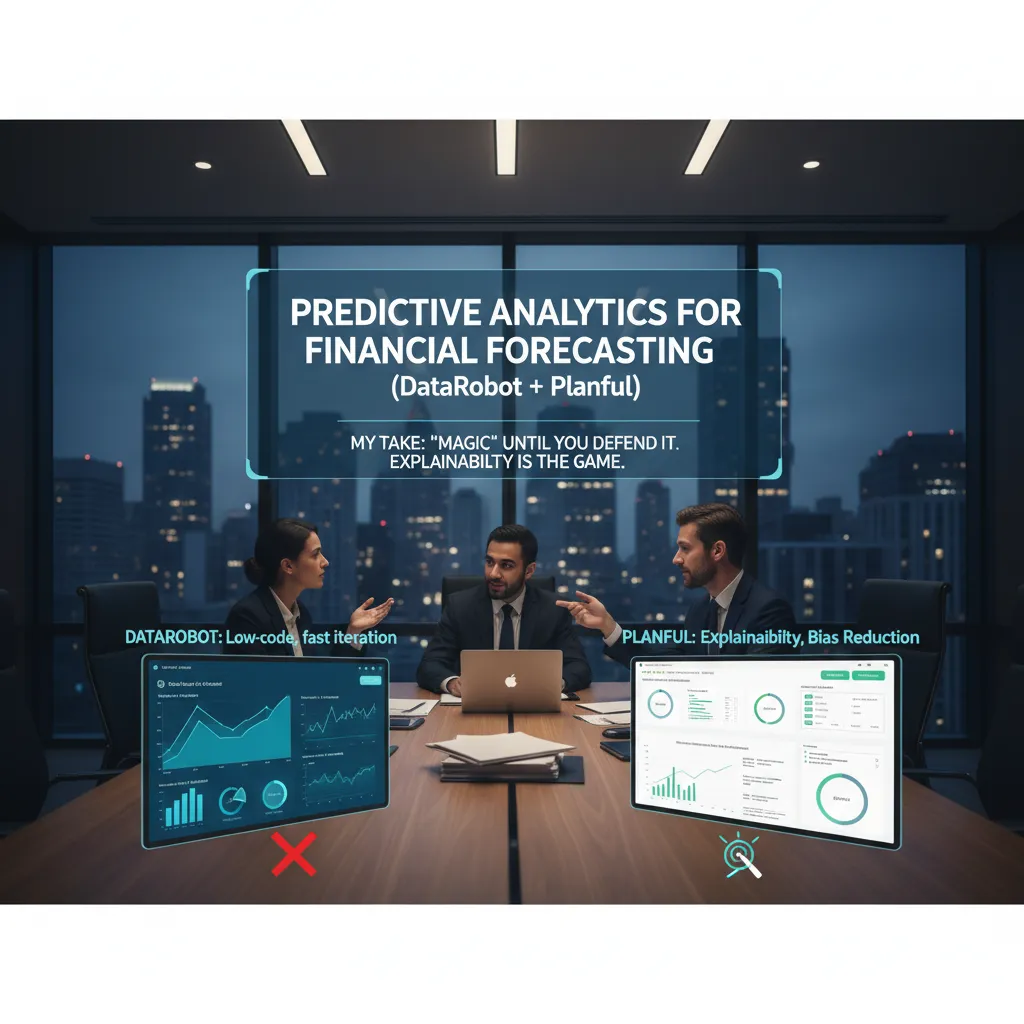
My take: Predictive Analytics is only “magic” until you have to defend it in a budget meeting—then explainability becomes the whole game. In my 2026 shortlist, I keep coming back to two different styles of AI-powered forecasting: DataRobot for fast model building, and Planful for FP&A-friendly projections you can actually talk through.
DataRobot: low-code forecasting when speed matters
DataRobot is my pick when I need predictive analytics quickly and I expect to iterate. It’s strong for cash flow forecasting and anomaly detection—the “something looks off” moments that can save a month-end close from becoming a fire drill. I like that it’s low-code: I can test different model approaches without waiting weeks for a full data science cycle.
Planful: explainable AI for FP&A (and fewer fights)
Planful feels built for the real world of FP&A. Its Predict signals and ML-driven projections aim to reduce bias and make the forecast easier to defend. In practice, that means less arguing about whose spreadsheet is “right,” and more time spent on the drivers that actually move the numbers.
What I look for in financial forecasting
- Cash flow forecasting accuracy (not just revenue accuracy)
- Scenario toggles I can switch in seconds (base, downside, upside)
- A clean link back to drivers—headcount, pricing, churn, DSO—not vibes
A quick hypothetical I use to test tools
Sales dips 8% next quarter. How fast can the model show the cash impact, and what assumptions did it use (collections timing, gross margin, spend elasticity)? If I can’t explain the “why” in plain language, I don’t trust the “what.”
Small practical note: overrides and audit trails
Decide upfront who can override forecasts and how overrides are logged. I want a clear audit trail: what changed, who changed it, when, and why. That’s the difference between AI forecasting that helps and AI forecasting that creates new risk.

4) Credit Risk Automation & Loan Origination AI (Zest AI vs Upstart)
Credit risk automation is where AI can help—or hurt—fast, so I treat governance like a first-class feature. In my 2026 shortlist, I look for tools that don’t just “score” borrowers, but also explain decisions, track model health, and support audits. This is the difference between a smart system and a risky one.
Zest AI: underwriting ML with a bias-and-accuracy promise
Zest AI is best framed as automated credit underwriting using machine learning. The pitch (and the point) is that better models can improve accuracy while also reducing bias—especially compared to rigid, legacy scorecards. When I evaluate Zest AI-style credit underwriting automation, I focus on whether the platform helps teams test outcomes across groups, document model changes, and keep decision logic consistent across channels.
Upstart: loan origination AI beyond traditional credit scores
Upstart is often positioned as loan origination AI that goes beyond traditional credit scores. The goal is straightforward: approve more loans with fewer defaults by using more signals and smarter risk models. In practice, I think of Upstart as a system that tries to expand access while keeping loss rates in check—useful, but only if the “why” behind approvals and declines is clear enough for regulators and customers.
What I’d ask in a demo (my governance checklist)
- Bias measurement: How do they measure bias, and what fairness metrics are standard?
- Retraining cadence: How often do models retrain, and what triggers an emergency update?
- Human control: What can a human underwriter override, and how is that override logged?
- Drift monitoring: How do they detect drift in data, performance, and approval rates?
Ethical aside: “approve more” is not automatically good if the reasons aren’t legible to regulators and customers.
The practical output I want from either Zest AI or Upstart is simple: clearer credit risk assessment, faster decisions, and better monitoring for drift—without turning compliance into an afterthought.
5) Financial Crime Detection & Compliance Tools (SymphonyAI)
This is the section where I stop being cute and get serious: false positives cost teams nights and weekends. If your alert queue is noisy, good analysts burn out, real risk hides in plain sight, and the business starts treating compliance like a fire drill instead of a system.
In my 2026 shortlist, SymphonyAI stands out as a vertical AI option for financial crime detection, AML, and regulatory compliance. It’s built for the classic “needle in a haystack” problem—finding the few truly suspicious behaviors inside millions of normal transactions and relationships.
Where anomaly detection actually shines
For me, the value shows up in three practical areas:
- Unusual transaction patterns: spikes, odd timing, new corridors, or behavior that doesn’t match a customer’s history.
- Entity resolution: connecting people, accounts, merchants, and counterparties even when names, IDs, or addresses don’t match cleanly.
- Risk scoring that updates: scores should change as new data arrives, not stay frozen after onboarding.
My rule of thumb: audit trails beat pretty dashboards
I like clean UI as much as anyone, but regulators don’t grade aesthetics. I prioritize tools that make it easy to explain why an alert fired and what the analyst did next. If I can’t export a defensible record, the “AI” isn’t helping.
My bias: if it can’t be audited, it can’t be trusted.
A quick incident drill (Friday spike scenario)
Imagine suspicious payments spike late Friday. My test questions are simple:
- How fast can we triage and cluster related alerts?
- Can we document decisions with consistent reasons and evidence?
- How quickly can we file the right report with the right fields?
What “good” looks like is fewer false positives without missing real risk, plus a clear, defensible story for every alert—who/what/when/why—ready for internal review or an examiner.
6) AI Investing Platforms: my “don’t-fall-in-love-with-a-chart” lineup
Confession: I once changed an investment strategy because a backtest looked gorgeous. It was a bad week. The chart was smooth, the returns were shiny, and I ignored the boring parts—fees, slippage, and what happens when the market gets messy. Since then, I’ve been picky about AI investing platforms and how they prove their value.
Kavout: systematic screening with AI rankings
Kavout is the tool I reach for when I want AI-powered stock ranking plus backtesting and real-time market monitoring. It’s best for building a repeatable process: screen, rank, review, and then decide. I like it for systematic investors who want signals that can be checked against fundamentals and risk rules—not just “hot picks.”
Trade Ideas: fast scans for trade setups
Trade Ideas focuses on scanning markets for trading opportunities using technical indicators and market sentiment analysis. When I’m exploring short-term setups, it helps me spot patterns I’d miss manually. The key is to treat it like a radar screen: it shows movement, but I still confirm the “why” before acting.
Magnifi: conversational AI for portfolio questions
Magnifi is useful when I want answers in natural language, not a 14-tab dashboard. I can ask portfolio-style questions and get guided suggestions. For me, it’s less about day trading and more about clarity: “What am I exposed to?” “How does this fit my goal?”
How I compare AI investing tools (my reality checks)
- Investment analytics depth: rankings, risk metrics, portfolio views, and monitoring.
- Explainability: can I see why the tool likes a stock or setup?
- Paper-trading/backtesting realism: does it account for slippage, liquidity, and timing?
- Ugly-day behavior: what happens in drawdowns, gaps, and high-volatility sessions?
These tools are like GPS—great until you blindly drive into a lake. Use judgment.
7) Spend Management & Autonomous Receivables: the unglamorous ROI (HighRadius)
This is the part of finance I used to ignore because it felt operational—until I saw how cash gets trapped in tiny delays. One late approval, one missing PO, one “we never got the invoice” email, and suddenly the month-end cash story changes. In my 2026 shortlist, that’s why I keep coming back to HighRadius for the order-to-cash side of the house.
Why HighRadius makes “boring” work pay off
HighRadius focuses on autonomous receivables, AI-driven forecasting, and treasury optimization across the order-to-cash process. In plain terms, it helps AR teams decide what to chase first, what will likely slip, and what can be handled with automation instead of endless follow-ups. When I compare AI finance tools, I’m not just looking for dashboards—I’m looking for fewer manual touches and fewer surprises.
Where spend management AI intersects with receivables
Spend management and AR sound like separate worlds, but they collide in real life. Cleaner approvals and better purchasing controls upstream usually mean fewer invoice disputes downstream. When spend management AI tightens workflows, I see better cash visibility once it’s paired with receivables automation—because the “why haven’t you paid?” conversations happen less often, and the right data is already attached to the invoice.
The receivables + treasury lens I actually care about
From a treasury angle, the value is in prioritizing collections, predicting delays, and nudging the right customers at the right time. That’s the unglamorous ROI: not a flashy model, but a calmer cash forecast and fewer fire drills.
If I’m measuring impact, I keep it simple: DSO, dispute cycle time, forecast variance, and percent of cash collected on time. And my final filter is human: the best tool is the one your AR team doesn’t hate using at 8 a.m.—because adoption is the real automation.
TL;DR: If you need workflow and auditability, start with StackAI. For order-to-cash and treasury, HighRadius stands out. For predictive analytics in a low-code vibe, DataRobot is a workhorse. For credit risk automation, Zest AI and Upstart are the names to know. For financial crime detection and compliance tools, SymphonyAI is built for the job. For AI investing platforms, Kavout, Trade Ideas, and Magnifi cover ranking, scanning, and conversational analysis. For FP&A tools 2026, Planful (plus enterprise CPM leaders like Anaplan and Prophix One) brings explainable AI into forecasting—when your data house is in order.