
The first time I tested an AI role-play for a “difficult conversation,” I treated it like a video game. Two minutes in, I realized my habit was saying “just” and “actually” every other sentence—and the tool caught it instantly. That tiny, slightly embarrassing moment is why I’m taking AI leadership development seriously: it notices what my colleagues are too polite to say. In this post, I’m comparing the top leadership technology solutions that do that kind of feedback well—without pretending every platform is magic or that every team needs the same thing.
1) The weird moment AI coached me better than a peer
My “filler-word spiral” in a mock feedback talk
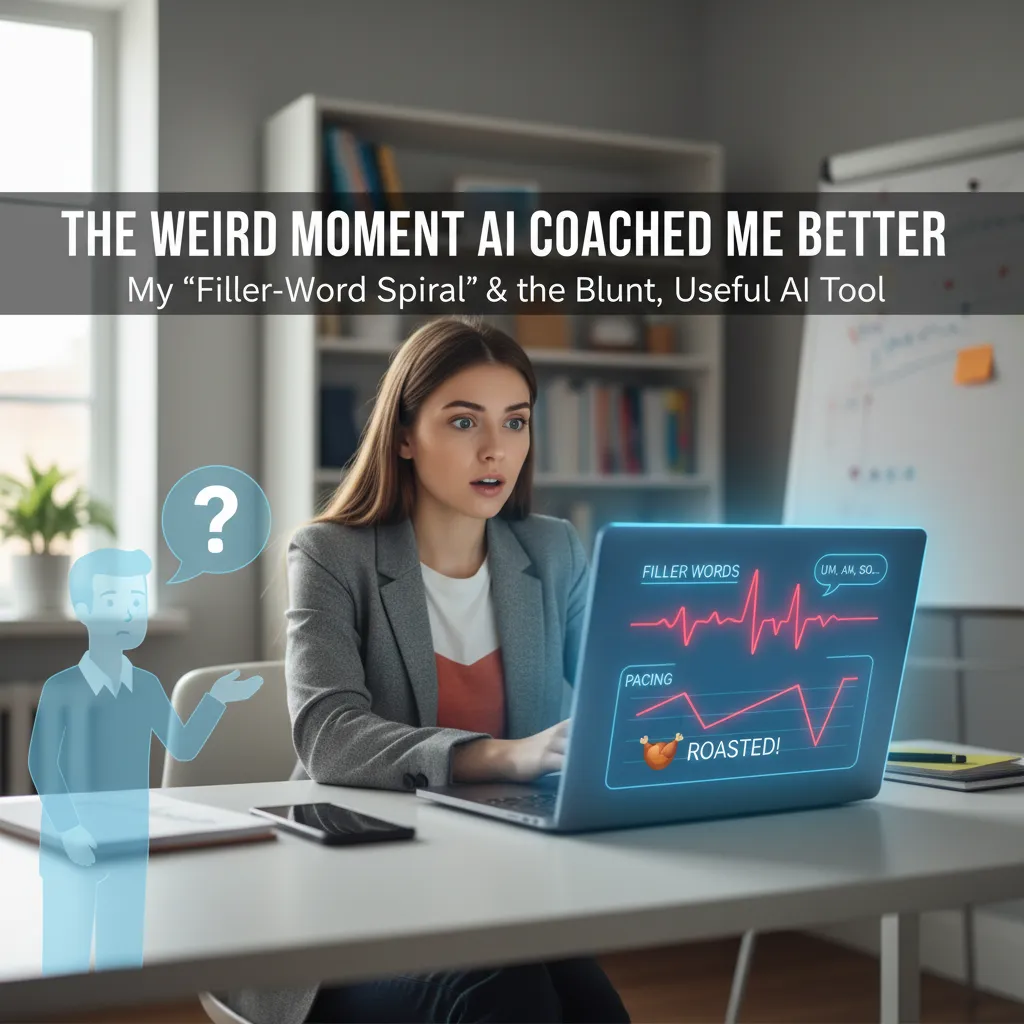
During a practice session for a tough feedback conversation, I hit what I now call my filler-word spiral. I started strong, then the nerves kicked in. Every sentence had “um,” “like,” or “you know.” A peer in the room tried to help, but their notes were broad: “Be more confident” and “Slow down”. Helpful, sure—but not something I could act on in the moment.
Then I tried an AI-powered leadership tool from a “Top Leadership Tools Compared” list—one of those real-time coaching systems that listens to your voice and flags patterns. It was weirdly specific. It didn’t just tell me I was nervous; it showed me where my delivery broke down.
Why real-time feedback feels blunt—but useful
Real-time AI feedback can feel blunt because it doesn’t soften the message. It will tell you, right away, that your pace jumped or your tone flattened. But that bluntness is also the point. In leadership communication, small habits add up fast, and real-time leadership coaching catches them before they become your “style.”
The tool didn’t judge me, but it did roast my pacing
Here’s the tiny tangent: the tool didn’t judge me as a person. No awkward facial expressions. No “I know you’re trying.” It just roasted my pacing with a chart that basically said: you started at 145 words per minute and ended at 190. Ouch. Accurate, though.
“Pace increased 31%. Filler words spiked after the first objection.”
What I look for now: actionable cues, not generic tips
When I compare AI leadership tools, I’m not looking for motivational advice. I want actionable cues I can practice:
- Tone: Did I sound calm, sharp, or defensive?
- Clarity: Did I use short, direct sentences or ramble?
- Empathy: Did I acknowledge the other person’s view before correcting?
- Timing: Where did I interrupt or rush?
That’s the difference for me: AI-powered leadership tools that measure real behaviors beat vague feedback—especially when I’m trying to improve fast.
2) AI leadership tool selection: start with the moment, not the brand
When I compare AI leadership tools, I don’t start with the logo or the “all-in-one” promise. I start with the moment I’m facing. Most “Top Leadership Tools Compared: AI-Powered Solutions” lists blur this, but in real work, leadership happens in short, high-stakes conversations.
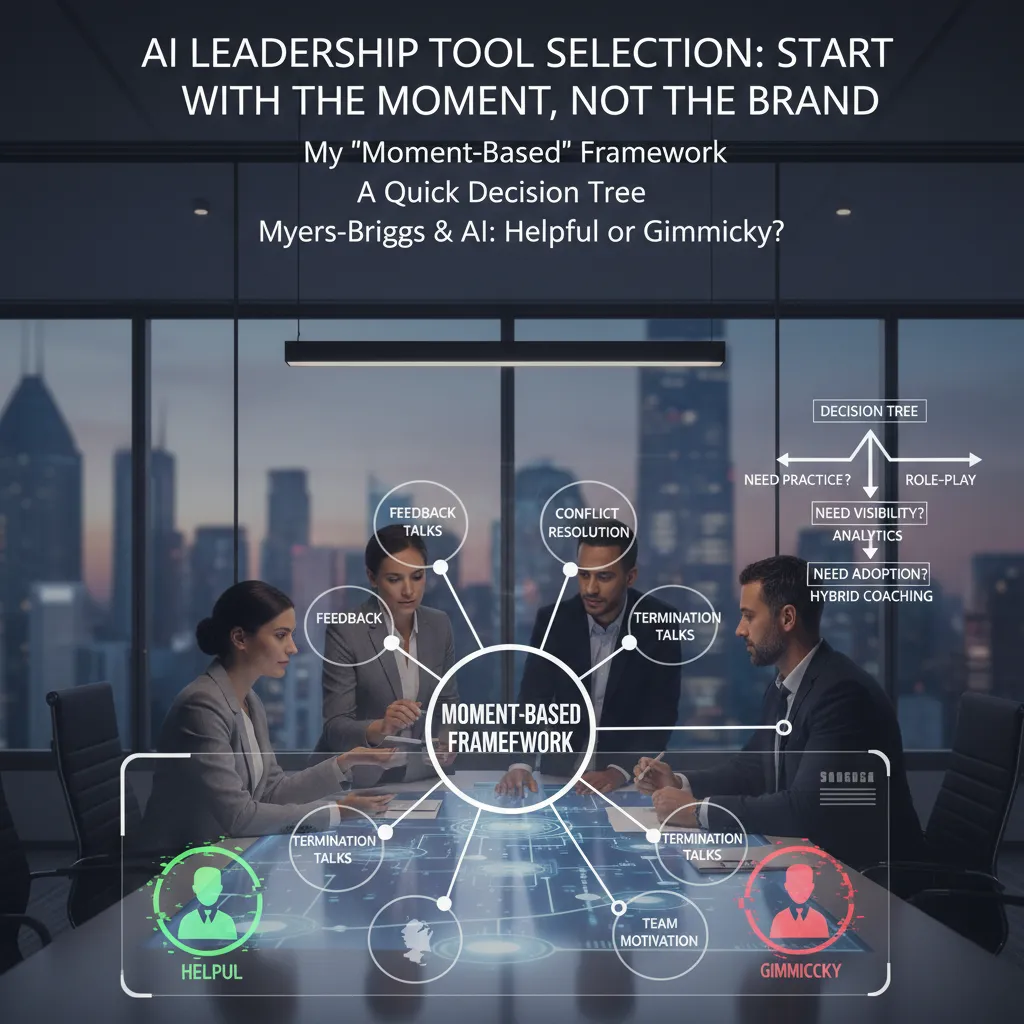
My moment-based framework
- Feedback talks: clarity, tone, and follow-up actions
- Conflict resolution: de-escalation, listening, shared next steps
- Termination talks: legal-safe wording, empathy, structure
- Team motivation: recognition, goals, energy, and trust
A quick decision tree (what you actually need)
I use a simple filter before I pick any AI-powered leadership solution:
- If you need practice → role-play (AI simulations, scripted scenarios, objection handling).
- If you need visibility → analytics (patterns in engagement, meeting load, sentiment, follow-through).
- If you need adoption → hybrid coaching (AI prompts + human coaching + team routines).
Need = practice | visibility | adoption
Then I choose the tool type, not the brand name.
Where Myers-Briggs characters help (and where they get gimmicky)
Some tools use Myers-Briggs-style characters to suggest how to phrase feedback or motivate different people. I find this helpful as a starting script, especially for new managers who freeze in tough talks.
But it turns gimmicky when it becomes labeling: “She’s an INTJ, so she won’t care.” Real leadership is context, not a personality costume. I treat these models as communication hints, not truth.
Scenario: remote manager in Berlin, onboarding across 3 time zones
Imagine I’m managing from Berlin, onboarding teammates in the US, India, and the UK. My “moment” is team motivation plus feedback talks in week one. I’d pick:
- Role-play to rehearse a first 1:1 and set expectations without sounding cold on video.
- Analytics to spot who is missing handoffs due to time-zone gaps.
- Hybrid coaching to turn AI suggestions into a shared onboarding rhythm the team actually follows.
3) The feature checklist I actually use (and the stuff I ignore)
When I compare AI leadership tools, I use a simple checklist from Top Leadership Tools Compared: AI-Powered Solutions. I’m not looking for “wow.” I’m looking for features that help leaders practice, reflect, and improve in a way I can explain to HR and finance.
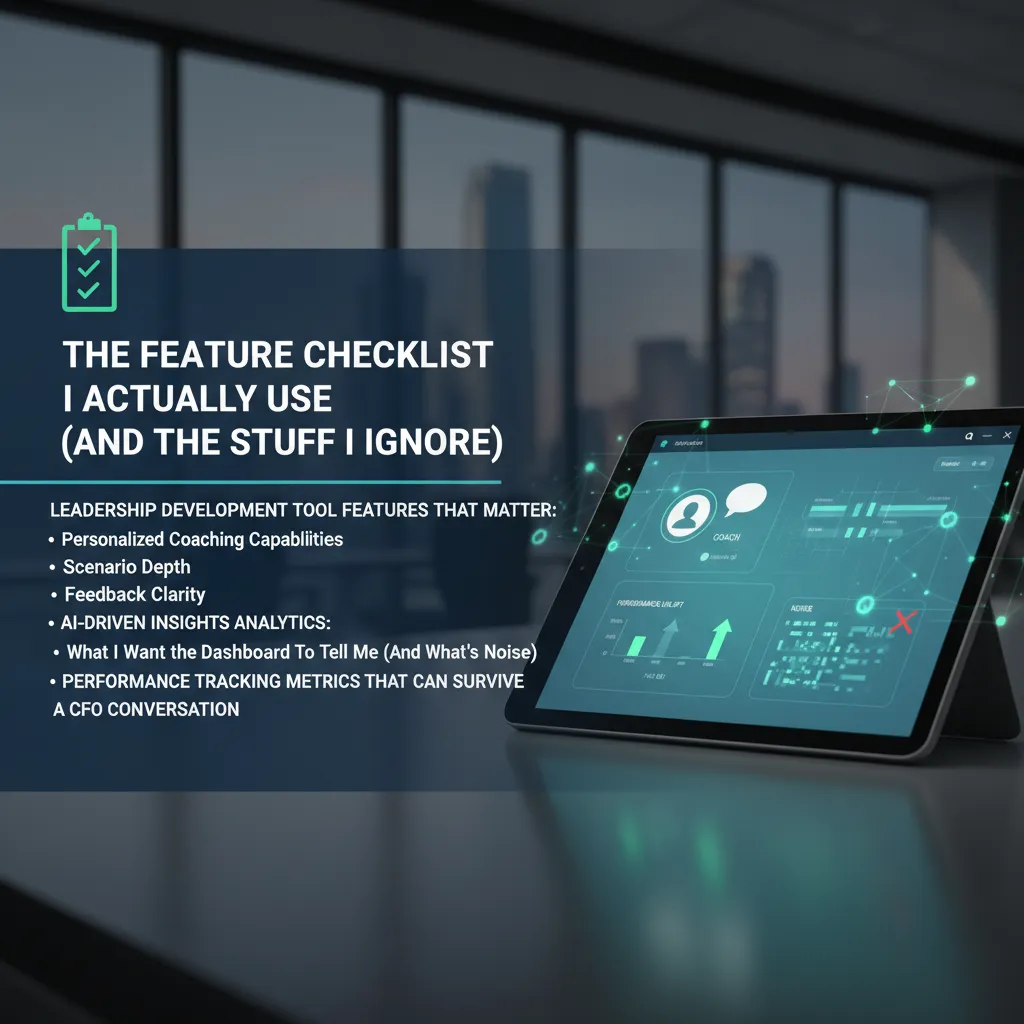
Leadership development features that actually matter
- Personalized coaching: I want the tool to remember my goals, role level, and weak spots, then adjust prompts and practice plans. Generic advice is just a blog post in disguise.
- Scenario depth: Real leadership is messy. I look for branching scenarios (pushback, emotion, trade-offs) instead of one perfect script.
- Feedback clarity: I need feedback that is specific and usable: what I said, why it landed poorly, and what to try next time.
AI insights: what I want the dashboard to tell me (and what’s noise)
Dashboards can be helpful, but only if they answer leadership questions. I want:
- Behavior trends over time (e.g., “interrupting,” “clarifying goals,” “coaching questions”).
- Skill gaps by context (1:1s vs. performance reviews vs. conflict).
- Practice-to-change links: what exercises correlate with better outcomes.
What I ignore: vanity charts, “engagement scores” with no definition, and heatmaps that don’t lead to a clear action.
Metrics that survive a CFO conversation
If I can’t defend it in a budget review, I don’t count it. I look for:
- Time saved (hours of coaching prep, manager enablement).
- Retention and internal mobility signals tied to leadership cohorts.
- Performance cycle impact: fewer escalations, faster goal alignment, cleaner review narratives.
A small rant: “accuracy” claims are useless without context
“95% accurate” means nothing unless I know: accurate at what, on whose data, and with what governance.
I want clear model limits, bias checks, data handling rules, and admin controls. Without that, “accuracy” is marketing, not leadership development.
4) Tool round-up: where each platform ‘wins’ in real life
When I compare AI leadership tools, I try to ignore big claims and focus on the day-to-day use case: What problem does this solve on Monday morning? Below is where each platform tends to “win” in real leadership development work.
- Careertrainer.ai platform: I reach for this when GDPR-first handling and a practical coaching flow matter most. It fits teams that want clear steps, repeatable sessions, and coaching that feels usable, not abstract.
- Retorio behavioral analysis: This is strongest when I want multimodal signals (like voice and video cues) plus structured feedback. It’s useful for leaders who learn best from specific observations and consistent scoring.
- Tenor AI coaching: I consider Tenor when I need EU-minded governance and coaching behaviors that feel aligned with modern people practices. It’s a good match for orgs that care about oversight, safety, and responsible rollout.
- Second Nature roleplay: This wins when role-play at scale is the priority and you need global language support. I like it for sales-adjacent leadership moments (coaching, feedback, tough talks) where practice beats theory.
- Monark leadership intelligence: I use this framing when the need is bigger than one person—org diagnostics plus hybrid coaching vibes. It’s helpful when you want to spot patterns across teams and still support individual growth.
- VirtualSpeech soft skills: This is the pick when practice reps and soft-skill drills are the point. It works well for presentation skills, confidence building, and repeated rehearsal without scheduling a live facilitator.
- Luster predictive enablement: I look here when the goal is skill gap analysis and even prediction across roles. It’s a fit for workforce planning conversations where leaders need to see what skills are emerging and where to invest.
In real life, the “best” AI leadership platform is usually the one that matches your risk rules, your coaching style, and how your people actually learn.
5) Integration with HR systems: the unsexy part that decides adoption
When I compare AI leadership tools, I spend less time on shiny coaching features and more time on integration. In the source material (“Top Leadership Tools Compared: AI-Powered Solutions”), the pattern is clear: tools that fit into existing HR systems and learning workflows get used; the rest become “nice pilots” that fade out.
HRIS + LMS integration: why single sign-on is my hill to die on
If a manager has to create yet another password, adoption drops fast. I push hard for SSO (SAML or OIDC) tied to our identity provider, plus clean links to the HRIS and LMS. The goal is simple: the tool should feel like part of the stack, not a separate destination.
Workflow reality: Slack/Teams nudges beat “log in to another portal”
Most leadership habits are small: a weekly check-in, a feedback prompt, a reminder to prep for a 1:1. I’ve seen better follow-through when the tool can send Slack/Teams nudges, create calendar prompts, or surface a quick action card. “Go log into a portal” is where good intentions go to die.
“If it doesn’t live where managers already work, it won’t get used.”
Data governance: what I ask about storage, retention, and EU servers
AI tools touch sensitive data: performance notes, coaching reflections, sometimes even engagement signals. I ask where data is stored, how long it’s kept, and whether EU data residency is available. I also ask what gets used to train models, and whether we can opt out.
Mini checklist for a security review (I’m not legal counsel)
- SSO supported (SAML/OIDC) + SCIM provisioning for joiners/leavers
- Role-based access controls and admin audit logs
- Data encryption in transit and at rest
- Clear retention policy + deletion process on request
- EU servers/data residency options (if needed)
- Model training policy: what’s used, what’s excluded, opt-out terms
- Security docs: SOC 2/ISO 27001, pen test summary, DPA availability
6) Plan comparison table (and my ‘don’t get trapped by pricing’ rule)
When I compare AI leadership tools, I start with a plan comparison table. I map features to tiers before I look at dollars. This keeps me honest, because “Top Leadership Tools Compared: AI-Powered Solutionsundefined” shows a common pattern: the feature you actually need is often one tier higher than the marketing page suggests.
Plan comparison table (features first, price second)
| Tier | Best for | What you usually get | What’s often missing |
|---|---|---|---|
| Free | Trying the workflow | Basic prompts, limited projects, light templates | Team analytics, exports, admin controls |
| Starter | Solo leaders | More usage, saved playbooks, simple coaching notes | Scenario depth, measurement, integrations |
| Pro/Team | Managers + teams | Collaboration, shared libraries, role-based access | Advanced reporting, governance, SSO |
| Business | Departments | Dashboards, integrations, audit logs | Custom models, deep security reviews |
| Enterprise | Org-wide rollout | SSO, SLAs, data controls, vendor support | Nothing—except your time to implement |
Pricing stratification reality check
Pricing is rarely a smooth ladder. Free → enterprise can be a canyon. The jump is often driven by security, admin, and reporting, not “smarter AI.”
My ‘don’t get trapped by pricing’ rule
I pay for measurement and scenario depth, not for buzzwords.
- Measurement: outcomes tracking, feedback loops, exportable reports.
- Scenario depth: “what-if” planning, decision logs, risk trade-offs.
- Skip: vague labels like “next-gen,” “agentic,” or “executive-grade.”
A quick, made-up budgeting story
I asked finance for a 60-day pilot: 12 managers on a Team plan. I framed it as a test of measurable leadership outcomes: fewer meeting hours, faster decision cycles, and better 1:1 consistency. I showed a simple ROI line: if each manager saves 30 minutes/week, the pilot pays for itself. Finance approved because I tied cost to tracked behavior change, not tool hype.
7) Conclusion: my ‘future me’ note for choosing calmly in 2026
If I’m reading this in 2026, here’s the reminder I’ll need most: the goal was never “AI leadership development.” The goal was fewer messy Mondays. Fewer unclear priorities, fewer tense 1:1s, fewer meetings where everyone leaves with different stories. In the source comparison of AI-powered leadership tools, it’s easy to get pulled into features, dashboards, and big promises. But the real question is simple: does this tool help me lead with less friction and more follow-through?
I also want to keep my head clear about hybrid coaching. AI is great for reps: drafting agendas, summarizing feedback, turning notes into action items, and nudging me to practice hard conversations before I have them. Humans are still better for nuance: reading the room, spotting what’s not being said, and holding me accountable when I’m avoiding the real issue. The best setup isn’t AI versus people. It’s AI for the repeatable parts, and humans for the parts that require judgment, trust, and context.
Here’s my wild card analogy: choosing leadership tools is like choosing running shoes. Specs matter, but fit beats specs. A shoe can have the best foam, the best reviews, and the best marketing, but if it rubs my heel, I won’t run in it. Same with AI leadership platforms. If it doesn’t match my team’s rhythm, my calendar, and my style of communication, it will become shelfware—no matter how “smart” it is.
So my next step is not another comparison spreadsheet. It’s this: pick one scenario (like weekly 1:1s, performance feedback, or meeting follow-ups), run a short pilot, review metrics, and decide. I’ll track time saved, adoption, quality of conversations, and whether outcomes actually improve. Then I’ll either scale it, swap it, or stop. Calm choices, real data, fewer messy Mondays.
TL;DR: AI leadership development tools are maturing fast in 2026: look for strong scenario libraries (14–150+), real-time feedback, measurable performance tracking analytics, and clean HR systems integration. If you’re in the EU, prioritize GDPR compliant platforms and EU AI Act readiness. Hybrid AI + human coaching models tend to stick better. Pick the tool that matches your leadership moments (feedback, conflict, termination talks), not the fanciest demo.