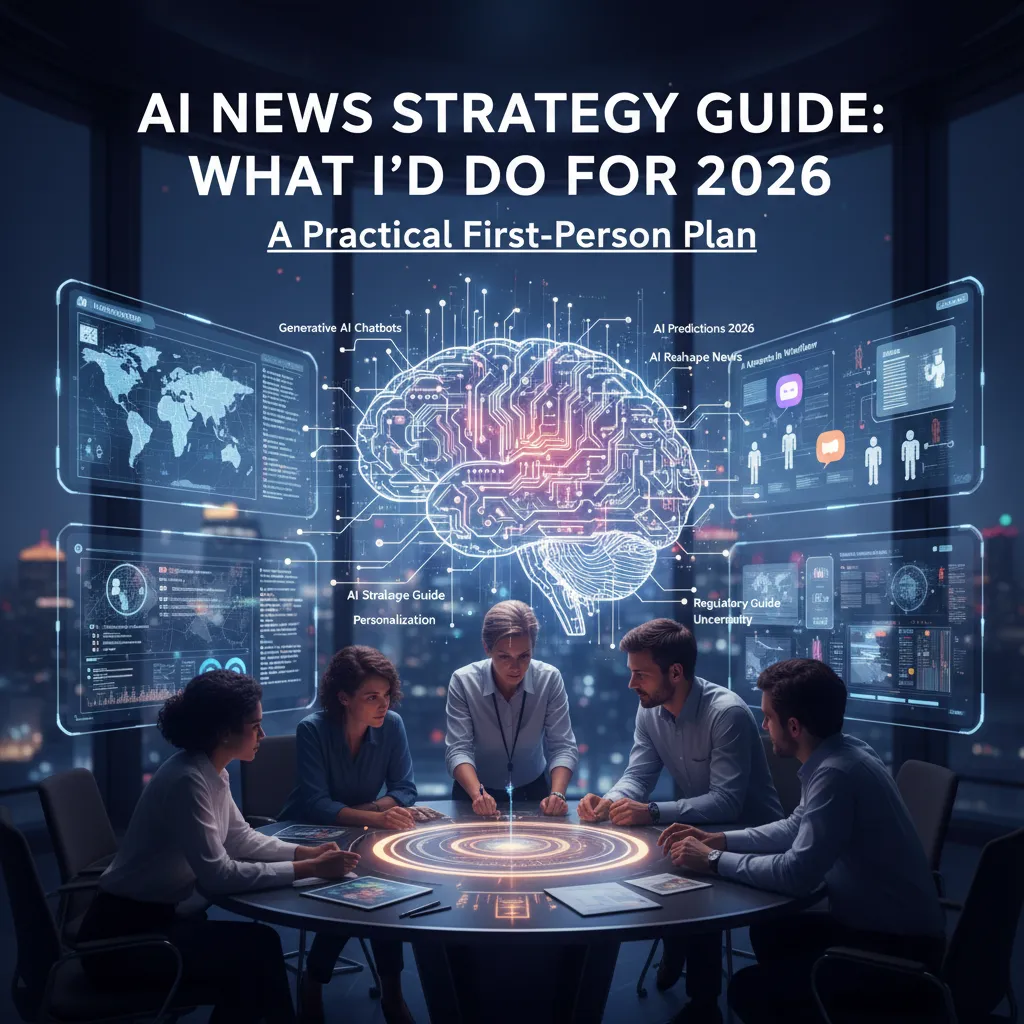
Last winter I watched a friend “read the news” by arguing with a chatbot at the kitchen counter. No tabs, no apps—just a back-and-forth conversation that ended with: “Send me the three sources.” That tiny moment made my stomach drop and my strategist brain light up. If audiences access news through AI-powered chatbots and LLMs, then my old playbook—headlines, clicks, and homepage hero slots—starts to feel like using a paper map in a rideshare. This guide is my attempt to make the shift feel concrete: what to build, what to stop doing, and where to stay stubbornly human.
1) How AI reshape news: my “chatbot front page” wake-up call
My wake-up call came the morning I realized I wasn’t opening a news site at all. I was asking a chatbot, “What happened overnight, and what should I care about?” It answered like a calm editor: summary first, context second, links only if I asked. That felt oddly natural because it matched how my brain works before coffee: I want a guided conversation, not a homepage full of choices.
Why audiences access news through AI conversations
In the Complete AI News AI Strategy Guide mindset, the big shift is that discovery becomes a dialogue. People use AI because it:
- Reduces effort: one question replaces ten clicks.
- Personalizes the angle: “Explain this like I’m new to the topic.”
- Stays with the thread: follow-ups feel like talking to a beat reporter.
- Compresses time: summaries, timelines, and “what changed?” in seconds.
The click-to-conversation shift: what I’d measure in 2026
If the “front page” is a chat, pageviews stop being the main scoreboard. I’d track conversation-native metrics that show whether our journalism is being used and trusted:
- Answer share: how often our reporting is cited or linked inside AI answers.
- Attribution quality: whether the chatbot names us clearly, not as “a source.”
- Conversation depth: number of meaningful follow-up questions after our story appears.
- Return prompts: users coming back with “Update me” or “What’s new since yesterday?”
- Correction rate: how often we flag and fix AI-misstated facts about our work.
Hallucinations are the main plot for trust
Hallucinations aren’t a side quest; they are the trust battlefield. If an AI confidently invents a quote, date, or claim and attaches our name to it, the damage lands on us. I’d treat this like a product and editorial problem: publish clean source pages, consistent author bios, clear timestamps, and machine-readable corrections. I’d also keep a simple internal playbook for “AI said we reported X, but we didn’t.”
In a chatbot world, accuracy is not just what we publish—it’s what the model repeats about us.
Wild card: the “chatbot app store” future
I can imagine a “chatbot app store” where a publication is a plugin, not a site. Users might install “Local Investigations,” “Climate Desk,” or “Elections Tracker” the way they add tools. Our job would be to package reporting into reliable, query-ready modules—so when someone asks, the chatbot pulls from our verified work first.

2) Automation reshape newsrooms (but not the way my intern feared)
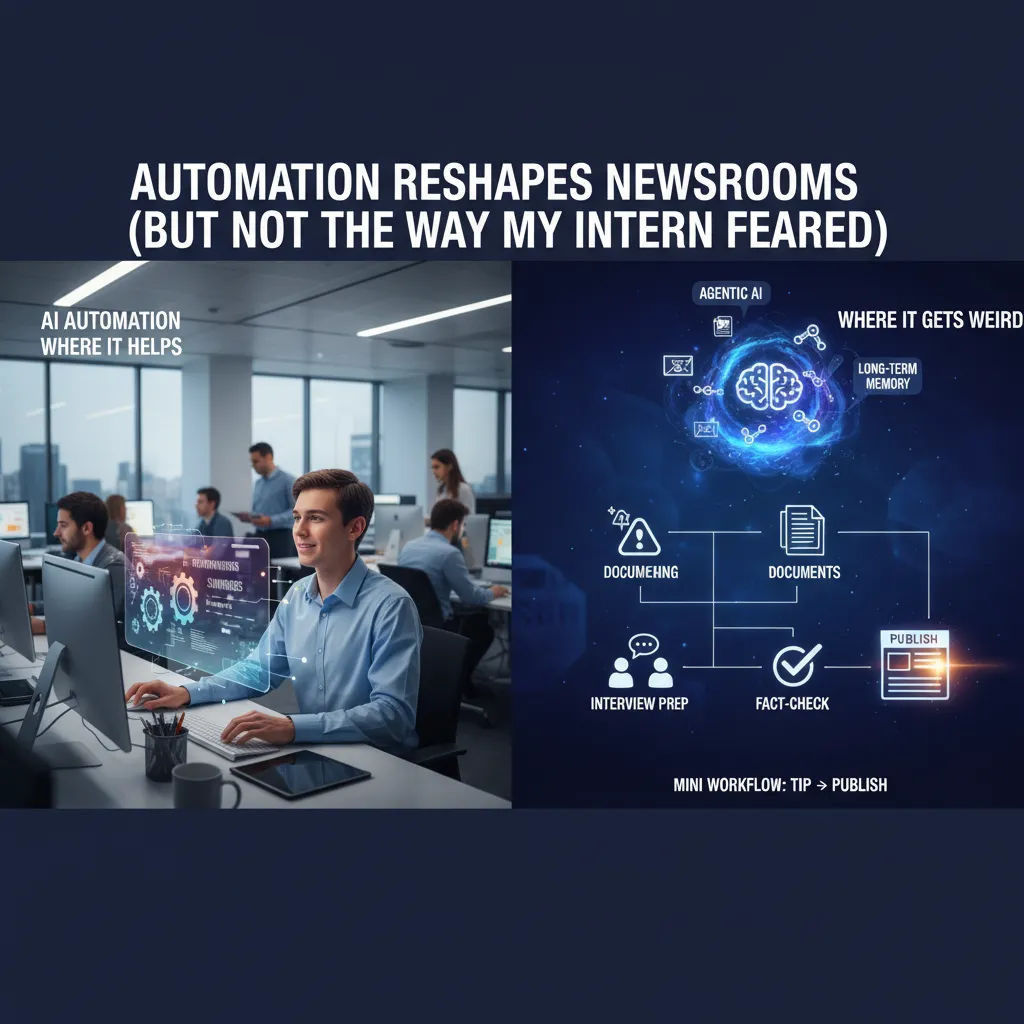
When my intern first heard “automation,” they pictured a silent newsroom where bots write everything and humans just watch dashboards. That is not what I see in 2026 planning. In practice, automation helps most when it takes the boring, repeatable work off our plates so reporters can spend more time calling sources, reading documents, and thinking.
Where automation actually helps (and feels normal)
- Rote monitoring: tracking beats, alerts, filings, meeting agendas, and social posts for early signals.
- Summaries: turning long reports, hearings, and transcripts into quick briefs with links back to the source.
- Translation: fast first-pass translation so we can spot news in other languages, then verify with humans.
- Packaging: headlines, SEO metadata, pull quotes, captions, and multiple story formats (web, newsletter, audio scripts).
This is the “assistive” layer described in The Complete AI News AI Strategy Guide: automation that supports editorial judgment instead of replacing it. It’s also where source-first habits matter. If the system can’t point to the original doc, it’s not done.
Where it gets weird: agentic systems with memory
The strange part is not a single tool writing a paragraph. It’s agentic AI: systems that chain tools (search, scrape, summarize, draft, schedule) and keep long-term memory about your beat. That can be powerful, but it can also create quiet risks: stale assumptions, hidden prompt drift, and “helpful” actions taken without enough editorial context.
Informal tangent: the first time I saw “Deep Research” produce a decent background brief, I felt both grateful and unemployed.
Mini workflow map (tip → publish)
- Tip intake: AI logs the tip, tags the beat, and suggests initial questions.
- Document pull: it gathers public records, prior coverage, and key PDFs, then creates a source list.
- Background brief: a short timeline + “what we know / don’t know,” with citations.
- Interview prep: suggested questions, names, and contradictions to probe (not final wording).
- Fact-check assist: claim extraction + checklist; flags numbers, dates, and quotes to verify.
- Publish + package: web draft support, headline options, translations, and newsletter version.
I treat automation like a junior producer: fast, tireless, and sometimes wrong. The newsroom wins when we use it for monitoring, summaries, translation, and packaging—while keeping humans in charge of reporting, verification, and accountability.
3) Verification work demand: the tax we pay for speed
In 2026, the fastest newsroom is not the one that publishes first. It’s the one that can verify at scale. AI tools let us produce more drafts, more alerts, more explainers, and more social posts in less time. But that volume creates a hidden cost: every extra output is another thing that can be wrong, outdated, or missing context. When content volume explodes, verification work gets heavier because the error surface grows with it.
Why verification gets heavier when AI increases output
- Speed compresses judgment: editors have less time to pause and ask “what’s the source?”
- Summaries can flatten uncertainty: “unconfirmed” becomes “confirmed” in one rewrite.
- Model confidence is not evidence: fluent text can hide weak sourcing.
- Repetition creates false credibility: one bad claim gets copied into many formats.
My upgraded “two-source rule”: provenance + model behavior + primary docs
I still use a two-source rule, but I treat it as a verification stack, not a checkbox. Source-first AI news strategy means I ask three questions before I trust anything:
- Provenance: Where did this claim originate? Can I trace it to a named person, document, dataset, or direct observation?
- Model behavior: Did the model infer, guess, or “fill gaps”? If it can’t show how it got the answer, I assume risk.
- Primary docs: What is the closest original artifact—court filing, incident report, SEC note, on-record email, raw transcript?
Playbook: red-team prompts, citation requirements, human sign-off
To keep AI news verification practical, I use a simple workflow:
- Red-team prompts to stress-test claims:
List the top 5 ways this could be wrong, with what evidence would disprove it. - Citation requirements: every key fact must map to a link, document ID, or direct quote. No “according to reports.”
- Human sign-off: a named editor approves the final framing, not just the facts.
Scenario: breaking cyberattack “born AI”
A major hospital network goes down. A rushed chatbot summary says, “Confirmed ransomware by Group X,” citing a single viral post. That line gets reused in push alerts, a headline, and a TV script. Hours later, incident responders publish a primary update: it was a misconfigured patch, not ransomware. The early AI summary quietly poisoned the narrative—investors react, patients panic, and the newsroom spends days correcting a claim that never had solid provenance.
4) News personalisation stride: letting readers pick the “version” of me
In 2026, I’d stop treating personalisation like a gimmick and use it as a delivery upgrade. Generative AI can help readers choose the format, tone, style, and depth they need—without turning serious reporting into “vibes.” My goal is simple: keep the same verified facts, but let people decide how they want to receive them.
Same facts, different “cuts” of the story
I’d build a system where every story has a source-first core (documents, transcripts, data, on-the-record quotes). Then GenAI creates safe variations that never change the underlying truth.
- Format: text, audio script, bullet brief, or a timeline
- Tone: neutral default, “just the facts,” or more conversational (still precise)
- Depth: 60-second scan, 5-minute read, or deep dive with context
- Style: explainer mode, Q&A mode, or “what changed since yesterday” mode
Personalisation should change the wrapper, not the reality.
Multiple GenAI products, built from one reporting pipeline
Instead of one article trying to serve everyone, I’d ship several GenAI-powered products that reuse the same reporting and citations:
- Daily briefings: tight summaries with links to primary sources
- Explain-the-basics: definitions, background, and “why it matters” sections
- Local angles: how a national story affects a city, school district, or industry
- Q&A companion: a guided chatbot that answers questions using only approved materials
For the Q&A companion, I’d make the rules visible, like:
Answer only from: article text + linked sources + newsroom notes. If missing, say “I don’t know.”
Synthetic audience models as a pitch sounding board
I’d use synthetic audience models (clearly labeled internal tools) as always-on test readers. Before I publish, I can ask: “What would a first-time reader misunderstand?” or “What questions would a local business owner ask?” This helps me tighten headlines, add missing context, and spot confusing jargon—without pretending these models are real people.
My line in the sand: personalisation must not hide material facts
I’m opinionated here: personalisation should never remove or downplay material facts. If a detail changes the meaning of the story—numbers, risks, conflicts of interest, uncertainty—it stays in every version. Readers can pick the “version” of me, but they can’t pick a different reality.
5) Newsrooms upskill infrastructure: the unsexy work that decides everything
If I were building an AI news strategy for 2026, I’d spend less time debating “which model” and more time fixing the plumbing. In practice, AI in the newsroom rises or falls on boring infrastructure: clean data access, reliable logs, and repeatable evaluation. This is the work nobody wants to present in an all-hands, but it decides whether your AI tools help reporters or quietly create risk.
What I’d actually budget for (before more AI features)
- Data access: one place to pull audience, CMS, archives, and analytics with clear permissions.
- Logging: prompts, sources used, tool calls, and outputs—stored in a way editors can review.
- Model evaluation: simple tests for accuracy, bias, and citation quality on your own content.
- Training time: not just “how to prompt,” but how to verify, how to cite, and when not to use AI.
I’d also budget for a small “maintenance lane”: time each week to update system prompts, refresh retrieval indexes, and review failures. Without that, your AI news strategy becomes a demo that slowly breaks.
Data journalists empower: move audience intelligence into chat
Most newsrooms still trap audience intelligence inside dashboards. I’d flip that. I want data journalists and audience teams to ship a chat layer that answers questions like: “What headlines worked for this topic last quarter?” or “Which segments are most likely to subscribe after a local investigation?”
The key is source-first answers: every insight should link back to the underlying report, query, or dataset. If the chat can’t show its work, it’s not newsroom-grade.
Agentic parsing for internal search: semantic profiles + multidimensional graphs
Internal search is where agentic workflows pay off fast. I’d invest in semantic profiles for people, places, beats, and story types, then connect them in a multidimensional graph. That lets reporters ask:
- “Show me past coverage that connects this company, this regulator, and this contract.”
- “Find contradictions between two timelines.”
Under the hood, this is less magic and more disciplined structure: entities, relationships, and retrieval that respects embargoes and rights.
Messy aside: I once watched a newsroom argue for two hours about UTM tags—now we need to argue about model memory and audit trails.
So yes, I still care about tracking. But in 2026, the real debate is: what does the model remember, and can we prove what it did?

6) Strategic planning practices: my scenario board for 2026 (and why I’m not waiting for AGI)
When I plan for 2026, I don’t bet on one “correct” future. I keep a simple scenario board because AI news is moving fast, and distribution rules can change overnight. I’m also not waiting for AGI to “arrive” before I act. If I wait for a perfect moment, I lose two years of learning, audience trust, and product reps.
Scenario planning under uncertainty: three plausible futures
Future 1: The AI answer layer wins. Search and social feel more like chat, and fewer people click. In this world, I’d shift from “traffic-first” to relationship-first: stronger email, direct subscriptions, and a clear member benefit (briefings, explainers, tools). I’d also package my reporting so it can be cited inside AI answers: tight headlines, clean structure, and clear attribution.
Future 2: Platforms fragment. No single channel dominates; audiences split across YouTube, podcasts, newsletters, and niche communities. Here, I’d invest in a repeatable content system: one core story, then multiple formats. I’d track what converts to returning readers, not just what spikes.
Future 3: Trust becomes the product. Deepfakes and synthetic spam rise, and people pay attention to sources that show their work. In this future, I’d publish methodology notes, link to primary docs, and build a visible corrections process. I’d treat credibility like a feature, not a slogan.
AI channel investments and Google product strategy
I assume distribution power may concentrate in a few “AI front doors”: Google’s AI surfaces, major chat apps, and OS-level assistants. That means I plan for zero-click discovery and focus on what I can control: brand recall, owned channels, and content that is easy for machines to summarize without losing my name. I also watch Google product moves closely because small UI changes can reshape the whole funnel.
Physical AI edge + XR: why I’m paying attention
Even as a news person, I track physical AI (robots, sensors, on-device models) and XR because they change what “a screen” is. If assistants move into glasses, cars, and workplaces, news distribution becomes ambient. I want to be early in learning how stories are requested, read aloud, and acted on.
I think of strategy like weatherproofing a house. I’m not trying to predict the exact storm. I’m reinforcing the roof, sealing the windows, and keeping supplies ready—so whatever 2026 brings, my newsroom can keep publishing, keep earning trust, and keep growing.
TL;DR: By 2026, I’m planning for AI-mediated news discovery (chatbots as new “app stores”), agentic AI systems that automate multi-step newsroom tasks, and a bigger verification burden. The winners will invest in discoverability inside AI conversations, data democratization via newsroom chatbots, and scenario planning around regulation, talent, and AI-era cyberattacks—without pretending AGI is around the corner.