

Last spring I watched a team demo an LLM chatbot that could “answer anything.” Ten minutes later, it couldn’t even agree on what a “customer” was because the CRM and billing tables used different definitions. That’s when the penny dropped for me: 2026 isn’t about louder AI—it’s about cleaner data, smaller models that ship, and agentic AI that quietly rewires how work gets done. Here’s what I think is changing in AI news across 2025–2026, plus the parts I’m personally skeptical about.
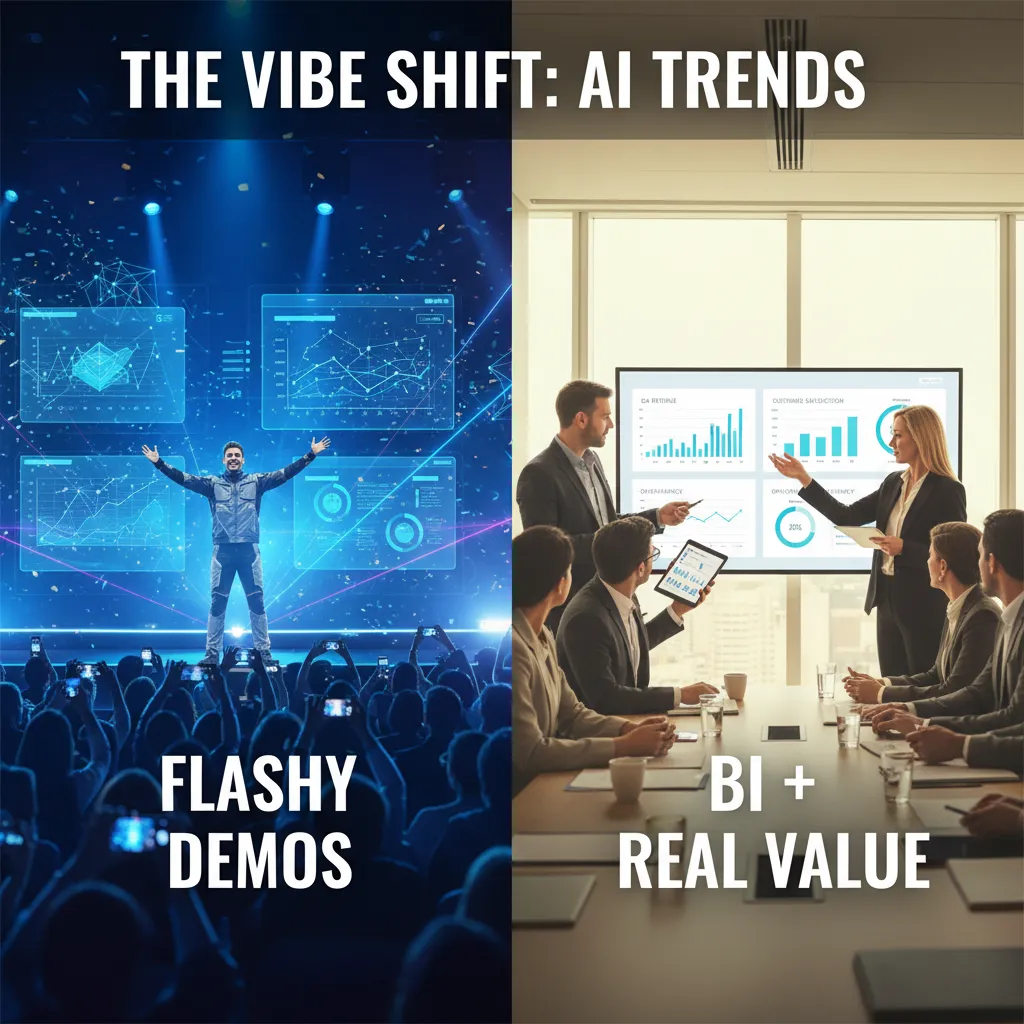
1) The vibe shift: from flashy demos to BI + real value (AI trends)
I’ll start with a confession: I’ve lived in pilot purgatory. I’ve shipped AI prototypes that looked amazing in a demo, got polite applause, and then quietly died before they ever met a CFO. They answered “Can we?” but not “Should we?” or “What does this change on the balance sheet?” That’s the big AI news trend I keep seeing in 2025–2026: less theater, more business intelligence (BI) outcomes.
Why 2026 feels like sober realism in BI and AI
In 2026, the mood is sober realism. Leaders are tired of endless pilots and “innovation labs” that never touch operations. The useful stuff wins: AI that improves forecasting, reduces manual reporting, and helps teams make decisions faster. In BI, that means fewer shiny dashboards and more systems that connect to real workflows—finance close, inventory planning, customer support, and compliance.
“If it can’t be measured, it can’t be funded.”
What I ask now in meetings
My first question is no longer “What model are we using?” It’s:
“Which metric moves, and who owns the data quality?”
If nobody owns data quality, the project becomes a blame game. If the metric is vague (“better insights”), the project becomes a dashboard factory. I also ask where the decision happens: in an email, in a ticket, in an ERP screen, or in a weekly meeting. BI + AI has to land there, not in a separate portal.
A quick yardstick for real value (not more dashboards)
When I’m evaluating AI trends in BI, I use a simple yardstick:
- Time saved: How many hours per week are removed from reporting, reconciliation, or triage?
- Errors reduced: Do we cut rework, duplicate entries, or “version-of-truth” fights?
- Decisions made faster: Do approvals, pricing changes, or replenishment calls happen sooner?
If we can’t write those outcomes down with a baseline and an owner, I treat it as a demo—not a deployment.
2) Generative AI grows up: it starts cleaning the mess (data quality)
In the 2025–2026 AI news cycle, the most useful shift isn’t a flashier chatbot. It’s the unsexy headline: generative AI doing classification, tagging, and metadata enrichment—basically making the data usable. When I look at what’s changing, I see teams moving from “look what the model can write” to “can the model make our systems trustworthy?” That’s where real ROI shows up.
The unsexy work that unlocks everything else
Most companies don’t have an “AI problem.” They have a data quality problem: missing fields, messy naming, duplicate records, and documents that live in email threads. Generative AI is getting better at turning that chaos into structured inputs—without needing a full rebuild of your stack.
- Classification: sorting content into the right buckets (policy, invoice, contract, claim).
- Tagging: adding consistent labels (region, product, risk level, customer type).
- Metadata enrichment: extracting key fields (dates, amounts, parties, renewal terms).
My favorite practical use-case: document processing
If I had to pick one “boring but powerful” win, it’s document processing that populates systems without 17 copy/paste steps. A model reads a PDF, pulls the right fields, and pushes them into your CRM, ERP, or ticketing tool. The best part is not speed—it’s consistency.
“Generative AI isn’t just generating text; it’s generating cleaner inputs for the business.”
Where I’ve been burned: confident garbage
I’ve also learned the hard way that auto-labeling without governance creates confident garbage. The model sounds sure, the tags look neat, and then you discover it quietly misfiled 8% of records. That 8% becomes a downstream mess in analytics, compliance, and customer support.
A workflow I’d bet on in 2026
- Humans set standards: schemas, allowed values, and “what good looks like.”
- Generative AI does the grunt work: extract, tag, normalize, and flag uncertainty.
- Audits catch drift: sampling, scorecards, and retraining when patterns change.
3) Agentic AI isn’t magic—it’s orchestration (agentic AI)
In AI news trends for 2025–2026, the phrase I keep hearing is agentic AI. It sounds like “the AI that just does things,” and that’s exactly why it makes people weirdly anxious. When a tool moves from answering questions to taking actions—creating tickets, changing settings, emailing vendors—our brains jump to worst-case stories. But most of what’s being built isn’t a robot mind. It’s orchestration: software that chains steps together, checks rules, and asks for approval at the right time.
Why “agentic” triggers anxiety
- Loss of control: people worry the system will act without permission.
- Hidden decisions: it’s hard to see why a chain of actions happened.
- Blame: when something breaks, nobody wants “the agent did it” as the answer.
My Monday morning ops cockpit (a “super agent” view)
Here’s what I imagine at work: a dashboard that looks like a calm control room. A “super agent” doesn’t replace teams; it routes work to smaller agents and tools. On Monday, it might show:
- Overnight incidents summarized, with links to logs and suggested fixes
- Inventory risks (low stock, delayed shipments) with draft vendor emails
- Finance flags (odd spend, late invoices) with a “request approval” button
- Customer support themes with proposed macros and escalation lists
Nothing ships automatically unless I set it that way. The value is speed, visibility, and fewer context switches.
Cooperative model routing: right model, right job
Instead of one giant brain, I see teams using cooperative model routing:
- A small fast model for triage and classification
- A stronger model for reasoning and drafting
- A rules engine for compliance checks
- A retrieval layer for “only use our docs” answers
My skepticism corner
I think agentic AI is overhyped today because reliability, permissions, and audit trails are still messy. But it’s still worth planning for within five years—mainly as orchestration plus guardrails, not magic autonomy.

4) Smaller models + edge AI: the quiet hardware revolution (edge AI)
In 2025–2026, I’m watching edge AI shift from “cool demo” to “it’s in the product.” The big change is hardware: ASIC accelerators built for AI workloads, plus chiplet designs that let vendors mix and match compute, memory, and I/O without redesigning an entire chip. That combo makes it realistic to run useful models on cameras, kiosks, vehicles, wearables, and factory gear—without sending every request to the cloud.
Why smaller models are my sleeper pick for 2026
I keep coming back to one idea: smaller models win more often than people expect. With distillation (teaching a compact model from a larger one) and quantization (using lower-precision weights), teams can ship models that are:
- Faster (lower latency on-device)
- Cheaper (less cloud inference and bandwidth)
- Easier to govern (tighter scope, clearer behavior, simpler audits)
For “AI News Trends 2025–2026,” this is the useful stuff: performance and cost improvements that actually change product decisions.
A practical example: on-device multimodal AI when Wi‑Fi is flaky
My favorite edge AI example is on-device multimodal assistants that can see, read, and act locally. Picture a field technician’s device that:
- Uses the camera to inspect a part and spot a mismatch
- Reads a label or manual page with OCR
- Triggers a workflow like “log issue,” “order replacement,” or “open checklist”
Even with weak connectivity, the core loop still works because inference happens on the device. Cloud sync becomes optional, not required.
The trade-off I keep wrestling with
Edge AI gives me privacy and latency wins, but updates in the field are harder. Model refreshes, safety patches, and version drift across thousands of devices can turn into a real ops problem.
Edge AI reduces data exposure, but it increases the importance of disciplined deployment and update pipelines.
5) Traditional AI makes a comeback (traditional AI) — and I’m relieved
One “unpopular opinion” I’ll defend in AI News Trends 2025–2026: The Useful Stuff Wins: not every problem needs an LLM. Sometimes a plain model is the adult choice. In the source trend notes for 2025–2026, I keep seeing teams quietly returning to traditional AI—logistic regression, gradient boosting, time-series forecasting, rules, and anomaly detection—because it ships value without drama.
Why traditional AI regains prominence in 2026
The big reason is simple: cost and stability. Traditional AI is often cheaper to run, easier to scale, and more predictable in production. It’s also easier to validate. When I need to explain why a model flagged a transaction or predicted churn, I can usually point to clear features and thresholds instead of a long prompt chain.
- Cost-efficient: smaller models, fewer GPUs, lower inference bills.
- Stable: fewer surprises from prompt drift or model updates.
- Easier to validate: clearer metrics, repeatable tests, simpler audits.
My rule-of-thumb decision tree
I use a very basic filter before I reach for generative AI:
- If the data is structured (tables, events, logs) and the task is repetitive, I try traditional AI first.
- If the output must be consistent (scores, flags, routing decisions), I prefer traditional AI.
- If the task is open-ended language (drafting, summarizing, chat), then I consider an LLM.
In practice, that means fraud scoring, demand forecasting, and quality checks often belong to traditional AI, even in 2026.
How generative AI still helps (yes, really)
LLMs still play a supporting role in these “boring” systems:
- Label generation: propose draft labels for human review to speed up training data.
- Feature hints: suggest useful signals (then I test them like any other feature).
- Better documentation: turn messy notes into clear model cards and runbooks.
My 2026 mindset: use LLMs for language, and use traditional AI for decisions that must be cheap, stable, and provable.

6) AI infrastructure + “AI factories”: the part nobody screenshots
In 2025–2026, I’m seeing the story shift from flashy demos to the boring parts that make AI work every day: AI infrastructure. The winners aren’t just the teams with the best model—they’re the teams with the best systems. Think dense, distributed “super factories” built for efficiency: GPUs packed tightly, workloads scheduled smartly, data moved less, and uptime treated like a product feature.
What “AI factories” mean in my head
When I say AI factory, I don’t mean one giant data center. I mean a repeatable pipeline that turns an idea into a reliable service, again and again:
- Idea → define the task and success metrics
- Data → collect, label, clean, and version it
- Model → train or fine-tune with clear baselines
- Deploy → ship safely with rollback paths
- Monitor → track drift, cost, latency, and failures
- Iterate → improve with feedback loops
In practice, the “factory” part is the repeatability: templates, automation, and guardrails that reduce surprises.
The hidden constraint: data quality + governance
Here’s the part people skip in screenshots: data quality and governance are infrastructure problems, not just tooling problems. If your data is messy, your model will be messy—no matter how good your GPUs are. And if you can’t answer basic questions like “Where did this data come from?” or “Who can use it?”, you don’t have an AI pipeline—you have risk.
“Model performance is often limited by the data plumbing, not the model architecture.”
Open source enters the chat (less romance, more contracts)
Open source is getting more practical in AI infrastructure. I see it used for diversification (avoid lock-in), interoperability (tools that talk to each other), and governance (clear rules, audits, and permissions). It’s less about vibes and more about agreements.
- Interoperability: standard formats, APIs, and connectors
- Governance: access control, lineage, retention policies
- Operations: cost tracking, quotas, and reliability targets
7) Wild cards: multimodal + physical AI + healthcare math (future AI)
When I look at AI news trends for 2025–2026, the “wild cards” are the ones that feel less like software updates and more like a shift in what work even is. Multimodal models are the first time I’ve felt “digital worker” might be more than a metaphor. When a system can read a chart, listen to a call, watch a short video, and then draft the follow-up email with the right attachments, it stops being a chatbot and starts acting like a junior teammate. That’s why multimodal AI keeps showing up in AI industry trends: it connects the messy parts of real work, not just text.
From text to action changes the risk profile
Physical AI and robotics AI raise the stakes because the output is not a paragraph—it’s an action. A wrong answer in text can be corrected. A wrong action can break equipment, hurt someone, or create a safety incident. That jump from “say” to “do” changes the risk profile and the safety checklists. I expect more focus on testing in real environments, clear limits on what the system is allowed to do, and better “stop” controls. In other words, the useful stuff wins only if it is also the safe stuff.
Healthcare math that’s hard to ignore
Healthcare AI is where the numbers stuck with me: estimates that 25–28% of professional work could be automated, with around $360B in potential savings. I don’t read that as “replace clinicians.” I read it as “remove the paperwork tax” that burns time and attention. If AI can reliably handle the repeatable parts, humans can spend more time on judgment, empathy, and edge cases.
My kitchen-table scenario
If my parent’s clinic got an agent tomorrow, what would I trust it to do first? Not diagnose. Not prescribe. I’d start with the boring, high-volume tasks: summarizing visit notes, drafting prior authorizations, checking for missing fields, preparing patient instructions in plain language, and flagging scheduling conflicts. If it can do that with strong privacy controls and clear audit trails, then the future AI story becomes simple: less friction, fewer errors, and more time for care.
TL;DR: AI news in 2025–2026 shifts from wow-factor to value: generative AI is increasingly used to fix data quality, agentic AI accelerates organizational change, edge AI becomes real via new chip designs, and traditional AI returns for cost-efficient wins. Expect more multimodal models, more open source governance talk, and “AI factories” as infrastructure—not just buzzwords.