

I didn’t plan to let a model “touch” our AI news workflow. Then one Monday morning, I watched a simple briefing task—usually a coffee-and-two-tabs ritual—turn into a 12-minute sprint with citations, angles, and a draft skeleton. It felt like cheating… until the first hallucinated stat showed up and I realized operations (not prompts) would decide whether this was magic or mayhem. This post breaks down the real operational shifts I’ve seen when AI moves from a solo tool to a team sport in AI news operations—and why 2026 looks like the year AI Operations Priority stops being a slogan and becomes a budget line.
1) When AI Became an Operations Priority (Not a Toy)
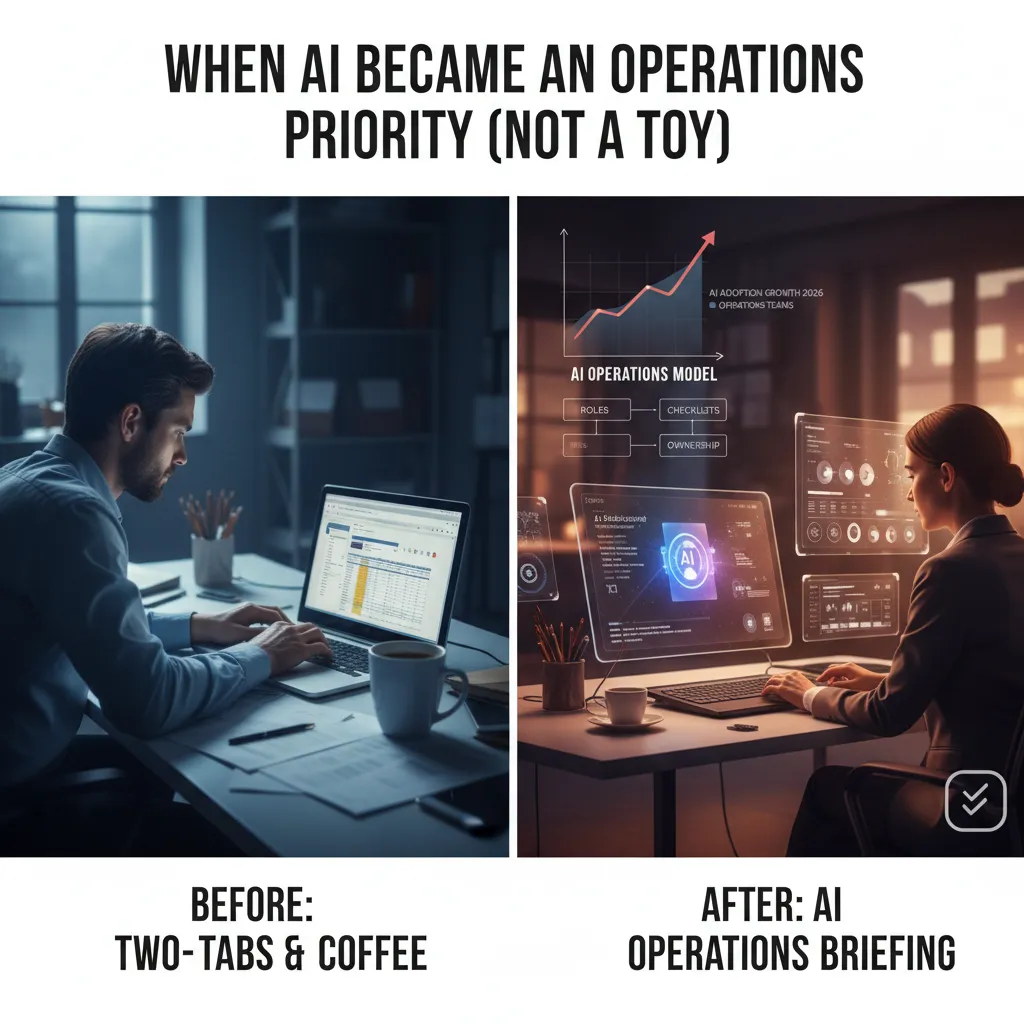
My “two-tabs and coffee” workflow vs. an AI-assisted briefing run
For years, my morning routine for AI news was simple: two browser tabs, one strong coffee, and a lot of manual scanning. One tab was for trusted sources, the other for my draft. I would copy quotes, check dates, and build a quick outline by hand. It worked, but it was slow, and it depended too much on my memory.
In 2026, I moved to an AI-assisted briefing run. What changed was the prep: I now start with a structured prompt that pulls themes, key updates, and “why it matters” angles into a single briefing. What didn’t change: I still verify sources, I still choose the story, and I still write in my own voice. AI didn’t replace my judgment; it reduced the busywork.
AI adoption growth in 2026: why operations teams scale faster
From what I’ve seen in AI news operations, the fastest growth in AI adoption isn’t coming from random one-off creators. It’s coming from operations teams, because they have repeatable work and clear goals. When a workflow repeats daily, even small time savings add up fast.
- Consistency: operations needs the same output format every day (briefings, alerts, summaries).
- Speed with control: teams can add guardrails like templates and review steps.
- Shared learning: one good prompt or checklist helps everyone, not just one person.
From experimenting to an AI Operations Model
The real shift happened when we stopped treating AI like a fun tool and started treating it like an operations system. That meant assigning ownership and building simple process controls.
- Roles: who runs the briefing, who verifies sources, who approves the final summary.
- Checklists: required citations, date checks, and “what changed since yesterday?”
- Ownership: one person accountable for prompt updates and model settings.
Even a small standard helped, like keeping a shared prompt library and a “do not publish without” list.
A small moment that showed everything had changed
“What are you writing?” became “What are we orchestrating?”
That one line in our morning standup captured the new reality. We weren’t just producing articles. We were coordinating inputs, checks, summaries, and distribution—an AI news workflow designed for real results, not experiments.
2) Productivity Gains AI: The Unsexy Wins That Actually Mattered
When people ask how AI changed our AI news operations, they expect a story about “writing faster.” That’s not what moved the needle. The real gains came from the boring minutes that used to vanish all day: reading, sorting, checking, and reformatting. In our workflow, AI productivity gains showed up most in the steps before a human ever wrote a clean paragraph.
Where the minutes disappeared
We didn’t “replace reporting.” We reduced the time spent getting to the point. The biggest wins were repeatable:
- Summarizing earnings calls: AI pulled key quotes, guidance changes, and risk language, then we verified against the transcript.
- Scanning reports: Instead of reading 40 pages end-to-end, we used AI to extract the sections that mattered (metrics, product updates, forward-looking statements).
- Drafting headlines: AI generated options based on our style rules, then an editor picked or rewrote.
The pattern was simple: AI did the first pass, then we handed off to humans for judgment, tone, and accuracy.
Knowledge work, industrial-style (without killing voice)
I started thinking of this as knowledge work industrial: not glamorous, but reliable. AI absorbed repetitive review tasks—like checking whether we included the “what happened / why it matters / what’s next” structure—without forcing a single robotic voice. In theory, editorial voice stays intact because humans still own the final framing. In practice, we had to be strict about edits, because AI will drift toward generic language if you let it.
Operational efficiency AI vs. “faster writing”
Speed is one writer finishing one draft sooner. Throughput is the team shipping more accurate stories with the same headcount. Operational efficiency AI helped throughput by clearing bottlenecks: fewer tabs open, fewer manual copy steps, fewer “did we miss that line?” moments. That meant editors spent more time on judgment calls and less time on cleanup.
My rule of thumb
If it can be checklist-verified, it can be partially automated.
We used simple checklists like:
- Are names, numbers, and dates matched to the source?
- Is the claim supported by a quote or document line?
- Does the headline match the lede?
That’s where AI operations delivered real results: not magic writing, but dependable, repeatable support that made the whole system move.
3) AI-Ready Data and the Unstructured Data Bottleneck (My Least Favorite Chapter)
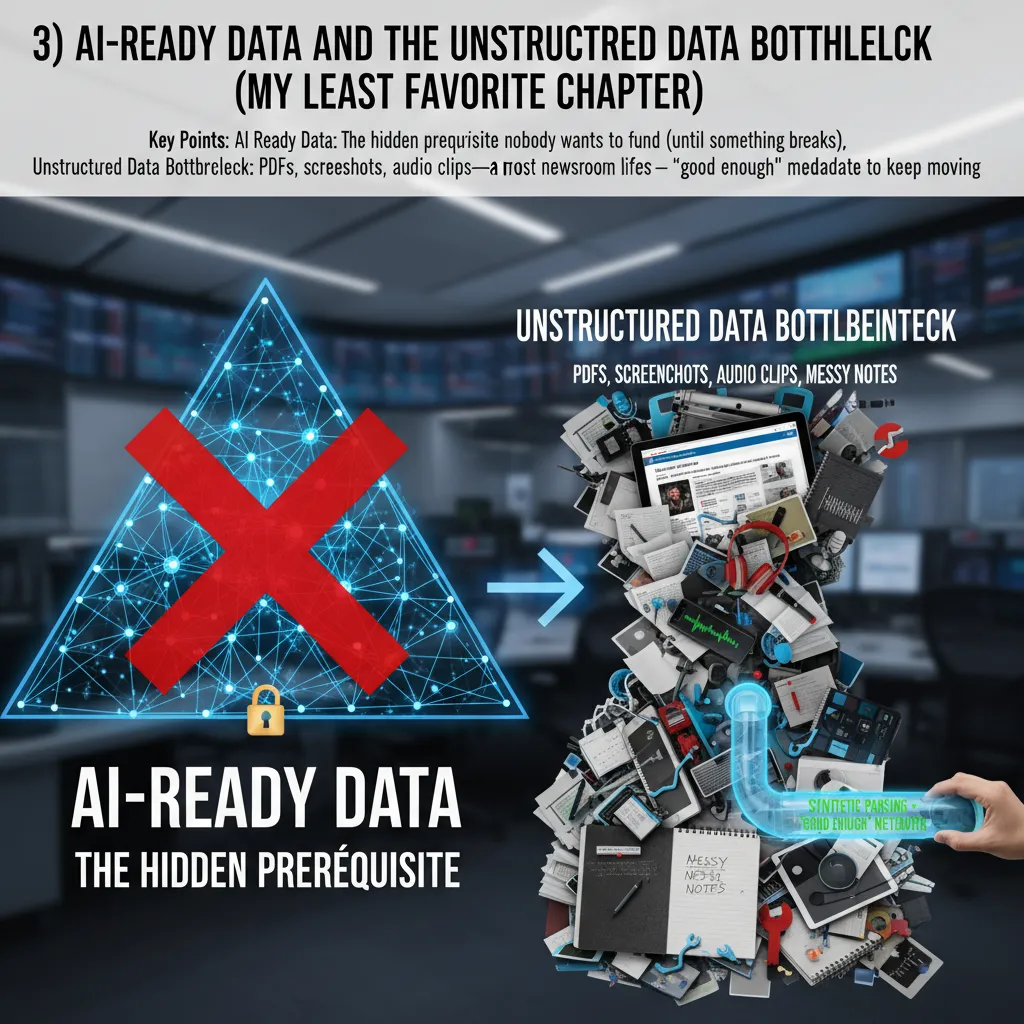
In How AI Transformed AI News Operations: Real Results, the part that always slows us down is not the model, the prompts, or even the tools. It’s data. Specifically, AI-ready data—the hidden prerequisite nobody wants to fund until something breaks in production and everyone suddenly cares.
AI-ready data: the work nobody budgets for
I’ve learned that “AI-ready” usually means boring, repeatable basics: consistent file naming, clear ownership, version history, and a place where the newsroom can actually find things. When we skip this, AI operations turn into a guessing game. The system can’t tell what’s final, what’s a draft, or what’s outdated—and neither can the humans at 2 a.m.
- One source of truth for key facts and reference docs
- Stable IDs for stories, topics, people, and organizations
- Access rules that match newsroom reality (fast, but safe)
The unstructured data bottleneck: most newsroom life
Here’s my least favorite truth: most newsroom inputs are unstructured. PDFs from agencies, screenshots of charts, audio clips from interviews, messy notes in chat, and images with text. AI systems can “handle” this, but only if we do the hard part first: extraction and cleanup.
“If the AI can’t read it, it can’t help you—no matter how smart it is.”
When unstructured data piles up, the AI pipeline stalls. Search gets weak. Summaries miss key context. Fact checks become slower than doing it manually.
A messy-but-real tactic: synthetic parsing + “good enough” metadata
What worked for us (even when it wasn’t pretty) was building a synthetic parsing pipeline and accepting good enough metadata so we could keep moving. The goal wasn’t perfection—it was momentum.
- Run OCR on PDFs and screenshots
- Transcribe audio clips automatically
- Attach minimal metadata: topic, date, source, confidence
- Store both the raw file and extracted text side-by-side
{"source":"agency_pdf","topic":"election","date":"2026-03-14","confidence":0.78}
Wild card scenario: the chart screenshot problem
Imagine an agent that can’t read a chart screenshot. Now picture it running your breaking-news desk. It sees the headline, misses the data trend, and publishes a summary that’s technically fluent but factually wrong. That’s why I treat unstructured data as an AI operations priority for 2026: not glamorous, not fun, but directly tied to real results in AI news workflows.
4) Context Engineering AI: The Day Prompts Stopped Being Enough
In our AI news workflow, I hit a wall: no matter how much I tweaked prompts, results stayed uneven. One editor would get a clean draft, another would get a messy one, even with “the same prompt.” That’s when I learned the real shift was context engineering, not prompt polishing.
Context Engineering vs. Prompt Tweaking: Building Repeatable “Story Brains”
Prompt tweaking is like giving directions every single time. Context engineering is building a reusable story brain that travels with the task. For us, that meant packaging:
- Style: voice, reading level, headline rules, and formatting
- Sources: approved feeds, internal notes, and primary links
- Constraints: what to include, what to avoid, and how to verify
Once we did this, our “AI News Operations” became more stable and easier to train across the team.
Foundation Models ML: Why Model Choice Mattered Less Than Retrieval
We tested different foundation models, expecting a big jump. The surprise: the model mattered, but retrieval and constraints mattered more. When the AI had the right articles, quotes, and timestamps in front of it, even a “good enough” model produced strong work. When it didn’t, even the best model guessed.
So we invested in source-first retrieval: pulling the exact items the model was allowed to use, then forcing it to stay inside that box.
A Practical Play: Briefing Packs + Forbidden Zones
Our most reliable pattern was simple:
- Briefing pack: the only material the model may use
- Forbidden zones: topics, sources, and claims it must ignore
“If it’s not in the pack, it’s not in the story.”
Here’s a lightweight template we used:
BRIEFING PACK: [links, excerpts, internal notes, dates]

FORBIDDEN ZONES: [no anonymous claims, no competitor rumors, no old stats]

OUTPUT RULES: [cite sources, label uncertainty, keep to 300 words]
Generative AI Debt: The Hidden Cost of a Thousand One-Off Prompts
Before context engineering, we had prompts everywhere: in docs, Slack, personal notes. That created Generative AI Debt: inconsistent outputs, hard-to-audit decisions, and constant rework. Centralizing “story brains” reduced drift and made our AI news results repeatable, measurable, and easier to improve.
5) AI Observability Governance: The Guardrails That Kept Us Employed
In our AI News operations, the biggest shift wasn’t a new model. It was AI observability governance. Once we could see what the system did, people stopped assuming the worst. Editors, legal, and leadership calmed down because we could answer simple questions fast: Where did this come from? Which model wrote it? Who approved it?
AI Observability: What We Logged (and Why It Reduced Panic)
We treated every AI-assisted draft like a newsroom artifact that needed a paper trail. Our logs weren’t fancy; they were consistent. For each output, we captured:
- Inputs: prompt, instructions, and any constraints (tone, length, embargo rules)
- Sources: URLs, documents, transcripts, and “no-source” flags when none were used
- Model version: provider, model name, and configuration
- Approvals: who reviewed, what changed, and when it shipped
This made audits boring—in a good way. When someone challenged a claim, we didn’t argue. We pulled the trace.
Governance Without Killing Creativity
We learned that governance fails when it feels like a new bureaucracy. So we built lightweight policies that match newsroom cadence:
- Two-lane workflow: fast lane for summaries and headlines, slow lane for analysis and sensitive topics.
- Default disclosure: if AI touched the draft, we marked it internally and required a human final read.
- Source-first rule: no citations, no publish—unless it’s clearly labeled as opinion or internal notes.
These guardrails didn’t slow us down; they prevented rework and late-night corrections.
Agentic Workflows: When Automation Drifted
We also tested agentic workflows—systems that fetch sources, draft, and suggest updates. That’s where we saw automation drift. One agent started “helpfully” pulling older articles as if they were new. Another over-prioritized engagement keywords and softened cautious language.
Our handbrake was simple:
- Rate limits and sandbox runs before production
- Human approval gates for topic selection and final claims
- Alerts when source mix or writing style changed suddenly
The Most Human Metric: Editor Confidence
After we added traceable citations, we tracked a surprisingly useful metric: editor confidence. We asked editors to rate, “Do I trust this draft enough to edit quickly?” Scores rose when every key fact had a clickable source trail.
“I don’t need the AI to be perfect. I need it to be explainable.”
6) Vertical AI Industries and Enterprise Transformation: Why News Ops Borrowed from Factories
When I look back at how our AI news operations matured, the biggest shift was accepting a simple truth: editorial work is creative, but operations must be repeatable. We stopped pretending we were “too unique” to learn from other vertical AI industries. Instead, we borrowed proven patterns from finance, healthcare, and customer operations, then reshaped them for newsroom reality.
Vertical AI industries: borrowing patterns, not copying culture
Finance taught us controls: audit trails, approvals, and clear ownership. Healthcare taught us risk thinking: document sources, track changes, and treat mistakes like safety issues. Customer ops taught us handoffs: routing work to the right role at the right time. We didn’t copy their language or pace. We adapted the structure so editors still had final judgment, while AI handled the heavy lifting around research, summaries, and consistency checks.
Enterprise AI scale: from clever demos to role-based workflows
In early pilots, we celebrated “wow” moments: a great draft, a fast summary, a smart headline. But enterprise AI scale is not a demo; it’s a system. We moved to role-based workflows where each step had a purpose, a responsible person, and a measurable output. Reporters used AI for source-first research and note cleanup. Editors used it for structure checks and tone alignment. Standards teams used it for policy checks. This is where “AI news, real results” became real: fewer reworks, faster cycles, and clearer accountability.
Modular IT stacks: splitting the monolith into services
Generative AI pushed us to break one big “write an article” task into smaller services: research, draft, QA, and publish. Each service could be improved without breaking the rest. It also made integration easier across our CMS, analytics, and archives. I started thinking like a factory line—not to remove creativity, but to protect it by reducing chaos.
A contrarian note: not every workflow needs an agent
Here’s the part I wish more teams said out loud: not every workflow deserves an AI agent. Some steps just need a better template, a clearer checklist, or a stronger prompt library. We learned to reserve agents for tasks with real branching decisions, and use simple tools for everything else.
That’s my conclusion for AI Operations Priority 2026: the newsroom that wins won’t be the one with the flashiest model. It will be the one that builds repeatable, source-first workflows, borrows smart patterns from other industries, and keeps humans in charge of judgment.
TL;DR: AI transformed AI news operations when we treated it like an operations program: AI-ready data + context engineering + AI observability governance. The wins were real (speed, consistency), but so were the bottlenecks (unstructured data, governance, agentic workflow drift).