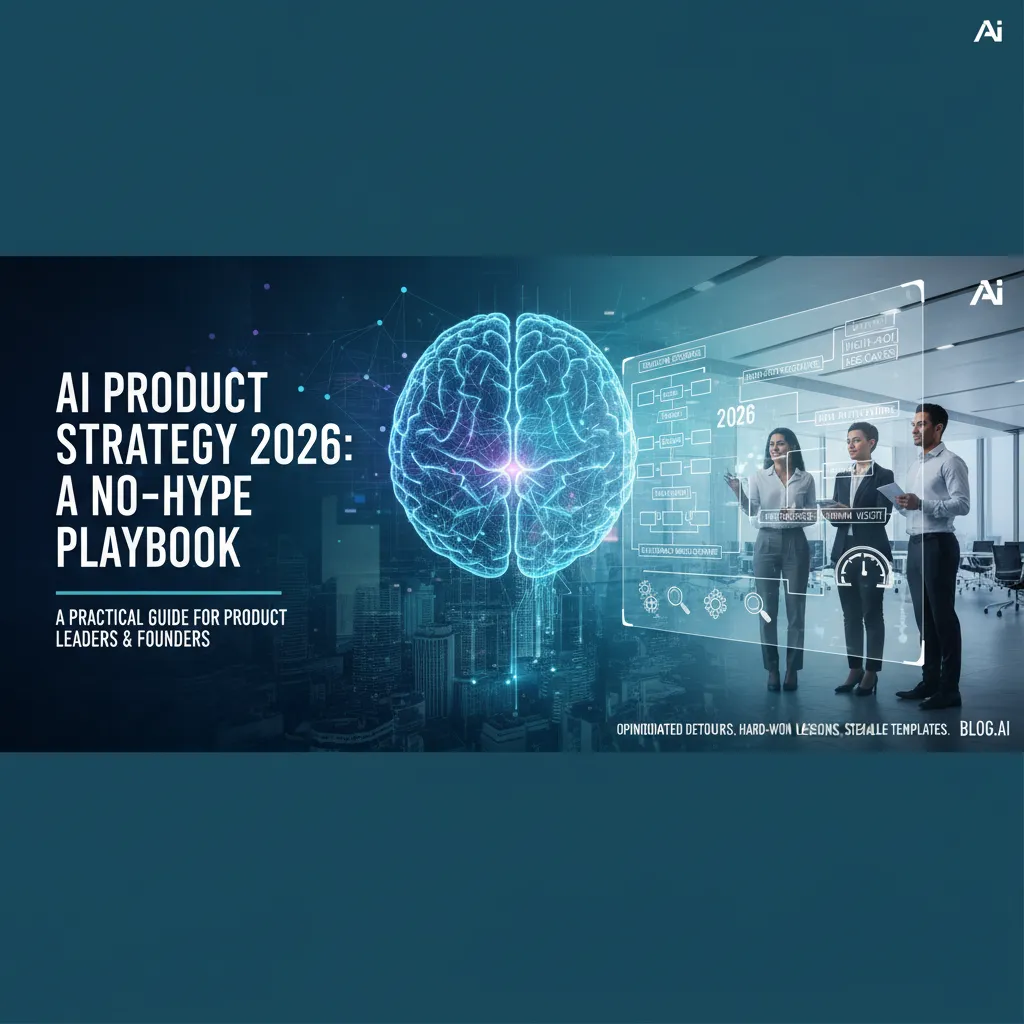
The first time I tried to “add AI” to a product, I did it the lazy way: a shiny demo, a rushed roadmap, and a vague promise that an LLM would magically fix onboarding. Two sprints later, support tickets doubled and my team started saying things like, “So… what does ‘good’ even look like?” That mini-disaster is why I now treat AI Product Strategy like product strategy with a new physics engine underneath: uncertainty, cost curves, and weird failure modes. In this guide, I’ll lay out the complete product AI strategy approach I wish I’d had—complete with the unglamorous bits: model observability, audit logs, fallback logic, and the uncomfortable question of whether your ‘AI feature’ deserves to exist at all.
1) The awkward truth: your roadmap isn’t AI-ready yet
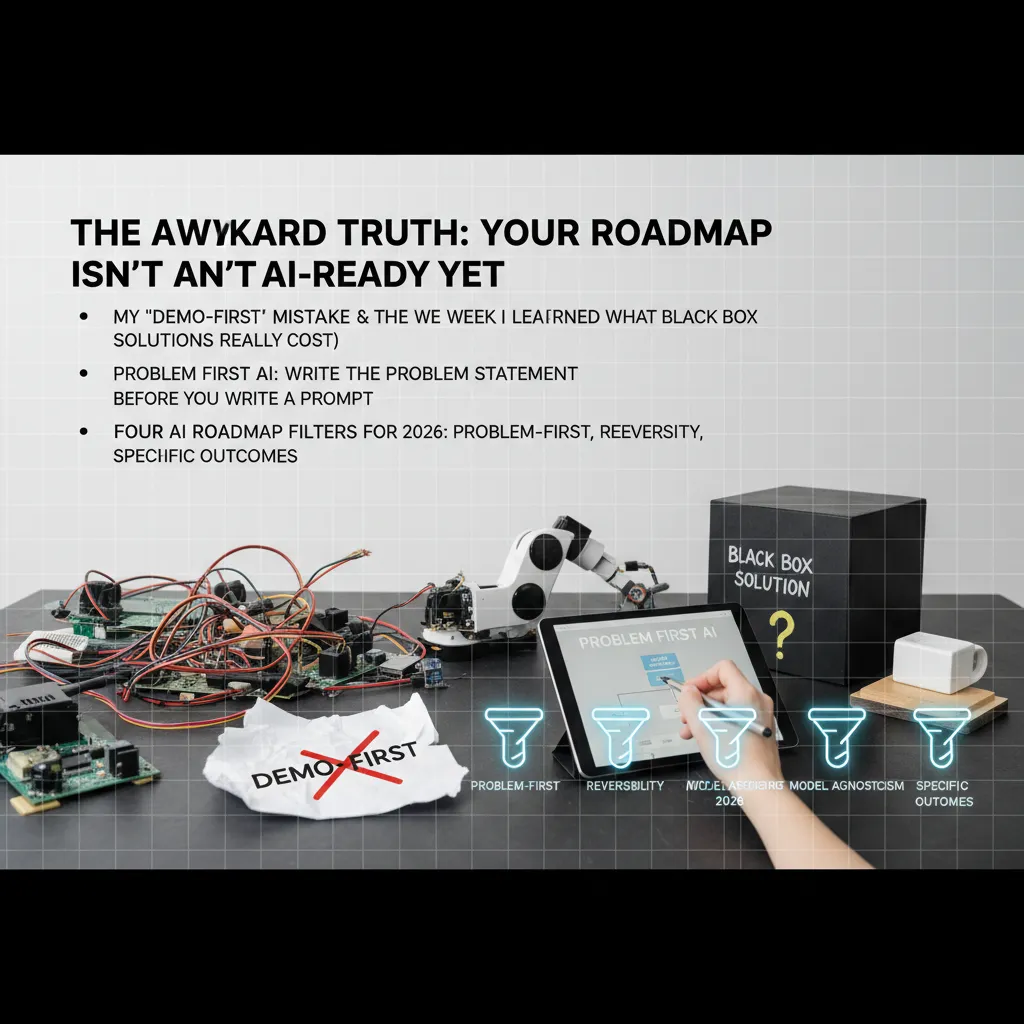
My “demo-first” mistake (and the week I learned what Black Box Solutions really cost)
I once built an AI demo before I had a real product problem written down. The demo looked great in a meeting. Then came the painful week: we couldn’t explain why the model made certain calls, we couldn’t reproduce results, and we couldn’t estimate cost. The “black box” wasn’t magic—it was risk. We spent more time patching prompts and chasing edge cases than improving the product. That week taught me a simple rule from The Complete Product AI Strategy Guide: a roadmap that starts with demos usually ends with debt.
Problem First AI: write the problem statement before you write a prompt
In an AI product strategy, prompts are not requirements. I now force myself to write a problem statement first, in plain language, with a user and a measurable pain.
“If you can’t describe the problem without saying ‘AI,’ you don’t have a product problem yet.”
Here’s the format I use:
User: ____

Problem: ____

Current workaround: ____

Impact: ____ (time, errors, cost)

Success metric: ____
Four AI Roadmap Filters for 2026
Before anything enters the AI roadmap, I run it through four filters:
- Problem-first: Does it solve a real workflow issue, not just add a model?
- Reversibility: Can we turn it off, roll back, or fall back to rules/manual flow?
- Model agnosticism: Can we swap models/providers without rewriting the product?
- Specific outcomes: Do we have a target like “reduce handle time by 20%” or “cut rework by 30%”?
This keeps “AI features” from becoming vague bets. It also supports better AI governance: clearer ownership, clearer testing, clearer risk.
Strategy roadmap sanity check: stability track vs agentic discovery track
My roadmap is now split into two tracks:
- Feature stability track: reliability, latency, cost controls, evals, monitoring, and safe UX.
- Agentic discovery track: small experiments with agents, tool use, and automation—boxed by time and budget.
This separation stops experimental agentic AI from breaking core product promises.
Wild-card aside: my “hype jar” rule
I keep a hype jar in planning meetings. Every time we say “AI will…,” we owe a measurable outcome. If we can’t name the metric, it doesn’t go on the roadmap.
2) Use Case Prioritization that survives contact with reality
In 2026, I don’t start AI planning with models. I start with a use case list and a scoring rubric that forces trade-offs. Borrowing from The Complete Product AI Strategy Guide, I treat prioritization like product discovery: assumptions must meet data, cost, and delivery constraints.
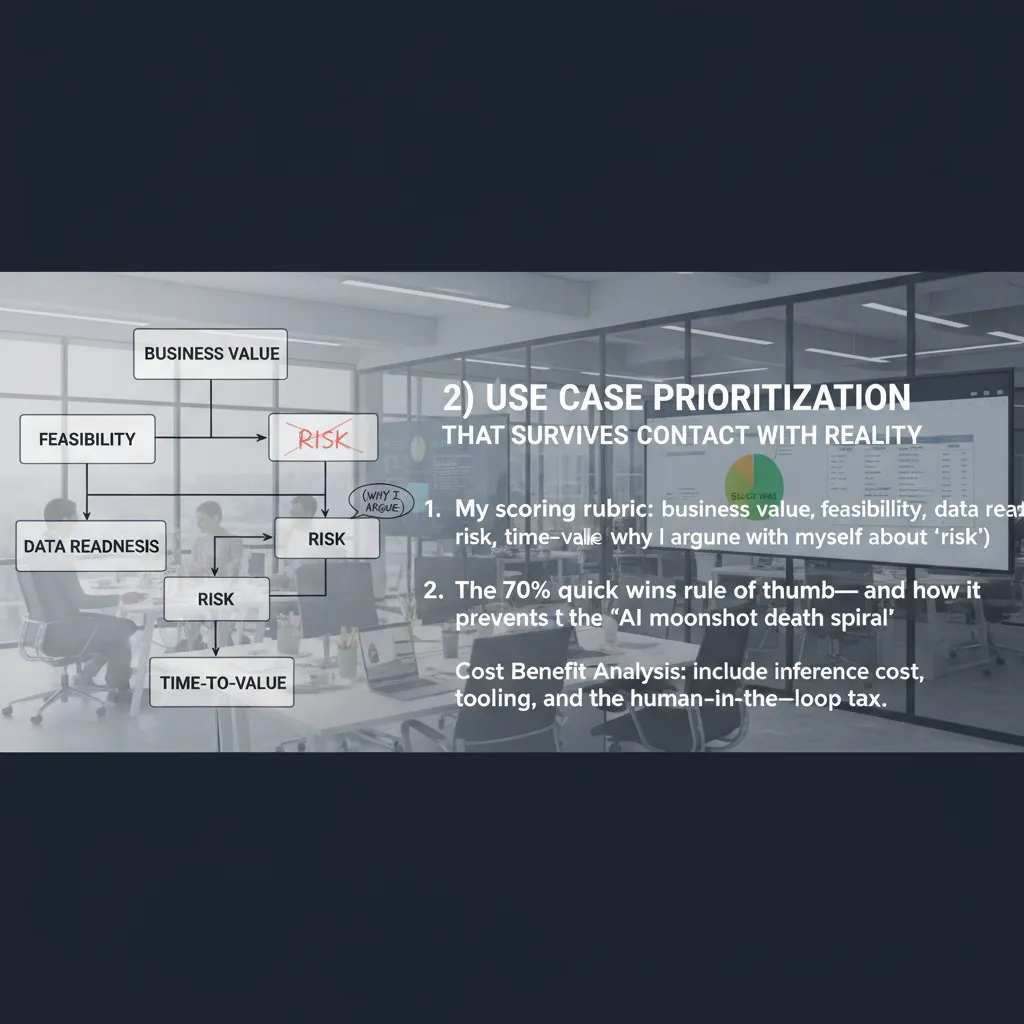
My scoring rubric (and why I argue with myself about “risk”)
I score each use case 1–5 across five dimensions:
- Business value: revenue, retention, cost savings, or compliance impact.
- Feasibility: engineering effort, integration complexity, and model fit.
- Data readiness: do we have labeled data, clean logs, and clear definitions?
- Risk: privacy, safety, brand damage, and “silent failure” risk.
- Time-to-value: how fast we can ship something useful.
I argue with myself about risk because teams misuse it. Sometimes “high risk” really means “I don’t understand it.” Other times it’s real: regulated workflows, sensitive data, or decisions that can’t be explained. I separate perceived risk from measurable risk by asking: “What’s the worst plausible outcome, and how would we detect it?”
The 70% quick wins rule (anti moonshot death spiral)
My rule of thumb: 70% of the roadmap should be quick wins—use cases with strong value and short time-to-value. This prevents the AI moonshot death spiral: one giant bet that burns budget, misses timelines, and kills trust before the second iteration.
Cost-benefit analysis that includes the hidden taxes
I don’t accept “it’s just an API call.” I model:
- Inference cost: tokens, latency, peak usage, and retries.
- Tooling: eval harness, monitoring, prompt/version control, vector DBs.
- Human-in-the-loop tax: review time, escalation queues, QA sampling, and training.
“If humans must check every output, you didn’t automate—you shifted work.”
Product initiatives menu: pick 3, kill 7
I build a menu of 10 initiatives, then I force a decision: pick 3, kill 7. Yes, it hurts. But it protects focus, data quality, and measurement.
Hypothetical tie-breaker: Structured Capability Data wins
Two use cases look identical: “AI summarizes customer calls.” One wins because it also produces Structured Capability Data—tags for intent, objections, competitor mentions, and next steps—stored in a consistent schema. That structured output compounds: it improves search, analytics, coaching, and future models. The other is just text. In my rubric, that difference shows up as higher business value, better data readiness over time, and faster iteration.
3) AI Native Architecture: the stuff nobody puts in the keynote
AI Native Architecture in plain English
When I say AI Native Architecture, I don’t mean “we added a chatbot.” I mean intelligence shows up at every interaction and system decision: what the user sees, what we store, what we automate, and what we refuse to do. In practice, this looks like small AI decisions everywhere—classifying intent, extracting fields, ranking options, detecting risk—so the product gets smarter without forcing users into one “AI screen.”
Intelligence Middleware: why I like a “router” mindset
The most useful pattern I’ve borrowed from “The Complete Product AI Strategy Guide” is treating AI like traffic. I put a thin layer in the middle—call it intelligence middleware—that routes each request to the right tool. Not every task deserves the biggest model.
- Task Complexity Routing: simple extraction → small model or rules; multi-step reasoning → stronger model.
- Cost: I cap spend per workflow and downgrade when we hit limits.
- Urgency: real-time UX gets fast models; background jobs can wait for better quality.
I often express it like this:
route(task) = f(complexity, cost_budget, latency_budget, risk)
Fallback Logic: when the model is wrong, slow, or expensive
Keynotes skip this part, but users live here. I design fallback logic before I ship:
- Wrong: show sources, ask a clarifying question, or switch to a safer template response.
- Slow: return partial results, queue the rest, and notify when ready.
- Expensive: summarize less, batch requests, or use cached answers for repeated queries.
I also decide what “safe failure” looks like. For some flows, the right answer is: don’t guess.
Model Observability: the three questions I ask after every incident
After an AI incident, I don’t start with “which model broke?” I ask:
- What changed? Prompt, model version, tools, data, or user behavior?
- Where did it fail? Retrieval, routing, reasoning, formatting, or policy?
- How do we detect it earlier? Add evals, alerts, and better logging on inputs/outputs.
Mini-tangent: I don’t chase the “best model”—I chase Proof Performance
I’ve learned to ignore leaderboard hype. I care about Proof Performance in my domain: measured accuracy on my tasks, my data, my edge cases, and my costs. If a smaller model wins there, that’s the “best model” for my product.
4) Proprietary Data Moats: boring, defensible, and wildly underpriced
In 2026, I care less about which model you picked and more about what unique data your product can learn from. Models change fast. Your data advantage compounds. That’s why I treat proprietary data moats as the most “boring” strategy that keeps winning.
Proprietary Data Moats > model choice: my “LLM du jour” rule
My rule is simple: assume today’s best LLM will be average in 12 months. So I don’t build strategy around a vendor. I build around repeatable access to high-signal workflows: user decisions, edits, approvals, exceptions, and outcomes. If switching models breaks your product, you don’t have a moat—you have a dependency.
Data readiness checklist: what I look for before I greenlight an agentic workflow
Before I approve an agent that can take actions, I want proof the data is usable and safe:
- Ownership: we have rights to store and learn from it.
- Coverage: enough examples across common and edge cases.
- Quality: low duplication, clear labels, consistent formats.
- Freshness: data updates match the pace of the workflow.
- Feedback loops: users can correct outputs in-product.
- Grounding: reliable sources (docs, tickets, CRM, logs) for retrieval.
- Risk controls: PII handling, redaction, and access rules.
Cumulative Intelligence: how products get “stickier” as they learn context
I call this Cumulative Intelligence: the product remembers what matters—preferences, constraints, prior decisions, and “how we do things here.” Over time, the AI stops being a generic assistant and becomes your assistant. That’s retention you can’t copy with a prompt.
AI Governance Framework basics: who can ship what, and how we keep receipts
Governance doesn’t need to be heavy. It needs to be clear:
- Roles: who can deploy prompts, tools, and agents.
- Change control: reviews for high-impact workflows.
- Audit logs: inputs, outputs, tool calls, and user approvals.
- Evaluation: offline tests + live monitoring for drift.
“If it can take an action, it must leave a trail.”
Personal example: the moment I realized retention was hiding in the feedback queue
I once treated user feedback as support noise. Then I noticed the same corrections repeating: “use our template,” “don’t email legal,” “this customer is sensitive.” We turned those into structured signals and fed them back into the workflow. The AI got better every week, and churn dropped—not because the model improved, but because our product learned our users.
5) Agentic Workflow Dominance: when your product starts doing the job
Agentic Workflows: what I mean (and what I don’t)
When I say agentic workflows, I mean a product that can take a goal, plan steps, use tools, and deliver an outcome with minimal back-and-forth. It’s not just “chat with AI.” It’s “tell the product what you need, and it moves work forward.”
What I don’t mean: a black-box bot that acts without limits, or a generic assistant that answers questions but never finishes tasks. Agentic doesn’t mean reckless autonomy; it means bounded ownership of a workflow.
Agentic Workflow Dominance vs automations
Automations follow a script: if X, then do Y. They’re great until the real world changes. Agentic workflow dominance is different: the system is proactive, checks context, and adapts to reach the outcome. In practice, I look for three signals:
- Proactive problem-solving: it notices missing info and asks once, not five times.
- Outcome ownership: it tracks the job to “done,” not “started.”
- Tool use: it can call APIs, search internal docs, update records, and create drafts.
This is where AI strategy becomes product strategy: the “unit of value” shifts from features to completed work.
GenUI Optimization and Dynamic Content Personalization
GenUI helps when it reduces effort: drafting a report in my format, summarizing a long thread, or generating a dashboard view that matches my role. Dynamic personalization is useful when it’s predictable and easy to undo.
It annoys users when it feels like the UI is moving under their feet. If every screen re-writes itself, people lose confidence. My rule: personalize defaults, not controls. Keep stable navigation, stable labels, and clear “why am I seeing this?” explanations.
AI Discoverability: if users can’t find it, it doesn’t exist
Even brilliant agents fail if users don’t know what to ask for. I design discoverability like a product surface, not a help article:
- Show suggested actions in context (next to the work, not in a separate tab).
- Use examples that match real jobs-to-be-done.
- Add lightweight status: what it’s doing, what it needs, what changed.
Retention Led Growth loop
Agent does work → user trusts → product becomes default
When the agent reliably completes meaningful tasks, users return because it saves time, reduces risk, and creates a sense of progress. That trust becomes retention, and retention becomes growth—without forcing virality.

6) Executive Guide AI: metrics, budgets, and the part where we stay employed
Learning Velocity beats release velocity (and makes budget talks calmer)
When I brief leadership on AI Product Strategy 2026, I don’t lead with how many features we shipped. I lead with Learning Velocity: how fast we turn real user behavior into better outcomes. Release velocity can look great while the model quietly fails in production. Learning Velocity is the metric that connects spend to progress, because it tracks the full loop: hypothesis → experiment → evaluation → decision → rollout. When I show this, budget conversations get less emotional. We stop arguing about “more headcount” and start asking, “What did we learn this month, and what will we learn next?”
Model Observability KPIs: quality, cost, latency, and safety incidents
From The Complete Product AI Strategy Guide, the biggest shift is treating models like living systems. That means I report four KPIs together, not one at a time:
- Quality: task success rate, groundedness, and user-rated helpfulness
- Cost: cost per successful task, not cost per token
- Latency: p95 response time and time-to-first-token
- Safety incidents: policy violations, data leakage risk, and escalation volume
These KPIs trade off with each other, so I keep them on one dashboard. If quality rises but safety incidents spike, that’s not a win. If latency drops but cost doubles, we didn’t really improve the product.
Operating model: who owns prompts, evals, and incident response
AI work fails when ownership is fuzzy. I set a simple operating model: Product owns use cases and success metrics, Engineering owns runtime and reliability, and a shared AI team owns prompts, evaluation suites, and model changes. Most important: we define incident response up front. If a safety issue happens, we don’t debate in Slack—we follow a runbook, roll back, and document what changed.
The PwC nugget and the politics you can’t ignore
PwC reports that nearly half of tech leaders have AI fully integrated into strategy. In plain terms: AI is now a power center. If your org isn’t aligned, someone else will define “AI strategy” for you—often as a tool purchase, not a product plan.
I end every exec review with the same reminder: the only “complete” AI product strategy is the one we revisit monthly, because models drift, costs move, and user expectations change faster than our annual planning cycle.
TL;DR: Build an AI Product Strategy for 2026 by going problem-first, prioritizing high-ROI use cases (aim ~70% quick wins), designing AI-native architecture with intelligence middleware and model observability, protecting proprietary data moats, and optimizing for learning velocity + retention-led growth—not demos.