
Last year I watched a smart team spend months “doing AI” and still fail the simplest test: nobody could explain what changed for customers or the P&L. The models weren’t the problem. We had no ownership, no people strategy, and a vague sense that a tool would magically become a transformation. This guide is the outline I wish I’d handed our execs on day one—equal parts leadership reality check and step-by-step AI strategy.
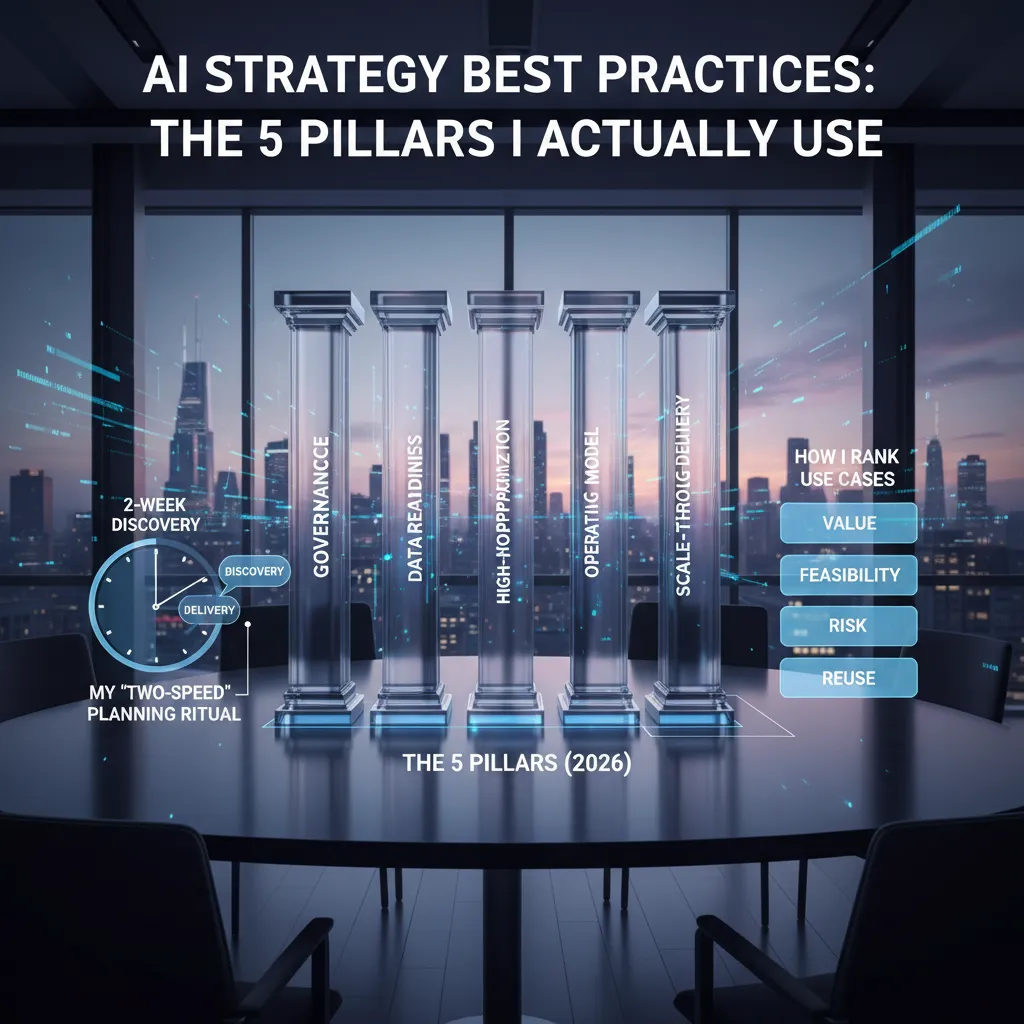
Turning AI Strategy Into People-First Leadership (My hard lesson)
My quick confession: it “worked” technically, but failed socially
I once led an AI rollout that hit every technical target: clean data, solid model, fast deployment. The dashboard looked great. But the teams avoided it, managers didn’t trust it, and frontline staff felt watched instead of helped. In the end, adoption was low and the business impact was close to zero. That failure mattered more than any model metric, because it showed me a hard truth from The Complete Leadership AI Strategy Guide: AI strategy is a leadership problem before it is a technology problem.
The core leadership challenge: ownership vs. delegation
The mistake was subtle. I treated AI like a project I could hand off to “the AI team.” I delegated decisions that should have stayed with leaders: what success looks like, who is accountable, and how work will change. When leaders step back, people fill the gap with fear, rumors, and resistance.
- Ownership means leaders set the purpose, guardrails, and outcomes.
- Delegation means experts build the system, but they don’t “own” the change.
People strategy before platform
In 2026, the real bottleneck is rarely the tool. It is skills, accountability, and trust. I now start with three questions:
- Who needs new skills to work with AI outputs, not just use a button?
- Who is accountable when AI is wrong, biased, or unclear?
- What will we do to earn trust: transparency, feedback loops, and human override?
If I can’t answer these, I don’t buy more software.
The value sentence I use to keep it human
To avoid “AI for AI’s sake,” I write one simple line and make leaders sign off:
For [who], AI will [do what], so we get [business impact].
Example:
For customer support agents, AI will draft first replies, so we reduce handle time by 15% without lowering CSAT.
Wild card analogy: kitchen service, not a cookbook
AI strategy is a kitchen service, not a cookbook. Ingredients (models, data, vendors) matter, but roles and timing decide whether the meal works. Who preps, who cooks, who tastes, and who serves? That is people-first leadership.
AI Strategy Best Practices: The 5 Pillars I Actually Use
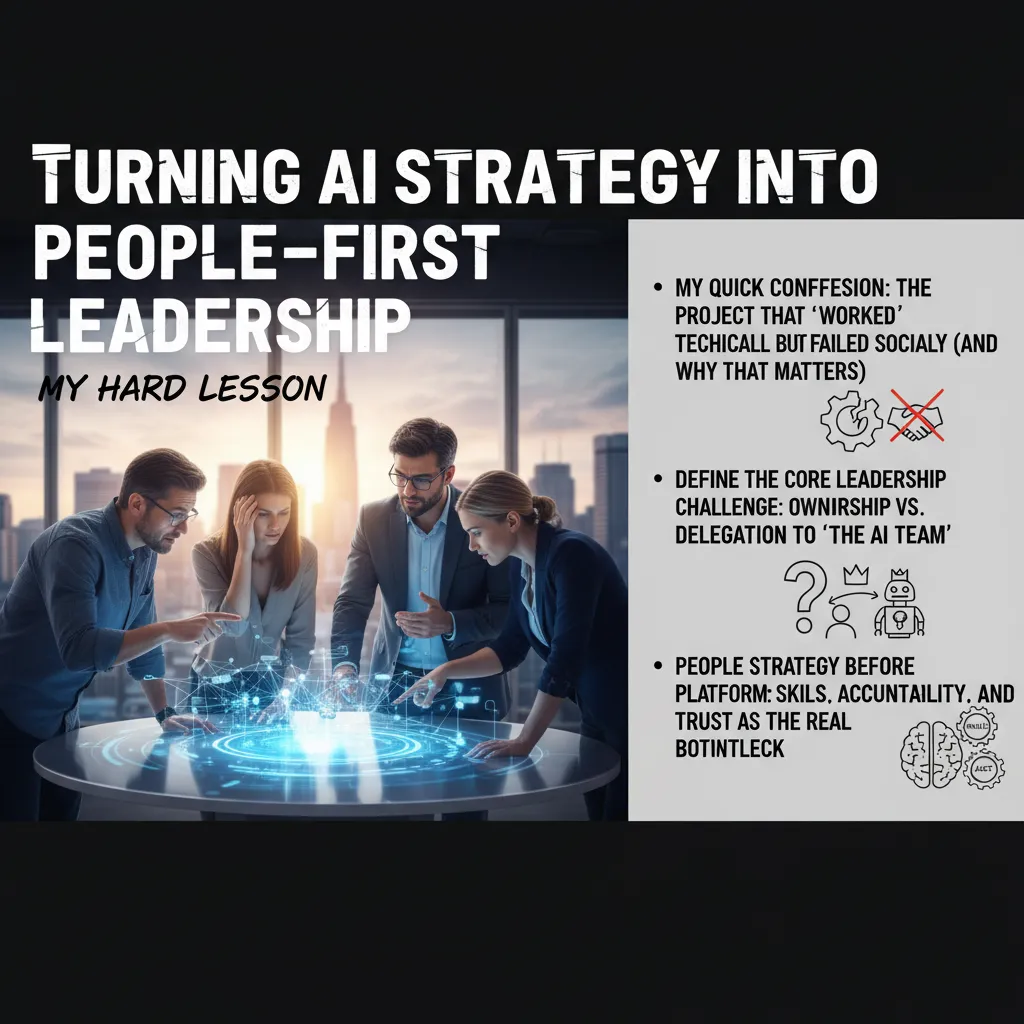
In 2026, I keep my AI strategy simple and people-first by anchoring it to five pillars from The Complete Leadership AI Strategy Guide. When leaders ask for “the framework,” this is the one I actually use because it turns AI from a buzzword into a repeatable operating rhythm.
The five pillars (2026)
- Governance: clear decision rights, model risk rules, and human accountability (not “the vendor said so”).
- Data readiness: trusted data, access paths, and basic quality checks before we automate anything.
- High-ROI prioritization: focus on outcomes (time saved, revenue protected, errors reduced), not demos.
- Operating model: who builds, who approves, who runs it, and who supports users day-to-day.
- Scale-through-delivery: shipping into real workflows with training, monitoring, and change management.
My “two-speed” planning ritual (keeps hype in check)
I run AI planning in two speeds: 2-week discovery and 2-quarter delivery. Discovery is for scoping, data checks, and risk review. Delivery is for building, integrating, training, and measuring. If a team can’t name what changes over two quarters, it’s usually not ready.
How I rank “strategic” use cases
When everyone says their idea is strategic, I score four factors:
- Value: measurable impact tied to a business KPI.
- Feasibility: data availability, integration effort, and team capacity.
- Risk: privacy, bias, safety, regulatory exposure, and reputational harm.
- Reuse: can we reuse data products, prompts, components, or patterns across teams?
Tiny tangent: why “pilot purgatory” happens
Pilot purgatory shows up when pilots have no owner, no production path, and no deadline. I spot it in meeting invites that say “AI sync,” “explore,” “brainstorm,” with no decision maker, no metrics, and no integration partner.
Checkpoint list: what must be true before you scale
- Named executive sponsor and product owner
- Documented governance and risk sign-off path
- Data sources validated and access approved
- Baseline metrics and target outcomes defined
- User workflow and training plan ready
- Monitoring plan for quality, drift, and incidents
- Support model (help desk, runbooks, escalation) in place
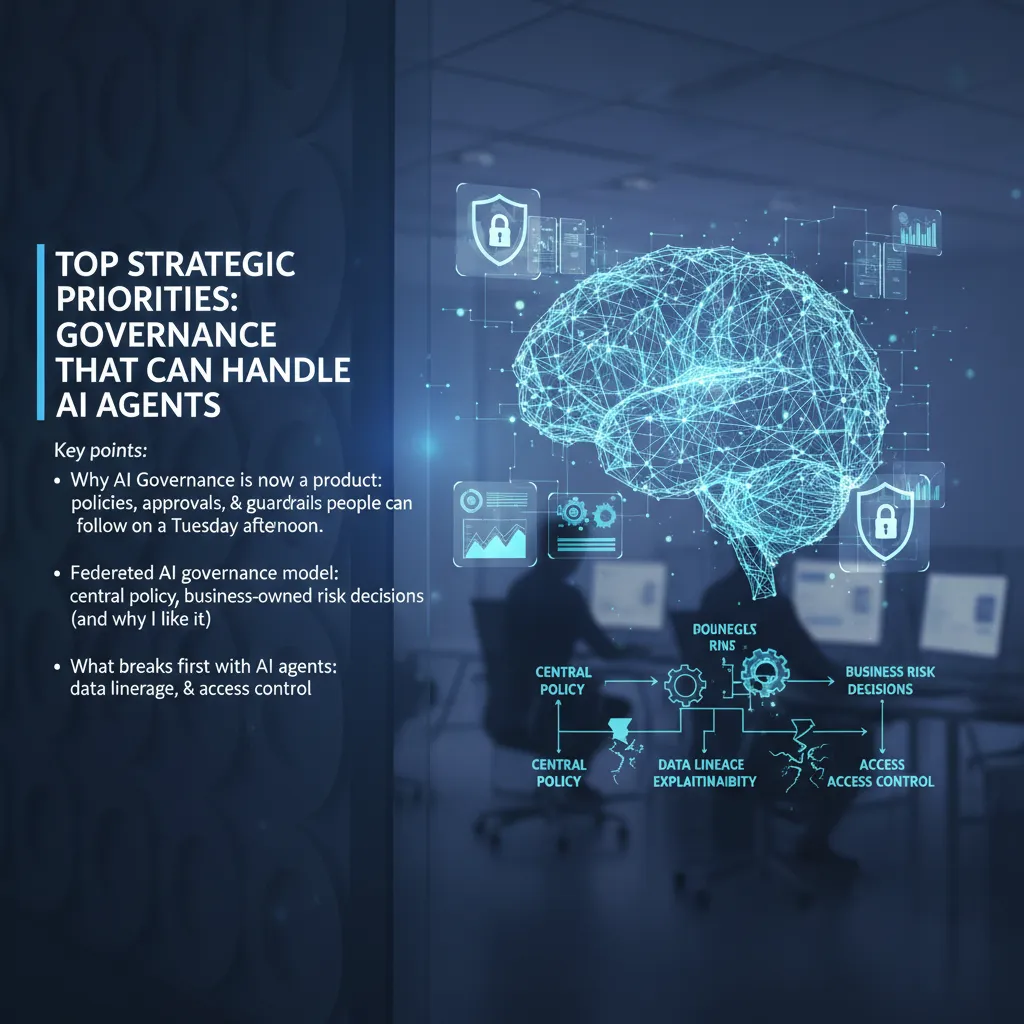
Top Strategic Priorities: Governance That Can Handle AI Agents
Why AI governance is now a product
In 2026, I treat AI governance like a product, not a policy binder. If people can’t follow it on a Tuesday afternoon, it won’t be used. Good governance gives teams clear guardrails, fast approvals, and simple “yes/no” checks before an AI agent touches customer data or triggers actions in systems.
Federated governance: central policy, business-owned risk
The model I like most is federated AI governance: a small central group sets standards, while business leaders own risk decisions for their use cases. Central teams should define what “safe” means (privacy, security, audit), but the business should decide what trade-offs are acceptable, because they understand the workflow, the customer impact, and the cost of delay.
What breaks first with AI agents
AI agents don’t just answer questions; they act. The first cracks I see are:
- Data lineage: teams can’t trace what data the agent used, when, and why.
- Explainability: no one can explain the agent’s decision path in plain language.
- Access control: agents get broad permissions “for convenience,” then become a security risk.
A pragmatic governance starter kit
From The Complete Leadership AI Strategy Guide, I borrow a simple starter kit that scales:
- Roles: Executive sponsor, AI product owner, risk owner, security, legal, and an on-call incident lead.
- Escalation paths: one page that says who decides, and how fast.
- Model cards: purpose, data sources, limits, evaluation results, and approved actions.
- Incident drills: practice “agent did the wrong thing” before it happens.
Risk management without fear
Instead of fear-mongering, I run a pre-mortem with execs:
“It’s six months from now and this AI agent caused a serious issue. What happened?”
We list failure modes, rank them, and assign owners. This turns anxiety into a plan, and makes AI risk management a normal leadership habit.
Operating Model That Ships: From Sandbox to Business Value
When leaders ask me why their AI pilots never become real business value, I start with one operating model question: “Who wakes up at 2 a.m. when it breaks?” If nobody owns that moment, you don’t have a product—you have a demo. In 2026, a people-first AI strategy needs clear ownership, clear lanes, and clear outcomes.
Define delivery lanes (and stop mixing them)
I separate work into three delivery lanes so teams don’t confuse learning with shipping:
- Experimentation: fast tests, small data, tight guardrails, short timeboxes.
- Production: reliability, monitoring, incident response, change control.
- Scale: repeatable patterns, shared platforms, training, rollout support.
Mixing these lanes is how “quick prototypes” become fragile systems that burn out teams.
Business value isn’t a slide
I treat AI business value like any other delivery commitment: measurable outcomes, named owners, and timelines. If we can’t write it down, we can’t manage it.
| Outcome | Owner | Timeline |
|---|---|---|
| Reduce handle time by 10% | Support Ops Lead | 90 days |
| Cut rework by 15% | Process Owner | 120 days |
Data readiness reality (the unglamorous work)
Most AI transformation work is not model tuning. It’s data quality, access, and definitions. I push teams to agree on:
- Quality: missing fields, duplicates, and drift checks.
- Access: who can use what data, and under what controls.
- Definitions: one shared meaning for key metrics and labels.
Mini playbook: my AI transformation squad
“If it’s everyone’s job, it’s no one’s job.”
- Product: sets the problem, success metrics, and roadmap.
- Data: builds pipelines, features, and evaluation.
- Risk: privacy, security, compliance, and model governance.
- Ops: workflow fit, training, monitoring, and support ownership.
AI Workforce & Leadership Skills: Building Teams (and AI Workers)
When I build an AI workforce in 2026, I don’t start by hiring a few data scientists and calling it done. I start by redesigning work. The real shift is mapping how decisions, handoffs, and approvals happen today, then rebuilding the process so humans and AI each do what they do best.
AI workers for end-to-end process automation
I treat “AI workers” as digital teammates that can run parts of a workflow from intake to output. They are great at speed, consistency, and first drafts. Humans stay essential where context and accountability matter.
- AI helps: triage, summarizing, drafting, routing, checking for missing fields, creating options.
- Humans stay essential: final decisions, sensitive conversations, exceptions, ethics, and sign-off.
My rule: if the task needs judgment people will defend in public, a human owns it.
The AI skills stack I look for in leaders
From The Complete Leadership AI Strategy Guide, I focus on four leadership skills that scale across teams:
- Framing: turning a vague goal into a clear problem statement and success measure.
- Data pragmatism: knowing what data you have, what you need, and what “good enough” looks like.
- Risk tradeoffs: balancing speed vs. safety, automation vs. control, and cost vs. quality.
- Storytelling: explaining the “why,” the limits, and the new way of working in plain language.
My favorite exercise: prompt-to-policy
I ask teams to take one helpful prompt and make it repeatable:
- Write the prompt that gets a useful output.
- Add constraints: tone, sources, privacy rules, and “do not” items.
- Turn it into a checklist and a review step.
Prompt + Rules + Review = Process
What I’d put in a 6-week internal AI leadership course
| Week | Focus |
|---|---|
| 1 | AI basics, limits, and common failure modes |
| 2 | Process redesign and where automation fits |
| 3 | Data, evaluation, and “good enough” quality |
| 4 | Risk, privacy, and governance in daily work |
| 5 | Prompt-to-policy workshop with real workflows |
| 6 | Change leadership: adoption, metrics, and coaching |
AI Product Strategy Without the Hype: Budget, Build, Buy, Borrow
In The Complete Leadership AI Strategy Guide, I keep AI product strategy simple: decide fast, learn safely, and ship only what people will use. I use a decision tree so we stop debating and start testing.
My Build / Buy / Borrow Decision Tree
- Build when the workflow is core to our advantage, data is unique, and we can maintain it for 12–24 months.
- Buy when the problem is common (search, meeting notes, ticket triage) and a vendor already meets security and compliance.
- Borrow (partner) when we need speed, domain expertise, or shared risk (co-develop with a vendor or integrator).
- Stop debating when we can run a 2-week pilot with clear success metrics. If we can’t define metrics, we’re not ready.
Budgeting: Learning Spend vs Production Spend
I separate budgets to protect momentum:
- Learning spend: small experiments, sandbox data, training, and time for teams to practice.
- Production spend: integration work, monitoring, security reviews, and change management.
This keeps “trying AI” from quietly becoming “running AI in production” without controls.
Evaluating Tools Without Tool-Worship
I score tools on what matters in real operations:
- Integration: SSO, APIs, logging, and how it fits our stack.
- Governance fit: audit trails, access controls, retention, and vendor risk.
- Data constraints: where data lives, what can’t leave, and what must be masked.
Autonomous Agents: Useful vs Liability (Right Now)
Agents help with bounded tasks like drafting, routing, and summarizing with human approval. They become a liability when they can trigger actions across systems without strong permissions, testing, and rollback.
If My CFO Demands ROI in 90 Days, Here’s My Monday Plan
- Pick one high-volume workflow (e.g., customer support triage) with baseline metrics.
- Buy or borrow first; avoid custom model training.
- Ship a human-in-the-loop pilot in 2 weeks.
- Track ROI weekly: time saved, cycle time, deflection rate, and quality checks.
- Scale only after governance sign-off and a clear owner for ongoing ops.
Conclusion: The AI Leadership Course I’d Give My Past Self
If I could teach my past self one lesson from The Complete Leadership AI Strategy Guide, it would be this: ownership beats optimism. In 2026, a people-first AI strategy is not about believing AI will “transform everything.” It is about taking clear responsibility for how AI changes work, decisions, and trust. The five pillars only matter when they protect people: clear governance, ready data, a working operating model, a prepared workforce, and outcomes you can measure.
My North Star Checklist for AI Strategy
When I feel pulled in ten directions by new tools, I come back to one simple checklist. Do we have governance that sets rules, risk limits, and accountability? Is our data readiness real, not assumed—clean inputs, access controls, and clear ownership? Do we have an operating model that explains who builds, who approves, and who maintains AI in daily workflows? Are we investing in the workforce with training, role clarity, and support for change? And can we prove measurable outcomes like cycle time, quality, cost, or customer impact?
What I’d Do in the Next 30 Days
I would stop trying to “AI everything.” I’d pick two high-ROI use cases tied to real pain—one internal efficiency win and one customer-facing improvement. Then I’d set lightweight governance: a named owner, a risk review, and a simple policy for data and prompts. Finally, I’d ship one workflow end-to-end, even if it is small, so the team learns by doing and trust grows through results.
Where AI Trends Fit (and Where They Don’t)
I’d keep a watchlist, not a wish list. Agents, multimodal tools, and new models matter only when they support the strategy and the people doing the work. If a trend cannot map to a use case, a risk plan, and a metric, it stays on the watchlist.
Dear 2030 me: Remember that leadership did not become “managing AI.” It became designing work—protecting trust, setting standards, and helping people grow with the tools. Keep the humans in the loop, and keep the outcomes honest.
TL;DR: AI strategy in 2026 is less about picking shiny tools and more about people-first leadership: clear ownership, a federated AI governance model, data readiness, an operating model that can ship, and a measurable portfolio of high-ROI use cases. Treat AI as a leadership skill, build an AI workforce that pairs humans with AI workers/agents, and measure business outcomes early—because adoption without EBIT impact is just expensive enthusiasm.