
Last spring I watched a tiny campaign spreadsheet turn into a hydra: five tabs for leads, three for content briefs, and one ominous column labeled “AI??” I did what any tired marketer would do—I started trialing AI marketing automation tools like it was a hobby. The surprise wasn’t that the tools were powerful. It’s that they’re powerful in very different ways, and picking the wrong “all-in-one” can slow you down faster than no tool at all. This post is my field-guide-style comparison: what each platform is good at, what it’s secretly bad at, and how to choose without getting dazzled by demos.
1) My not-so-scientific way to compare AI marketing platforms
When I compare AI marketing platforms for 2026, I don’t start with feature lists. I start with the bottleneck the tool removes. In my notes from Top Marketing Tools Compared: AI-Powered Solutions, the winners usually solve one of three problems: time (faster output), quality (better messaging and creative), or visibility (what’s actually working?). If a tool can’t clearly move one of those, it’s just “nice to have.”
The demo effect is real
Day 1 demos are designed to sparkle. So I run a simple test: I use the tool for a few real tasks, then I write down what broke on day 3. That’s when the friction shows up—limits, messy workflows, confusing permissions, or “AI” features that are really just templates. I care less about what dazzled on day 1 and more about what still works when I’m tired and busy.
My quick rubric (the stuff that matters)
- Setup time: Can I get value in an hour, or does it take a week?
- Learning curve: Is it simple, or do I need training videos and a Slack channel?
- Integration depth: Does it connect to my CRM, ads, email, and analytics—or just export a CSV?
- AI style: Is it assistive (helps me write, plan, or analyze) or truly automated (runs workflows with rules and approvals)?
A small tangent: my “boring tool” slot
I always keep one slot open for a boring tool—often a spreadsheet. Sometimes the best “AI marketing tool” is a clean table that tracks campaigns, costs, and results without hiding the logic.
My rule: if the platform can’t explain why it made a suggestion, I don’t trust it with budget.

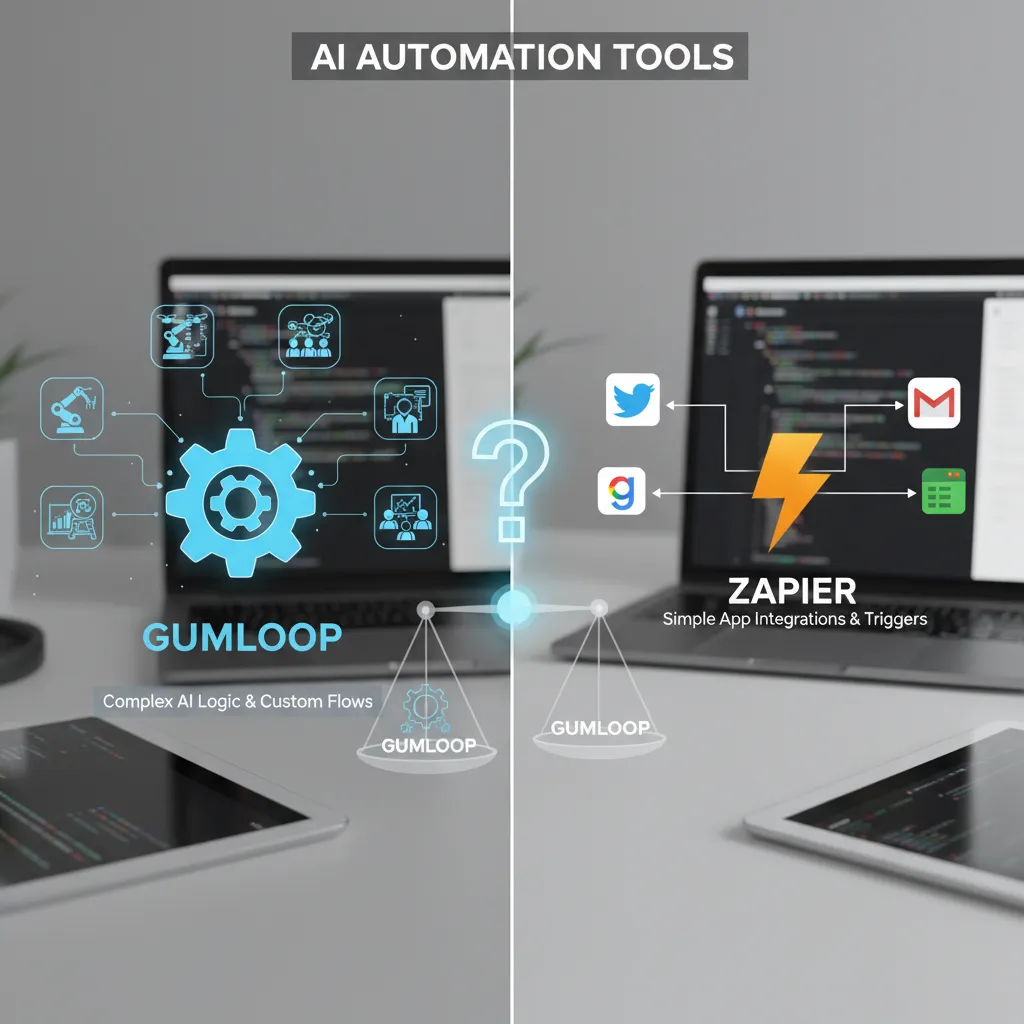
2) AI automation tools: where Gumloop fits (and when Zapier still wins)
When I compare AI marketing automation tools for 2026, I split them into two jobs: thinking and moving data. Gumloop shines when I want the “thinking” part inside the workflow—like chaining GPT-4, Claude, or Grok into steps without me writing code. My favorite Gumloop pattern is an auto-brief + QA checklist: it pulls a campaign goal, drafts a short creative brief, then runs a second model pass to check tone, claims, and missing info before anything goes live.
I still reach for Zapier a lot, though. It’s boring, but it’s dependable app-to-app glue. If I need a quick one-off fix—like “new Typeform response → add row to Google Sheets → ping Slack”—Zapier is usually faster to set up, easier to hand off, and less likely to break when I’m busy.
My workflow automation integration checklist (the unsexy stuff)
- Triggers: What starts the flow (webhook, form submit, new CRM record)?
- Error handling: Retries, fallbacks, and what happens when an AI step fails.
- Logging: A simple audit trail so I can see inputs/outputs and debug fast.
- Permissions: Who can access tokens, CRM fields, and scraped data.
Weekend scenario: solo marketer, full pipeline
If I’m a one-person marketing team building web scraping prospect research → outreach → CRM updates in a weekend, I’d use Gumloop to scrape pages, summarize each company, and generate a personalized first email. Then I’d use Zapier to push the final contact + notes into HubSpot/Salesforce, create tasks, and send alerts. That combo keeps the AI work flexible, while the integrations stay stable.
3) Content optimization software: Semrush vs Surfer SEO (plus Jasper when I’m stuck)
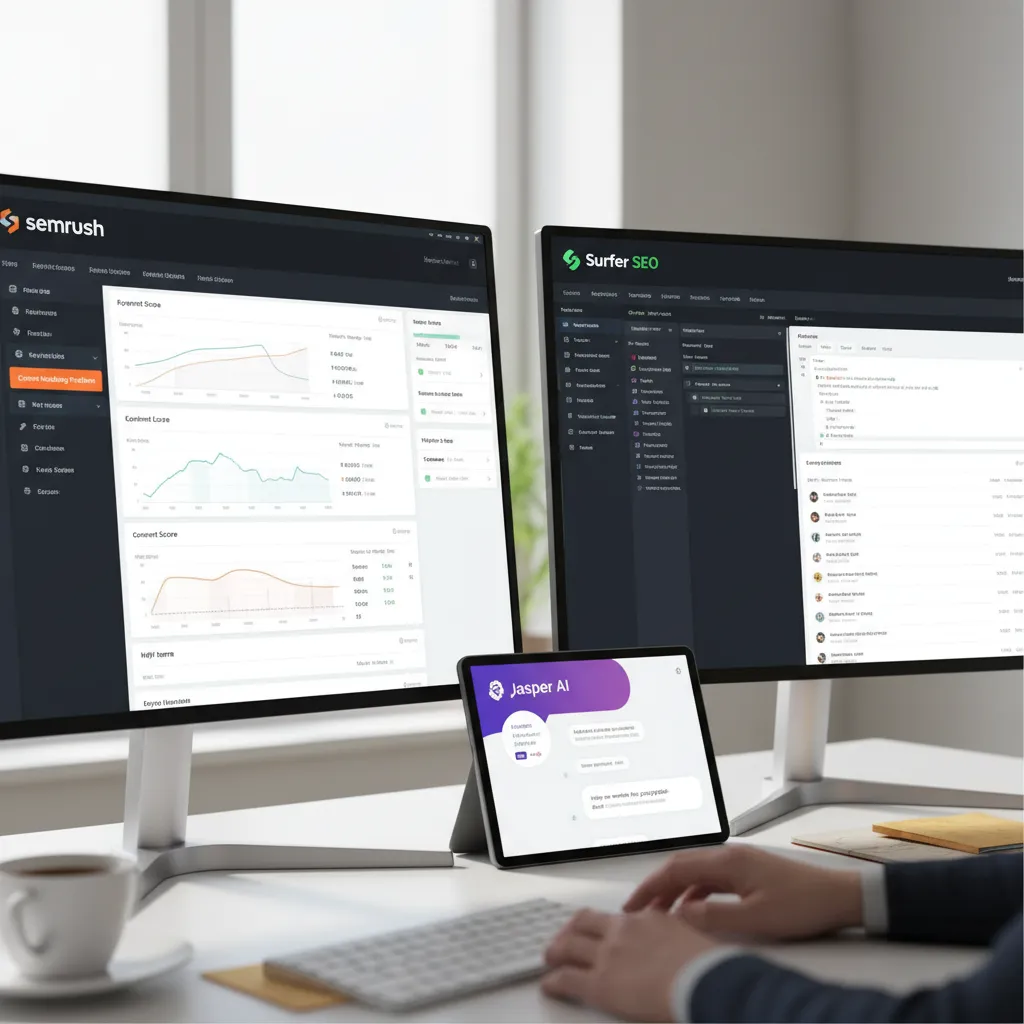
When I’m comparing AI marketing tools for 2026, I separate “planning” from “polishing.” That’s why I keep both Semrush and Surfer SEO in my stack, and I pull in Jasper when my brain is blank.
Semrush: my “Swiss Army knife” for quarterly planning
Semrush feels like the all-in-one tool I open when I’m mapping a quarter of content. I usually move through a simple flow:
- Topic Finder to spot themes and keyword clusters
- SEO Brief Generator to outline intent, headings, and key questions
- Content Optimizer to check coverage before I publish
This workflow keeps me focused on search intent and consistency across multiple posts, not just one page at a time.
Surfer SEO: my “tighten the screws” tool
Surfer SEO is what I use when a post is 80% done but not ranking. I’ll run the page through Surfer’s content optimization and look for practical gaps: missing subtopics, weak headings, or sections that are too thin. It’s less about big strategy and more about making a single URL stronger without rewriting everything.
Jasper: a sparring partner, not a ghostwriter
Jasper AI copywriting helps when I’m stuck on:
- headline options and hooks
- fresh angles for the same keyword
- rewrites to simplify a messy paragraph
Then I rewrite again so it sounds like me, not like a template.
Mini confession: the fastest way to ruin content is to chase a score and forget a human question.
I treat optimization scores as signals, not goals. If the page answers the reader clearly, the SEO tools usually fall into place.
4) Lead scoring automation & the ‘grown-up’ stacks: HubSpot, Salesforce Pardot, Adobe Marketo
Predictive lead scoring is where I stop guessing and start prioritizing (and yes, sales notices). Instead of debating “hot” leads in a meeting, I let behavior, fit, and intent signals roll up into a score I can trust. In the source material on AI-powered marketing tools, this is the point where automation moves from “nice to have” to revenue discipline.
HubSpot Marketing Hub + Analytics + Breeze
When I need speed, HubSpot is usually the quickest to implement. HubSpot marketing analytics paired with Breeze helps me get practical wins fast: cleaner email workflows, quick summaries of campaign performance, and content suggestions that don’t require a months-long project. It’s a strong choice when my team wants AI help inside the same place we already run email, landing pages, and reporting.
Salesforce Marketing Cloud (Pardot) + Einstein AI
Pardot (now under Salesforce Marketing Cloud) with Einstein AI is where things get serious. I use it when segmentation, account-based routing, and ROI tracking need to connect tightly to Salesforce CRM. The upside is deep data and strong attribution paths; the trade-off is that pricing and setup can feel “enterprise-first.”
Adobe Marketo Engage
Adobe Marketo is built for enterprise marketing automation and attribution modeling. When I run complex nurture tracks across many products or regions, Marketo can handle it—but it also feels like owning a race car (maintenance included). I plan for admin time, governance, and clean data to keep it fast.
- Best for speed: HubSpot + Breeze
- Best for Salesforce-native ops: Pardot + Einstein
- Best for enterprise scale: Adobe Marketo
5) Email marketing automation & send-time quirks I didn’t expect to matter
From the source notes in Top Marketing Tools Compared: AI-Powered Solutions, the “quiet” AI feature that kept showing up was email send-time optimization. I used to think it was a nice extra. In 2026, I treat it like a core lever—especially when your list is tired, your open rates are flat, and you’re trying to avoid burning out the people who still care.
Send-time optimization adds up (even when nothing else changes)
When an AI email tool can learn when each subscriber actually checks email, it stops forcing everyone into the same schedule. That small shift can lift results without rewriting copy or redesigning templates. It’s not flashy, but it compounds over weeks.
I compare tools less by templates and more by segmentation
Templates are easy to copy. What I look for is whether the platform uses AI to improve:
- AI-powered segmentation (grouping by behavior, not just tags)
- Engagement predictions (who is likely to open/click next)
- Deliverability hygiene (cleaning inactive contacts, throttling sends, spam-risk signals)
My rule: explain the “why,” or I won’t use it for launches
If your tool can’t explain why it picked a send time, I don’t trust it with big launches. I want a simple reason like: “This segment opens most often between 7–9pm local time,” or “Recent engagement dropped at morning sends.”
“If the AI can’t show its logic, it’s guessing—and guessing is expensive during launch week.”
Quick example: stop blasting everyone at 9am
I watched a mid-market newsletter switch from a fixed 9am blast to AI-driven timing. The tool split the list into smaller engagement bands, sent active readers in their usual windows, and slowed down sends to colder contacts. It started acting like a human, not a megaphone—and the list felt healthier fast.
6) Conversational marketing chatbots: Drift, plus the awkward truth about “instant” pipeline
When I compare AI marketing tools for 2026, I put Drift in a very specific lane: it shines when the job is qualify lead → book meeting → capture context for sales. If your goal is “answer everything for everyone,” most chatbots (and most teams) struggle. Drift works best when you design the conversation like a fast, helpful front desk—not a full support agent.
Where Drift actually wins
In conversational marketing, speed matters, but clarity matters more. Drift is strongest when it can route the right visitor to the right next step, without making them repeat themselves later.
- Qualification: firmographics, intent questions, and routing rules
- Meeting booking: calendar handoff that feels seamless
- Sales context: capturing pain points, timeline, and objections
Conversation intelligence is more than transcripts
A transcript is just a record. What I care about is patterns: common objections, buying signals, and the best moment to hand off to a human. That’s where “conversation intelligence” becomes useful for marketing and sales ops—because it helps you tune prompts, questions, and timing.
“Instant pipeline” is real only when your chat flow matches your ICP, your routing is tight, and sales actually follows up fast.
Pricing reality check (and why it feels awkward)
Drift pricing can range from $50–1,500+/month depending on features, seats, and scale. The awkward truth: paying more doesn’t automatically create pipeline. If your traffic is low, your offer is unclear, or your SDR response time is slow, “instant” becomes “eventually.”
Wild-card thought experiment
Before going live, I like this test: what if your chatbot had to pass a “polite human” Turing test? If it interrupts, over-promises, or asks five questions in a row, it fails. Keep it short, respectful, and genuinely helpful.
7) Landing page optimization & ad campaign optimization: the ‘last mile’ tools people forget
When I compare AI marketing tools for 2026, I notice a pattern: teams obsess over ad creative and budgets, but ignore the last mile—the landing page and the tracking that proves what worked. If ad spend looks fine but conversion is leaky, Unbounce is my go-to for landing page optimization.
Why Unbounce stays in my stack
I like Unbounce because it helps me move fast without guessing. I care most about form personalization, multivariate testing, and how cleanly it connects to the rest of my funnel. In practice, that means I can test different headlines, layouts, and form fields while still sending clean data into my CRM.
- Form personalization: I tailor questions by traffic source (paid search vs. LinkedIn) to reduce friction.
- Multivariate testing: I test combinations, not just one change at a time.
- Integrations: Smooth handoffs to HubSpot, Salesforce, or Marketo—often via Zapier—so leads don’t get lost.
Ad optimization is only as good as attribution
Ad campaign optimization is only as good as your attribution modeling and tracking—otherwise you’re tuning an instrument in the dark. I always check the basics before I “optimize” anything:
- UTMs are consistent and enforced.
- Conversion events match real pipeline stages, not vanity form fills.
- Offline conversions (SQLs, closed-won) can flow back to ad platforms.
“If you can’t trust the tracking, you can’t trust the optimization.”
A quick story from my own campaigns
I once boosted landing page copy and got more leads—but they were worse. The fix wasn’t another headline test. It was aligning the page promise and form fields with our lead scoring definition, so we attracted the right intent and routed it correctly.
8) Conclusion: my ‘tool diet’ for 2026 (and a simple buying map)
After comparing the AI-powered options in Top Marketing Tools Compared: AI-Powered Solutions, my 2026 “tool diet” is simple: I choose one core marketing automation platform, then I add specialist tools only where the bottleneck is loud. In practice, that means I want one system to own contacts, lifecycle stages, email, reporting, and handoffs to sales. Then I layer SEO/content, chat, and landing pages as needed—because those are the areas where AI marketing tools can remove the most friction without creating a messy stack.
If you’re mid-market, my sane default is HubSpot as the core, paired with Semrush or Surfer for SEO and content optimization, Drift for conversational chat and routing, and Unbounce for fast landing page testing. I like this mix because it covers the full funnel: attract, convert, qualify, and measure. You can swap pieces based on team strengths—if your writers love Surfer, keep it; if your SEO team lives in Semrush, lean there. The point is to keep the center of gravity in one place.
If you’re enterprise, Pardot (Marketing Cloud Account Engagement) or Marketo earns its keep when predictive lead scoring, attribution, and segmentation are non-negotiable. At that scale, the “best AI marketing tools” are the ones that keep data clean, governance tight, and reporting trusted across regions and teams.
Tools are like spices—more isn’t better; the right combo is.
My buying map is: pick your core platform first, confirm your biggest bottleneck second, then add one specialist at a time until the funnel stops squeaking.
TL;DR: If you need no-code workflow automation, start with Gumloop. For SEO content optimization, Semrush or Surfer SEO are the workhorses. For predictive lead scoring and enterprise-grade segmentation, look at Salesforce Pardot, Marketo, or HubSpot. For conversational marketing chatbots and fast pipeline capture, Drift is the cleanest bet. Match tools to your bottleneck (time, content, pipeline quality, or attribution), not to buzzwords.