The first time I watched a finance team “launch AI,” it looked like a magic trick: a bot summarized a QBR deck, everyone clapped, and then… nothing changed. Two quarters later, the close was still late, AP was still drowning in exceptions, and the ROI slide deck had quietly disappeared.
That experience made me stubborn about one thing: in finance, AI only counts when it touches the messy middle—approvals, reconciliations, vendor emails, controls, and the daily decisions we pretend are “quick.” This guide is how I now think about a finance AI strategy for 2026: fewer pilots for bragging rights, more boring wins you can measure.
Why 2026 Feels Like a Tipping Point (and a Trap) — AI in Finance 2026
In AI in Finance 2026, the adoption curve is real. I see it in vendor roadmaps, board decks, and even job titles. “Everyone’s doing AI” can be motivating because it reduces fear and creates budget momentum. But it’s also misleading. Adoption is not the same as advantage. When every finance team pilots the same tools, the differentiator becomes execution: controls, data quality, and whether the work actually changes decisions.
My contrarian take is simple: adoption is not success—value is the bottleneck. I’ve watched teams celebrate a chatbot demo while month-end close still runs on fragile spreadsheets. I’ve also seen “AI forecasting” projects that produce pretty charts but don’t improve cash planning, working capital, or risk outcomes. In 2026, the trap is mistaking activity for impact.
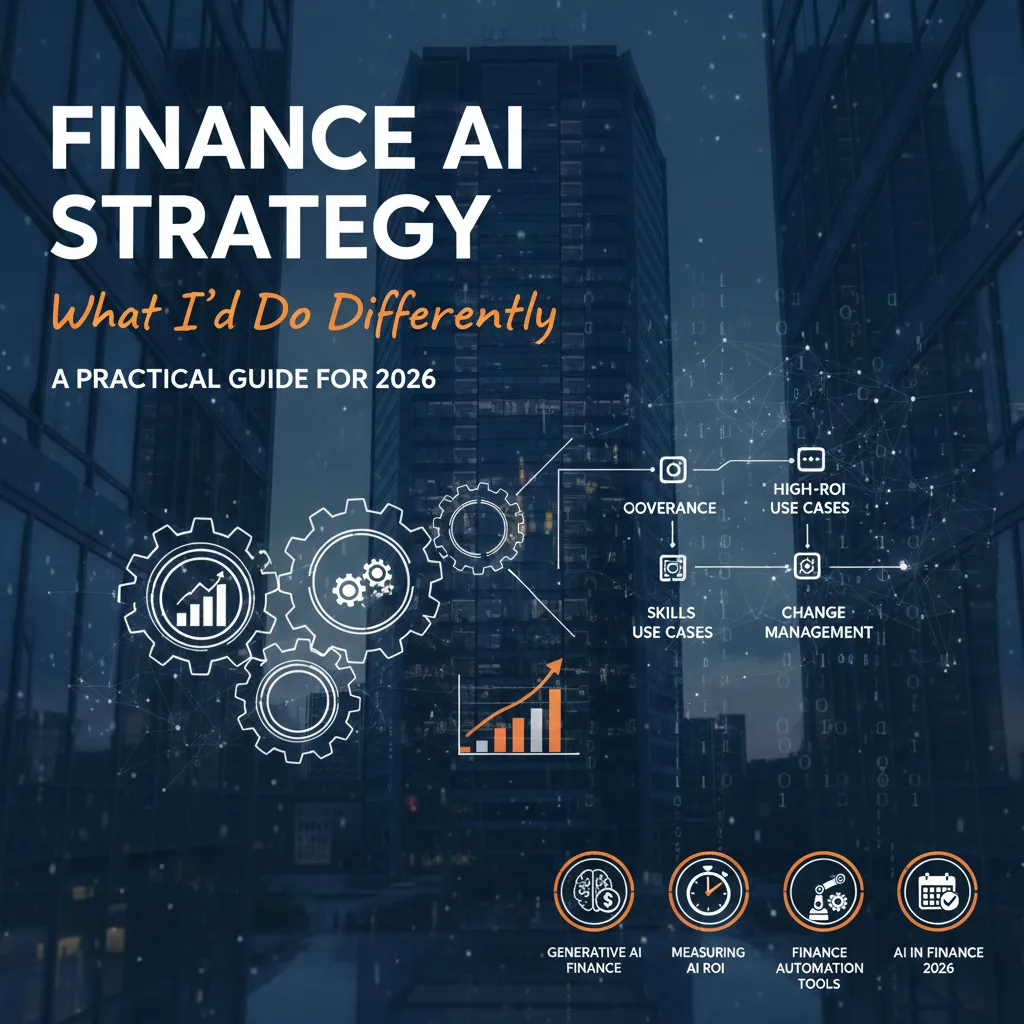
The 5 pillars I use to sanity-check Finance Digital Transformation
When I review any finance AI strategy, I run it through five pillars from The Complete Finance AI Strategy Guide mindset: if one pillar is weak, the whole program wobbles.
- Governance: model risk, approvals, audit trails, and clear ownership.
- Data/platform: trusted data sources, integration, security, and scalable architecture.
- Use cases: a ranked backlog tied to measurable finance outcomes (time, cost, risk, accuracy).
- Talent: finance translators, data/AI skills, and vendor management—not just “one AI lead.”
- Change: process redesign, training, comms, and incentives so people actually use the new way.
A quick tangent on budgeting and controls
“We’ll figure the controls later.”
This is the most dangerous sentence in finance budgeting. In AI programs, “later” becomes rework: access rules, segregation of duties, prompt logging, model monitoring, and documentation. If controls are bolted on after pilots, teams either slow down or ship risky automation. I now budget governance and compliance work from day one.
Mini self-audit: planning vs production vs scaled use
- Planning: Do we have named owners, a use-case scorecard, and a data readiness view?
- Production: Are any AI workflows live with monitoring, audit evidence, and support SLAs?
- Scaled use: Are we reusing components (data, prompts, controls) across teams, or rebuilding each time?

Measuring AI ROI Without Fooling Myself (Measuring AI ROI)
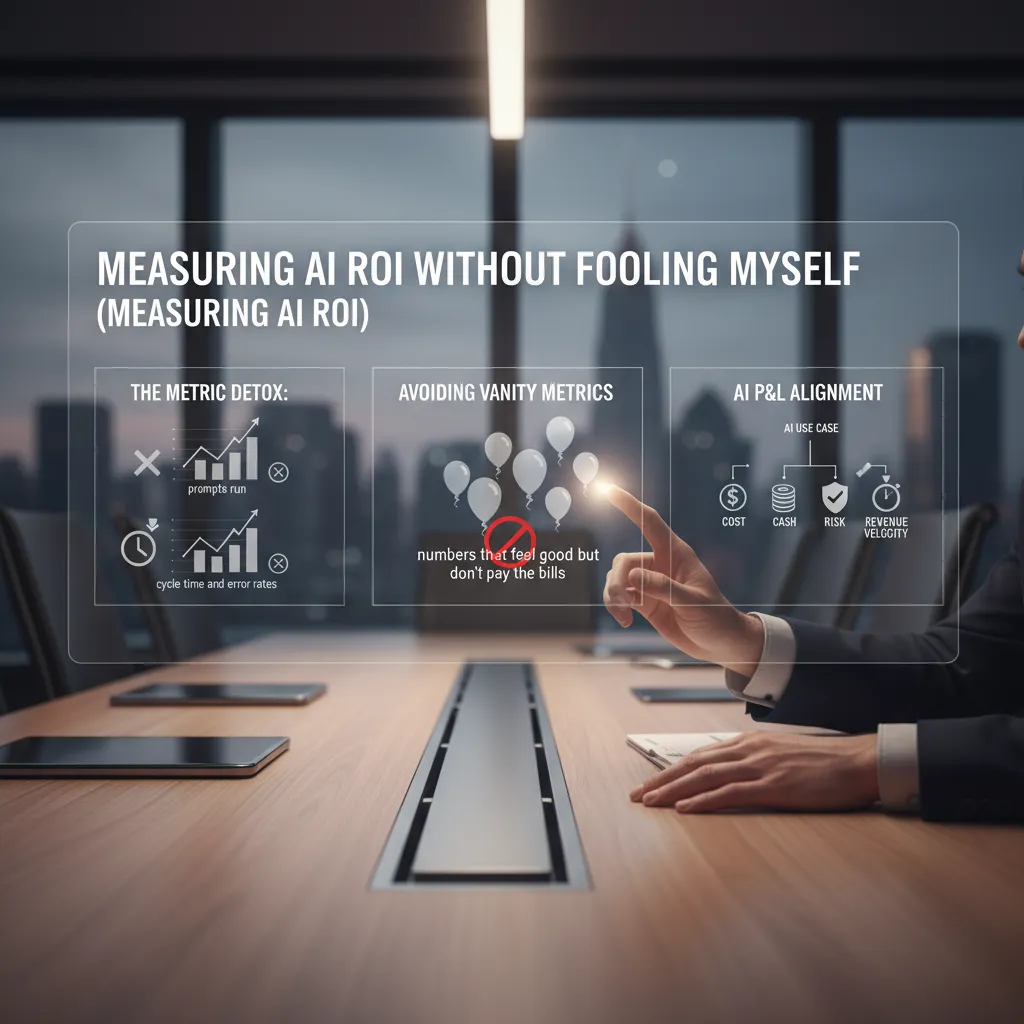
The metric detox: from “prompts run” to cycle time and error rates
Early on, I reported prompts run like it meant progress. It didn’t. In The Complete Finance AI Strategy Guide, the real win is operational: faster close, cleaner reconciliations, fewer rework loops. So I switched to metrics that show whether finance work is actually getting better: cycle time (how long a task takes end-to-end) and error rates (how often humans must fix AI output). If AI makes a process 20% faster but doubles corrections, ROI is fake.
Avoiding vanity metrics
These numbers feel good in a slide deck, but they don’t pay the bills:
- Prompts run or “AI queries per week”
- Users onboarded without active usage tied to a workflow
- Time saved based on surveys instead of timestamps
- Model accuracy measured in a lab, not in production exceptions
- Documents summarized with no downstream decision impact
Now I ask one blunt question: What finance outcome moved?
AI P&L alignment: one use case, one lever
I stopped letting projects claim “strategic value” in general. I map each AI use case to one P&L lever, then measure it like a finance leader would:
- Cost: fewer hours in AP matching, close tasks, or audit prep
- Cash: faster dispute resolution, better collections prioritization
- Risk: fewer policy exceptions, stronger controls testing coverage
- Revenue velocity: quicker pricing approvals, faster quote-to-cash handoffs
“If I can’t tie an AI workflow to a single lever, I’m not ready to claim ROI.”
A simple ROI scorecard I’d actually show a CFO
| Workflow | Baseline | Target | Owner | Review cadence |
|---|---|---|---|---|
| AP invoice coding assist | 6.0 min/invoice, 4% rework | 4.5 min, 2% rework | AP Manager | Weekly |
| Close variance commentary | 3 days, 12% corrections | 2 days, 5% corrections | Controller | Monthly |
Wild card: if my budget got cut 30%
I’d keep AP invoice processing with human-in-the-loop controls. It hits cost immediately, improves cycle time, and is easy to audit. Everything else can wait if cash and accuracy are protected.
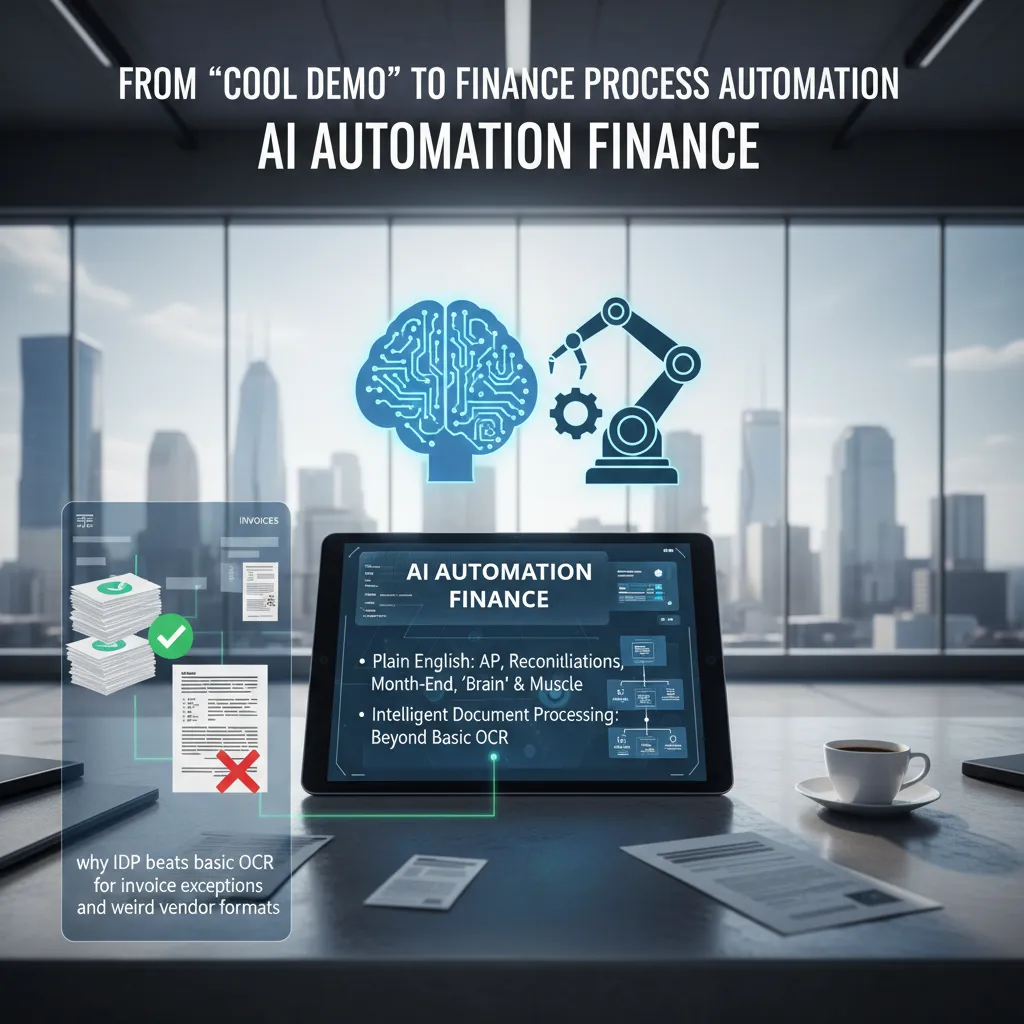
From “Cool Demo” to Finance Process Automation — AI Automation Finance
In my early Finance AI Strategy work, I chased “cool demos” that looked great in a meeting but didn’t change the close calendar. What I’d do differently is start with AI Automation Finance in plain English: pick the finance work that is repetitive, rules-based, and high-volume—then automate it end to end.
Where automation pays off fastest
The fastest wins usually show up where teams spend hours moving data between systems and chasing exceptions. If I were rebuilding my roadmap, I’d prioritize:
- Accounts Payable (AP): invoice intake, coding suggestions, exception routing, and payment status updates
- Reconciliations: matching bank/GL/subledger items and explaining breaks
- Month-end close: checklist execution, variance commentary drafts, and task reminders
- Expense: policy checks, receipt capture, and faster employee Q&A
Generative AI workflows + RPA: the “brain” and “muscle” combo
What finally clicked for me is that generative AI is the brain (it reads, interprets, and drafts), while RPA is the muscle (it clicks, posts, and moves data). Alone, each one hits a wall. Together, they handle real finance work:
Generative AI decides what to do next; RPA executes how it gets done in the system.
For example, AI can classify an invoice exception and draft a resolution note, while RPA opens the ERP, updates fields, and routes approval.
Why IDP beats basic OCR for messy invoices
I used to think OCR was “good enough.” It isn’t when vendors send odd formats, split line items, or include credits and freight in strange places. Intelligent Document Processing (IDP) goes beyond text capture: it understands document structure, learns vendor patterns, and flags low-confidence fields. That’s the difference between “data extracted” and “invoice ready to post,” especially for exceptions.
Vendor communication: same work, just faster
Finance teams already write the same emails all day: “We need a PO,” “Your remit details don’t match,” “Payment is scheduled for Friday.” Natural language tools can draft these messages, pull context from the ticket, and log the interaction—while keeping humans in the loop for edge cases.
Fraud detection and compliance: build controls into the workflow
The mistake I’d avoid is stapling controls on later. I’d design them inside the automation: segregation of duties, approval thresholds, audit logs, and anomaly checks (new vendor + bank change + urgent payment) before anything posts. In AI Automation Finance, controls are part of the process, not a separate step.
Cash Flow Management That Updates While I’m in Meetings
If I were rebuilding my finance AI strategy, I’d start with AI cash flow forecasting that refreshes daily, not monthly. When forecasts update once a month, I spend the first week explaining why the numbers are already old. When they refresh daily, the conversation changes: I stop defending a static model and start managing decisions as they happen—collections, payment timing, and inventory buys.
AI Cash Flow Forecasting: Daily Refresh Changes the Job
Daily updates mean I can see the impact of a late customer payment or a surprise vendor invoice before it becomes a “month-end issue.” The best part is not the prediction itself; it’s the speed of feedback. I can test a change (like tightening credit terms for one segment) and watch the forecast adjust within days.
Real-Time Data Analysis: Working Capital as a Live Dashboard
In “The Complete Finance AI Strategy Guide,” the big shift is treating working capital as a living system. I’d turn what used to be a quarterly slide into a dashboard that pulls from ERP, billing, bank feeds, and CRM. While I’m in meetings, the dashboard updates and flags what needs attention.
- Cash in: expected receipts by customer, with confidence ranges
- Cash out: upcoming payments, grouped by vendor and due date
- Working capital: DSO, DPO, and inventory signals in one view
AI Working Capital Management: Practical Levers I’d Use
I’d focus on levers that teams can actually pull:
- DSO: AI prioritizes collections by “risk of slip,” not just aging. It suggests who to call first and what invoices are likely to dispute.
- DPO: AI recommends payment timing that protects cash without breaking vendor trust (and highlights early-pay discounts worth taking).
- Inventory signals: even if finance doesn’t “own” inventory, AI can flag slow movers, stockout risk, and purchase orders that will strain cash.
Predictive Analytics Finance: Scenario Planning I Can Explain
I’d keep scenarios simple enough for non-finance teammates: “If renewals slip by 10 days, here’s the cash gap,” or “If we reduce inventory buys by 5%, here’s the runway.” I like using clear labels and a small table:
| Scenario | Assumption | Cash Impact (30 days) |
|---|---|---|
| Base | Normal collections | Stable |
| Slow pay | +10 days DSO | Cash tight |
| Inventory pause | -5% purchases | Cash improves |
Small confession: I once trusted a forecast that looked perfect; the messy one was right.
The “perfect” model smoothed out reality. The messy forecast showed uncertainty, exceptions, and timing risk—and that’s what cash management really is.
Agentic AI Finance: When the System Starts “Doing” (Carefully)
Agentic AI systems vs chatbots: the moment AI moves from answering to acting
In my earlier finance AI plans, I treated AI like a smarter search box: ask a question, get an answer. But agentic AI is different. A chatbot talks. An agent does. It can pull data, run checks, draft entries, route approvals, and trigger workflows. That shift matters in finance because “doing” can change numbers, timing, and risk. So if I were rebuilding my Finance AI Strategy today, I’d draw a hard line between advice and action, and I’d only allow action when the controls are strong.
Finance AI implementation: guardrails I’d demand
Before any agent touches a real process, I’d require guardrails that look like finance controls, not tech features. Specifically:
- Approval chains: the agent can prepare, but a human approves anything that posts, pays, or commits budget.
- Audit trails: every step logged—inputs, data sources, prompts, outputs, timestamps, and who approved.
- Human override: a clear “stop” button and a way to roll back actions fast.
- Permissioning: least-privilege access, with separate roles for read, draft, and execute.
I’d also insist on simple thresholds: under a certain dollar amount the agent can draft and route; above it, the chain gets longer. That keeps speed where it’s safe.
Decision support agents: resource allocation in natural language
Where I see quick value is decision support. I want an agent that lets leaders ask, in plain language, “If we cut vendor spend by 8% and shift two hires to Q3, what happens to cash runway?” The agent can translate that into scenarios, pull the right drivers, and return options with assumptions. That saves time because finance teams stop rebuilding the same models for every meeting.
My rule: the agent can simulate freely, but it can’t commit without review.
Strategic planning control without red tape
I’d keep strategy flexible by using “lightweight controls”: standard templates, pre-approved data sources, and short approval paths for experiments. Controls should protect the business, not slow it down.
My wild card analogy
I treat agentic AI like giving an intern a company card—very useful for speed, but never unsupervised. The card limit, receipts, and manager sign-off are the whole point.
The People Part: Skills, Outsourcing, and Change Management
If I could redo our Finance AI strategy, I’d start with people, not platforms. In The Complete Finance AI Strategy Guide, the message is clear: AI adoption in finance stalls because the skills gap is not a footnote—it’s the plot. We expected “smart tools” to fix messy work. But the real blocker was that many of us didn’t know how to frame good questions, test outputs, or spot risk. Without those basics, even great models become expensive confusion.
Outsourced Services: Smart Help vs. a Crutch
Outsourcing can be the fastest way to move, especially for data engineering, model setup, or security reviews. It becomes a crutch when the vendor is the only one who understands the workflow. If I did it again, I’d structure vendor communication around three simple rules: one named finance owner, one named technical owner, and one shared backlog. I’d also require short weekly demos using our real data, plus a written “decision log” that explains what changed and why. That keeps learning inside the team, not trapped in a slide deck.
A Lightweight 30-60-90 Enablement Plan
Instead of broad “AI training,” I’d run role-based practice. In the first 30 days, FP&A would learn prompt basics, variance story checks, and how to validate numbers against source systems. AP would focus on invoice exception handling, vendor master data hygiene, and how to review AI-suggested coding. Controllership would practice policy mapping, audit trails, and approval logic—because controls are where automation often breaks.
By 60 days, each group would ship one small use case with clear success metrics. By 90 days, we’d rotate “AI champions” so knowledge spreads, and we’d document what humans must still do every time.
Change Management: The Awkward Conversations
The hardest part wasn’t the model—it was ownership. Who owns the bot? Who signs off on postings? Who gets paged at 2 a.m. when an integration fails? I learned to treat bots like junior staff: they need supervisors, escalation paths, and limits. We also had to be honest about job impact, and reframe it as shifting time from rework to review.
My closing reflection is simple: the most “AI” thing I did was rewrite our SOPs, not buy software. Once the work was clear, automation finally had something stable to follow.
TL;DR: In 2026, finance AI strategy isn’t about owning the coolest model—it’s about measurable business outcomes. Start with governance and data readiness, pick high-ROI workflows (AP, fraud, forecasting, reporting), combine Generative AI (the “brain”) with RPA (the “muscle”), and measure ROI with outcome metrics (not vanity metrics). Expect skills gaps; many teams will use outsourced services to move faster, but you still need change management to make AI adoption stick.