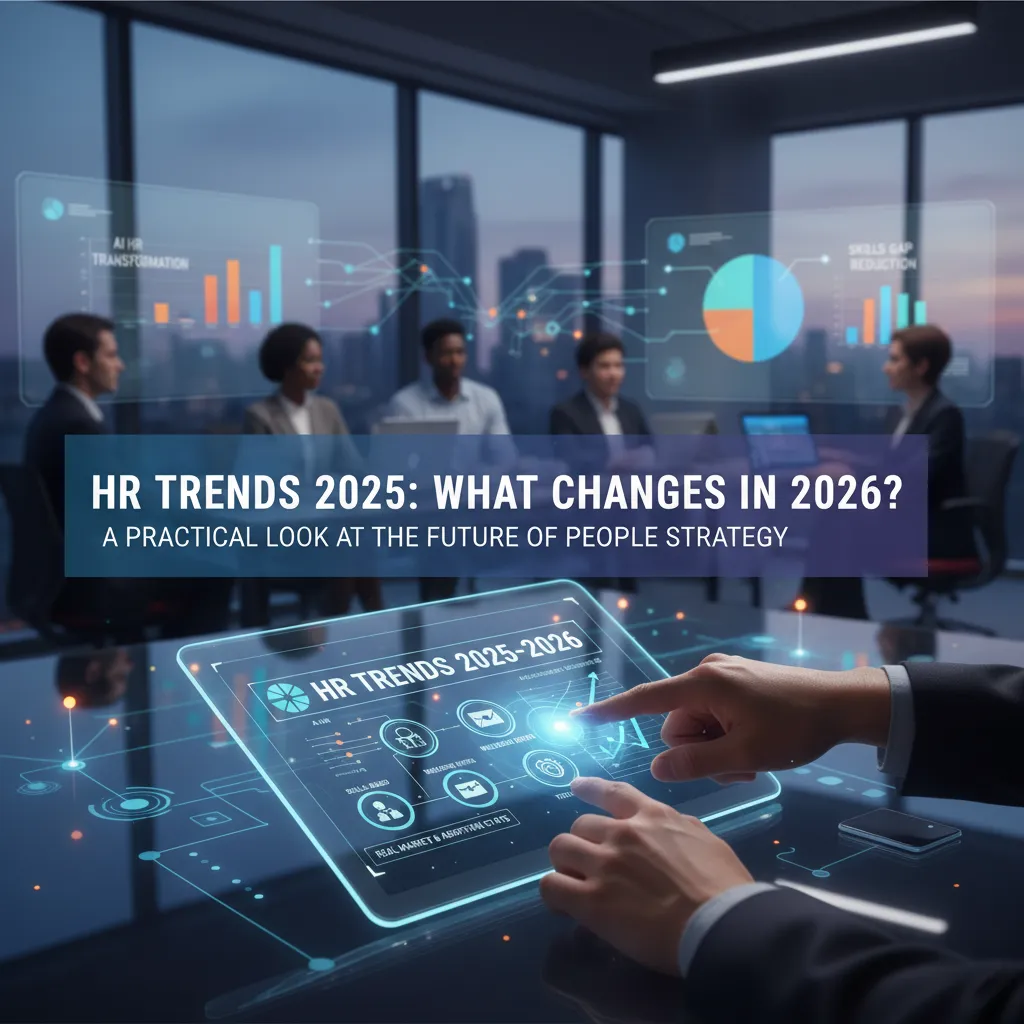
The first time I watched a hiring manager reject a brilliant candidate because of a missing “required” degree, I remember thinking: we’re filtering humans like spam. Fast-forward to planning headcount for 2026, and the conversation has shifted—less “who fits the job description?” and more “what skills do we actually need, and how fast are they changing?” This outline is my field-notes version of HR trends 2025 and the HR trends 2026 wave that’s already washing up on our calendars.
1) HR trends 2025: The year “People + Systems” got real
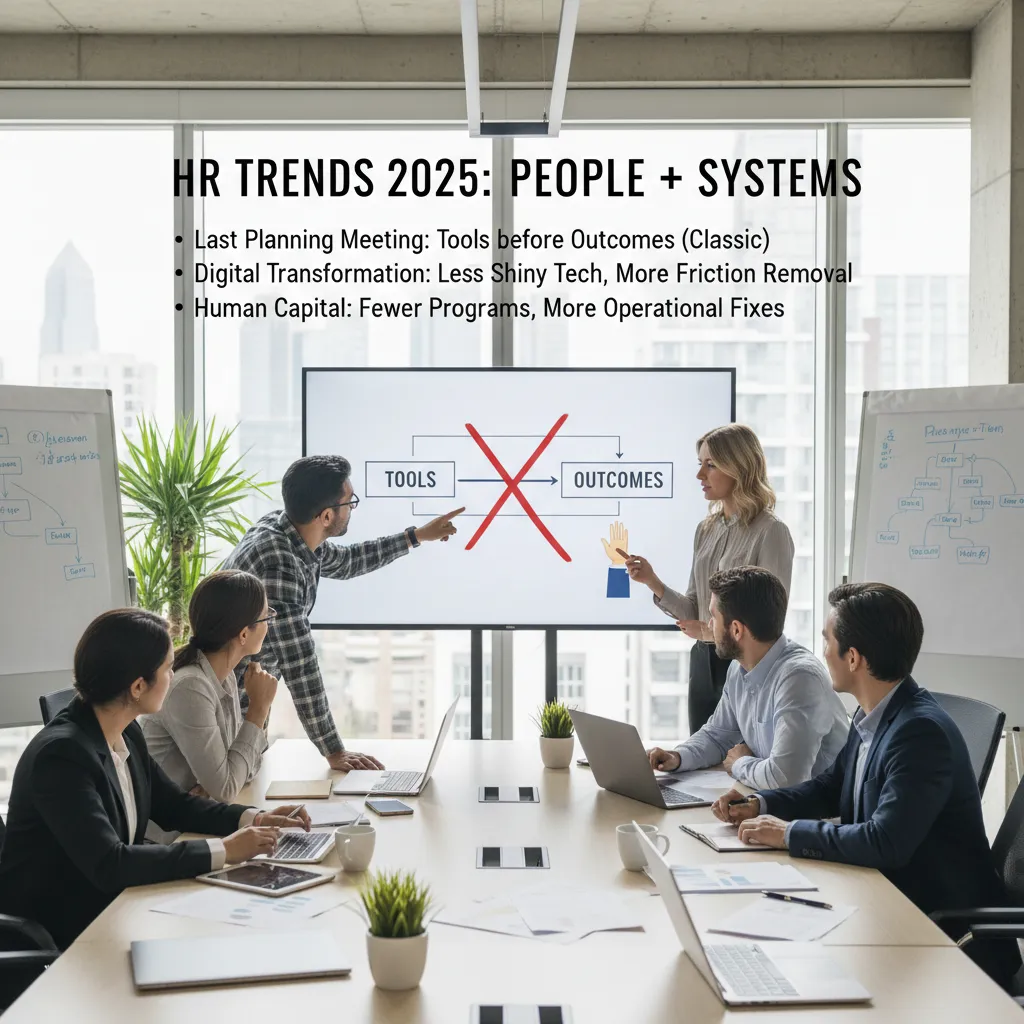
A quick scene from my last planning meeting: we argued about tools before we agreed on outcomes (classic). Someone wanted a new HRIS module, someone else pushed an AI assistant, and I kept asking, “What problem are we fixing on Monday morning?” That moment summed up HR trends 2025 for me: the shift from “buy tech” to “build a working system” where people + systems actually fit together.
Why HR digital transformation matters now
In 2025, HR digital transformation stopped being about shiny HR tech market news and started being about removing friction in daily work. The wins I saw were not flashy. They were practical: fewer clicks, fewer handoffs, fewer “Where do I find that?” messages. When systems are clean, managers spend more time leading and less time chasing forms.
- Clear outcomes first, then tools that support them
- One source of truth for employee data and policies
- Simple workflows that match how work really happens
Human capital trends I’m seeing: small fixes that compound
Instead of big “programs,” I’m seeing more small operational fixes that stack up over time. Think: tightening job architecture, standardizing interview steps, cleaning up onboarding tasks, and making performance check-ins easier to run. These changes look boring on a slide, but they reduce errors and speed up decisions—two things every business wants in 2026.
“The best HR systems don’t feel like systems. They feel like work got easier.”
Wild card: upgrading a plane mid-flight
HR in 2026 feels like upgrading a plane mid-flight—possible, but only with checklists and calm pilots. I’m treating every change like a controlled release: document it, test it with a small group, train managers, then scale. That’s how people + systems stays real, not just a slogan.
2) Artificial intelligence HR: automation, but make it accountable
When I look at HR trends 2025 moving into 2026, the real impact of artificial intelligence in HR isn’t just chatbots answering policy questions. AI is becoming the workflow glue that connects daily work: resume screening, interview scheduling, HR case triage, and fast knowledge search across handbooks, tickets, and past cases. Done well, it removes friction. Done poorly, it scales mistakes.
Mini confession: I used to fear “AI replacing HR.” Now I worry more about AI creating quiet bias at scale. A model can learn patterns from old hiring or promotion data and repeat them, but faster and with less visibility. That’s why I treat accountability as a design requirement, not a nice-to-have.
Where I’d deploy agentic AI first (and where I’d slow down)
- Start low-risk: scheduling, document routing, onboarding checklists, benefits Q&A, and drafting first-pass responses for HR service tickets (with human review).
- Use caution: candidate ranking, performance scoring, compensation decisions, and employee relations (ER) investigations—areas where context, fairness, and trust matter most.
People analytics as the sanity check
My rule is simple: if we can’t measure it, we shouldn’t automate it. People analytics software should track outcomes before and after automation, so we can spot drift and bias early.
| AI HR workflow | What I measure |
|---|---|
| Screening | Pass-through rates by group, time-to-fill, quality-of-hire signals |
| Case triage | Resolution time, escalation rate, employee satisfaction |
| Knowledge search | Answer accuracy, repeat questions, policy compliance |
Automation is only “smart” when it stays explainable, auditable, and correctable.
3) Skills-based hiring: the degree is no longer the hero
In the 2025–2026 shift I’m seeing, skills-based hiring is becoming the practical fix for a problem HR helped create: inflated job descriptions. I’ll admit it—I used to copy-paste “requirements” from old templates, then add a degree line “just in case.” The result was predictable: fewer applicants, less diversity, and roles that sounded senior even when the work wasn’t.
Skills-based workforce beats bloated job ads
When I rebuild roles around skills, the conversation changes from “Do you have the right pedigree?” to “Can you do the work?” That’s why a skills-based workforce is the antidote: it forces clarity on what matters, and it makes hiring faster and fairer.
- Define outcomes (what success looks like in 90 days)
- List skills (tools, behaviors, domain knowledge)
- Prove skills (work samples, simulations, structured interviews)
Predictive matching and “hidden” internal candidates
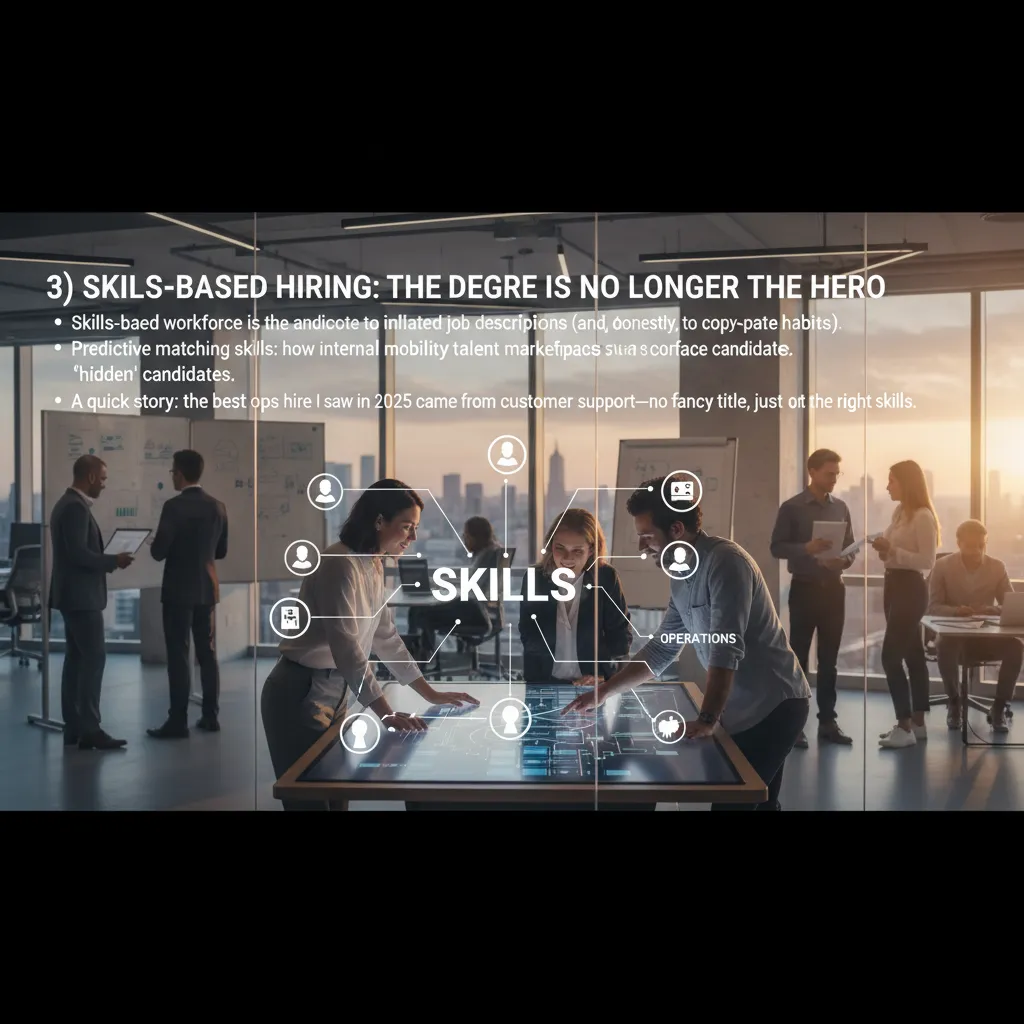
Another change from the source material is the rise of internal mobility talent marketplaces. With predictive matching, employees get surfaced for roles based on demonstrated skills, projects, and learning history—not just their current title. I’ve watched these systems uncover “hidden” candidates who would never self-nominate because they don’t match a traditional checklist.
“Titles tell you where someone sits. Skills tell you where they can go.”
A quick story from 2025
The best operations hire I saw in 2025 came from customer support. No fancy title. No perfect resume. But they had the right skills: process mapping, calm escalation handling, and a habit of documenting fixes. Once we assessed those skills directly, the decision was easy.
Pathways, not ladders
Finally, attracting and retaining talent gets easier when we show pathways, not ladders. People stay when they can see multiple skill routes—lateral moves, short-term gigs, and stretch projects—not just one narrow promotion track.

4) Remote work policies: from perk to operating system
Remote work used to be framed as a “nice-to-have.” In 2026, I treat it like an operating system for how work gets done. The data point I keep coming back to is simple: 98% of employees want remote work, and they’re not subtle about it. So the real question isn’t “Should we allow it?” It’s “Can our policies, tools, and managers run it well?”
The real fight: async norms, not office days
What I’m seeing across HR Trends 2025-2026 is that the biggest friction isn’t the number of in-office days. It’s the lack of shared asynchronous rules: when to write, when to meet, how fast to respond, and where decisions live. Without clear norms, hybrid teams drift into constant pings and calendar overload.
- Response-time expectations (e.g., “same day” vs. “within 2 hours”)
- Decision logs so choices don’t disappear in chat threads
- Default-to-document for updates, plans, and handoffs
Engagement that works in hybrid
Employee engagement strategies that actually hold up in hybrid are practical, not flashy. I focus on meeting hygiene, written decisions, and manager signal boosting—making sure quieter voices and remote teammates get airtime and credit.
- Meeting hygiene: agenda, owner, and a decision goal
- Written decisions: capture “what/why/who/when” in one place
- Signal boosting: managers repeat and attribute good ideas publicly
A tiny tangent: I once watched a team go hybrid and accidentally turn every meeting into a podcast—lots of talking, no decisions.
That’s why I now require a simple line at the end of invites: Decision(s) expected: and Output:. It keeps remote work policies from being promises on paper and turns them into daily behavior.
5) Wellbeing infrastructure: burnout prevention as board-level math
In the 2025–2026 HR trend cycle, I’m watching employee wellness move from perks (yoga stipends, app subscriptions, one-off webinars) to wellbeing infrastructure: the policies, rhythms, and manager habits that shape daily work. This shift matters because burnout is no longer treated as a personal resilience issue—it’s being measured like any other business risk.
From “nice-to-have” to KPI reality
Burnout prevention is showing up in KPI decks, not just all-hands slides. I’m seeing leaders track signals like overtime, after-hours messaging, PTO usage, and regrettable attrition alongside delivery metrics. When wellbeing becomes board-level math, the question changes from “Are people motivated?” to “Is the system sustainable?”
“If the workload model requires heroics, the organization is the problem—not the employee.”
My take: wellbeing is a systems problem
I’m opinionated here: most burnout is driven by workload, role clarity, and recovery time. If priorities shift weekly, if roles overlap, or if “urgent” is the default, no mindfulness session will fix it. Real wellbeing organizational infrastructure means designing work so people can win without constant sprinting.
- Workload: capacity planning that matches headcount and deadlines
- Role clarity: clear owners, fewer “shadow responsibilities”
- Recovery: protected focus time, real PTO, predictable cycles
A small experiment I recommend
Try a “meeting diet” month and pair it with a simple manager checklist for load balancing.
- Cut recurring meetings by 25% and default to async updates.
- Set two no-meeting blocks per week for deep work.
- Use a weekly manager checklist: top 3 priorities, dropped work, and who is overloaded.
In HR Trends 2025, this is the practical shift I expect to define 2026: wellbeing as an operating system, not a benefit line item.
6) Total rewards design: clarity is the new currency
In the 2025–2026 HR trend work I’ve been tracking, total rewards design is shifting fast. The old question was “what can we afford?” Now it’s “what do we stand for?” When rewards reflect clear values, people feel consistency—and consistency builds trust. In 2026, I expect more leaders to treat clarity as a real business asset, not a nice-to-have.
From perk lists to a clear rewards story
Where I’ve seen teams stumble is simple: perks grow like weeds. One year it’s a wellness stipend, then a new app, then a random bonus program. After a while, nobody remembers why each benefit exists, who it’s for, or what problem it solves. Employees don’t experience that as “generous”—they experience it as confusing.
- Clarity: what we offer and why
- Consistency: the same rules across teams
- Trust: fewer surprises in pay and benefits
Pair compensation with growth (not just cash)
I’m also seeing stronger results when compensation is paired with growth systems. Pay alone can’t carry engagement if people can’t see a future. In practice, that means linking rewards to a skills framework, internal mobility, and transparent leveling so employees understand how to progress.
| Rewards element | Clarity signal |
|---|---|
| Base pay + leveling | “Here’s what good looks like at each level.” |
| Skills framework | “Here’s what to learn next—and how it’s valued.” |
| Internal mobility | “Here are real paths, not promises.” |
Wild card: fewer benefits, better decisions
What if we offered fewer benefits, but guaranteed decision speed and manager coaching quality?
I’ve watched slow approvals and weak coaching cost more retention than any single perk. A 2026-ready total rewards strategy may include fewer extras, but stronger day-to-day work experience—because that’s what people feel every week.
7) The messy middle: HR compliance updates + employee relations trends
In the 2025–2026 HR trends cycle, I keep coming back to the same reality: the “messy middle” is where trust is won or lost. Employee relations trends are getting spikier as work becomes more distributed and expectations rise. When teams are spread across time zones, small issues—tone in chat, response time, meeting load—can turn into big conflict fast.
Employee relations: more signals, less context
I’m seeing more cases where people feel unheard, even when managers think they’re being responsive. Hybrid work also changes what “fair” looks like: who gets visibility, who gets flexibility, and who gets the best projects. In practice, I’m focusing on:
- Clear norms for communication and availability
- Consistent manager coaching on feedback and conflict
- Faster intake for concerns before they escalate
HR compliance updates: boring, but high stakes
HR compliance updates are not glamorous, but the fastest way to lose trust is to mishandle a policy change. In 2026 planning, I treat every update—leave rules, pay practices, AI use, data privacy, workplace conduct—as both a legal and a people issue. If employees feel surprised, they assume the worst.
My three-question gut check before any rollout
- Is it fair? Who benefits, and who carries the burden?
- Is it clear? Can a new hire understand it on day one?
- Can we explain it in one minute? If not, it’s not ready.
A quick note to my past self: document decisions like someone will read them later—because they will.
I now write down the “why,” the options we rejected, and the date we reviewed it. That simple habit supports HR compliance, protects employee relations, and makes audits and investigations less painful.
Conclusion: My 2026 HR “north star” checklist
As I look at HR trends 2025 and what will matter most in 2026, I keep coming back to one idea: HR has to become more adaptive, not just more efficient. For me, that means tying five threads together—AI in HR that supports decisions, a skills-based workforce that moves talent faster, wellbeing infrastructure that prevents burnout, clear remote work policies that reduce confusion, and total rewards design that matches what people value now.
My personal commitment this year is simple: less guessing, more experiments. Instead of debating what employees “probably” want, I’m committing to smaller pilots with clear measures—like testing AI-assisted job matching in one business unit, or running a short skills assessment sprint before we rewrite job levels. I also want to treat wellbeing like a system, not a perk: workload signals, manager habits, and recovery time need as much attention as benefits.
When it comes to prioritizing, I’m using one rule: start where the pain is loud and the data is easy. If turnover is spiking in one role and we already have exit data, that’s a better starting point than a big culture project with no baseline. If remote work friction shows up in ticket logs, meeting overload, or performance reviews, that’s a clear place to tighten policy and manager support.
In 2026, I want my HR practice to feel more like a learning loop: listen, test, measure, adjust. If skills change fast, what’s one policy you can make more flexible this month—job requirements, internal mobility rules, scheduling, or how you define performance?
TL;DR: HR trends 2025–2026 are converging around three pressure points: AI HR transformation (automation + new roles), skills-based hiring and workforce planning (because skills are shifting fast), and a more intentional employee experience (remote work policies, wellbeing infrastructure, and total rewards design). Use the stats to prioritize: start small, measure, and keep humans in the loop.