The first time I tried to “fix culture,” I did it with a spreadsheet and a smiley-face pulse survey. Two weeks later, a top performer quit anyway—politely, quietly, and with the kind of resignation email that haunts you. That’s when I learned HR isn’t a checklist; it’s pattern recognition, trust, and timing. This post isn’t 39 tips as a rigid list—it’s the notes I wish I’d had in my pocket before budget season, before the RTO memo, before the disengagement signals got loud.
1) My messy cheat-sheet: Top HR Strategies for 2026
I used to treat HR like policy management: write the rules, enforce the rules, repeat. But in 2026, that mindset breaks fast. Now I treat HR as a decision system—a way to make consistent calls when the facts are messy (performance, pay, AI use, hybrid work, burnout). Policies still matter, but they’re just the “labels on the jars,” not the recipe.
The 39-tip map (so nothing falls through the cracks)
From my notes on “39 HR Tips Every Professional Should Know,” I keep everything in six buckets. It’s simple, but it stops me from chasing shiny objects.
- Metrics: define what “good” looks like and measure it weekly.
- AI: set guardrails for tools, data, and bias checks.
- Hiring: tighten role clarity, structured interviews, and onboarding.
- Culture: reinforce behaviors, not slogans.
- RTO/Hybrid: make work visible and fair across locations.
- Well-being: reduce chronic load, not just offer perks.
My first-30-days HR self-audit (and what I ignore on purpose)
When I join or inherit a team, I run a quick audit before I “fix” anything.
- Do we have clear goals and owners?
- Are hiring and promotion decisions documented?
- What’s our attrition and why are people leaving?
- Is pay roughly aligned, or are there obvious equity gaps?
- Where does hybrid work feel unfair?
What I ignore at first: rewriting the handbook, rebranding values, and launching new surveys. I wait until I understand the real constraints.
Wild card analogy: HR is kitchen prep
If you don’t sharpen the knives (systems), dinner service (people issues) gets chaotic fast.
In practice, “sharpening” means clean workflows, decision logs, and simple escalation paths.
When HR buzzwords actually help
I don’t use “skills-based hiring,” “people analytics,” or “psychological safety” to sound smart. I use them like tags in a notebook—language that helps me spot patterns, compare teams, and choose the next best HR strategy for 2026.

2) HR Benchmarks I actually use: HR Metrics Scorecards
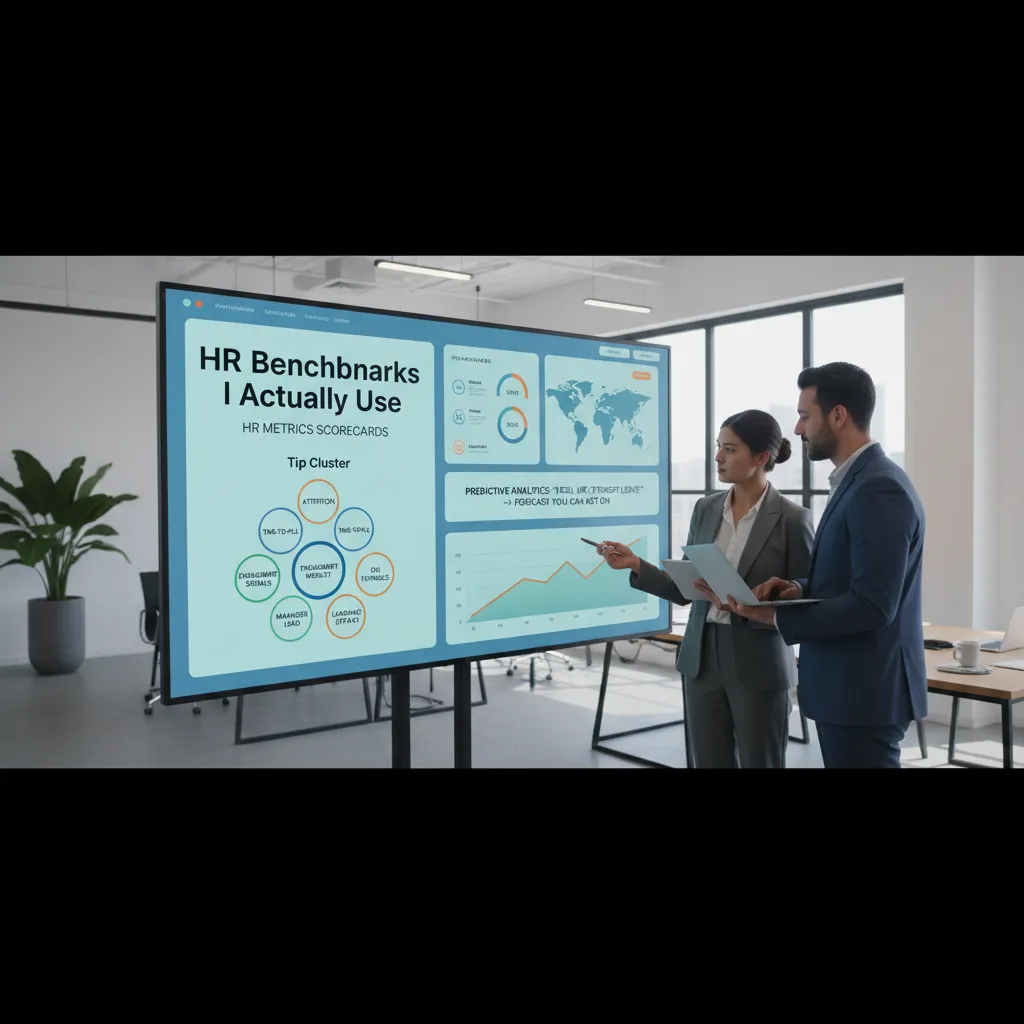
In 2026, I stopped chasing “hot” HR metrics and started building a scorecard that fits our business reality. My rule: pick 7–10 benchmarks you can explain, influence, and review on a steady rhythm. If a metric looks impressive but doesn’t change decisions, it’s noise.
My go-to HR metrics scorecard (the ones I actually use)
- Attrition (overall + regrettable loss): who leaves, when, and from which teams.
- Time-to-fill: speed matters, but I pair it with quality signals.
- Internal mobility: % roles filled internally and time-to-move.
- Engagement signals: pulse trends, eNPS, and “quiet” indicators like survey comments.
- Manager load: span of control, open roles per manager, and 1:1 coverage.
- DEI funnels: representation by stage (apply → interview → offer → accept → promote).
- Learning uptake: completion rates plus “did it change behavior?” checks.
I keep these in a simple HR metrics dashboard so leaders can see patterns fast. When we need more detail, I drill down by location, role family, tenure band, and manager.
Where predictive analytics finally became practical
Predictive analytics helped me turn “I feel like people might leave” into a forecast I can act on. I don’t need fancy AI to start—just consistent data. For example, I watch combinations like low engagement + high manager load + stalled internal mobility. When those stack up, I treat it like an early warning and plan retention actions (career paths, manager coaching, workload fixes) before resignations hit.
A tiny ritual that keeps metrics human
My best habit is a monthly metrics review with one story per number. Each metric gets a real example: a team that improved, a hiring bottleneck, a promotion that unlocked retention. It prevents the scorecard from becoming cold reporting.
Benchmarking without copying culture
What changed my mind was benchmarking against top employers without copying their culture wholesale. I use external HR benchmarks to sanity-check ranges, then translate them into goals that match our size, growth stage, and talent market.
3) AI HR without the hype: AI Adoption HR + AI HR Platforms
In 2026, I treat AI in HR like any other HR technology: useful when it solves a real workflow problem, expensive when it’s just a demo. My biggest lesson from AI adoption in HR is simple: start with the work, not the tool.
Audit workflows before buying AI HR platforms
Before I approve any AI HR platform, I map the process end-to-end and mark where humans add value vs where we repeat steps.
- Resume screening: I look for bottlenecks (duplicate reviews, unclear criteria) before adding AI matching.
- Onboarding: I separate “must be human” moments (welcome, team norms) from admin tasks (forms, reminders).
- Fraud prevention: I check where risk shows up (time theft patterns, fake documents) and what data we already have.
AI spending reality check: how I justify HR tech to finance
I stopped selling “innovation” and started using a basic business case. I bring finance two numbers: time saved and risk reduced.
| What I measure | Example |
|---|---|
| Hours saved/month | Recruiting coordination reduced by 25 hours |
| Cost of delay | Faster hiring = fewer overtime hours |
| Risk reduced | Fewer compliance misses, cleaner audit trail |
AI fluency is the baseline (not “prompt engineer”)
What I expect from HRBPs and managers: they can explain what the tool does, spot obvious errors, and know when to escalate. What I don’t expect: coding, model training, or blind trust in AI outputs.
Governance (I learned the hard way)
- Permissions: least access needed, reviewed quarterly.
- Bias checks: test outcomes by role, level, and protected groups.
- Data retention: clear timelines for candidate and employee data.
- Vendor contracts: ownership, security, audit rights, and exit terms.
Choosing AI agents: automation vs culture
AI agents help with scheduling, FAQs, and document routing. They hurt when they replace human connection.
Robotic onboarding doesn’t scale culture—it erases it.
4) Return Office mandates vs Hybrid Work Models (and the ‘Hushed Hybrid’ reality)
In 2026, I’ve learned that Return to Office (RTO) policies fail when they read like a slogan. I now write every RTO plan like a product spec: who it applies to, when people are expected in, why we’re doing it, what exceptions exist, and how we’ll review it.
Tip: Write the policy like a product spec
- Who: roles, teams, and locations (not “everyone”)
- When: days, hours, and how often
- Why: the business reason (training, customer work, security)
- Exceptions: caregiving, disability, distance, temporary needs
- Feedback loop: a monthly check-in and a quarterly reset
Why RTO backlash happens
Most backlash is not “people don’t want to work.” It’s mismatched expectations (“remote-first” suddenly becomes “office-first”), commute math (time + cost + childcare), and vague “culture” arguments that don’t explain what will change. When leaders can’t answer, “What problem does this solve?” employees fill in the blanks.
Hybrid work done honestly (and the ‘Hushed Hybrid’ reality)
Many companies say “3 days in,” but quietly tolerate less. That’s the Hushed Hybrid reality. I try to avoid badge-swipe management and instead define in-person moments that matter:
- Onboarding and first 30/60/90 days
- Quarterly planning and retros
- Customer workshops or lab work
- Team conflict repair and coaching
Handling flexibility requests without a fairness war
I use a simple rubric: role needs, team dependencies, performance, and risk. Then I document the decision in plain language and review it on a set date. Consistency beats perfection.
Same policy, different outcomes
I’ve seen two teams under the same hybrid work model: one thrives, one quits. The difference is manager behavior and management workloads. One manager plans meaningful office days and protects focus time. The other adds meetings “because we’re here,” creating burnout and resentment.
5) Talent Constraints meet Skills Based Hiring (hello, Internal Gig Economies)
In 2026, I’m seeing a strange mix: some teams feel a talent shortage, while others are stuck in slow hiring cycles. My biggest lesson from this tip cluster is simple: stop hiring for “years of experience” and start hiring for skills and outcomes. When I rewrite job descriptions, I lead with what success looks like in 90 days, not a long list of tools.
Rebuild job descriptions around skills + outcomes
I now use a plain format: outcome, skills needed, signals of skill. This helps candidates self-select and helps managers focus on what matters.
- Outcome: “Ship a weekly KPI dashboard used by Sales.”
- Skills: data modeling, stakeholder communication, QA habits.
- Signals: portfolio, work sample, structured interview score.
Workforce planning in a weak job market moment
Even when applications are high, the right capabilities can be rare. I plan hiring around what we can’t train fast (like deep security, complex negotiation, or domain knowledge). Everything else becomes “trainable” and moves into onboarding.
Skills-based hiring tactics I’ve seen work
These three tactics reduce bias and improve quality:
- Work samples: short, job-real tasks (2–4 hours max).
- Structured interviews: same questions, same scoring for all.
- Skill rubrics: clear levels (basic / solid / strong) with examples.
“If we can’t describe the skill, we can’t hire for it.”
Wild card: Fractional hiring as a pressure valve
When budgets are weird and priorities shift, I’ve used fractional hiring (part-time specialists, interim leads) to keep momentum without committing to a full headcount.
Internal gig economies to prevent “job hugging”
Finally, internal mobility matters. Internal gig marketplaces let people take short projects across teams, so they don’t “job hug” into disengagement. I’ve seen this boost retention, speed up delivery, and surface hidden skills—without waiting for a formal role change.

6) Employee Well-being, disengagement, and Cultural Risk (the stuff you feel before you measure)
In 2026, I treat employee well-being and cultural risk like smoke: you often smell it before you can measure it. The fastest wins come from spotting disengagement early—before it turns into exits, errors, or silence.
Tip cluster: how I spot disengagement early
- Productivity Theater: lots of “busy” signals (late emails, full calendars) with little real output.
- Quiet Cracking: a steady drop in energy, fewer questions, more “fine” answers.
- Micro-Pettiness: tiny rule fights, nitpicking, and scorekeeping that wasn’t there before.
- Task Masking: hiding behind low-impact tasks to avoid harder work or decisions.
- Ghost Work: invisible extra labor (covering gaps, emotional support, fixing broken processes) that never makes it into plans.
Cultural challenges checklist: where trust erodes
When I audit culture, I start with three common trust leaks:
- Manager inconsistency: different rules depending on who you are or who you report to.
- Unclear priorities: “everything is urgent,” so people stop believing deadlines.
- Unfair flexibility: remote or schedule freedom that feels random, not role-based.
My two-question stay interview script
This is simple, awkward, and effective:
1) “What would make you want to leave in the next 6 months?”
2) “What would make you want to stay and do your best work?”
I listen for patterns, not perfect answers, and I write down the exact words.
When employee well-being becomes operational
- Workload caps: define “max projects per person” and enforce trade-offs.
- Meeting hygiene: no-agenda meetings get declined; 25/50-minute defaults.
- EAP visibility: I repeat access links in onboarding, all-hands, and manager 1:1 kits.
- Recovery time: after launches or incidents, I schedule real downshift days.
Closing the loop when I’m wrong
If a policy lands badly, I do three things: apologize clearly, tweak the policy in writing, and set a follow-up date to confirm the fix worked.
7) Conclusion: turning 39 tips into a weekly practice
After writing down these 39 lessons, I realized the hard part is not learning them—it’s using them when the week gets busy. So I built a simple habit I can repeat. I call it my Friday 20-minute HR reset. It keeps “HR Trends 2026” practical, not just interesting.
My Friday 20-minute HR reset
In 20 minutes, I do three things: I check one metric, I have one conversation, and I make one system tweak. The metric is something I can act on fast (time-to-fill, regretted attrition, offer acceptance rate, engagement pulse, or internal mobility). The conversation is a short check-in with one manager or employee to hear what’s working and what’s stuck. The system tweak is tiny but real: a clearer job post, a better interview scorecard, a cleaner onboarding checklist, or one policy line that removes confusion.
How the tips connect in real life
The more I practice, the more I see how the tips support each other. Predictive People Analytics is not a fancy dashboard—it helps me spot patterns early and make smarter hiring and workforce planning choices. Clear hybrid work norms protect well-being because people stop guessing what “good” looks like and start managing their time with less stress. And AI tools in HR don’t replace judgment; they scale the boring parts—scheduling, summaries, first drafts—so I can spend more time on trust, coaching, and decisions.
Note to future-me: don’t chase Top HR Buzzwords—chase clarity for humans.
If you want to turn these 39 HR tips into action, here’s my challenge: pick five tips and try them for 30 days. Then review what actually changed—did hiring get faster, did managers get clearer, did employees feel more supported, did errors drop, did meetings shrink? Keep what works, drop what doesn’t, and repeat next month.
I’ll end with this: the best HR work is often invisible—until it isn’t.
TL;DR: If you do only a few things in 2026: track HR metrics scorecards like top employers, use predictive people analytics to forecast attrition, invest in AI HR platforms with governance, design humane hybrid work models (don’t botch Return Office mandates), and build skills-based hiring paths that reduce talent constraints.