

I remember the first time a false-positive blocked a loyal customer: an awkward call, lost trust, and a weekend of manual investigations. That experience pushed me into learning how AI can transform fraud detection. In this post I walk you through why AI matters, how to prepare your data, practical implementation steps, and what to measure once the system runs — all in first-person and with real-world sensibilities.
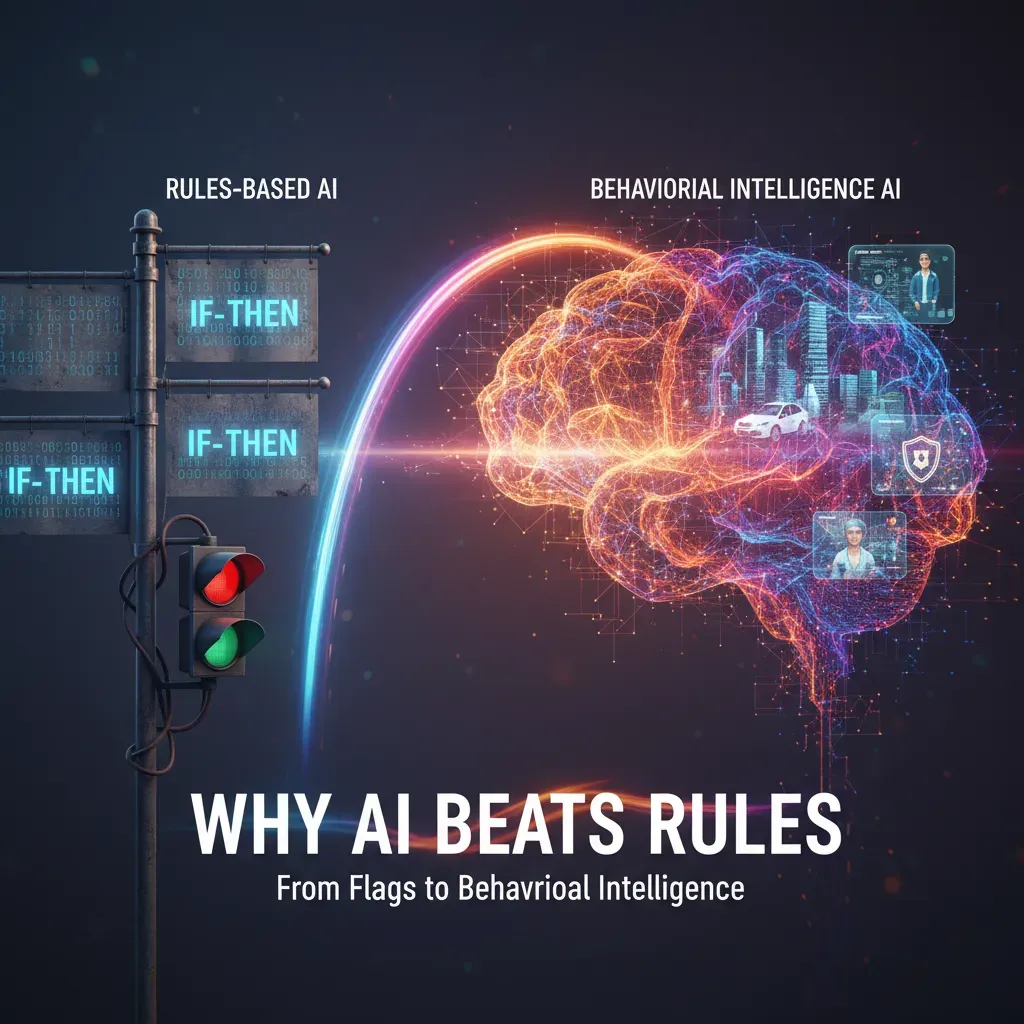
Why AI Beats Rules: From Flags to Behavioral Intelligence
When a “Good” Rule Ruins a Weekend
I still remember the Friday night when our rule-based fraud blocker did exactly what it was designed to do—and still failed the business. A long-time customer tried to pay for a last-minute hotel and rental car while traveling. The system saw “new city + higher amount + late hour” and fired a hard rule: block. No review, no context, no learning. The customer spent the weekend on the phone, frustrated and embarrassed, and we spent Monday issuing apologies and refunds.
That moment made the weakness of rigid rules painfully clear: they treat patterns like proof. In modern finance stacks, that creates more harm than protection.
Why Rigid Rules Fail in 2026-Style Fraud
Rules are great for simple, known threats. But fraud has moved past simple. Attackers use automation, synthetic identities, and even deepfakes to pass checks that used to work. A static rule can’t keep up with a moving target, especially when fraudsters test your thresholds like a game.
- Deepfakes can mimic voices and faces during verification.
- Automation can spread small attacks across many accounts to avoid limits.
- Bot-driven “human” behavior can look normal in one session but risky across many.
How AI Finds What Rules Miss
AI fraud detection works less like a checklist and more like a living model of behavior. Instead of only asking “Did this trip a flag?”, AI asks “Does this look like this customer, on this device, in this moment?” It can connect weak signals that rules ignore.
For example, AI can learn that a customer often travels, but usually books from the same phone and types at a consistent speed. If a “normal” purchase suddenly comes with strange navigation patterns, copy-paste fields, or device changes, AI can raise risk even when no rule triggers.
The Shift to Continuous Behavioral Intelligence
By 2026, the best systems don’t just score a transaction once. They build continuous behavioral intelligence across login, onboarding, payments, and support interactions. Risk becomes a stream, not a single checkpoint.
| Rules | AI Behavioral Intelligence |
| Static thresholds | Adaptive patterns over time |
| Binary decisions | Risk scores + next-best action |
| High false positives | Fewer blocks, smarter reviews |
Business Value I Can Measure
When I replaced “block-first” rules with AI-driven decisions, we saw fewer false positives, faster detection of real fraud, and better customer trust. Customers don’t care that we stopped fraud—they care that we didn’t stop them.
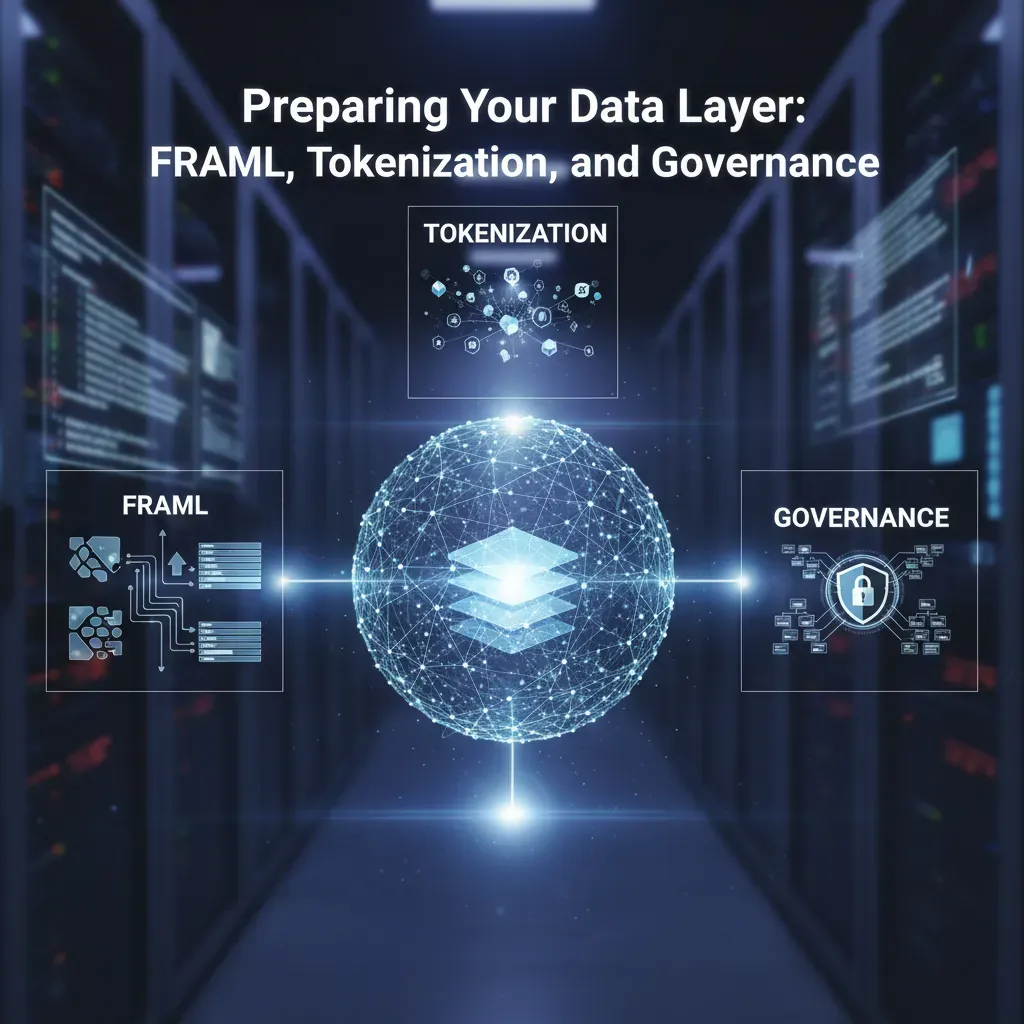
Preparing Your Data Layer: FRAML, Tokenization, and Governance
When I implement AI-powered fraud detection, I start with the data layer. Models only learn what I feed them, so I treat data prep as the real foundation. Before I train anything, I run a simple checklist to make sure I’m not building on gaps, duplicates, or risky data handling.
My checklist: inventory data sources before training models
I map every signal that could explain “who did what, when, where, and how.” In most modern finance stacks, that means:
- Transactions: authorizations, settlements, reversals, chargebacks, refunds
- Customer and account: profile changes, payee adds, password resets
- Device and session: device ID, IP, geolocation, velocity, emulator flags
- KYC/KYB: identity checks, document results, sanctions screening outcomes
- Case outcomes: analyst decisions, customer confirmations, dispute results
I also note ownership (who produces it), freshness (batch vs real time), and quality (missing fields, inconsistent formats). This prevents “mystery features” later.
Why FRAML gives a fuller customer risk view
Fraud teams and AML teams often work in parallel, but the customer is the same. I like the FRAML approach because it unifies fraud + AML signals into one risk view. For example, a pattern that looks like simple card testing can also connect to mule activity when I add AML context like unusual beneficiary networks or rapid cash-out behavior.
“FRAML helps me see risk as a customer journey, not a single transaction.”
Privacy-first controls: tokenization, masking, and privacy-preserving methods
To use data safely, I apply privacy controls early, not after the model is built. My default is tokenization for sensitive identifiers (PAN, bank account, national ID), plus masking for analyst screens. When I need analytics across systems, I use consistent tokens so joins still work.
customer_id_token = tokenize(customer_id, vault_key)
I also limit access with role-based controls and keep raw PII in a separate vault. When possible, I explore privacy-preserving methods like aggregation, hashing with salt, or secure enclaves for model training.
Governance and labeling: the invisible work
Reliable AI needs reliable labels. I define what “fraud” means (confirmed, suspected, chargeback-only) and track label timing to avoid leakage. I keep an audit trail of feature definitions, model versions, and decision reasons, so I can explain outcomes to auditors and internal risk teams.
| Governance item | What I document |
| Label rules | Sources, time windows, dispute outcomes |
| Data lineage | Where fields come from and transformations |
| Access controls | Who can view PII vs tokens |
Real-Time Transaction Monitoring: Architecture and Use Cases
In 2026, I prioritize real-time transaction monitoring because fraud does not wait for batch jobs. If I can score a payment while it is still “in flight,” I can block it, step it up with extra verification, or route it to review before money leaves the system. This is why I build my AI fraud detection around streaming pipelines instead of end-of-day reports.
Architecture I use for streaming fraud decisions
My baseline architecture is simple: events in, features enriched, model scored, action out. The key is keeping every step fast and observable.
- Event ingestion: card auths, ACH, transfers, logins, device signals, and KYC updates flow through a stream (for example, Kafka-like topics).
- Feature enrichment: I join real-time events with recent history (velocity counters, last-seen device, geo distance) using an online feature store.
- Decision service: a low-latency scoring API returns risk score + reason codes.
- Action layer: allow, deny, step-up (OTP/3DS), or queue for analyst review.
Common AI technologies I rely on
I typically combine multiple techniques because fraud patterns change and attackers mix tactics.
- ML classifiers to spot anomalies in transaction attributes (amount, merchant, time, device, IP reputation).
- Behavioral scoring to compare a user’s current session to their normal rhythm (typing speed, navigation flow, payee creation patterns).
- Graph analytics to detect hidden links: shared devices, reused emails, mule accounts, and merchant clusters. Graph signals often catch coordinated rings that single-event models miss.
Use cases I see most often
- Card-not-present fraud: I score checkout events in milliseconds and trigger step-up when risk is high, especially for first-time merchants or shipping changes.
- Synthetic identity checks: I use graph features (shared phone/address/device) plus consistency models to flag identities that look “assembled.”
- Account takeover detection: I monitor login velocity, device swaps, impossible travel, and sudden beneficiary changes, then lock or challenge the session.
Operational note: latency vs. throughput vs. model complexity
In production, I balance speed and accuracy. I keep a fast path model for sub-100ms decisions and a slow path for deeper graph queries or heavier models. I also log every score with features for audits and retraining, because AI only stays useful when it learns from fresh outcomes.
Implementation Roadmap: Pilots, Teams, and Governance
When I implement AI-powered fraud detection in a modern finance stack, I follow a phased roadmap: pilot → validation → scale. This keeps risk low, helps me earn trust with stakeholders, and prevents “big bang” launches that create customer pain through unnecessary declines.
Phase 1: Pilot (prove value fast)
I start with a narrow use case (for example: card-not-present payments, account takeover signals, or refund abuse). The goal is to connect data sources, run models in shadow mode, and learn how fraud patterns look in our environment.
- Integrate key events: login, device, payment, payout, and chargeback outcomes.
- Define a simple decision output: risk_score plus top reasons.
- Keep manual review in place while the model observes.
Phase 2: Validation (measure impact, not hype)
Before I let the model influence decisions, I validate it with clear metrics and business checks. I review performance weekly with fraud and compliance partners.
| Validation Area | What I Measure |
| Accuracy | Detection rate, false positives, false negatives |
| Customer impact | Decline rate, review time, support tickets, conversion |
| Operational fit | Analyst workload, queue size, SLA adherence |
| Regulatory alignment | Documented rationale, fairness checks, data retention rules |
In my experience, false positives are the fastest way to lose internal support—so I treat them as a first-class metric.
Phase 3: Scale (expand safely)
Once validation is stable, I scale in controlled steps: more geographies, more payment rails, and more automated actions. I also add monitoring for drift and performance drops, and I set rollback rules if metrics move outside thresholds.
Teams and roles (cross-functional by design)
- Data engineers: build reliable pipelines and feature stores.
- ML ops: deploy models, manage versioning, and run monitoring.
- Fraud analysts: label cases, tune rules, and provide feedback loops.
- Compliance officers: confirm policy fit, privacy, and audit readiness.
- Product owners: balance risk, customer experience, and business goals.
Governance (non-negotiable controls)
I treat governance as part of the build, not paperwork at the end. I require audit trails for every decision, model explainability that a reviewer can understand, and ongoing compliance monitoring for data access, retention, and change management.
Practically, that means logging inputs/outputs, storing model versions, documenting approvals, and running regular reviews so the AI stays accountable as fraud evolves.
Measuring Success: Business Outcomes and KPIs
When I implement AI-powered fraud detection in a modern finance stack, I don’t judge success by “the model looks accurate.” I measure success by business outcomes that finance, risk, and operations can all agree on. Clear KPIs also help me explain results to leadership without getting stuck in technical details.
What I track (the KPIs that matter)
These are the core metrics I track from day one, because they connect directly to losses, customer experience, and audit readiness:
- Fraud losses: total fraud dollars, fraud rate per 1,000 transactions, and loss by channel (card, ACH, wire).
- False-positive rate: how often good transactions get flagged or blocked. I also track “false-positive cost” (support contacts, churn risk).
- Time-to-detect: time from transaction to alert, and time from alert to action. Faster detection usually means smaller losses.
- Customer friction: step-up challenges triggered, decline rates, and abandonment during checkout or login.
- Compliance KPIs: alert documentation completeness, SAR/STR timeliness (where relevant), and audit exceptions.
Case example: real-world impact
I like to benchmark against peer results to set realistic targets. For example, some credit unions reported roughly a 40% reduction in fraud losses after AI adoption. I treat that as a directional goal, then adjust based on my fraud mix, transaction volume, and how mature the existing rules are.
My goal is not “more alerts.” My goal is fewer losses with less friction.
Quantifying operational efficiency
AI should also reduce manual workload. I track:
- Investigator hours saved: hours per case, cases per analyst, and backlog size.
- Percentage of automated remediation: share of alerts resolved automatically (auto-close, auto-hold, auto-step-up) with acceptable risk.
Linking outcomes to finance and reporting
Finally, I translate fraud KPIs into finance language: fewer chargebacks and write-offs, lower operational expense from reduced review time, and reduced regulatory penalties through stronger controls and cleaner audit trails. Better detection and documentation also supports improved financial reporting, because loss reserves and incident reporting become more consistent and easier to defend.

Future Predictions and Wild Cards: Ethics, Deepfakes, and Synthetic Identities
My speculative take for 2026: continuous behavioral intelligence
When I look at where AI fraud detection is heading in modern finance stacks, my bet for 2026 is clear: continuous behavioral intelligence will dominate. Instead of judging a transaction only at the moment it happens, systems will watch patterns over time—how a user types, how they move through screens, how often they change devices, and how their payment behavior shifts. This matters because fraud is rarely a single event anymore. It is a story that unfolds across logins, account changes, customer support calls, and payment attempts. In my view, the best AI models will act less like a gate at the end of a process and more like a quiet sensor network across the whole journey.
Ethics and privacy: protecting customers without over-collecting
This future also raises hard questions. If we track more signals, we must be careful not to cross the line into “collect everything.” I think the winning teams will balance customer protection with data protection and explainability. Customers and regulators will ask: Why was I blocked? What data did you use? Can I appeal? If my stack cannot answer those questions in plain language, I will lose trust even if my fraud rates look good. I also expect more pressure to reduce bias, especially when models learn from past decisions that may not be fair.
Wild card: synthetic identities + deepfake social engineering
The scenario that worries me most is a surge in synthetic-identity rings paired with deepfake-enabled social engineering. Synthetic identities can look “clean” because they are built slowly—new email, new phone, thin credit history, small transactions, then bigger moves. Add deepfakes and the attacker can sound like a real customer on a support call, or appear on a video verification step. That combination can bypass controls that rely too much on single checks like documents or one-time codes.
Practical advice to close the blog: build for privacy and practice for chaos
My practical advice is to invest now in privacy-preserving ML—data minimization, strong encryption, short retention windows, and techniques like federated learning where possible. At the same time, I would run tabletop exercises for novel threats: “What if a deepfake call convinces support to reset MFA?” “What if 5,000 synthetic accounts age for six months and then cash out in one week?” If I can rehearse these failures before criminals force them on me, my finance stack will be ready for 2026’s fraud reality.
I outline how AI Fraud Detection can shift finance stacks from brittle rule engines to continuous behavioral intelligence: prepare data, adopt privacy-safe tooling (tokenization/FRAML), prioritize real-time transaction monitoring, measure reduced losses (some credit unions saw ~40% less fraud), and plan for ethics and compliance.