

I still remember the first time someone suggested we “let the model decide” on inventory levels — I laughed, then agreed to test it. That pilot later saved us weeks of stockouts. In this guide I write as a fellow executive, not a data scientist: clear, candid and focused on business impact. Expect plain English, a few nerdy metaphors, and one or two small confessions about bold bets that didn’t pan out.
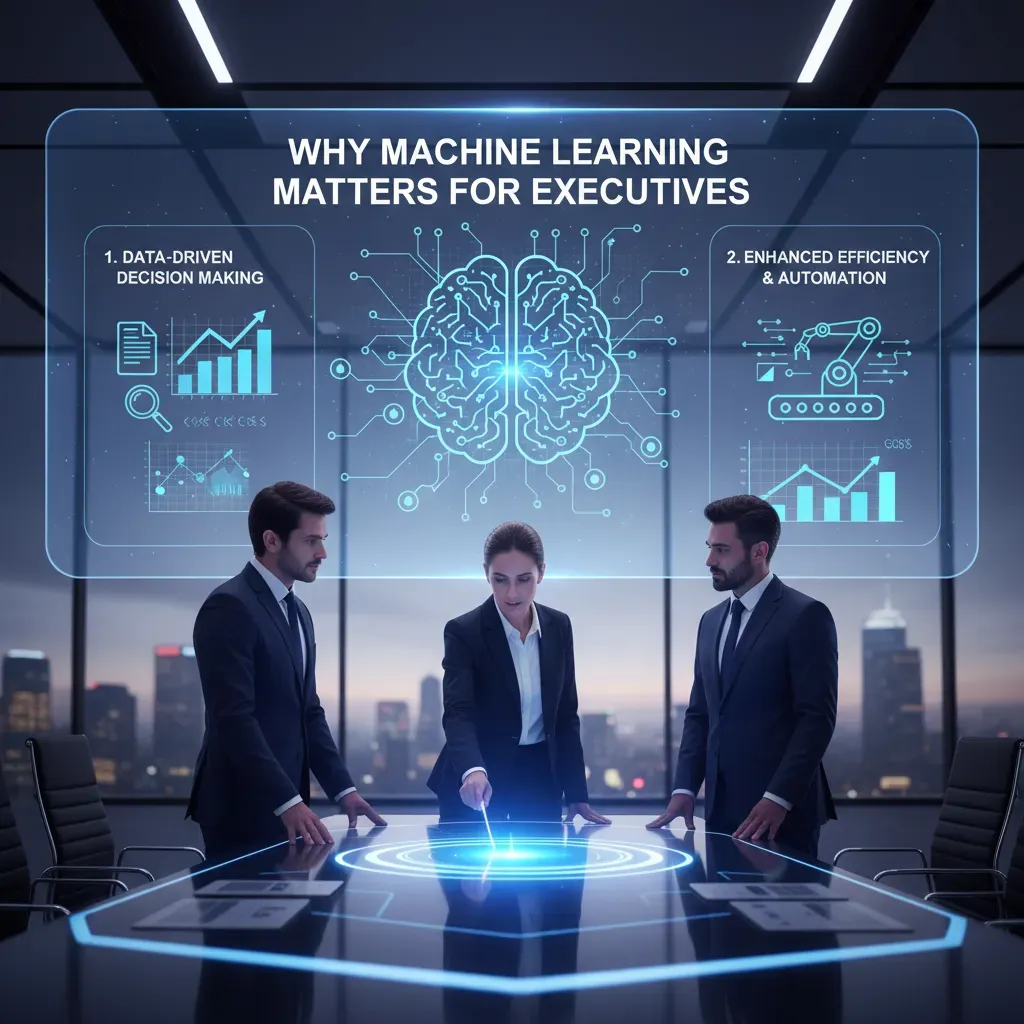
Why Machine Learning Matters for Executives
As an executive, I don’t need to write ML code to benefit from it. What I do need is a clear view of how machine learning for business turns everyday operational noise into decisions I can stand behind. Most companies already sit on a mountain of messy data—sales logs, support tickets, supply chain updates, website clicks. ML helps connect those dots so we can spot patterns early, forecast outcomes, and trigger risk alerts before small issues become expensive ones.
From messy data to strategic advantage
In practice, ML is a way to convert “too much information” into actionable signals. Instead of debating opinions in meetings, we can ask better questions like: “What is likely to happen next week?” or “Which customers are at risk of leaving?” That shift matters because speed and accuracy compound over time.
- Forecasting: demand, revenue, inventory needs, staffing levels
- Risk alerts: unusual transactions, delayed shipments, churn signals
- Focus: teams spend less time guessing and more time executing
The three stages of ML maturity
I’ve found it helpful to think of ML in three stages. Each stage builds on the last, and executives can sponsor progress without getting technical.
- Descriptive: What happened? Dashboards and summaries that explain performance.
- Predictive: What will happen? Models that estimate future demand, churn, or risk.
- Prescriptive: What should we do? Recommendations like pricing actions, next-best offers, or fraud holds.
Business outcomes I care about
When I evaluate ML initiatives, I look for outcomes that tie directly to growth, protection, and customer value.
- Better market trend forecasting: earlier signals for planning and investment
- Fraud detection: fewer losses and faster response to suspicious behavior
- Customer insights: clearer segments, smarter retention, more relevant experiences
A quick story: when the model beat our intuition
During one product launch, our leadership team leaned toward a broad rollout based on past wins. Our predictive model, trained on recent buying behavior and regional demand shifts, suggested a narrower launch with heavier inventory in two specific regions. I was skeptical, but we followed the model. Those regions sold through faster than expected, while the “obvious” markets stayed flat. That moment changed how I lead: I still value intuition, but I trust data-driven predictions when they’re tested and tied to real business goals.
Concrete Business Use Cases (Non-Technical)
When I explain machine learning for business to executives, I avoid math and focus on outcomes: lower losses, faster decisions, and better customer and employee experiences. Below are four practical, proven use cases that show how machine learning creates value without requiring a technical background.
Fraud Detection (Classification That Saves Money)
Fraud detection is one of the clearest wins. A simple classification model learns patterns from past transactions labeled “fraud” or “legit.” Then it scores new transactions in real time and flags the ones that look suspicious.
- What it uses: purchase amount, location, device, time of day, past behavior
- Business impact: fewer chargebacks, reduced manual review, faster approvals for good customers
- How I frame success: reduce fraud loss rate while keeping false alarms manageable
Supply Chain Optimization (Inventory + Dynamic Pricing)
In supply chain, machine learning helps me move from “best guess” planning to data-driven decisions. Demand forecasting models predict what will sell, where, and when. That supports smarter inventory management and even dynamic pricing.
- Inventory management: better reorder points, fewer stockouts, less overstock and waste
- Dynamic pricing: adjust prices based on demand signals, seasonality, and competitor trends
- Business impact: improved margins, lower carrying costs, and fewer markdowns
Customer Sentiment Analysis (Reviews Into Action)
Sentiment analysis turns unstructured text—reviews, support tickets, and social mentions—into clear signals. Models can tag comments as positive, negative, or neutral, and group them by themes like “shipping,” “quality,” or “ease of use.”
- Product improvements: spot recurring complaints and prioritize fixes
- Marketing lift: identify what customers love and reuse that language in campaigns
- Service gains: route urgent issues faster and reduce response time
Employee Retention (Predict Turnover, Target Investment)
Retention models help me focus on where interventions matter most. Using pulse surveys, HR data, and manager signals, machine learning can estimate turnover risk and highlight drivers like workload, growth, or team changes.
- What it enables: targeted coaching, career paths, compensation reviews, or workload fixes
- Business impact: lower replacement costs and more stable teams
In each case, the goal isn’t “AI for AI’s sake.” It’s a measurable business result tied to a decision we already make.
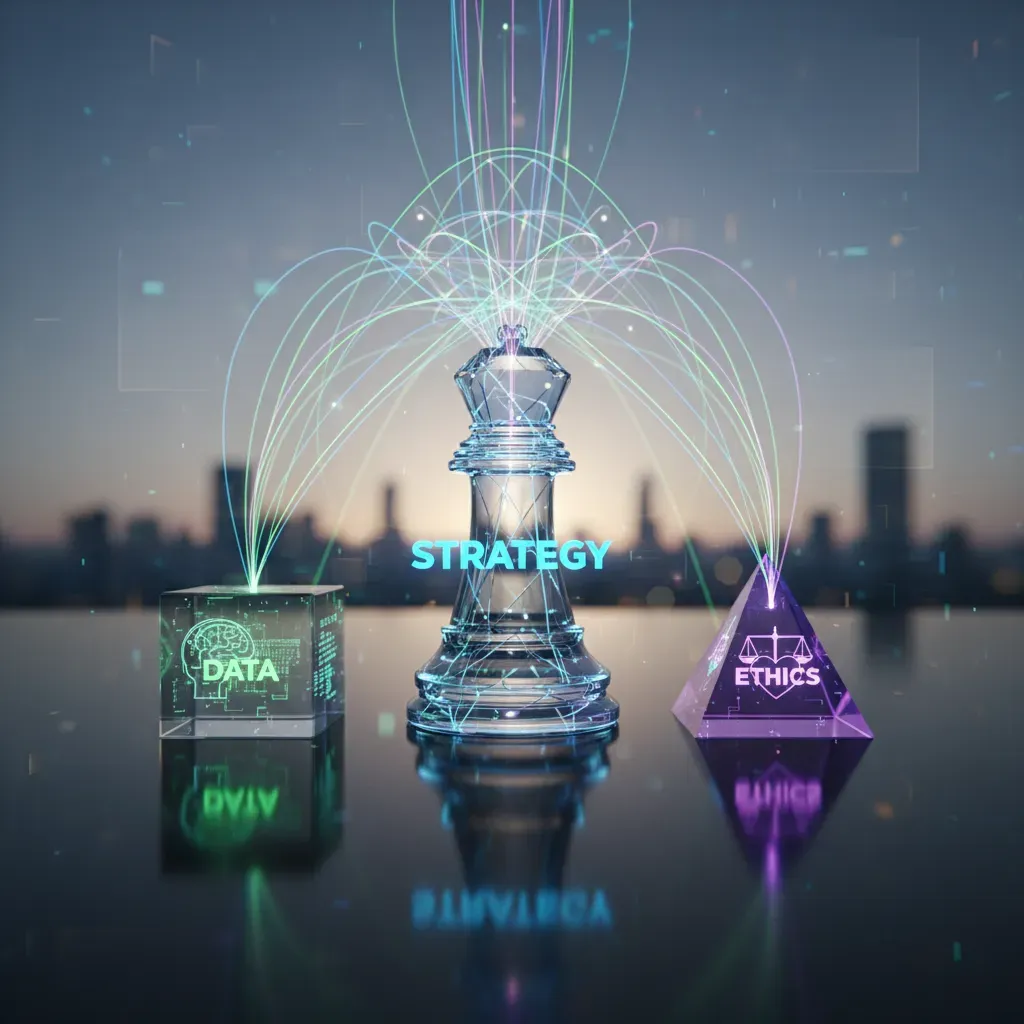
Choosing Approach: Strategy, Data, Ethics
Start with the business goal, not the model
When I evaluate a machine learning idea, I begin with what decision we want to improve. “Use AI” is not a goal. A goal is something I can measure and report: reduce churn by 5%, cut fraud losses by 10%, improve forecast accuracy, or shorten time-to-hire. I ask teams to define one primary KPI and one secondary KPI, plus a clear baseline. If we cannot explain how the pilot will move a business metric, I pause the project.
If we can’t measure success, we can’t manage risk or ROI.
Audit your data before you budget for models
In practice, data quality, volume, and access matter more than “fancy” algorithms. I run a quick audit with three questions: Do we have enough records? Are the fields consistent and complete? Are there privacy or contractual limits on using the data? Many pilots fail because data is scattered across systems, labels are missing, or definitions vary (for example, what counts as an “active customer”).
- Quality: missing values, duplicates, outdated records, inconsistent formats
- Volume: enough history to capture seasonality and edge cases
- Privacy: consent, retention rules, and restrictions on sensitive fields
Set an ethical framework as governance, not a slogan
Executives own the outcomes, so I treat ethics as a governance priority. I look for bias risks (who could be unfairly impacted), transparency (can we explain decisions to customers, regulators, and internal teams), and data privacy (collect only what we need, protect it well, and document usage). For high-impact use cases like lending, hiring, pricing, or healthcare, I require review checkpoints and clear accountability.
| Risk | Practical control |
| Bias | test outcomes by group; remove proxy features; monitor drift |
| Low transparency | use interpretable models; keep decision logs |
| Privacy exposure | minimize data; access controls; encryption; retention limits |
Select tools that match the cost-benefit
I usually start simple. Regression helps predict numbers (demand, revenue). Classification helps decide yes/no (fraud, churn risk). Clustering helps segment customers. Deep learning can be powerful, but it often costs more in data, compute, and maintenance. I prefer a small, testable pilot with a clear ROI before scaling.
Rule of thumb: simplest model that meets the KPI wins.
Algorithms & Models — What Executives Should Know
When I talk with executive teams about machine learning for business, I avoid model jargon and focus on what each approach does for the company. An algorithm is simply a method for finding patterns in data. A model is the output of that method—something we can use to predict, rank, or group items. The key executive question is: Which model type fits the decision we need to make?
Regression: Cost Optimization and Simple Forecasting
Regression is one of the easiest machine learning tools to explain to stakeholders because it connects inputs to an outcome. If I want to forecast demand, estimate delivery time, or understand what drives support costs, regression gives a clear starting point.
- Business uses: pricing and margin analysis, budget forecasting, staffing plans, churn risk scoring.
- Why executives like it: it supports “what-if” thinking (e.g., if we reduce shipping time, what happens to repeat purchases?).
Clustering: Customer Segmentation for Better Decisions
Clustering groups similar customers, products, or transactions without needing predefined labels. I often use it to move beyond broad segments like “SMB vs. enterprise” and find real behavior-based groups.
- Marketing: identify high-value segments, tailor messaging, reduce wasted spend.
- Product: spot usage patterns that suggest new features, bundles, or onboarding flows.
- Operations: detect unusual clusters that may indicate fraud or process issues.
Supervised vs. Unsupervised Learning (High-Level)
I frame this distinction in one sentence:
Supervised learning predicts a known outcome; unsupervised learning discovers structure when outcomes aren’t labeled.
- Supervised: churn prediction, lead scoring, invoice risk—best when you have historical examples of “good” and “bad.”
- Unsupervised: segmentation, anomaly detection—best when you’re exploring and don’t yet know the categories.
Deep Learning: Use When Complexity Has Clear ROI
Deep learning is powerful, but it’s not the default choice. I reserve it for complex tasks where simpler models struggle and the payoff is real—like image inspection in manufacturing, speech-to-text in call centers, or emotion detection for quality monitoring (with strong privacy controls). It often requires more data, more compute, and more governance, so I treat it as an investment decision, not a trend.
From Pilot to Strategy: Scaling ML in the C-Suite
Design pilots that speak in executive KPIs
When I sponsor a machine learning pilot, I don’t start with the model. I start with the business scorecard. If the pilot can’t report in terms I already use in board updates, it won’t scale. I ask the team to tie the pilot to one primary KPI and one secondary KPI, then define what “better” means in plain numbers.
- Revenue lift: incremental sales per segment, per channel, or per rep
- Cost reduction: hours saved, fewer refunds, lower inventory waste
- Churn delta: change in retention versus a control group
I also insist on a simple test design: a baseline, a control group, and a time window long enough to avoid “good week” bias. If the pilot can’t be measured cleanly, it’s not a pilot—it’s a demo.
Make the organizational changes early
Scaling machine learning for business executives is less about algorithms and more about ownership. I’ve learned to assign clear roles before the first dataset is pulled:
- Business owner: accountable for the KPI and adoption
- Data/ML lead: accountable for model quality and monitoring
- Data steward: accountable for data access, definitions, and privacy
- Governance sponsor: approves risk, fairness, and compliance checks
Then comes the build vs vendor decision. My rule: if it’s a common use case (forecasting, churn scoring, document extraction), I consider a vendor first. If it’s a differentiator tied to our unique data or process, I lean toward building. Either way, I require exit terms and data portability so we don’t get locked in.
Measure ROI and decide: double down or stop
I track ROI with a small table that forces clarity:
| Item | What I look for |
| Benefit | Lift vs control, in dollars |
| Cost | People time + tools + vendor fees |
| Risk | Compliance, customer impact, brand risk |
| Adoption | Usage rate in the workflow |
If benefits are real and adoption is rising, I fund the next phase. If the KPI doesn’t move, I stop quickly—no blame, just learning.
One pilot taught me the biggest win isn’t always the model—it’s the process it exposes.
In one churn pilot, the model was “okay,” but the analysis showed cancellations spiked after a billing handoff. Fixing that handoff reduced churn more than any prediction ever could, and it cost far less than scaling the model.
Wild Cards: Ethics, Analogies, and One Ridiculous Hypothetical
ML as an Apprentice Chef (Not the Head Chef)
When I explain machine learning for business to other executives, I use a kitchen image. I think of ML as an apprentice chef. It can study thousands of “recipes” (past data), learn patterns, and get fast at repeating what worked before. But it still needs a head chef—us—to decide what “good” means, what is safe to serve, and when the recipe should change. If the apprentice learns from a messy kitchen, it will copy messy habits. If the apprentice is asked to invent a new dish with no guidance, it may produce something that looks fancy but tastes wrong.
Ethical Pitfalls I Watch For
In a non-technical executive’s guide, ethics can’t be a footnote. Three risks show up again and again. First is bias: if historical decisions were unfair, the model can scale that unfairness at speed. Second is data privacy: even “helpful” models can expose sensitive customer or employee information if we collect too much, store it too long, or share it carelessly. Third is reputational risk from opaque models: if we can’t explain why a model made a decision, we may win short-term efficiency and lose long-term trust. In my experience, the question is not “Is the model accurate?” but also “Can we defend it in public, in court, and in the next board meeting?”
One Ridiculous Hypothetical: The Bonus-Setting Model
Now for the wild scenario: what if the board asked an ML system to set executive bonuses? It sounds efficient—tie pay to performance, remove politics, move faster. But I see immediate problems. The model would optimize what it can measure, not what truly matters. It might reward short-term gains over long-term health, or penalize leaders who take smart risks that don’t pay off right away. Worse, it could bake in hidden favoritism if past bonus decisions were inconsistent. And if an executive asks, “Why did I get less?” an answer like “the model said so” is not governance—it’s abdication.
My Favorite Bad ML Joke (Because We Need It)
I’ll end with a groaner I keep around for tense project reviews:
“A machine learning model walks into a bar… and immediately overfits to the happy hour menu.”
Not great, but it makes the point. Models learn from what they see. Our job, as business leaders, is to choose the right data, set the right goals, and keep human judgment in the loop—so this powerful apprentice chef helps the business instead of running the kitchen.
Machine learning helps leaders move from gut-driven choices to repeatable, data-driven strategy. Start with clear goals, audit your data, pick simple models (regression, clustering), pilot small, scale with governance and ethics.