I used to collect marketing tips like souvenirs—sticky notes, screenshots, half-finished swipe files. Then one quarter I hit “send” on a gorgeous campaign… and realized I couldn’t explain what it did for revenue. That mild panic turned into a habit: I only keep tips that survive contact with real customers, real budgets, and real bosses. This post is my personal filter for 39 marketing tips every professional should know—organized the way I wish someone had shown me earlier, with a few odd lessons I learned the hard way (including the time an event follow-up email beat our paid ads by a mile).
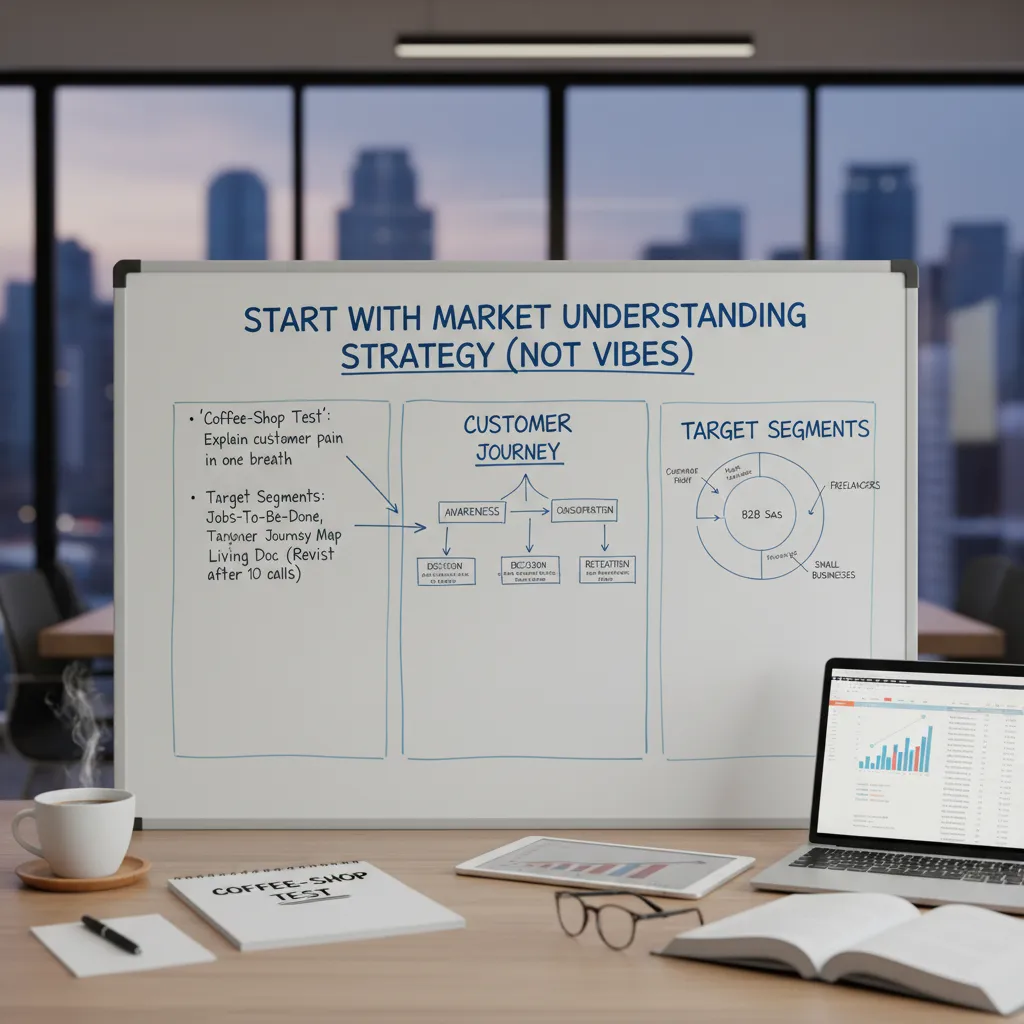
1) Start With Market Understanding Strategy (Not Vibes)
Before I touch ads, content, or “positioning,” I run what I call my coffee-shop test. If I can’t explain the customer’s pain in one breath—like I’m ordering a latte and the barista asks what I do—I don’t understand it yet. Marketing strategy in 2026 starts with market understanding, not gut feel.
Go past demographics: focus on the job, the trigger, the stop
I still note basics like industry and company size, but I don’t build target segments on demographics alone. I segment by:
- Jobs-to-be-done: what they’re trying to get done (not what they say they want)
- Buying triggers: the moment that forces action (new hire, audit, churn spike, budget freeze)
- Deal-stoppers: what kills the deal fast (security reviews, setup time, missing integrations)
Customer journey mapping (as a living doc)
I keep a simple customer journey map and treat it like a working file, not a one-time workshop. I revisit it after every 10 sales calls and update the real words people use. My map usually includes:
- First awareness (what they notice)
- Evaluation (what they compare)
- Decision (what proof they need)
- Onboarding (where friction shows up)
Competitive dynamics: what they compare you against
Customers don’t always compare you to a direct competitor. Sometimes your “competition” is a spreadsheet, an internal tool, or doing nothing. I ask on calls: “What are you using today, and what would you do if you didn’t pick us?”
Wild-card exercise: write an anti-pitch
Anti-pitch: “We’re not for teams who want the cheapest option, need zero change, or can’t commit to a clear owner. We’re for teams who want measurable outcomes and will follow a simple process.”
2) Strategic Objectives Marketing: My ‘Boring’ Revenue Math
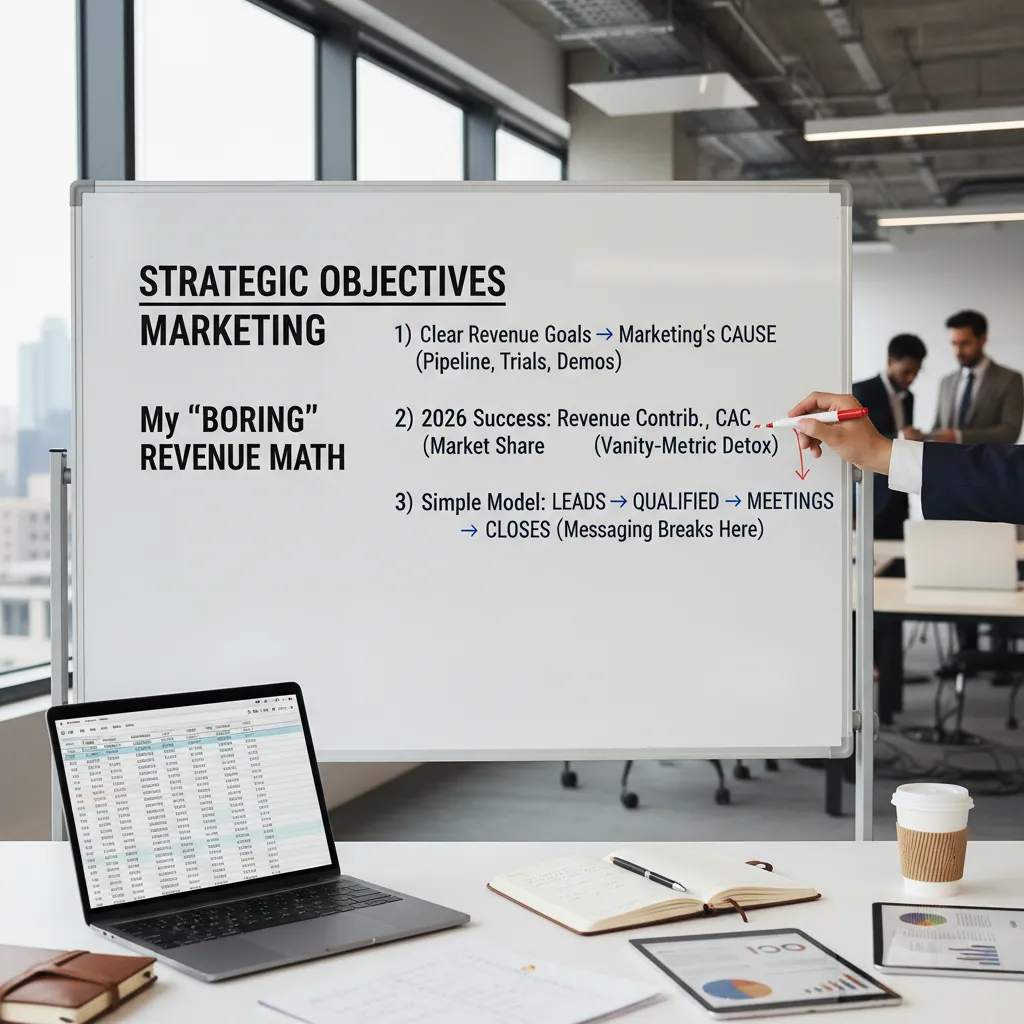
I start every marketing strategy with a revenue target, not a channel plan. If the business needs $1M in new ARR, I work backward and ask: what does marketing have to cause—pipeline, trials, demos, or partner referrals? This keeps my 2026 marketing plan tied to outcomes, not activity.
My 2026 success metrics (vanity-metric detox)
I track three numbers first: revenue contribution, customer acquisition cost (CAC), and market share growth. If a campaign can’t move one of those, it’s usually a “busy” project. I still look at clicks and traffic, but only as supporting signals.
The simple funnel model I actually use
My “boring” math is a straight line:
leads → qualified → meetings → closes
When results dip, I don’t guess. I find the broken link:
- Leads → qualified: targeting or offer is off.
- Qualified → meetings: messaging isn’t clear, or the CTA is weak.
- Meetings → closes: sales fit, pricing, or proof (case studies) is missing.
Why I stopped celebrating email opens
Small tangent: I used to cheer for open rates. Then I realized it was like clapping for a doorbell. An open is not intent; it’s a moment. Now I care more about replies, booked calls, trial starts, and influenced pipeline.
My “measurement menu” rule
Every campaign gets a primary metric and one backup metric:
- Primary: the outcome (pipeline $, demos booked, trials started).
- Backup: the best leading indicator (qualified rate, meeting rate, reply rate).
3) Marketing Channels Selection That Actually Cooperate
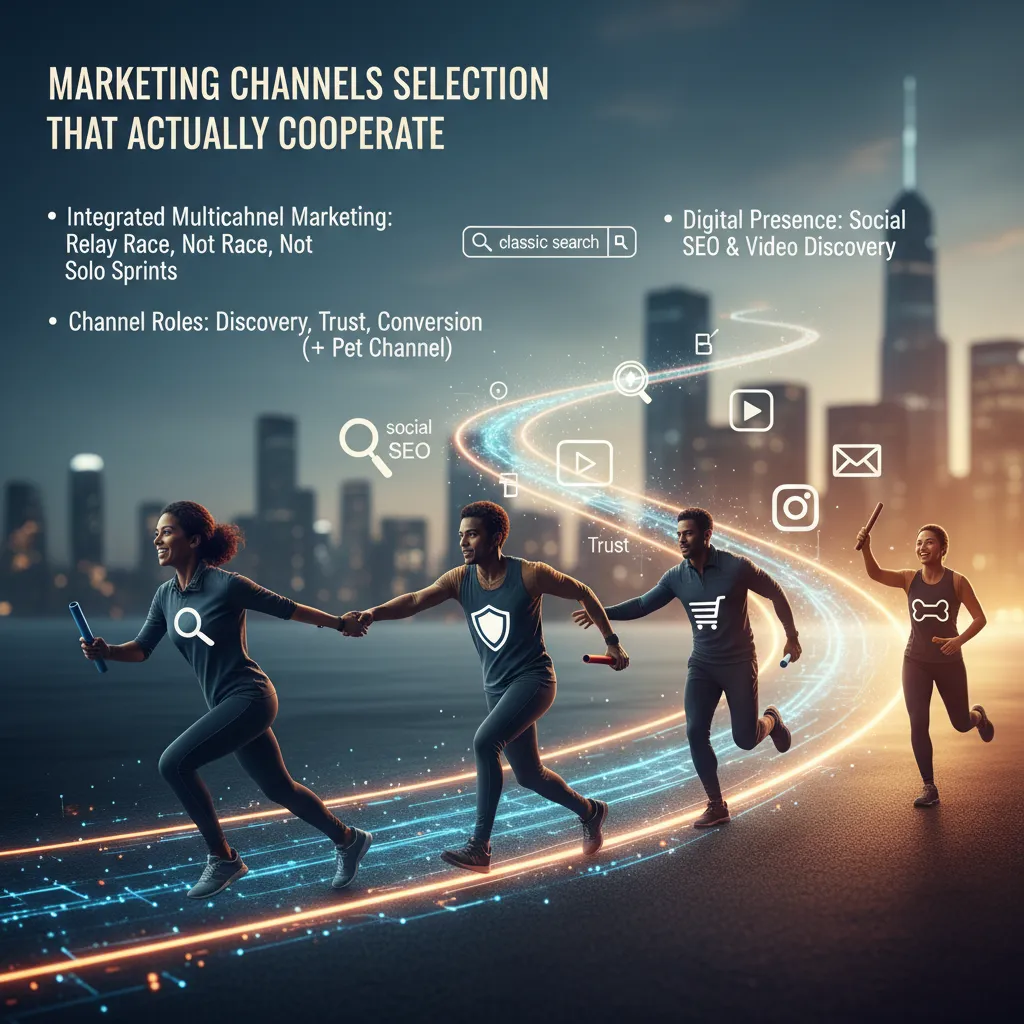
I pick channels the way I plan a relay race, not a bunch of solo sprints. Each channel hands the message to the next one, so the customer journey feels smooth instead of noisy. When I do this right, my content, ads, and emails stop competing and start supporting each other.
Give every channel a clear job
I assign roles before I write a single headline. My simple rule: one channel for discovery, one for trust, one for conversion, plus one “pet channel” I’m allowed to play with (as long as it doesn’t steal budget from the basics).
- Discovery: social SEO marketing, short-form video discovery, partnerships
- Trust: email, webinars, case studies, community posts
- Conversion: retargeting, product pages, sales calls, checkout flows
- Pet channel: the one I test for fun (right now: niche podcasts)
Digital presence now means more than classic search
In 2026, “SEO” is not just Google rankings. I optimize for social search (people searching inside TikTok, Instagram, LinkedIn) and for video discovery (titles, hooks, captions, and watch time). I also keep my brand pages consistent so the same promise shows up everywhere.
Write for humans and AI interfaces
Answer engine optimization (AEO) and generative engine optimization matter because customers ask questions in AI tools, not only in browsers. I use clear headings, direct answers, and simple examples. I also add FAQ-style lines that AI can quote without losing meaning.
My goal: one message, many formats, zero confusion.
Channel conflict: when paid stole credit from email
I once saw paid search “win” every conversion in reports. But the truth was email warmed people up, then paid got the last click. We fixed it by changing attribution rules: we tracked first_touch, assist, and last_touch, and we added a 7-day view-through window for email. Suddenly, budget decisions matched reality.
4) Personalization Priority Strategy: Treat Touchpoints Like Conversations
In 2026, I treat personalization like a real conversation, not a mail merge. The biggest shift I made from the “39 Marketing Tips Every Professional Should Know” mindset is this: I personalize context more than I personalize names. A first name in a subject line is fine, but knowing someone’s stage, need, and risk is what actually changes results.
Personalize the moment, not the person
At every customer touchpoint, I ask: “Where are they in the journey, and what could stop them?” Then I tailor the message to that reality. Context beats cleverness.
Rewrite one core message for three life stages
I keep one core promise, then rewrite it for three stages:
- New: simple value + fast win
- Evaluating: proof, comparisons, and risk reduction
- Renewing: outcomes, adoption, and what’s next
This keeps my planning audience-focused without creating 50 versions of everything.
Lightweight segmentation rules before “data science”
Before I build complex models, I start with three rules:
- Industry (what language and examples they trust)
- Trigger (what event made them pay attention)
- Intent (browsing, comparing, ready to buy)
Even a simple industry + trigger + intent setup makes emails, ads, and landing pages feel made for them.
The A/B tests I still run (promises win)
I still test subject lines and offers, but the biggest lift usually comes from the landing page promise: the headline, the first CTA, and the “what you get” section.
Tiny confession: my worst personalization mistake was being creepy—so I now follow a “no surprises” rule. If they’d be shocked I know it, I don’t use it.
5) Pick a Growth Engine: ABM, Product Led Growth, or Community Driven Marketing
In 2026, I don’t try to “do all the marketing.” I pick a growth engine that matches the business model, then I build the plan around it. The three engines I use most are Account-Based Marketing (ABM), Product-Led Growth (PLG), and Community-Driven Marketing.
When I choose ABM
I use ABM when deal sizes justify focus. That means fewer targets, deeper research, and tighter sales alignment. ABM works best when one closed deal can pay for months of effort.
- Fewer accounts, but higher intent and better fit
- Personalized messaging based on real account research
- Sales + marketing run one shared list and one shared goal
When I choose Product-Led Growth
I choose PLG when the product can deliver fast time-to-value. In PLG, onboarding is marketing, and activation is your loudest ad. If users “get it” in the first session, growth gets cheaper.
- Shorten the path from signup to first win
- Measure activation like a core marketing KPI
- Use in-product prompts instead of more top-of-funnel spend
When I choose Community-Driven Marketing
I invest in community when I want a moat. The goal is network effects: customers recruit customers quietly, but powerfully, because being part of the group adds value.
Community is the only channel where the audience can become the distribution.
If I had $5k/month and one marketer
I’d pick PLG first—because improving onboarding, activation, and retention compounds without needing a big team. If the product can’t self-sell, I’d switch to ABM and target 20–50 accounts.
Reality check: you can mix engines, but you can’t half-do all three. Pick one primary engine, then add a second only after the first is working.
6) Event Marketing Strategy + Follow-Up: The Unsexy Superpower
I used to treat events like a big launch: one date, one big push, then we moved on. That approach looks exciting, but it rarely compounds. Now I plan events like a TV season, not a movie premiere. A consistent seminar series builds familiarity, improves attendance over time, and gives my team repeatable assets for our 2026 marketing strategy.
Consistency beats the one-off splash
When I map a series, I can reuse the format, tighten the agenda, and learn what actually drives sign-ups. Each session becomes a new “episode” with a clear promise, a simple title, and one action I want people to take.
One theme, many micro-stories
I keep the core message stable, then tailor the examples by segment. Same theme, different angles. That’s where demographic insights matter: a founder wants speed, an ops lead wants fewer errors, and a finance lead wants predictable cost.
- Theme: one sentence I can repeat everywhere
- Segment story: one short case or scenario per audience
- Offer: one next step that matches the session
The follow-up sequence is the event
The best leads usually show up after the event, not during the coffee break. People need time to forward the recap, ask for budget, or watch the recording. So I design the follow-up like a mini-campaign.
My post-event rule: if we don’t ship the follow-up in 48 hours, we treat it as a missed event.
Integrated channels that make events work
I pair event marketing with email, short video recaps, and sales enablement notes so the message stays consistent across touchpoints.
- 0–48 hours: recap email + recording + one CTA
- Day 3–7: 60-second highlight video + key quote
- Week 2: sales note with attendee context and suggested outreach
7) AI Optimization Marketing Without Losing the Human Thread
I use AI as a speed layer, not a replacement for judgment. It helps me draft 5 headline variants, summarize sales and support call notes, and spot patterns in reviews and tickets. Then I do the part AI can’t: I edit with taste. I cut fluff, add real examples, and make sure the message sounds like a person who has actually talked to customers.
Predictive analytics for faster decisions
In my 2026 marketing strategy, predictive analytics is how I decide what to do next week. I look for signals like rising CAC, drop-offs by channel, or cohorts that retain better. That lets me move faster:
- Scale what’s trending up (and why it’s trending up).
- Pause what’s quietly bleeding budget.
- Test one clear hypothesis at a time (new offer, new audience, new creative angle).
The human-first media paradox
AI discovery is rising: search, feeds, and recommendations are more automated than ever. But that makes authentic connection premium inventory. The more content gets generated, the more people value signals of real effort: a founder’s voice, a customer story, a specific opinion, a behind-the-scenes lesson.
My safety checklist
- Don’t automate empathy: apologies, sensitive replies, pricing pushback.
- Do automate repetition: tagging, reporting, first drafts, meeting summaries.
- Keep a human review for anything customer-facing.
- Protect data: no private customer info in public tools.
Quick “what if” scenario: churn risk before renewal
What if an AI assistant flags churn risk 30 days before renewal? Marketing pulls a segment list and sends a helpful “value recap” email with a short case study. Customer Success gets an alert with the top 3 risk reasons (low usage, unresolved ticket, missing feature) and books a check-in. Same data, two human actions, one goal: keep trust.
Conclusion: My 39 Tips Filter for a Successful Marketing Plan
If I had to reduce everything in my “Marketing Strategy 2026” playbook to one filter, it would be this: understand the market, choose a growth engine, coordinate channels, personalize honestly, and measure revenue impact. That’s the core I keep coming back to when I review my notes from 39 marketing tips every professional should know and decide what actually belongs in a real marketing plan.
Before I ship any plan, I do one final pass. I check positioning (are we clear and different?), objectives (do we know what “good” means?), channels (are we picking, not collecting?), cadence (can we publish and follow up consistently?), measurement (do we track pipeline and revenue, not just clicks?), and the human thread (does this sound like a real person helping another real person?). If one of those is weak, I fix it before I add more tactics.
I also revisit marketing trends predictions quarterly, because 2026 will move fast. But I don’t rebuild my entire marketing strategy every time Twitter sneezes. I look for signals that match my market, then I test small, keep what works, and document the result.
My best marketing year was the one where I said “no” more often.
Saying no helped me protect focus, keep channel coordination tight, and give campaigns enough time to compound.
Now your turn: pick 3 tips from the 39 and implement them this week. Then schedule a 30-minute retro for two Fridays from now. In that retro, ask: what moved revenue, what wasted time, and what should we stop doing next?
TL;DR: If you’re building a Marketing strategy 2026, start with market understanding strategy and target segments identification, pick integrated marketing channels that reinforce each other, personalize every customer touchpoint, use AI optimization marketing to move faster, and measure marketing strategy results with revenue-driven goals—not vanity metrics.