
Last year I sat in a quarterly ops review where our “big win” was… finally deleting a spreadsheet nobody owned. It was funny until it wasn’t—because that single sheet was quietly driving pricing, inventory, and customer promises. That moment keeps coming back to me when I look at Operations Trends 2026: the tools are getting smarter, the economy is getting weirder, and the basics (clear ownership, clean data, resilient processes) are suddenly the competitive edge. If you’re planning for 2025–2026, this isn’t about predicting the future—it’s about getting good at operating in the messy middle.
1) Tech Trends 2025 meets Ops Reality: “AI, but useful”
In 2025, I’m seeing a clear shift: AI-augmented innovation is moving from pilots to daily workflows. The biggest sign? My team stopped calling it a “project.” When AI helps answer tickets, draft updates, reconcile numbers, or flag risks every day, it becomes part of operations trends 2025–2026, not a side experiment. The messy middle is learning where it fits, and where it doesn’t.
Where AI agents show up first (because the pain is obvious)
AI agents proliferation usually lands in the places where handoffs are slow and context gets lost. In my world, the first wins show up here:
- Customer support: summarizing threads, suggesting replies, tagging root causes.
- Forecasting: spotting pattern breaks and explaining “why” behind variance.
- Finance close: matching transactions, drafting narratives, chasing missing inputs.
- Sales ops handoffs: cleaning CRM notes, routing deals, reducing “what did we promise?” gaps.
The unsexy prerequisite: data governance that actually connects
GenAI only stays useful when it’s grounded in the right context. Without data governance integration, it will confidently hallucinate your KPIs, definitions, or targets. I’ve learned to treat governance like plumbing: boring until it breaks. We now push for:
- One source of truth for metric definitions
- Permissioning so sensitive data stays protected
- Lineage so we can trace where numbers came from
“If the model can’t cite the metric definition, it can’t publish the metric.”
A quick tool diet (I learned this the hard way)
Before adding another AI dashboard, I run a simple exercise: remove one dashboard before adding another. If we can’t delete something, we don’t understand it well enough to automate it.
Wild-card analogy: power tools need safety training
Running ops with AI is like giving everyone a power tool—amazing for speed, dangerous without basics. We write short “safety rules” like:
- Verify before you broadcast
- Don’t automate exceptions first
- Log prompts and outputs for audit

2) Economic Uncertainty Coping: Planning for 1–2% growth (without panic)
In the “messy middle” of 2025–2026, economic uncertainty persists in a way that feels less like a headline and more like a Tuesday. I see it in slower approvals, tighter customer budgets, and the steady drip of “can we revisit pricing?” emails. Deals don’t die; they stall. Forecasts don’t collapse; they wobble.
Inflation pressure is cooling compared to the last cycle, but operations teams are still stuck in a defensive crouch. Why? Because input costs don’t fall evenly, and tariff uncertainty can change landed cost overnight. Even when demand is stable, the cost side keeps moving, which makes planning feel like steering on ice.
My slightly unpopular opinion for 2026
I think the operational excellence premium beats heroic growth bets. When growth is only 1–2%, the winners aren’t the teams that gamble on a big swing—they’re the teams that tighten execution: cleaner demand signals, faster cycle times, fewer handoffs, and better cost visibility.
A simple scenario plan I use
I keep planning lightweight and repeatable. Three scenarios, one operating rhythm:
- Base case: 1–2% growth. Fund the essentials, protect service levels, and prioritize projects with clear payback.
- Stress case: flat growth. Freeze “nice-to-have” spend, renegotiate key supplier terms, and focus on cash and working capital.
- Upside case: selective demand spikes. Pre-approve capacity levers (overtime, temp labor, alternate suppliers) so we can respond without chaos.
To keep it practical, I write the triggers down in plain language:
“If approvals slip by 2+ weeks, we shift to stress actions. If lead volume jumps 10% in two weeks, we activate upside capacity.”
Mini-tangent: I miss when budgets felt like math instead of weather forecasting. But this is the reality of operations trends in 2025–2026—so I plan for small growth, protect the downside, and stay ready for pockets of surprise demand.
3) Supply Chain Diversify (and the Strategic Inventory Shift I resisted)
In 2025–2026, I stopped treating supply chain disruptions like a temporary headache. They’re a design constraint. Weather, geopolitics, port delays, cyber issues, and sudden demand spikes now show up often enough that “back to normal” is not a plan. The messy middle is learning to run operations assuming something will break—then building the system so it bends instead of snaps.
Three moves I’m seeing stick
- Nearshoring: not because it’s always cheaper, but because shorter lanes reduce lead-time risk and make planning less fragile.
- Multi-sourcing: splitting volume across suppliers, even if it adds work. The goal is optionality, not perfection.
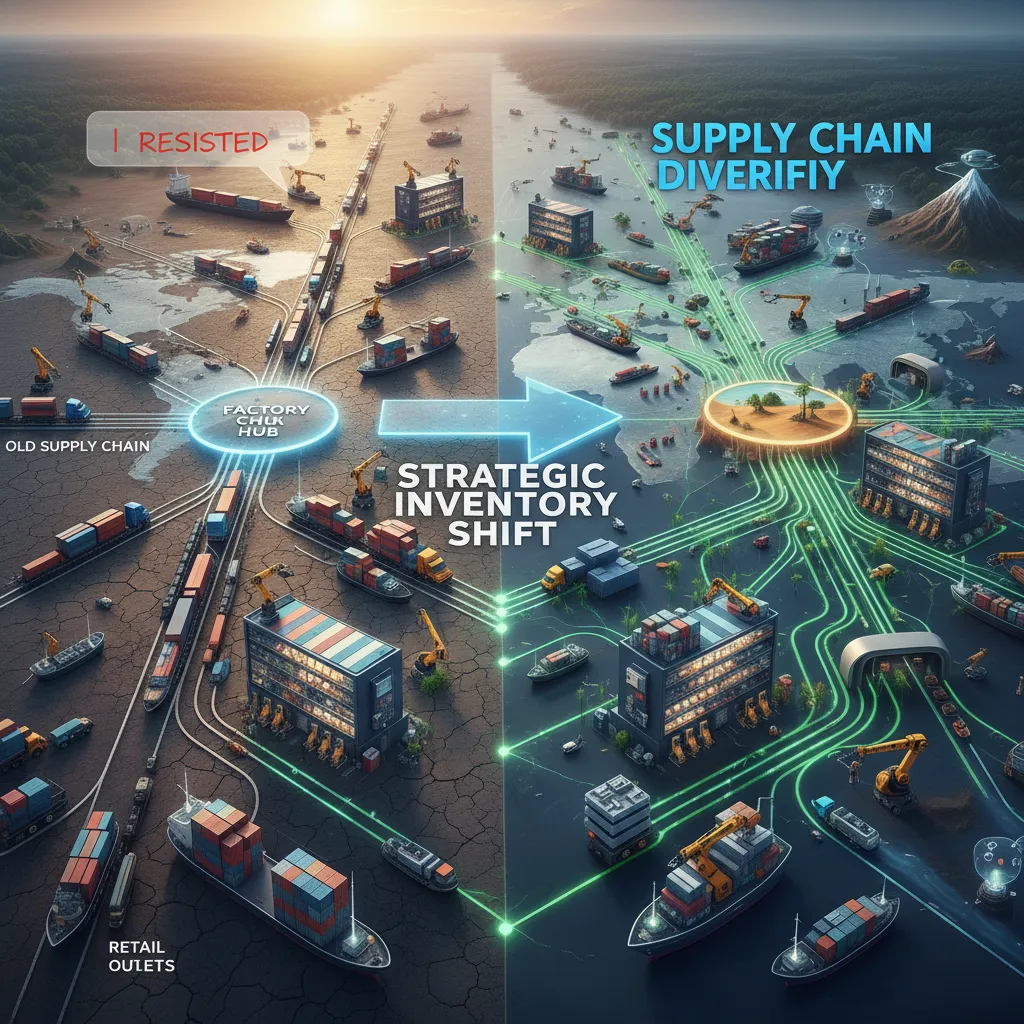
- Strategic inventory shift: yes, inventory—again. I resisted this because I grew up on “inventory is evil.” Now I see targeted buffers as an insurance policy, especially for long-lead or single-source parts.
A “resilience score” that’s more than vibes
I use a simple scorecard so we can argue with data, not feelings:
| Metric | What I measure | Why it matters |
|---|---|---|
| Lead-time spread | Best vs. worst case lead time | Wide spread = planning chaos |
| Supplier concentration | % of spend/volume in top 1–3 suppliers | High concentration = single point of failure |
| Substitution options | # of approved alternates (parts, materials, routes) | More substitutes = faster recovery |
Hypothetical stress test: top supplier offline for 6 weeks
I ask one question in S&OP: what breaks first—revenue, service levels, or the team’s sanity? If the answer is “all three,” we don’t have a supply chain; we have a hope chain.
Operational strategies map (so we don’t oversell reliability)
- S&OP: model constraints and set buffer targets by SKU, not by gut.
- Procurement: negotiate dual-source terms and qualify alternates before the crisis.
- Customer promise language: align SLAs, lead times, and “in-stock” claims to what the network can truly deliver.

4) Digital Transformation Mandatory… and Cybersecurity as Table Stakes
In the 2025–2026 “messy middle,” I see digital transformation shifting from “launch a shiny new app” to “make the systems we already own actually work together.” Most operations teams aren’t short on tools—they’re short on integration. The real wins come when the ERP, CRM, ticketing, finance, and warehouse systems stop acting like strangers. When data flows cleanly, handoffs shrink, errors drop, and cycle time improves without heroic effort.
Integration over novelty
Digital innovation now looks like fixing the boring stuff: shared IDs, clean APIs, consistent workflows, and fewer spreadsheets holding the business together. If I can’t trace an order from quote to cash without manual re-entry, I don’t call it “transformed.” I call it fragile.
Cybersecurity isn’t a department
Cybersecurity is also changing. Treating security like a separate “IT thing” is the fastest way to stay vulnerable. Every process design choice is a security choice—especially when automation increases speed and blast radius.
My rule of thumb: if a process touches money, customer data, or uptime—assume it’s a target.
Data governance as a daily habit
To make integration safe, I lean on data governance as routine work, not a one-time project. That means agreeing on definitions (what counts as “active customer”?), setting access control by role, and keeping audit trails. I know, thrilling—but it prevents “multiple versions of truth” and makes incidents easier to investigate.
The checklist I repeat like brushing teeth
- Patch cadence: a clear schedule, plus a fast lane for critical fixes.
- Vendor access review: who has access, why, and when it expires.
- Backup restore test: not “we have backups,” but “we restored last week.”
In this period, I’m not chasing perfection. I’m building operational resilience: integrated systems, secure-by-default workflows, and simple controls that run every week—because threats and complexity don’t take breaks.
5) The Human Side: Talent Scarcity Structural + Hybrid Work That Actually Works
In 2025–2026 operations, talent scarcity feels structural, not temporary. The workforce is also more disengaged and smaller. That isn’t a headline—it’s the quiet drag I feel in cycle times, messy handoffs, and “waiting on someone” delays that add days to simple work.
From “presence” to output-based management
I stopped treating hybrid work like an attendance problem and started managing to outputs. That shift made my 1:1s less awkward because we weren’t debating where someone sat—we were looking at what moved.
- Clear deliverables (what “done” means)
- Service levels (response times, turnaround times)
- Quality signals (rework rate, customer feedback)
Role-based flexibility beats blanket policies
I’ve seen role-based flexibility work better than one rule for everyone. Some roles need core collaboration days (handoffs, planning, coaching). Others need long deep-work blocks (analysis, build, documentation). When we matched flexibility to the role, we reduced friction and improved throughput.
| Role pattern | Best hybrid setup |
|---|---|
| High-handoff / cross-team | 2–3 core collaboration days |
| Build / analysis heavy | Protected deep-work time + fewer syncs |
Activity-based working: design days around the work
Instead of letting the calendar default decide our week, I plan around activities: customer calls, planning, build, review. That simple change reduced context switching and made hybrid work feel intentional.
“The goal isn’t more meetings. It’s fewer handoffs and faster decisions.”
A small experiment that actually helped
One month, we ran no-meeting Wednesdays and added visible SLA boards for key requests. The result was surprisingly effective: fewer interruptions, faster completion, and less “status chasing.”
- No internal meetings on Wednesdays (exceptions required a reason)
- SLA board showed
owner,due date,status, andblocked by - Friday review focused on bottlenecks, not blame
6) Pricing Trends 2026 & Profitability Mindset Pivot (aka: Stop Subsidizing Chaos)
In 2026, I’m treating pricing as an operations decision, not a marketing trick. The price we set is really a promise about lead times, quality, service levels, and how many “special requests” we’ll absorb. If our delivery system can’t support that promise, pricing becomes a quiet way we subsidize chaos—until margins disappear.
Pricing is delivery capability in disguise
When I look at pricing trends for 2026, the ops angle is clear: the product isn’t just what we sell; it’s how we deliver it. Two customers can buy the same item and create totally different workloads. That’s why pricing needs to reflect the real work required to serve each segment.
Cost-to-serve finally gets invited to the party
I’m seeing more teams build pricing around cost-to-serve, not just unit cost. That means segmenting customers by operational drag, such as:
- Support load (tickets, onboarding time, account hand-holding)
- Returns and rework (damage, mis-picks, “not as expected” patterns)
- Promise complexity (custom packaging, split shipments, special compliance)
Once those drivers are visible, pricing can match reality: standard service stays competitive, while high-touch service is priced like the premium work it is.
AI won’t fix a leaky margin model
A gentle warning from the “messy middle”: AI-driven transformation won’t repair broken economics. If we automate a process that’s already underpriced, we just make the leak faster. Before scaling with AI, I want clean rules: what we charge for, what we don’t, and what triggers an exception fee.
When to say “no” operationally
Profitability in 2026 often comes from refusing the wrong complexity:
- Custom exceptions that bypass standard workflows
- Rush orders that disrupt planning without a rush premium
- Perpetual discounts that turn “special” into the default
The loop closes when operational excellence shows up as a premium: fewer exceptions, cleaner promises, and pricing that rewards stability instead of funding disorder.
Conclusion: Future Operations 2026 is a muscle, not a forecast
When I look across the operations trends 2025–2026, I don’t see one big “next thing.” I see four threads that keep tightening together: AI-augmented innovation, a rising premium on operational excellence, more resilient supply chains, and human-centered management. In plain terms, the winners aren’t just adopting new tools. They’re building systems that learn, recover, and improve without burning people out.
AI is speeding up decisions, but only when the basics are solid. Operational excellence is no longer a nice-to-have; it’s how you protect margins when costs swing and customers expect faster service. Supply chain resilience is shifting from “cheapest” to “survivable,” with more dual sourcing, better visibility, and clearer trade-offs. And management is changing too: the best teams I see are run with trust, clear goals, and support—not constant monitoring.
For my own 2026 planning, I keep a “sticky note” checklist on my desk. It’s simple: integrate data so teams aren’t arguing about numbers; harden security because every new connection is a new risk; diversify suppliers so one disruption doesn’t stop the whole line; manage by outputs so people focus on results, not activity; and re-check pricing because value and cost are moving targets. None of these are flashy, but they compound.
That compounding is the widening gap. Adaptive companies stack small improvements—better handoffs, cleaner data, tighter cycle times—and those gains multiply. Everyone else compounds firefighting: urgent fixes, rushed hires, surprise stockouts, and “temporary” workarounds that become permanent.
Here’s my wild-card scenario: what if your best operator quits tomorrow—does your system still run? If the answer is no, the priority isn’t another tool. It’s documentation, cross-training, and process design that makes performance repeatable.
My parting thought is this: the future of operations in 2026 feels less like a straight line and more like a series of small, well-chosen defaults. Build the muscle now, and you won’t need perfect forecasts later.
TL;DR: Operations Trends 2026 rewards companies that pair AI-driven transformation with boring fundamentals: data governance, cybersecurity, supply chain resilience, and output-based management. Expect 1–2% growth, persistent uncertainty, and a widening gap between adaptive teams and everyone else.