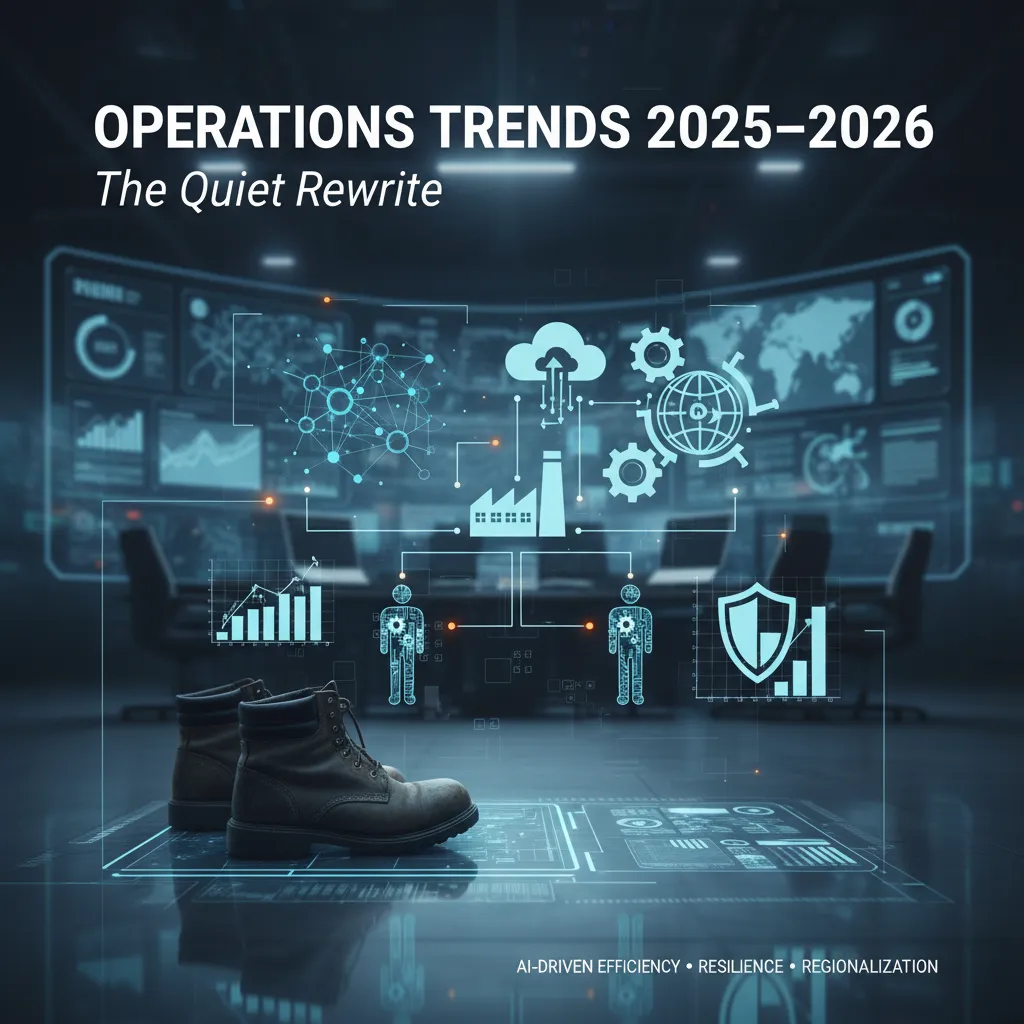
The first time I watched a “perfect” plan fall apart was on a Tuesday—because a single late shipment made our spreadsheet timeline laughably irrelevant. That moment changed how I think about operations: it’s less about making a plan and more about building systems that can absorb surprises. Heading into 2025–2026, the themes are familiar—AI, cloud, talent, risk—but the way they’re converging feels new. It’s like operations is quietly rewriting its own job description: from cost center to intelligence center, from reactive firefighting to real-time visibility and continuous planning.
1) AI Driven Efficiency: less “automation,” more orchestration
My “one bot” experiment (and the three broken handoffs it exposed)
When I first tested a single automation bot, I expected a small win: fewer copy-paste steps and faster updates. Instead, it became a spotlight. The bot did its job perfectly—and still triggered three failures across the process. One team used a different naming rule, another approved work in email (not the system), and a third relied on a spreadsheet no one owned. That day taught me what AI-driven efficiency really means in 2025–2026: not more automation, but better orchestration across people, tools, and handoffs.
“The bot didn’t break the process. It revealed where the process was already broken.”
Where AI-driven efficiency actually lands in 2026
In the source material, the shift is clear: operations teams are moving from task automation to AI that coordinates work. In my world, the practical wins show up in three places:
- Scheduling: AI suggests staffing and sequencing based on demand, skills, and constraints—not just a static rota.
- Quality checks: AI flags missing fields, unusual patterns, and “this doesn’t look right” cases before they become defects.
- Exception handling: Instead of treating every case the same, AI routes edge cases to the right person with context and next-best actions.
This is why I say “less automation, more orchestration.” The value is not that AI does everything. The value is that AI keeps work moving when reality gets messy.
Predictive analytics: from dashboards to decisions (and why that made me nervous)
I used to be comfortable when predictive analytics lived in dashboards. A forecast could be wrong, but it was still “advice.” In 2026, the trend is that predictions start triggering actions: reorder points, schedule changes, escalation rules. That made me nervous because it changes accountability. If the model is wrong, the impact is immediate.
So I now push for simple guardrails:
- Human approval for high-cost decisions.
- Clear thresholds for when AI can act.
- Audit trails that show why a decision happened.
Wild card: the “agentic AI shift supervisor”
If I had an agentic AI shift supervisor on day one, I’d let it:
- Rebalance queues and assign work within set rules
- Chase missing inputs with polite nudges
- Open tickets and attach evidence automatically
What I would never allow at first: firing vendors, overriding safety steps, or changing quality standards without explicit sign-off. Orchestration is powerful—but only when the boundaries are just as strong as the model.

2) Cloud ERP as the new ‘ops nervous system’ (Cloud ERP + Real Time Visibility)
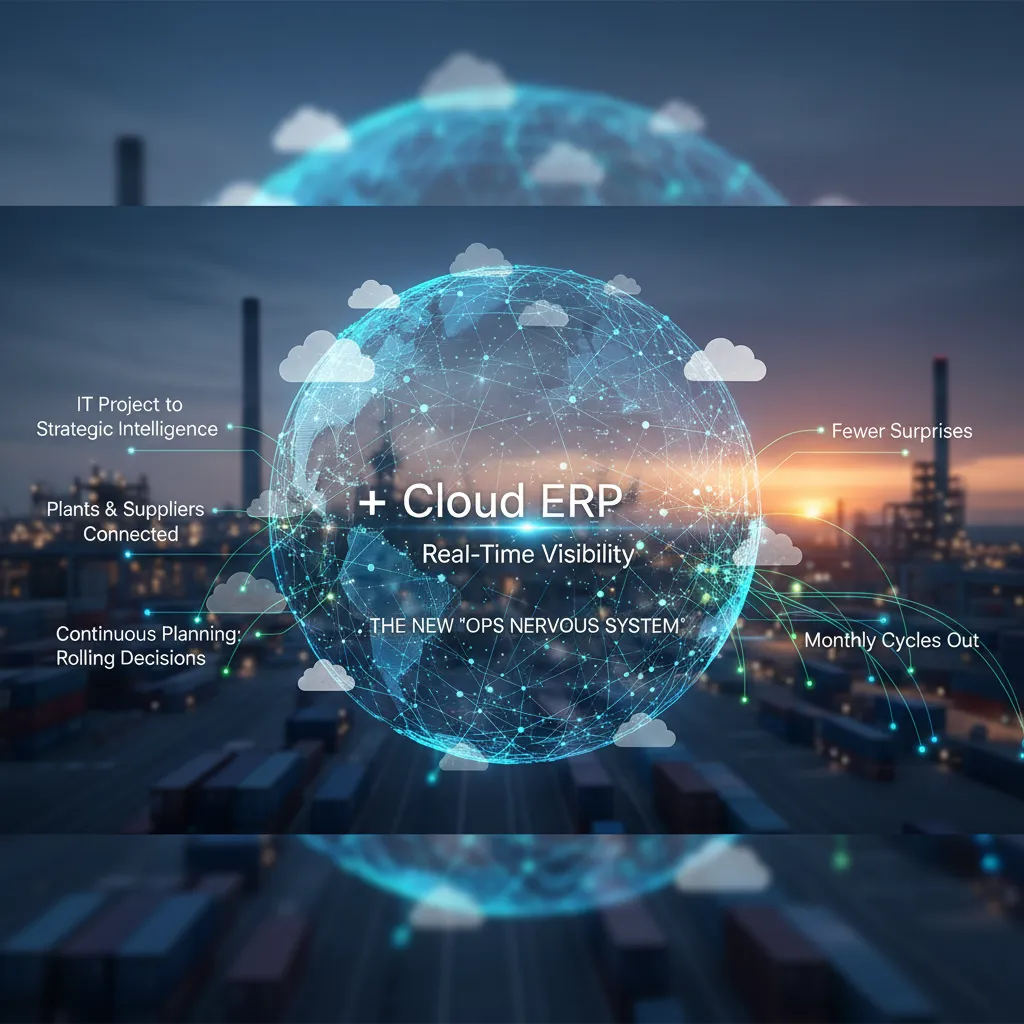
Cloud ERP stopped being an IT project the moment we needed real-time visibility across plants and suppliers. In 2025–2026, the pressure isn’t just “move to the cloud.” It’s “show me what’s happening right now”—inventory, capacity, quality holds, late shipments, and supplier risk—without waiting for a weekly report or a month-end close.
From system of record to “strategic intelligence layer”
The phrase I keep hearing is strategic intelligence layer. On the ground, that means Cloud ERP is no longer only where transactions live. It becomes the shared operational truth that planning, procurement, production, finance, and customer teams can all read from—fast.
- One view of demand and supply across sites, not separate spreadsheets per plant.
- Faster exception handling: shortages, expediting, and substitutions show up as alerts, not surprises.
- Better supplier coordination because purchase orders, confirmations, and inbound status are visible end-to-end.
“If I can’t see it, I can’t manage it.” Cloud ERP is becoming the place where visibility turns into action.
Continuous planning replaces monthly cycles
Monthly planning cycles made sense when change was slower. Now they create blind spots. With Cloud ERP and real-time signals, I’m seeing teams shift to continuous planning: rolling decisions that update as demand, lead times, and constraints change.
Practically, that looks like:
- Re-forecasting more often (weekly or even daily for key SKUs).
- Rebalancing inventory across plants based on current orders and capacity.
- Using exception-based workflows so planners focus on what changed, not what didn’t.
The payoff is fewer surprises: fewer last-minute expedites, fewer stockouts that “came out of nowhere,” and fewer production schedule resets that burn overtime.
Mini-rant: messy master data just gets messy faster
Here’s the part people skip: if your master data is a mess, Cloud ERP just makes the mess faster. Bad item masters, inconsistent units of measure, duplicate suppliers, and outdated lead times don’t disappear in the cloud—they spread.
I push for a simple rule set before scaling:
- Clear ownership for item, supplier, and BOM data.
- Standard definitions (UOM, locations, naming rules).
- Ongoing governance, not a one-time cleanup.
3) Supply Chain Resilience isn’t a slogan anymore (regionalization, nearshoring, geopolitical risks)
The new baseline: disruptions aren’t rare events, they’re background noise
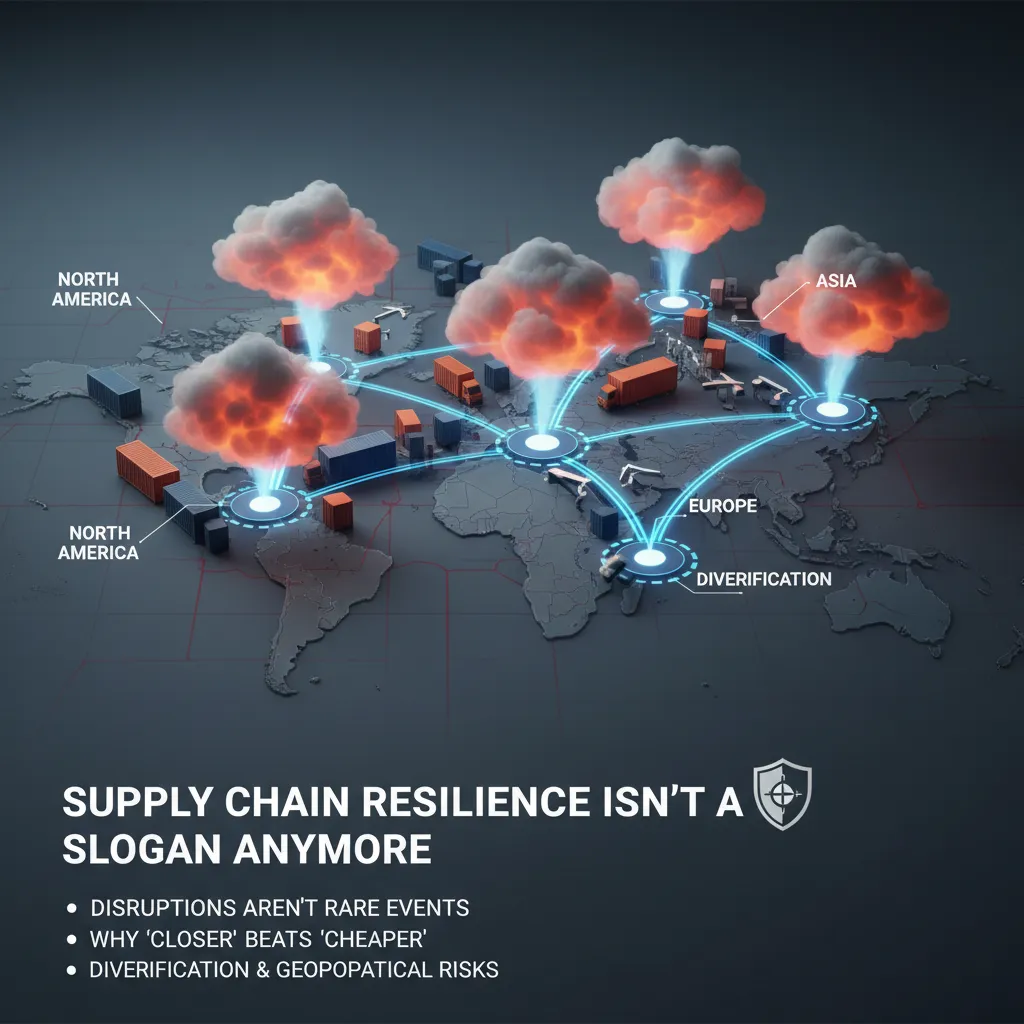
In 2025–2026, I treat supply chain disruption as the default setting, not a surprise. Weather swings, port delays, cyber issues, labor gaps, and policy changes show up like background noise. That shift matters because it changes how I plan: I don’t ask, “Will something break?” I ask, “What breaks first, and how fast can we recover?” In this new baseline, supply chain resilience is not a poster on the wall—it’s a set of daily operating choices.
Regionalization strategies: why “closer” sometimes beats “cheaper”
Regionalization and nearshoring keep coming up because they reduce the distance between problems and solutions. Yes, unit cost can be higher, and finance may flinch. But I’ve learned that “cheaper” often ignores hidden costs: expediting, excess safety stock, quality escapes, and lost sales when lead times stretch.
- Shorter lead times mean faster replenishment and less inventory risk.
- Fewer border crossings reduce customs and compliance surprises.
- Better collaboration improves quality and change control.
When I compare options, I push for a total-cost view, not just piece price.
Diversification as a hedge against geopolitical risks—what I’d diversify first
Geopolitical risks are now a core supply chain variable: sanctions, export controls, shipping lane instability, and sudden regulatory shifts. My first move is not to diversify everything at once. I start with the parts that can stop the business.
- Single-source components with long tooling or certification cycles.
- Critical raw materials tied to one region or one trade route.
- Logistics capacity (carriers, ports, lanes) where congestion is common.
- Key contract manufacturers concentrated in one country.
Resilience is a portfolio strategy: I’d rather have “good enough” options in two places than “perfect” in one.
Real-time visibility: the difference between proactive and panicked
Visibility is what turns resilience from theory into action. If I can’t see inventory, orders, and supplier status in near real time, I’m reacting late. With better visibility, I can reallocate stock, adjust production, and communicate early—before teams start expediting in panic.
I look for simple signals that travel fast: confirmed ship dates, supplier capacity updates, exception alerts, and one shared view of demand and supply across operations, procurement, and logistics.
4) Workforce Transformation: the awkward middle stage (Reskilling Imperative + Employee Empowerment)
I’ll start with a confession: I underestimated the culture dissonance of human-machine collaboration. On paper, adding AI copilots, robotics, and smarter dashboards looks clean. In real operations, it can feel awkward. People wonder, “Is this tool helping me, or checking on me?” Teams also struggle with new handoffs: when a machine flags an issue, who owns the next step—an operator, a planner, or an algorithm?
The reskilling imperative: what actually sticks
From what I’m seeing in 2025–2026 operations trends, the reskilling programs that work are not just “learning modules” and quizzes. They are practical, tied to daily work, and supported by managers who protect time for practice. The most useful skills are also more specific than most training catalogs admit.
- AI oversight: knowing how to review AI suggestions, spot weak inputs, and challenge outputs with process knowledge.
- Robotics maintenance: basic troubleshooting, safe resets, sensor checks, and knowing when to escalate.
- Digital systems fluency: using MES/CMMS/WMS screens correctly, understanding data fields, and keeping records clean so analytics stays reliable.
I’ve learned that “reskilling” is less about turning everyone into data scientists and more about building confidence in new workflows. If the tool changes the job, the training has to change the job too—otherwise people go back to old habits under pressure.
Employee empowerment via technology enablement
Employee empowerment sounds like a slogan until the tech is set up to support it. When it works, decisions get faster and meetings get shorter. The best examples I’ve seen share a few traits:
- Clear decision rights: the dashboard shows the issue, and the frontline role is allowed to act.
- Simple alerts: fewer notifications, better thresholds, and a clear “next best action.”
- Visible impact: teams can see how their choices affect scrap, downtime, or service levels.
“If I can fix it in five minutes, I shouldn’t need a meeting to get permission.”
A small story: the operator who became the best “analytics translator”
One of my favorite moments this year came from a line operator who wasn’t impressed by charts. But after a few weeks of working with a simple downtime dashboard, she started translating patterns into plain language: “This spike happens after changeover B, not after lunch.” She didn’t just read the analytics—she made it usable. In that room, she became the best analytics translator, because she connected data to real work.
5) Operational Resilience goes to the boardroom (Finance Operations + Investment Operations angle)
In the 2025–2026 operations trends I’m seeing, operational resilience has moved from an IT checklist to a board-level topic. It’s no longer just “keep the lights on.” It now sits at the intersection of governance, cyber risk, and business continuity. When an outage, data issue, or vendor failure hits, the question isn’t only “how fast can we recover?” It’s also “who owned the risk, what controls were in place, and what did we tell clients and regulators?”
Resilience is now governance + cyber + continuity
Boards want proof that resilience is designed into day-to-day operations, not added after an incident. That means clearer ownership, tested runbooks, and better reporting. I’ve noticed teams shifting from informal knowledge to documented processes and measurable controls.
- Governance: defined accountability for critical processes and third parties
- Cyber: tighter access, monitoring, and response plans tied to operations
- Continuity: realistic testing (not just “paper” disaster recovery)
Why Finance Operations is suddenly in the ops conversation
Finance Operations used to show up mainly at budget time. Now it’s pulled into resilience because finance data is the system of record for performance, fees, and reporting. If finance workflows break, the business can’t close books, meet deadlines, or explain numbers with confidence.
What’s changed is the expectation for audit-ready operations: faster closes, cleaner reconciliations, and stronger controls across data flows. Finance Ops is being asked to partner earlier with operations and technology on system design, not just downstream checks.
Investment operations: automated NAV and real-time accounting
On the investment operations side, the trendline is clear: automated NAV capabilities and near real-time accounting are becoming expectations, especially as product complexity grows. Manual workarounds don’t scale when valuations, corporate actions, and cash movements need to be reflected quickly and consistently.
“Resilience is the ability to produce the right number, on time, even when something breaks.”
Convergence across products and operations (and the integration headaches)
Firms are pushing for unified systems across asset classes—public markets, private markets, derivatives, and alternatives—so reporting and controls look consistent. The upside is simpler oversight and fewer data silos. The downside is integration pain: mapping data models, aligning valuation rules, and standardizing workflows across teams that have operated differently for years.
In practice, operational resilience becomes the forcing function: if systems can’t integrate cleanly, they can’t recover cleanly either.
6) Project Management gets hybrid (and a little more honest)
In 2025–2026, I’m seeing project management shift into a more hybrid style—and it’s not a trend I fight anymore. It’s a practical response to how operations really work. We still want the urgency and fast feedback loops of agile, but we also live in a world of dependencies, approvals, vendors, and compliance. So yes, Gantt charts still exist. I use them when I need clear dates, handoffs, and capacity planning, even if the team runs two-week sprints.
Hybrid methods: agile energy, ops reality
What’s changing is the honesty about tradeoffs. I can run daily standups and quick demos, while also keeping a simple timeline that shows when training, procurement, and rollout must happen. Hybrid isn’t “agile-lite.” It’s acknowledging that operational projects often have fixed constraints, and pretending they don’t just creates stress later.
Continuous planning replaces the big reveal
Project governance is getting quieter too. Instead of one big steering meeting where we “reveal” progress, I’m moving toward continuous planning: smaller check-ins, clearer metrics, and steady steering. Leaders don’t want surprises at the end; they want signals along the way. That means I share risks earlier, update scope more often, and treat plans as living documents. The result is fewer dramatic pivots and more controlled adjustments.
When I choose slower on purpose
There’s also a growing tension between operational excellence and speed. Sometimes I choose “slower” because it’s actually safer and cheaper. If a process touches customers, finance, or safety, I’d rather spend an extra week on testing, documentation, and training than spend a month cleaning up errors. In this era, being fast is good—but being stable is often better.
Ops projects feel like a kitchen at dinner rush
The best analogy I’ve found is running a kitchen during a dinner rush. Tickets keep coming, priorities change, and you can’t stop service to redesign the menu. You prep what you can, you communicate constantly, and you protect quality even when it’s busy. That’s hybrid project management in operations: move quickly where you can, slow down where you must, and stay honest about what the system can handle. That’s the quiet rewrite—and it’s how I plan to lead projects through 2026.
TL;DR: For 2025–2026, operations trends converge around AI-driven efficiency, cloud ERP as an intelligence layer, supply chain resilience via real-time visibility and regionalization, workforce transformation through reskilling, and board-level operational resilience (including cyber readiness).