

The first time I tried to “automate my ops life,” I built a Zap that emailed me every time a spreadsheet changed. It worked… until it spammed my inbox at 2 a.m. because someone pasted 300 rows. That was my wake-up call: operations automation isn’t about doing more—it’s about doing the right things reliably, with a human loop where it matters. In this post, I’m lining up today’s Top AI Tools for business operations—some friendly, some fiercely customizable, some enterprise-grade—and comparing them the way I actually choose tools: integrations, control, cost, and how badly they fail when something unexpected happens.
1) My slightly chaotic way to compare AI Tools
When I review the Best AI Tools for business operations, I don’t start with features—I start with failure modes. What breaks first when the AI Workflow hits real data, real people, and real deadlines? That mindset keeps me honest when vendors demo shiny AI agents and promise instant workflow automation.
Two buckets: AI Workflow Automation vs AIOps
From “Leading Operations Tools Compared: AI-Powered Solutions,” most Top AI Tools share patterns: multi-step workflows, app integrations, and support for non-technical users. I split them into:
- General AI Workflow Automation: cross-app tasks, approvals, handoffs, AI Integration.
- AIOps tools: incident management/observability, alerts, runbooks, on-call.
My four lenses (and the human loop rule)
- App Integrations: can it connect to the systems we actually use?
- Workflow Automation depth: branching, retries, multi-step logic, and AI Workflow Automation that survives edge cases.
- Governance: audit logs, permissions, data controls, and enterprise grade basics.
- AI Copilot usefulness: does it help operators decide faster, or just chat?
I love AI agents—but I still insist on an approval workflow and a clear human loop for operational risk. My “2 a.m. spam Zap” incident (yes, I once auto-sent the wrong template to a whole list) taught me that automation without guardrails is just faster failure.
“Automation should remove decisions from humans only after you’ve made the decision process explicit.” — Andrew Ng
My informal scoring rubric + gut-check demo questions
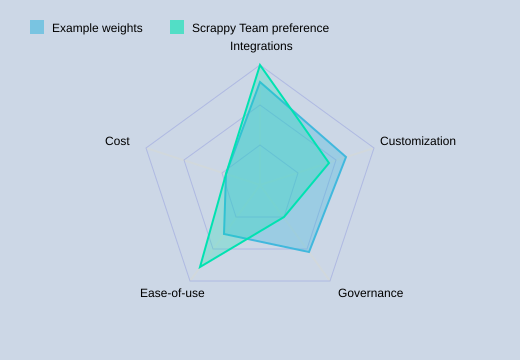
| Criteria | Weight |
|---|---|
| Integrations | 30% |
| Customization | 25% |
| Governance | 20% |
| Ease-of-use | 15% |
| Cost | 10% |
Risk tiers: Low (finance/HR), Medium (RevOps), High (internal tooling). In 2026, I also ask the awkward one: self-hosting or open-source options? Deep customization matters for efficiency.
Wild card: the “airport test”
Can I debug this on weak Wi‑Fi with cold coffee? If not, it’s not ready for real ops.

2) The integration monsters: Zapier vs Workato (and why that matters)
Workflow Automation + AI Integration: where I start
When I compare AI Automation Tools for business operations, I start with App Integrations. Not because it’s exciting, but because it decides what I can automate without duct tape. As Gaurav Dhillon said:
“The best integration is the one you can maintain six months from now.” — Gaurav Dhillon
Zapier: the friendliest on-ramp for Workflow Automation
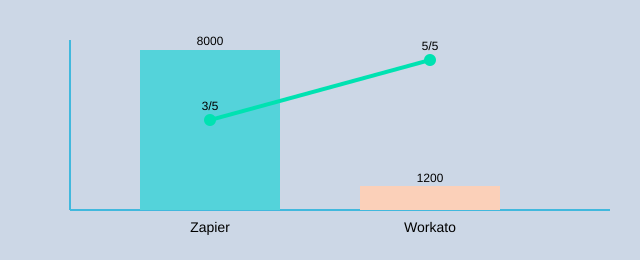
Zapier is my go-to when a team needs fast workflow automation. With 8000+ app integrations, it’s hard to hit a dead end. Its AI Copilot and AI agents feel approachable, especially for beginners who just want “when X happens, do Y” without learning a platform.
Workato: Enterprise Automation with governance baked in
Workato is built for Enterprise Automation. It has 1200+ integrations, plus the AIRO copilot, and it’s serious about controls like SOC Compliance (including SOC 2 compliance). If you need role based access, audit trails, and standard patterns across teams, Workato fits better.
Where App Integrations become the bottleneck
- Auth: token refresh, shared service accounts, least privilege
- Rate limits: “works in testing” fails at real volume
- Weird webhooks: retries, duplicates, and missing fields
Honest aside: I’ve overpaid for “enterprise” features I never enabled.
Free Tier reality
Most tools offer a Free Tier. I use it for prototypes, but governance shows up later—once multiple people edit flows and data access becomes sensitive.
Mini-scenario: Salesforce lead routing + Slack alerts + approvals
If I need it today: Zapier wins on speed. If I need approvals, RBAC, and auditability for a larger rollout: Workato wins.
| Tool | Integrations | Governance (5) | Time-to-first-automation |
|---|---|---|---|
| Zapier | 8000+ | 3/5 | ~30 min |
| Workato | 1200+ | 5/5 | 2–5 days |
3) The builders’ corner: Make, n8n, and Activepieces for AI Workflow Automation
When I’m choosing AI Workflow Automation tools for busy business operations, I start with one question: do we need a Visual Builder that keeps everyone moving, or do we need custom code and a debugging story we can actually tell? Tiny tangent: I once named a scenario FINAL_final_v7—tools can’t fix me, but they can help.
Make: Visual Builder-first workflow automation (and budget-friendly)
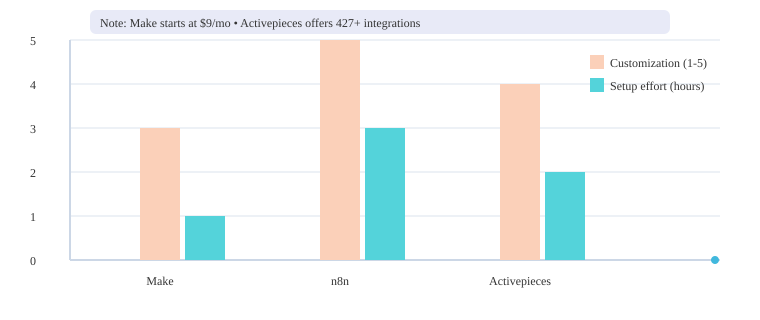
Make (formerly Integromat) is my go-to when logic gets twisty—branching, filters, and data transformation—and budgets don’t. It’s strong for fast AI Integration via prebuilt modules, and the pricing floor is friendly at $9/mo (plus a Free Tier for light use).
n8n: Self Hosting + maximum customization
n8n is source-available and Self Hosting friendly. If I want “custom code without regret,” this is it: JavaScript and Python support makes edge cases manageable. It also fits 2026 trends: deep customization for operational efficiency, and optional GitHub Sync as a desirable capability for versioned workflows.
Activepieces: Open Source with an AI Copilot angle
Activepieces leans hard into Open Source and Self Hosting, with 427+ integrations. I like it when teams want an AI Copilot feel for building flows faster, without giving up control.
“Open source wins when your constraints are unique, not when your taste is.” — Kelsey Hightower
| Tool | Pricing floor | Hosting options | Integrations | Customization (1–5) | Setup effort (hrs) |
|---|---|---|---|---|---|
| Make | $9/mo | Cloud | Many | 3 | 1 |
| n8n | Free tier available | Cloud + Self Hosting | Many | 5 | 3 |
| Activepieces | Free tier available | Self Hosting | 427+ | 4 | 2 |
4) When the stack chooses you: Power Automate & Agentforce
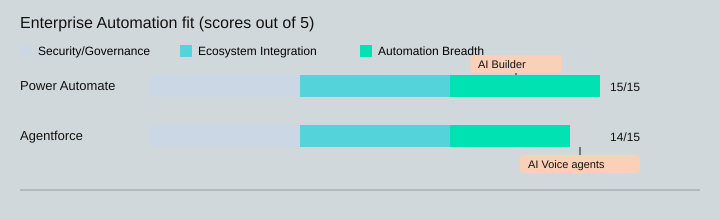
In this Ops AI Tools face-off, I’ve learned the “best” Productivity Tools often pick you first. If your team already lives in Microsoft 365, it’s hard to justify anything beyond Power Automate: AI Builder for quick AI Integration, plus Desktop Automation (RPA) when a legacy app won’t cooperate. For Salesforce Users, Agentforce feels native—built for Enterprise Automation inside CRM, with AI agents, Multi Agent orchestration, and even AI Voice agents that can handle real customer follow-ups without duct-tape integrations.
“In large organizations, the constraint isn’t creativity—it’s permissioning.” — Satya Nadella
Enterprise Grade security changes the workflow
I once tried to route approvals through email and regretted it. Threads got lost, people forwarded the wrong version, and I had no clean audit trail. Now I design around Enterprise Grade controls: Role Based access, Approval Workflows, and audit logs—because security isn’t a feature, it’s the workflow.
Same tools, different risk: HR vs Sales
HR onboarding (risk 9/10) touches identity, payroll, and access. Sales lead follow-up (risk 6/10) is faster, but still needs guardrails. Internal IT requests (risk 7/10) sit in the middle.
| Use case | Risk (1–10) | Best tool | Required controls |
|---|---|---|---|
| HR onboarding | 9 | Power Automate | Role Based, Approval Workflows, audit trails |
| Sales lead follow-up | 6 | Agentforce | Role Based, logging, safe prompts for AI agents |
| Internal IT requests | 7 | Power Automate | Approvals, ticket linking, least-privilege |
Scores: Automation capability (1–5): Power Automate 5, Agentforce 4. Adoption friction (weeks): Power Automate 2, Agentforce 3. My opinionated note: “deep integration” can feel like a warm hug—or a gentle trap when you need to switch stacks later.
5) Data teams’ lane: Alteryx for data transformation & predictive analytics
When I compare ops AI tools, Alteryx feels less like “glue code” and more like a data assembly line (and yes, it’s a different vibe). It’s built for Data Transformation, repeatable Data Prep, and end-to-end analytics workflows—especially when teams want Predictive Analytics without turning business operations into a science project. Research notes also line up: Alteryx focuses on advanced data analytics, Predictive Modeling, and end-to-end workflows for data teams.
“Every model is a product—if nobody can use it, it’s just math.” — Cassie Kozyrkov
Where Predictive Modeling fits into business operations
I’ve seen Alteryx work best when the output is operational, not academic. Example: we build a churn risk score, then push it out (file, database table, or API output) to trigger AI Workflow Automation steps—like creating a retention task—while keeping a human loop for edge cases.
- Input: CRM + billing + support tickets
- Process: Data Transformation + Data Prep + Predictive Modeling
- Output: risk tiers that downstream tools can act on
Trade-offs I’ve seen (cost vs. fewer “spreadsheet crimes”)
The trade-off is real: enterprise pricing can range widely, up to $5,195/year (Alteryx). But I often see fewer manual merges, fewer broken formulas, and clearer ownership of the analytics pipeline.
Quick sanity check for Machine Learning
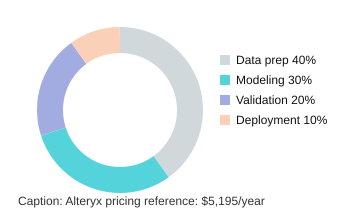
Before you call it Machine Learning, I ask: do we have clean Data Prep, or just optimism? If 40% of the work is cleaning, Alteryx can make that repeatable and auditable.
| Item | Example |
|---|---|
| Alteryx pricing reference | $5,195/year |
| Workflow stages (duration) | Data prep 40% • Modeling 30% • Validation 20% • Deployment 10% |
| Model impact (illustrative) | 15% reduction in manual review time |

6) The AIOps tools corner: BigPanda vs Datadog (noise reduction is a love language)
I still remember an on-call night when Slack looked like a slot machine: 200+ alerts, most duplicates, and one real outage hiding in the pile. That’s why I care about AIOps tools—not for hype, but for Noise Reduction that saves sleep and sanity.
BigPanda: ML-driven Incident Management that cuts the junk
BigPanda is built for Incident Management triage. The platform uses ML to correlate alerts, reduce noise, and trigger response automation. In plain terms: it helps me see the “one incident” behind 50 noisy signals, then route it to the right team with workflow automation.
Datadog: Cloud Native observability with AI-enhanced monitoring
Datadog shines when I need Cloud Native visibility across infrastructure and applications. Its AI-enhanced monitoring helps spot patterns and anomalies, but the big win is breadth: logs, metrics, traces, and app performance in one place.
How I explain AIOps to a non-IT exec
AIOps is workflow automation for “stuff is on fire” moments: detect issues fast, connect the dots, and get humans working the right problem.
Practical triage flow (and where AI agents help)
- Detect (Datadog finds signals)
- Correlate (BigPanda groups related alerts)
- Assign (AI agents suggest owner/runbook)
- Resolve (automation + humans fix)
- Postmortem (learn, tune rules)
“You can’t automate clarity; you have to design it.” — Gene Kim
Slightly spicy take: if your alerts are junk, AI just gets you junk faster.
| Tool | Focus area | Best fit org size | Outcome metric (noise reduction) |
|---|---|---|---|
| BigPanda | Incident correlation + response automation | Mid/enterprise | Alert volume reduced 30% after correlation (illustrative) |
| Datadog | Cloud-native observability across infra + apps | Startup to enterprise | MTTR triage 20% faster (illustrative) |

7) Putting it together: my 2026-ish shortlist (and a weird thought experiment)
I’m ending where I started in my intro story: when ops breaks, it’s rarely “lack of tools”—it’s change management, unclear owners, and workflows nobody can explain later. For 2026, my Top Tools shortlist is less about shiny Best AI features and more about dependable AI Workflow Automation for real business operations.
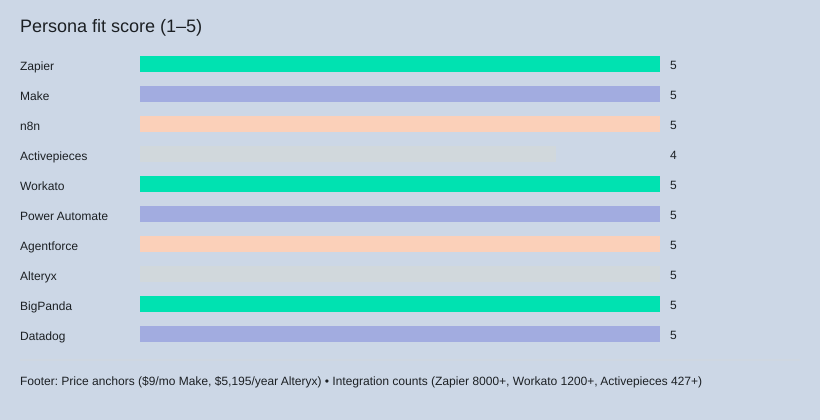
My shortlist by persona (AI automation tools that fit)
- Solo ops: Zapier (8000+ integrations) as the fastest Productivity Tools win.
- Growing BizOps: Make (starts at $9/mo) for visual flows and team-ready governance.
- Builders: n8n + Activepieces (427+ integrations) when I need Self Hosting, Open Source, and deep customization.
- Data team: Alteryx (up to $5,195/year) when analytics pipelines must be repeatable.
- Enterprise IT: Workato (1200+ integrations) or Power Automate for Enterprise Grade controls.
- Salesforce-heavy org: Agentforce when the CRM is the operating system.
- On-call + cloud teams: BigPanda + Datadog for incident signal and logging.
Pricing sanity pass (Free Tier isn’t “free forever”)
Most tools offer free tiers, but “free” often ends when you add teammates, need audit logs, or hit task limits. I sanity-check every stack against Make’s $9/mo floor and Alteryx’s $5,195/year ceiling before I promise anything to finance.
“Simplicity is prerequisite for reliability.” — Ben Treynor Sloss
Trend watch: Self Hosting + Open Source = leverage
In 2026, self-hosting, open-source, and deep customization aren’t ideology—they’re leverage: lower lock-in, better security posture, and faster operational efficiency. Still, I feel tool fatigue too, and I have to resist the urge to “just add one more app.”
Weird thought experiment: if every tool vanished tomorrow…
I’d rebuild approvals + logging first. If I can’t approve changes and trace what happened, no AI can save the workflow. The best AI productivity tool is the one I can explain to my future self. Next step: pick one workflow, one metric, one owner.
| Tool | Best-fit persona | Fit (1–5) | Notes |
|---|---|---|---|
| Zapier | Solo ops | 5 | 8000+ integrations |
| Make | Growing teams | 5 | From $9/mo |
| n8n | Builders | 5 | Self Hosting / Open Source |
| Activepieces | Builders | 4 | 427+ integrations |
| Workato | Enterprise IT | 5 | 1200+ integrations |
| Power Automate | Microsoft orgs | 5 | Enterprise Grade |
| Agentforce | Salesforce orgs | 5 | CRM-native automation |
| Alteryx | Data teams | 5 | Up to $5,195/year |
| BigPanda | On-call teams | 5 | Incident correlation |
| Datadog | Cloud teams | 5 | Observability + logs |
TL;DR: If you want fast wins, Zapier or Make are my “get it done today” picks. If you want self hosting and open source control, look at Activepieces or n8n. For enterprise automation, Workato, Power Automate, and Agentforce are built for governance. For data transformation and predictive analytics, Alteryx is the specialist. For AIOps tools, BigPanda and Datadog are about noise reduction and incident management—not marketing automations.