
The year I missed quota by a mile, I tried to out-hustle the problem: more calls, more emails, more tabs open. It felt heroic… right up until I realized I was spending most of my day on everything except selling. The uncomfortable truth: effort isn’t the bottleneck—focus is. This post is my messy, lived-in collection of 39 sales tips, mapped to what’s happening now (not what worked in 2012), and peppered with the stats that made me stop blaming “the market.”
1) The quota gap wake-up call (and my mild panic)
I still remember the week I realized my quota gap wasn’t “a bad month.” It was a pattern. My first reaction was mild panic, then shame. I treated quota like a personal moral score: hit it and I’m “good,” miss it and I’m “lazy.” That mindset made me chase busywork. When I reframed quota as a system problem, everything got calmer—and more fixable.
Why quota attainment stagnation changed my week
Quota attainment stagnation (when results flatline even though activity stays high) forced me to stop worshipping activity counts. I used to plan my week around what looked productive: more emails, more calls, more tabs open. Now I plan around leverage: the few actions that move deals forward. If an activity doesn’t create a clear next step, it’s probably vanity.
“If my calendar is full but my pipeline isn’t moving, I’m not busy—I’m blocked.”
My non-selling tasks burden audit (the calendar cleanse)
I did a simple audit: for two weeks, I labeled every calendar block as selling, deal work, or non-selling. The non-selling tasks burden was bigger than I wanted to admit—internal meetings, “quick” admin, Slack spirals. Then I cleansed:
- Declined meetings without a decision needed.
- Moved admin to one daily batch block.
- Set two protected “prime selling hours” blocks per day.
What I track now (metrics that correlate with deals, not dopamine)
I still like dashboards, but I’m picky. I track sales performance metrics that connect to revenue, not the dopamine hit of “more activity.” My weekly view is:
- New qualified conversations (ICP-fit, not just replies)
- Meetings that end with a single next step
- Stage-to-stage conversion (where deals stall)
- Pipeline coverage vs. quota (gap size, not vibes)
- Time in selling blocks (protected hours kept)
Tip cluster (1–8) I actually use
- Clarify ICP: write who wins fast and who churns.
- Pick one priority segment per week.
- Define a single next step for every active deal.
- End calls with a calendar invite, not “I’ll follow up.”
- Protect prime selling hours like a customer meeting.
- Batch research and admin; avoid constant context switching.
- Stop random acts of outreach; use a tight list and message.
- Review stalls weekly and fix the step, not the person.

2) Sales enablement metrics: turning chaos into a playbook
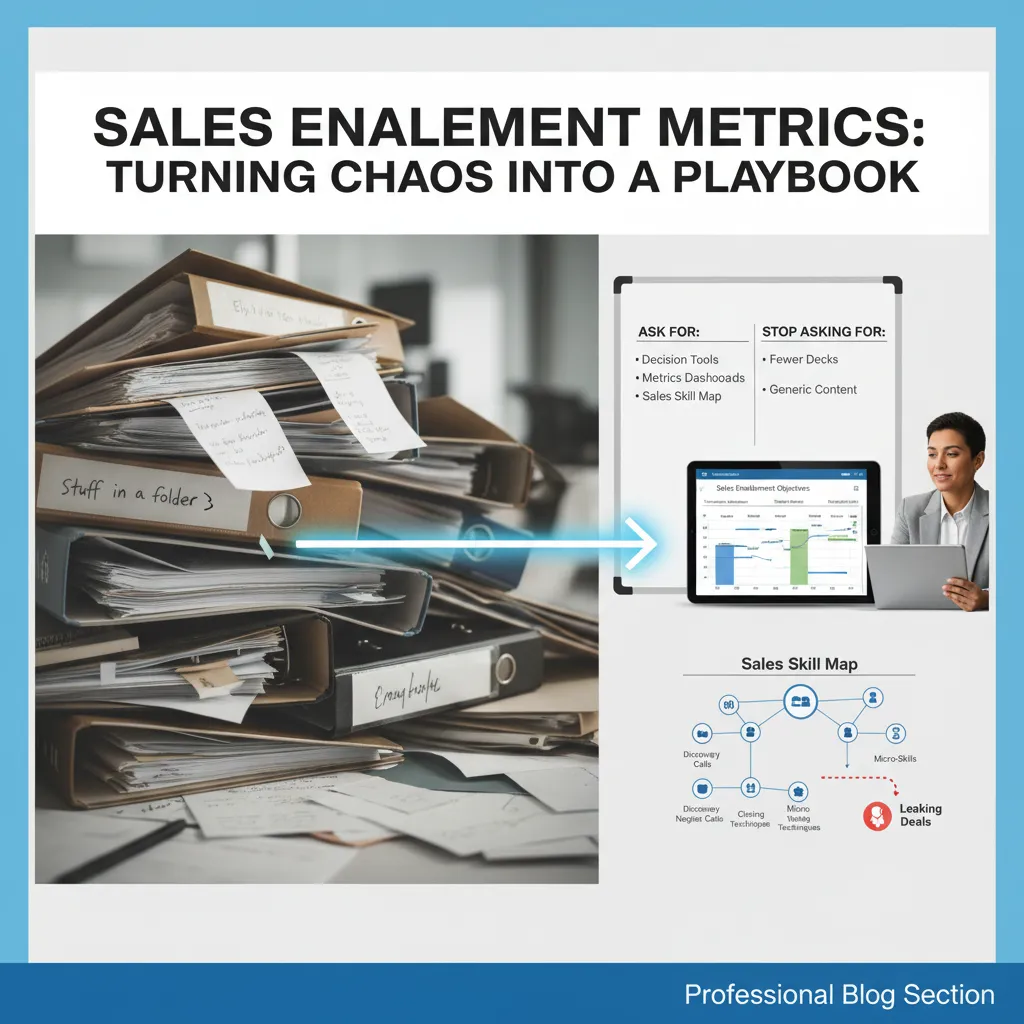
I used to treat enablement as stuff in a folder: decks, battlecards, random notes, and a “final_v7” PDF nobody opened. It felt busy, but it didn’t change outcomes. Now I treat enablement like sales enablement objectives with deadlines. If it doesn’t move a metric, it’s not enablement—it’s clutter.
Enablement objectives I actually track (with deadlines)
I ask enablement/RevOps to tie every asset to a measurable behavior change. Here are the metrics I watch weekly:
- Time-to-first-value: how fast a rep can run a clean first call (days from start date).
- Stage conversion: especially Lead → Qualified and Qualified → Demo.
- Follow-up SLA: % of leads contacted within our target window.
- Proof usage: how often reps use a case study or ROI note in active deals.
- Talk track adherence: not “script reading,” but hitting the key questions.
What I ask enablement/RevOps for (and what I stopped asking for)
I stopped asking for “a new deck.” Decks are easy to make and hard to use. I ask for decision tools that reduce thinking time in live deals:
- One-page discovery prompts (by persona)
- Qualification checklist with pass/fail rules
- Pricing/packaging guardrails
- Objection handling: if they say X, ask Y, show Z proof
My lightweight “sales skill map professionals” check
When deals leak, I don’t blame “pipeline quality” first. I run a quick micro-skill audit: which skill is failing most?
| Leak | Likely micro-skill | Metric to watch |
|---|---|---|
| No-shows | Calendar + confirmation | Show rate |
| Stalls after demo | Next-step control | Days in stage |
| Discount pressure | Value framing | Avg. discount |
Tip cluster (9–16): the playbook I keep simple
- Build a one-page talk track (problem, impact, proof, next step).
- Create a proof library: 10 short stories tagged by industry and use case.
- Tighten the lead qualification process with clear entry/exit rules.
- Standardize follow-up with 3–5 templates and a timing rule.
A quick rant (sorry): tools don’t fix a broken workflow—use sales enablement tools only after you remove steps.
3) Social sellers outperform (and yes, I used to roll my eyes)
My “cringe to competent” journey
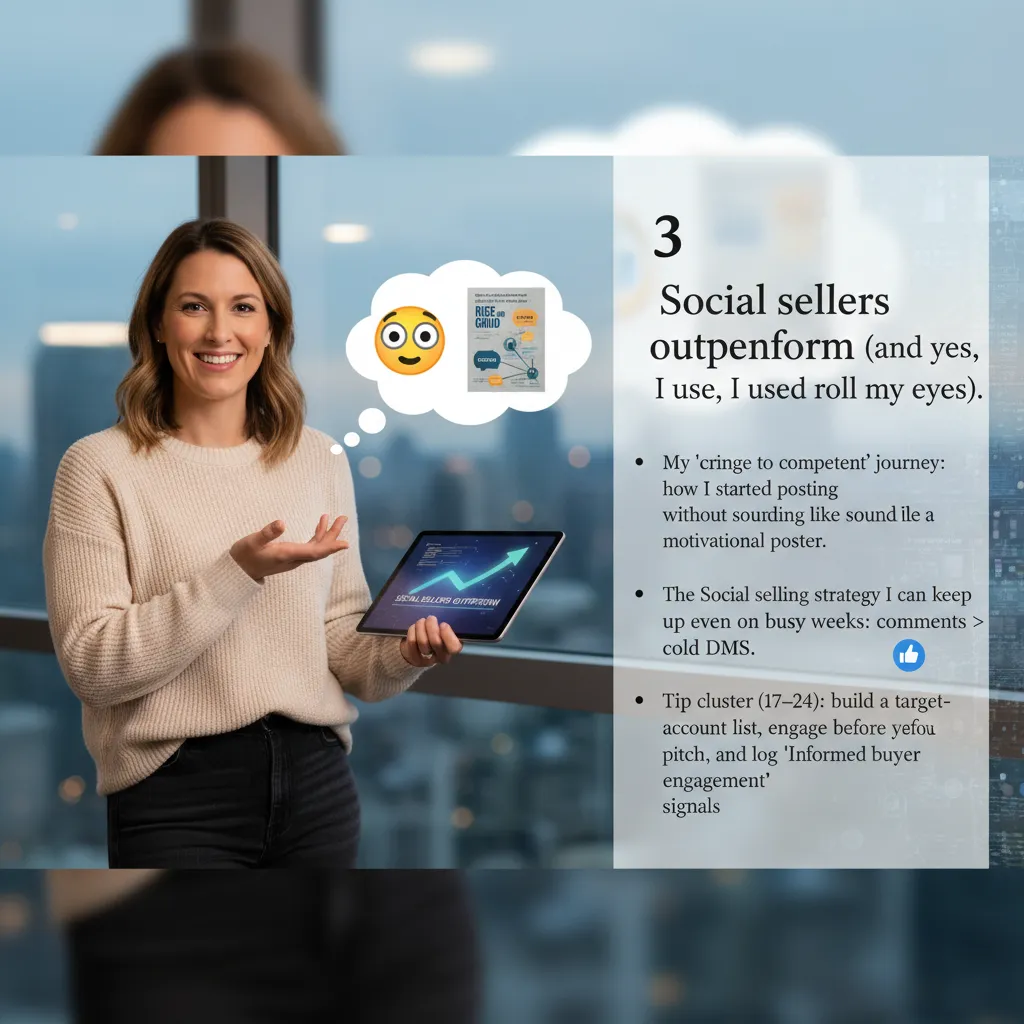
I used to think social selling was just people posting “hustle harder” quotes with a selfie. I rolled my eyes and went back to cold calls. Then I noticed something in my own pipeline: the reps who showed up online (in a normal way) got replies faster and booked cleaner first meetings. That’s when I stopped trying to “go viral” and started trying to be useful.
My rule: if a post sounds like a motivational poster, I rewrite it as a short lesson from a real deal. I share one problem, one example, and one takeaway. No hype.
The strategy I can keep up on busy weeks: comments > cold DMs
When my calendar is packed, I don’t force daily posting. I do 10–15 minutes of comments on the right people’s posts. Comments are lighter than DMs, and they build familiarity without asking for anything.
My simple filter: “Would this comment help the buyer think clearer?” If yes, I hit send.
Tip cluster (17–24): target accounts, engage first, log signals
This is where my social selling strategy became repeatable. I treat it like account work, not content creation.
- Build a target-account list (20–50 accounts I actually want).
- Map 3–5 people per account (champion, manager, finance, ops, IT—whoever fits).
- Engage before you pitch: comment, react, share their webinar, reference their announcement.
- Log “Informed buyer engagement” signals in my CRM: job change, new initiative, tool switch, hiring spree, funding, compliance deadline, public KPI.
I literally track it like this:
Signal: "Hiring 5 SDRs" → Hypothesis: "Pipeline push" → Next step: "Send 2-sentence note + relevant case"
Where social fits (and doesn’t)
Social selling isn’t magic. It won’t fix a weak offer or bad targeting. What it does do is build pre-call trust so your outreach feels less random. When I finally DM or email, I’m not a stranger—I’m “that person who’s been helpful in the comments.”
The weird analogy that made it click
Social selling is like warming up the pan before cooking. Same ingredients (your pitch, your product, your pricing), totally different outcome. Cold pan = sticking, mess, frustration. Warm pan = smoother, faster, better results.
4) Consultative selling strategies when buyers show up pre-informed
In 2026, most buyers arrive with screenshots, reviews, and a short list. That’s why I lean hard on consultative selling: less “let me show you,” more “let’s map what success looks like.” This section pulls from the consultative mindset in 39 Sales Tips Every Professional Should Know and the tip cluster I use most (25–31).
My favorite discovery question (that doesn’t sound like a script)
The question I use most is:
“What would make you feel like this decision was a win 90 days after you start?”
It doesn’t feel like a checklist, and it shifts the talk from product details to outcomes. It also changed my close rate expectations because it reveals the real “finish line” early—metrics, timelines, and internal pressure. When buyers are pre-informed, they often skip this part. I don’t.
Strategic partner positioning: outcomes before features
I practice business outcome planning by mapping outcomes before I ever demo. I’ll ask for the top 1–2 priorities, then I write a simple outcome map:
- Goal: what they want to improve
- Proof: how they’ll measure it
- Constraints: budget, time, tools, approvals
- Risks: what could derail adoption
Only after that do I connect features to the map. This keeps me positioned as a strategic partner, not a vendor reading a spec sheet.
Tip cluster (25–31): objections, status quo cost, decision plan
When objections show up, I try to treat them as missing info, not rejection:
- Reframe objections: “When you say ‘too expensive,’ is that compared to doing nothing or compared to another option?”
- Quantify cost of status quo: I ask for a monthly number—hours lost, churn, delays—and write it down.
- Co-create a decision plan: “What steps do you need to feel confident?” Then we list stakeholders, dates, and success criteria.
Why top reps pitch only 7% of the time (and how I shut up sooner)
I aim for a simple rule: ask, listen, summarize. If I’m talking too much, I pause and use:
“Let me repeat what I heard—did I get that right?”
Small tangent: my competitor bingo card
When buyers compare vendors, I stay calm with a “competitor bingo card” of common claims (cheaper, faster setup, more features). It reminds me to ask one steady question:
“Which outcome matters most, and what trade-off are you willing to accept?”
5) Sales coaching methods that don’t feel like a performance review
Confession: I avoided coaching for a long time because I didn’t want to hear my own calls. I told myself I was “too busy,” but really I didn’t want the cringe. Then I tried simple call listening techniques weekly, and it changed how I think about sales coaching. Not because it felt inspiring, but because it felt practical.
What “effective coaching methods” look like on a remote team
On a remote team, the best coaching is short, consistent, and slightly awkward at first. If it feels like a formal review, people get defensive. If it feels like a quick tune-up, people stay open.
“Coaching works when it sounds like help, not judgment.”
My rule: keep sessions under 20 minutes, focus on one moment from real work, and end with one clear next step.
Tip cluster (32–36): the coaching moves I actually use
- Weekly check-ins: 15 minutes, same day/time. I bring one win and one stuck point. My manager brings one observation.
- Call shadowing: I listen to a top rep’s call once a week. Not to copy their style, but to steal their structure (opening, discovery, close).
- Call listening (my own calls): I pick one 5-minute clip, not the whole call. I write down where I talked too much or missed a question.
- Email reviews: We review two emails: one that got a reply and one that didn’t. We look for clarity, length, and the ask.
- One metric at a time: I choose one thing for the week (like talk-to-listen ratio, number of discovery questions, or follow-up speed).
How I measure sales coaching effectiveness
I don’t measure coaching by “pep-talk vibes.” I measure it by behavior change. Did I do the new thing on real calls? Did my emails get shorter? Did I ask the question I kept skipping?
| Coaching input | Behavior I look for |
|---|---|
| Call feedback | One new question used in the next 3 calls |
| Email review | Clearer CTA + fewer words |
| Weekly check-in | One blocked deal gets a next step |
The hard truth: self-coaching is a career skill
When 45% of people rate coaching below average, waiting for perfect coaching is risky. I treat self-coaching like pipeline work: scheduled, repeatable, and a little boring. I keep a simple note after each call:
Keep / Stop / Try next time
6) Team selling collaboration + a “what if” scenario to steal
I used to “lone wolf” deals because it felt faster. One thread, one deck, one closer. But buyers in 2026 are rarely one person with one concern. Even in mid-market, I’m seeing security ask for controls, finance ask for payback, and ops ask how this won’t break their workflow. When I show up alone, I can only answer from one angle. When I bring the right team, the customer hears a complete story—and the deal moves.
Why I stopped lone wolfing complex deals
Here’s the simple truth behind modern sales statistics 2026: collaboration closes—not just consensus meetings. I keep coming back to the “81% lesson” I’ve seen echoed across teams and results: when we collaborate well, we win more. Not because we add more people to calls, but because we reduce risk for the buyer. Risk is what stalls deals.
Tip cluster (37–39): pre-brief, roles, and calm debriefs
My best team selling collaboration habits come from a tight cluster of tips I actually use:
- Run a tight internal pre-brief before any key meeting. Ten minutes is enough: goal, agenda, landmines, and the one question we must get answered.
- Define roles so we don’t talk over each other. I decide who leads, who demos, who handles security, and who takes notes.
- Debrief the loss without drama. If we lose, we don’t blame. We document what happened, what we missed, and what we’ll change next time.
The “what if” scenario: the 15-minute triangle call
What if your deal is stuck after legal or security review? Here’s the move I steal from myself all the time: a 15-minute “triangle call” with me (AE), my SE, and the customer champion. The goal is not a full meeting—it’s a reset.
“Can we take 15 minutes to align on what’s blocking approval, and decide the next two steps?”
On that call, I ask the champion to name the real objection, my SE answers the technical risk in plain language, and I confirm the business outcome and timeline. We end with one email the champion can forward internally.
My personal rule to close this section—and the blog—is simple: if it’s a strategic account, I never show up alone—ever.
TL;DR: Quota attainment is sliding, cold email is weaker, and buyers show up pre-informed—so I win more often by trimming non-selling work, leaning into social selling, running tighter discovery, and getting coached weekly. These 39 tips are grouped into five “sales survival kits” you can apply immediately.