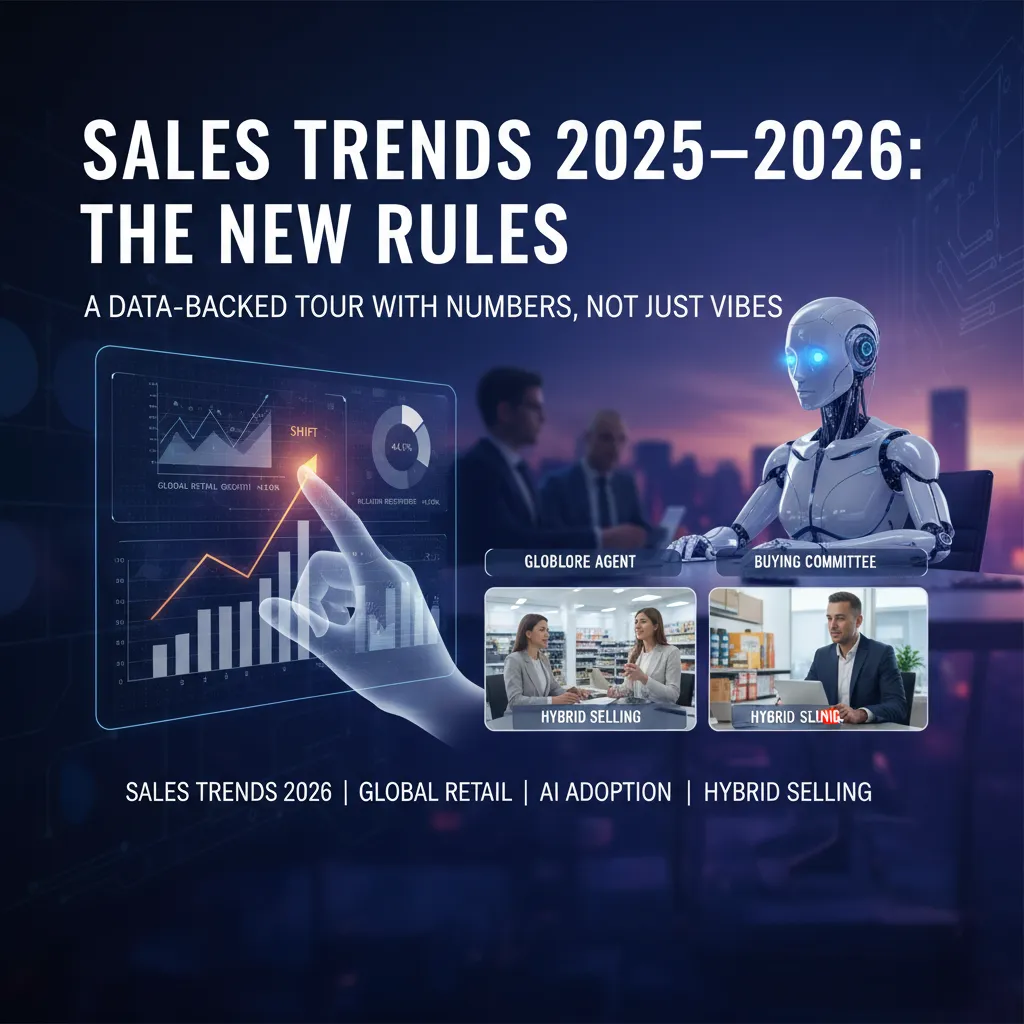
Last spring I stood in a half-empty mall food court watching a sneaker store line snake past a ‘Now Hiring’ sign. Two things hit me at once: people were still shopping, but they were shopping differently—more pre-researched, more price-sensitive, and weirdly more patient if the experience felt smooth. That small scene has been my mental sticky note for the 2025–2026 sales outlook: the demand is there, but it’s choosier, slower to win, and increasingly negotiated by algorithms as much as humans.
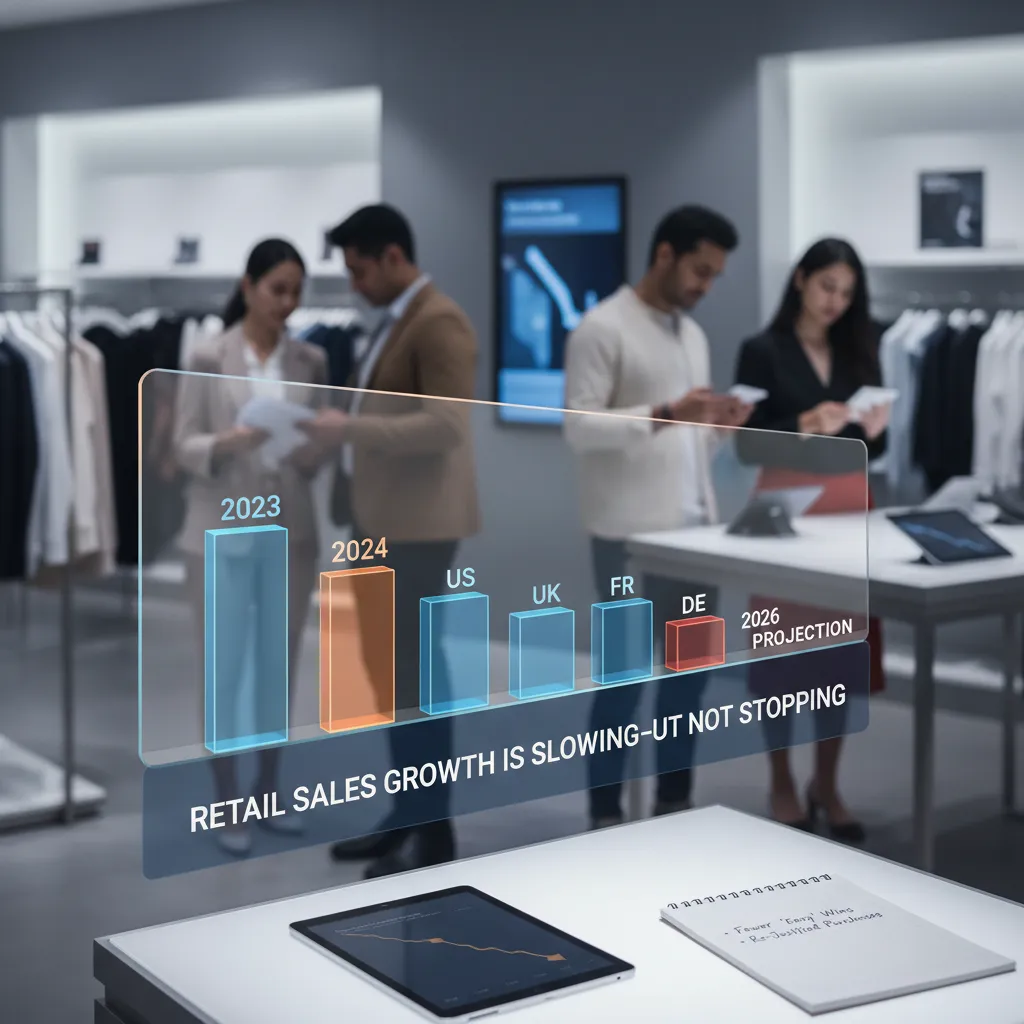
1) Retail Sales Growth Is Slowing—But Not Stopping
Why growth can look “fine” while the floor feels tougher
In the source material (Sales Trends 2025-2026: What’s Changing), one theme keeps coming up in planning talks: retail sales growth can stay positive even when unit volume barely moves. That’s because topline sales are often lifted by price, mix, and promotions—not just more items sold. On paper, revenue looks steady. On the floor, it can feel worse: fewer walk-ins, smaller baskets, and more “I’ll wait” behavior.
I’ve seen teams misread this gap. They celebrate a healthy growth headline, then wonder why reps are working harder for the same results. If volume is modest, you need more touches per deal, tighter follow-up, and better qualification. The market isn’t stopping—it’s just asking for more proof.
What 2026 projections imply across the US and Europe
The projections discussed for the US, UK, France, and Germany point to the same direction: continued growth, but at a slower pace. The US tends to hold up better due to scale and consumer resilience, while the UK and parts of the euro area often show more sensitivity to household budgets. France and Germany can look stable, but buyers there may be more deliberate—especially on discretionary categories.
| Market | 2026 Sales Performance implication |
|---|---|
| US | Growth continues, but conversion depends on value proof and availability |
| UK | More price checking; expect longer decision cycles and promo-driven spikes |
| France | Steady demand, but buyers want clearer justification and trusted brands |
| Germany | Careful purchasing; strong need for reliability, ROI, and low-risk offers |
My rule of thumb for 2025–2026 planning
From recent planning sessions, my simple rule is: assume fewer “easy” wins and more re-justified purchases. Customers aren’t only asking “Do I want this?” They’re asking “Do I need this now?” That changes how I coach teams to build pipeline.
- Lead with outcomes, not features
- Expect more comparisons and prep competitive answers
- Re-earn renewals with usage proof and clear next-step value
The weird comfort of a smaller forecast
One quiet upside of slower growth is focus. A smaller forecast can remove the pressure for heroic stretches and shift energy to what actually works: pipeline quality, clean stages, and real buyer intent.
When growth slows, the teams that win aren’t louder—they’re sharper.
2) Consumer Confidence vs. Consumer Strain: The ‘Flight To Value’ Era
Why confidence can look “fine” while wallets feel tight
In 2025–2026, I’m seeing a split that confuses a lot of teams: consumer confidence can read as “okay,” yet consumer strain shows up everywhere in the cart. People may feel stable about jobs or the economy, but they still act careful because everyday costs and uncertainty make them protect cash. That’s why the same customer who says they’re optimistic will still buy less per order, wait longer to upgrade, and send more items back if anything feels off.
On the ground, strain looks like:
- Smaller baskets (one item instead of two, fewer add-ons)
- Delayed upgrades (“I’ll keep my current model one more year”)
- More returns (buyers reduce risk after the fact)
“Flight to value” translated into sales strategy
The “flight to value” isn’t just shoppers chasing the cheapest option. It’s shoppers demanding proof: proof the product will arrive on time, work as expected, and be easy to return. My best-performing plays in this era are simple and repeatable:
- Bundles: package the core item with the most-used accessory or service so the value is obvious.
- Good / Better / Best pricing: three clear tiers so customers can self-select without feeling tricked.
- Clearer guarantees: plain-language shipping promises, warranty terms, and return windows.
I also push teams to write value in the customer’s language: “saves 30 minutes a day,” “fits in a carry-on,” “works with your current setup.” Features don’t calm strain; outcomes do.
My own checkout behavior (and what it signals)
I still buy online, but I interrogate shipping times and return policies like it’s my job. If delivery is vague (“5–12 business days”) or returns feel messy, I pause—or I choose the brand that makes the risk smaller. That’s the mindset behind today’s value: not just price, but certainty.
What I measure weekly (because vibes don’t hit quota)
- Sales velocity: how fast revenue moves from lead to closed.
- Deal velocity: time-in-stage and where deals stall.
- Customer value: AOV, repeat rate, refund rate, and margin by tier.
If confidence is the headline, these metrics are the truth on the floor.
3) AI Agents Just Joined the Buying Committee (Yes, Really)
The moment it clicked for me was on a routine discovery call. The buyer shared their screen and pulled up a clean comparison table—features, pricing tiers, security notes, even “best fit” recommendations. They didn’t build it in Excel. An AI tool did. And the message was clear: if buyers can show up with AI-generated research, they expect me to be equally prepared.
What “Agentic AI” and “AI Agents” actually mean
In the 2025–2026 sales trends I’m seeing, we’re moving from AI that answers to AI that acts. That’s what people mean by Agentic AI: systems that can take a goal and complete steps toward it with limited human input.
- AI Agents are task-focused helpers that can research, draft, analyze, and trigger actions across tools.
- An AI Teammate for reps is the practical version: a “digital coworker” that supports the sales workflow end to end.
How an AI Teammate changes the rep workflow
When I use an AI Teammate well, it doesn’t replace my judgment—it removes the busywork that slows me down. The best use cases are simple:
- Drafting emails, call follow-ups, and first-pass proposals in my tone
- Summarizing calls into clear notes, risks, and decision criteria
- Orchestrating next steps like reminders, mutual action plans, and stakeholder mapping
Even a basic prompt like Summarize this call and list next steps by owner can save real time—if I review it and make it human.
The downside: AI can make everyone sound the same
There’s a real risk in “AI productivity”: sameness. If every rep uses the same templates and the same tools, every message starts to read like it came from the same person. Buyers notice. So I treat AI output as a draft, then add what AI can’t: specific context, a point of view, and a clear recommendation.
Wild card scenario: bots negotiating while we sleep
Imagine a procurement bot emailing your renewal terms at 2:00 a.m., countering your price increase with market benchmarks, and proposing a new contract structure—before your rep even wakes up.
That’s not science fiction. It’s a preview of how AI agents will reshape negotiation speed, pricing pressure, and the new rules of being prepared.

4) Hybrid Selling Is the Default—So Your Process Can’t Be ‘Vibes’
In 2025–2026, I don’t see hybrid selling as a “Zoom vs. in-person” debate anymore. It’s an omnichannel experience problem. Buyers move across channels because it’s faster and safer for them, not because they want to make our lives harder. The trend I keep noticing is that the sale is won or lost in the handoffs: when a buyer jumps from one touchpoint to the next and the story breaks.
The journey is messy (and that’s normal now)
Most buying journeys don’t look like a clean funnel. They look like a trail of tabs, screenshots, and half-finished conversations. A common path I see looks like this:
- Social proof (reviews, LinkedIn posts, customer stories)
- Chatbot Q&A to confirm basics after hours
- Store visit or on-site meeting to “feel” the product
- Follow-up text because email is too slow
- Invoice link to pay without another call
That’s hybrid selling in real life: a blended experience where the buyer expects context to travel with them. If your team treats each step like a fresh start, the buyer feels friction. And friction is where deals stall.
What I’ve seen work: fewer tools, tighter handoffs
When hybrid selling becomes the default, “winging it” stops working. The best teams I’ve worked with do three simple things:
- Tighter handoffs: one clear owner, shared notes, and a single timeline so the buyer never repeats themselves.
- Fewer tools: not every channel needs a new app. The goal is speed and clarity, not a bigger tech stack.
- Clear next steps: every touch ends with a specific action and date—even if the buyer goes quiet.
I like to write next steps in plain language, almost like a checklist:
Next step: I’ll send the quote by 3 PM. If it looks right, you can approve via the link. If not, reply “edit” and tell me what to change.
A small tangent: I miss the old flow
I do miss the simplicity of call → demo → close. But I don’t miss the guesswork. A real hybrid sales process replaces “vibes” with visibility—so no matter where the buyer shows up next, we’re ready.
5) Pricing Trends 2026: Gradual Price Increases, Quietly Spicy
In the “Sales Trends 2025–2026” conversations I keep having, pricing in 2026 feels less like a big jump and more like a slow climb. Tariffs are a big reason. Even when a tariff hits one part of the supply chain, the cost shows up in packaging, components, freight, and sometimes financing. Most brands won’t raise prices once and move on. They’ll adjust in small steps as costs roll through. Customers still notice, because they compare totals over time, not just the sticker price.
Why tariffs create “small but steady” increases
Tariffs rarely land cleanly on one SKU. They create uneven cost pressure, so I see teams spreading increases across products and quarters to avoid shock. That’s why 2026 pricing can feel quietly spicy: not dramatic, but persistent.
Pricing moves I’d actually dare to use
- Smaller packs (done honestly): keep an entry price for price-sensitive buyers, but label it clearly so it doesn’t feel sneaky.
- Subscription perks: instead of discounting the product, I’d add value—free shipping, priority support, bonus refills, or a locked-in rate for 6–12 months.
- Transparent surcharges: if tariffs or freight spike, I’d rather show a line item than hide it in a “mystery” price change.
- Fewer fake discounts: constant 30% off trains customers to wait. I’d reduce promo frequency and use targeted offers tied to behavior (first order, bundle, renewal).
How I message increases without sounding defensive
I try to avoid long apologies. I focus on clarity and choice:
- Show options: “Standard pack stays the same; larger pack increases by $2.”
- Show tradeoffs: “We can keep price flat by removing feature X, or raise price to keep quality.”
- Show timing: give a date, give a reason, and give customers a chance to buy ahead or switch plans.
“Prices are changing. Here are the choices you have, and what each choice means.”
Mini checklist: hold price vs. raise
- Hold if you’re already priced above close competitors and your value story isn’t crystal clear.
- Hold if churn is rising and your best customers are price-sensitive.
- Raise if demand is steady, win rates are strong, and customers cite outcomes (not price) as the reason they buy.
- Raise if competitors have moved up first, or if your product has a clear quality/service edge.
- Raise if you can pair it with a visible improvement (faster delivery, better warranty, better onboarding).

6) Forecasting & Budget Alignment: Less Heroics, More Math
In 2025–2026, I’ve learned the hard way that forecasting can’t be a “spreadsheet optimism” contest. Sales cycles are longer, buyers do more research before they ever talk to us, and deals stall for reasons that don’t show up in a rep’s gut feel. If I want a forecast I can run a business on, I need predictive analytics and clean inputs—pipeline age, stage conversion rates, activity quality, and buyer signals—not last-minute heroics.
How I Forecast Now: Segment + Channel + Confidence
The approach that’s worked best for me is simple and repeatable. I forecast by segment (SMB, mid-market, enterprise), by channel (direct, partner, inbound), and by a confidence tier. The tier is not a vibe; it’s rules. For example, “High” means verified next step, confirmed economic buyer, and a real timeline. “Medium” means one of those is missing. “Low” means we’re still guessing.
Then I pressure-test the number with scenarios. I’ll run a base case, a downside case (slower approvals, lower win rates), and an upside case (faster cycle time, higher attach). This is where forecasting becomes math: I’m not asking, “Can we make it?” I’m asking, “What has to be true for this to happen?”
Budget Alignment: What I’d Fund in 2026 (and What I’d Cut)
When budgets tighten, I stop spreading money across everything and start funding what improves forecast accuracy and execution. In 2026, I’d spend more on enablement that shortens ramp time and improves deal quality, data hygiene so CRM fields actually mean something, and supply chain visibility so we don’t sell timelines we can’t deliver. I’d cut duplicate tools that do the same job with different dashboards, because tool sprawl creates reporting noise and weak accountability.
The Ritual That Makes It Stick
To close the loop, I run a monthly forecast post-mortem. It’s blame-free, but brutally specific: which segments drifted, which channels surprised us, which confidence tiers lied, and which assumptions broke. We document the top three causes, update the rules, and move on. That one habit has done more for my sales forecasting and budget alignment than any “end-of-quarter push” ever could.
TL;DR: 2025–2026 sales is a game of modest growth, stubborn inflation, gradual price increases, and faster AI adoption. Winners build confidence with value, run hybrid selling like an operating system, consolidate tech, and forecast with reality—not hope.