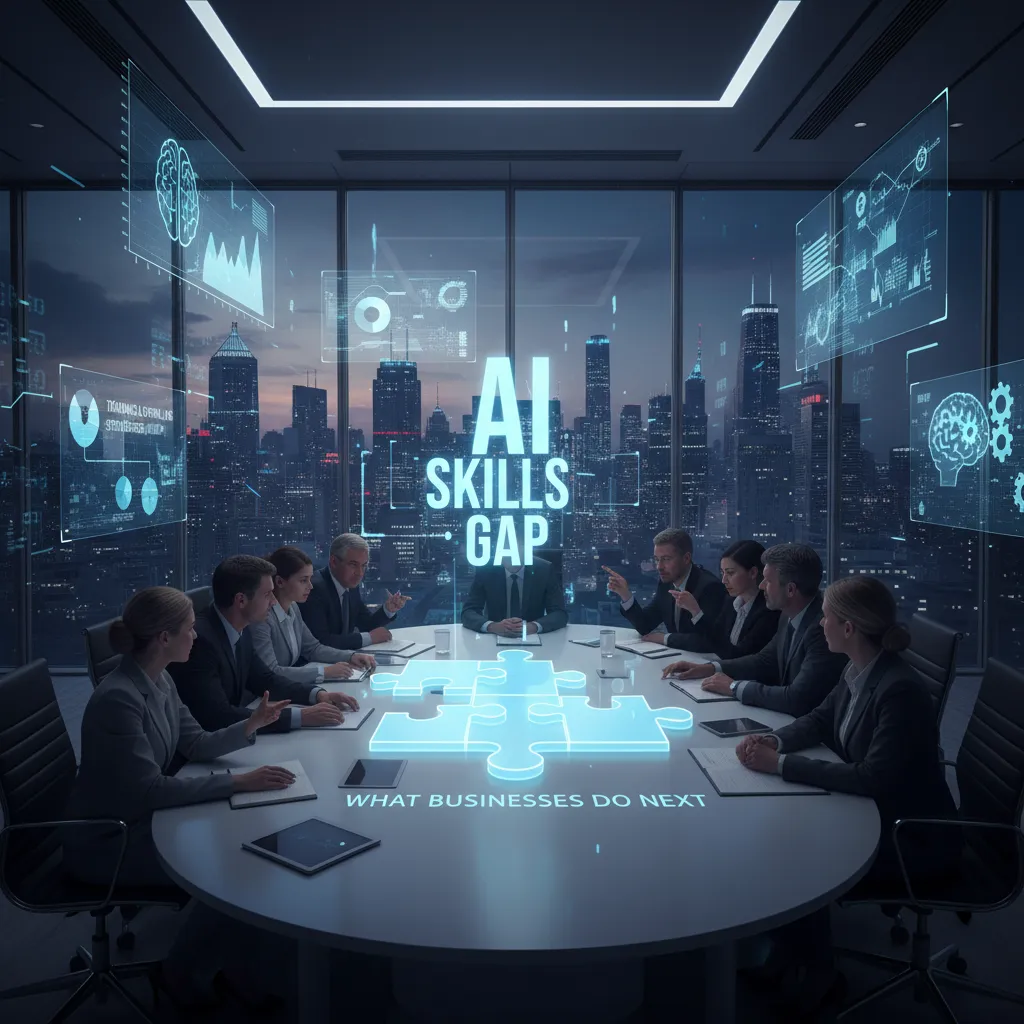
The first time I watched an “AI kickoff” meeting go sideways, it wasn’t because the model was bad. It was because we didn’t have a shared vocabulary. One director kept saying “automation,” another meant “generative AI,” and someone quietly asked if this would “replace analysts by Q3.” That tiny moment—half confusion, half fear—made the AI skills gap feel less like a talent problem and more like a coordination problem. In this post, I’m mapping what I’m seeing businesses do when they move past the hype and start building an AI-ready workforce: the wins, the workarounds, and the uncomfortable parts (like the critical thinking gap nobody budgets for).
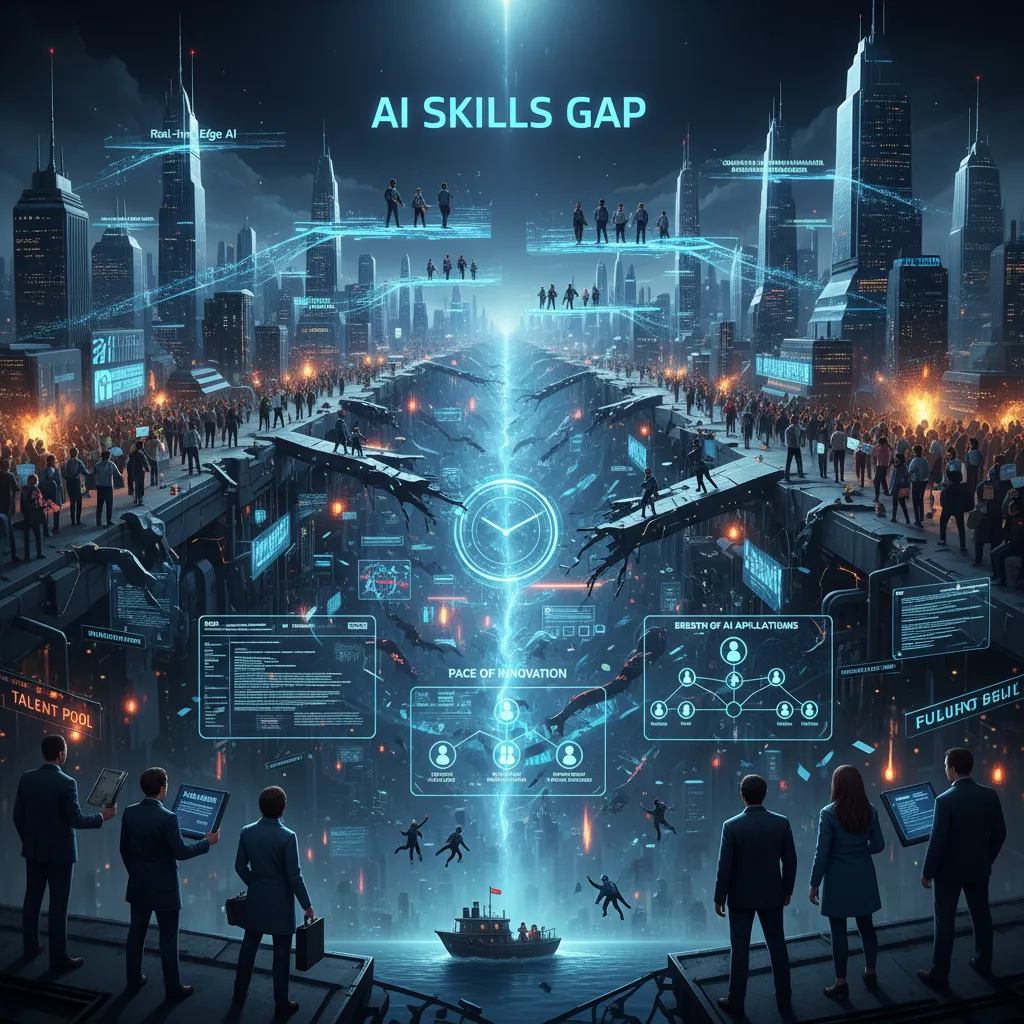
1) Why the AI skills gap feels bigger than ‘talent’
When people say “AI skills gap,” it can sound like a simple hiring problem: we just need more data scientists. But in plain terms, I define the AI skills gap like this: there aren’t enough people who can build, use, and supervise AI safely. That includes technical skills (training models, working with data, testing outputs) and practical skills (setting rules, spotting risks, and knowing when not to use AI).
AI readiness isn’t only an engineering issue
I had a moment that changed how I think about AI in business. I was in a meeting where an engineer explained a model’s limits clearly, but the real confusion came from the room’s decision-makers. That’s when I realized “AI readiness” includes managers, product owners, legal, HR, and operations—not just engineers. If leaders can’t ask good questions, teams can’t use AI well, even if the model is strong.
- Builders need to create and test AI systems.
- Users need to apply AI tools correctly in daily work.
- Supervisors need to manage risk, quality, and accountability.
Roles change faster than job descriptions
Workforce trends are colliding with business reality. In many AI-exposed roles—marketing, customer support, finance, sales ops—tasks are shifting quickly. That means job descriptions “rot” fast. A role written 12 months ago may ignore new AI workflows, new compliance needs, or new expectations like prompt design, data handling, and evaluation.
So the gap feels bigger because companies aren’t just missing people; they’re missing updated role definitions and clear skill pathways.
The quiet issue: critical thinking is part of AI skill
Another gap shows up in a subtle way: people over-trust dashboards and model outputs. I’ve seen smart teams treat AI results like facts instead of probabilities. This is a critical thinking gap, not a coding gap. It looks like:
- Accepting confident answers without checking sources or data quality
- Ignoring edge cases because “the model says it’s fine”
- Missing bias signals because metrics look clean
“If you can’t explain why the AI is right, you can’t know when it’s wrong.”
The money shape of the problem
Finally, the AI skills gap is also about economics. AI wage premiums pull skilled people toward the highest bidders. Smaller firms and public-sector teams may train talent—then lose them. That makes the gap feel permanent, even when training improves, because the market keeps re-sorting where AI capability lives.
2) The readiness paradox: CEOs want AI, teams don’t feel ready
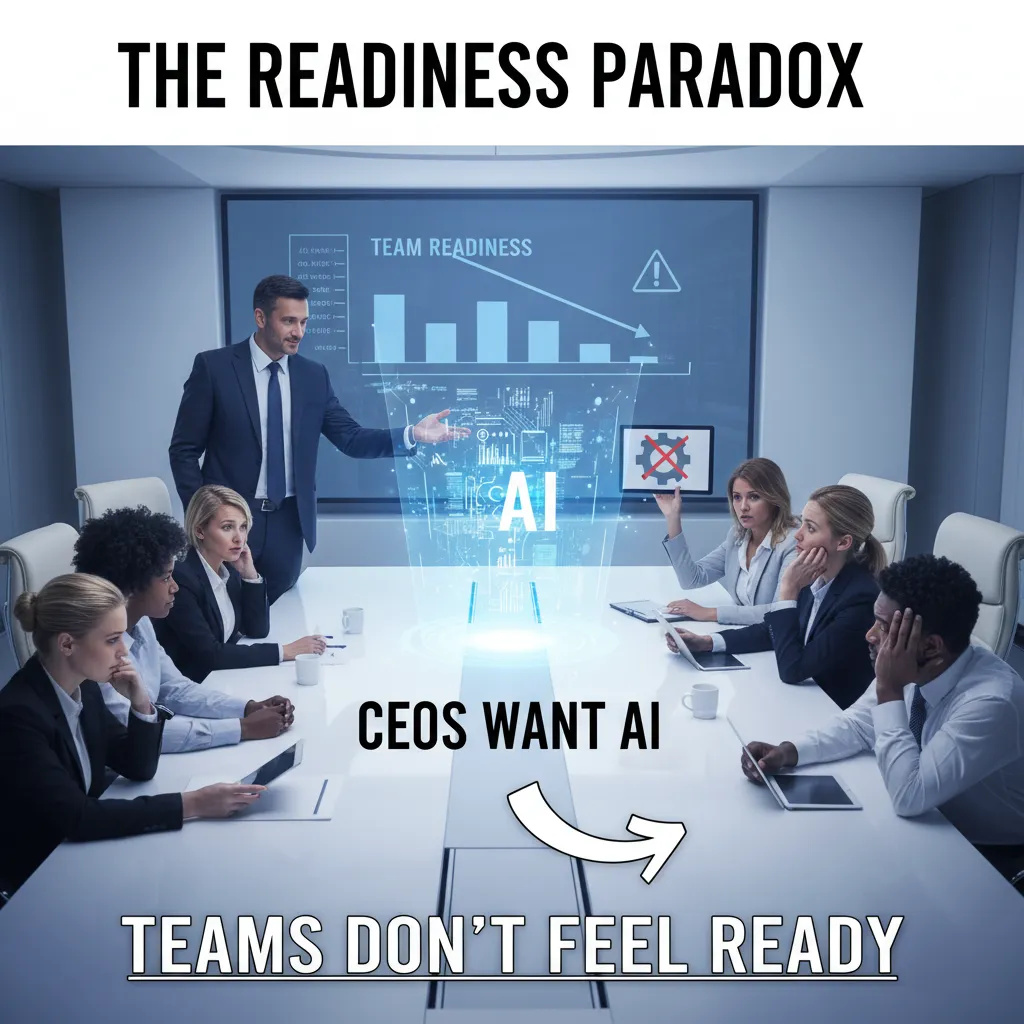
I keep seeing the same split inside companies: leaders feel urgent pressure to “do something with AI,” while teams quietly feel unsure, overloaded, or even skeptical. Both sides are right. CEOs are reacting to competitors, board questions, and fast-moving tools. Employees are reacting to real day-to-day limits: unclear goals, messy data, and not enough time to learn.
Why leadership urgency and employee confidence don’t match
From the top, AI looks like a lever: buy a tool, roll it out, get results. On the ground, AI feels like a new way of working. That shift needs practice, feedback, and guardrails. When those pieces are missing, people don’t “resist AI”—they avoid risk and extra work.
What AI readiness looks like in real work
In my experience, readiness is not a slide deck. It’s a set of conditions that make learning possible:
- Tool access: the right AI tools, connected to the systems people actually use.
- Time to practice: space in the week to test prompts, review outputs, and improve workflows.
- Permission to experiment: clear rules on what’s allowed, plus support when early attempts are imperfect.
“If AI is only allowed when it’s perfect, it will never be used enough to get better.”
A common scenario: the copilot that makes things worse
Imagine a sales team gets a shiny genAI copilot to write outreach emails and summarize calls. Everyone is excited—until the outputs start sounding off. The tool pulls from outdated product notes, inconsistent customer fields, and random meeting transcripts. There’s no data governance, no shared definitions (What counts as a “qualified lead”?), and no review process. The team then concludes the model is bad, when the real issue is the inputs and the workflow around it.
The metric trap: licenses don’t equal capability
I also see companies celebrate adoption by counting seats: “We deployed 500 AI licenses.” But that number doesn’t tell me if people can use AI safely and effectively. Better signals are:
- How many teams have repeatable AI workflows (not one-off demos)?
- How often outputs are reviewed and improved with feedback loops?
- Whether employees can explain when not to use AI (privacy, accuracy, bias).
When pilots fail, it’s often a people-and-process story, not a model story. The gap is rarely “we need smarter AI.” It’s “we need clearer work, cleaner data, and supported learning.”
3) What businesses are doing: upskilling, reskilling, and ‘AI fluency’ sprints
When I look at how companies respond to the AI skills gap, I see a practical playbook show up again and again. They don’t start by turning everyone into data scientists. They start with role-based AI fluency—what a marketer, analyst, support agent, or manager needs to use AI safely and well—then they add deeper tracks for the people who will build, automate, and govern.
Start with role-based AI fluency, then go deeper for builders
Most teams run short “AI fluency sprints” (often 1–2 weeks) focused on daily work. The goal is simple: reduce fear, build shared language, and teach the basics of using AI tools with company data and policies.
- Fluency track: prompting basics, data handling, privacy, and when not to use AI.
- Builder track: automation, evaluation, integrations, and lightweight model understanding.
- Leader track: risk, ROI, workflow design, and decision-making with AI outputs.
Upskilling and reskilling as a portfolio (not one course)
I think the best programs treat upskilling/reskilling like a portfolio of learning options, not a single training event. The mix I see most often includes:
- Short clinics: 60–90 minute sessions on one skill (like prompt patterns or AI for spreadsheets).
- Internal communities: office hours, chat channels, and “show-and-tell” demos.
- Project-based learning: small pilots that turn into reusable templates.
My favorite training is the one tied to a real backlog item, not a generic course.
For example, instead of “learn AI,” a team picks one real task—summarizing support tickets, drafting sales follow-ups, or cleaning a report—and builds a working workflow. People learn faster because the outcome matters.
The human skills layer: judgment, critique, and uncertainty
AI fluency isn’t only tool skills. The strongest teams practice prompt critique (reviewing prompts like code), apply judgment to spot weak outputs, and communicate uncertainty clearly. I often teach teams to label results: draft, needs verification, or ready to ship.
Verification: proof, not vibes
Skills development needs evidence. Companies are adding lightweight checks like assessments, portfolios of real work, and peer review of prompts and outputs. A simple rubric—accuracy, safety, clarity, and impact—goes a long way in making AI capability measurable.
4) Hiring differently: skills-based hiring and ‘borrowed’ AI talent
When I see a job post for a “unicorn” AI lead—someone who can set strategy, build models, manage data, secure systems, and train the business—I usually know why it will fail. The market is tight, the role is unclear, and the expectations are too wide. Instead, I’ve found that skills-based hiring works better: define the work, list the skills needed to deliver it, and hire for the gaps that truly matter.
Why skills-based hiring beats the unicorn search
In practice, most companies don’t need one hero. They need a small set of repeatable capabilities: clean data, safe model use, and clear business ownership. Skills-based hiring shifts the focus from “years of AI” to “can you do these tasks in our environment?”
Mix-and-match: hire a few, borrow the rest
My preferred approach is a blend. I hire for a few critical roles that must sit close to the business, then I borrow AI talent through partners, agencies, and cloud providers for the rest.
- Hire: a data/product owner, a data engineer, and an AI-savvy analyst or ML engineer (depending on maturity).
- Borrow: model tuning, security reviews, MLOps setup, and short-term architecture help.
- Use providers: managed AI services for hosting, monitoring, and guardrails when speed matters.
Internal mobility: your hidden AI bench
I also look inward. Analysts, operations leads, and QA testers often have the best domain knowledge and process discipline. With the right support—training, sandbox access, and a mentor—they can move into AI-adjacent roles like prompt testing, data quality, workflow automation, and model evaluation.
Practical checklist: what I look for
- Data literacy: can they read a dataset, spot missing values, and ask where the numbers come from?
- Model oversight: do they understand limits, bias, drift, and how to validate outputs?
- Domain curiosity: do they ask “what decision will this change?” and “who uses it?”
- Communication: can they explain results without hiding behind jargon?
My opinion: hiring gets easier when I describe the job as outcomes, not tool names.
For example, I’d rather post “reduce support ticket handling time by 20% using AI-assisted workflows” than “must know TensorFlow, PyTorch, and five LLM frameworks.”
5) Measuring the gap: skills intelligence, verification, and the ‘critical thinking’ safeguard
From static models to skills intelligence
When I hear leaders talk about the AI skills gap, they often point to a static competency model: a spreadsheet that says who is “beginner” or “advanced.” That approach breaks fast. AI tools, workflows, and risks change monthly, so I prefer skills intelligence: a living, real-time map of who can do what, on which tools, in which context. Instead of job titles, I track skills like “prompting for analysis,” “data labeling,” “model monitoring,” or “policy review,” and I tie them to real work.
Verification I trust more than self-reporting
Self-assessments are useful, but they are not proof. To measure AI readiness, I rely on verification methods that show performance under pressure:
- Scenario tests: short, timed tasks like “summarize this customer complaint set, then flag risks and missing data.”
- Work samples: real outputs—dashboards, prompts, evaluation notes, or revised policies—reviewed against a clear rubric.
- Peer calibration: two or three reviewers score the same sample, then align on what “good” looks like.
This gives me signal, not noise. It also helps people see the gap without shame: the work either meets the bar or it doesn’t—yet.
AI readiness is also governance
Skills measurement is incomplete if I ignore governance. In practice, the AI skills gap includes “who owns the guardrails.” I ask simple questions:
- Who approves AI use cases before they go live?
- Who audits outputs for errors, bias, or unsafe advice?
- Who owns data quality and access rules?
If nobody can answer, the gap is bigger than training—it’s accountability.
The wild card: AI as a kitchen appliance
I treat AI like a new kitchen appliance: powerful, time-saving, and easy to misuse. A blender can make soup, but it can also make a mess—or start a fire if the wiring is bad. AI is similar: it can speed up research, drafting, and support, but it can also produce confident errors, leak data, or amplify weak assumptions.
Critical thinking is the control system
This is why I don’t treat critical thinking as a “soft” skill. It’s a control system: checking sources, testing outputs, spotting gaps, and knowing when to stop and escalate. In an AI-enabled business, critical thinking is how we keep speed from turning into risk.

Conclusion: Closing the gap without pretending it’s neat
When I step back from all the talk about AI, the “skills gap” rarely comes down to one missing course or one bad hire. It’s a system issue. It lives in people (confidence, habits, fear of looking slow), data (access, quality, privacy rules), incentives (what gets rewarded, what gets punished), and leadership behavior (what leaders model, what they ignore). If any one of those parts is out of sync, the gap shows up again, even after training.
If I had to start next week, I wouldn’t launch a big “AI transformation.” I’d keep it small and real. I’d pick one workflow that already matters—like drafting customer replies, summarizing sales calls, or cleaning up product notes. Then I’d train one team on that workflow only, using the same tools they already use. Finally, I’d measure one skill that we can see in the work, not in a quiz—like writing a clear prompt, checking sources, or documenting what changed. One workflow, one team, one skill. That’s enough to learn what’s actually blocking progress.
I think back to the meeting I opened with—the one where everyone agreed AI was “important,” but nobody could say who owned what. The change didn’t come from a new tool. It came when we named roles and responsibilities in plain language: who can use AI for what, who approves outputs, who maintains the data, and who is accountable when results are wrong. Once that was clear, people stopped waiting for permission and started practicing. The room got quieter in a good way—less hype, more decisions.
Here’s a wild card I like to ask: if AI became unavailable tomorrow, what human skills would we notice we lost? Maybe it’s writing clearly, doing first-draft analysis, asking better questions, or spotting weak logic. That question keeps me honest, because the goal isn’t to replace thinking—it’s to strengthen it, with AI as support.
I’m optimistic, but grounded. Closing the AI skills gap won’t look neat. It will look like small, repeated practice: short experiments, clear rules, honest reviews, and steady improvement. In my experience, that beats one giant announcement every time.
TL;DR: The AI skills gap isn’t just a shortage of ML engineers—it’s a messy mix of AI fluency, data quality, human skills, and workforce planning. Businesses are responding with upskilling/reskilling, skills-based hiring, partnerships, and skills intelligence—because most AI pilots fail without the people side.