
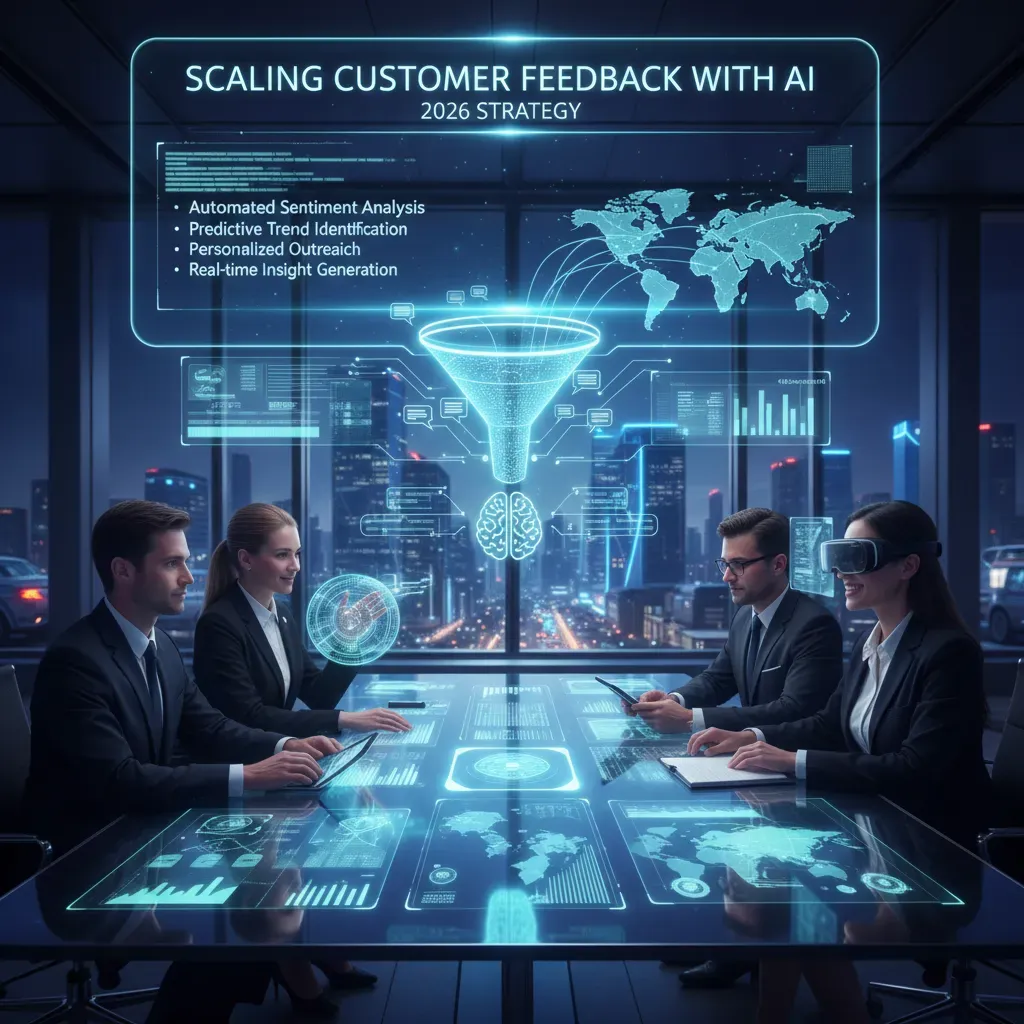
I still remember a late-night email thread where our small product team missed a recurring user pain because we only sampled feedback. That mistake pushed me to experiment with AI-driven analysis. Over the next few months I set up pipelines, tuned sentiment models, and—surprisingly—found patterns humans had overlooked. In this post I’ll walk you through what I learned: the practical AI techniques, trade-offs, and a simple playbook to scale feedback analysis without losing the human touch.
Why scaling feedback matters (and my late-night wakeup call)
My late-night wakeup call: the bug we “didn’t see”
One night in 2026, I was doing what I thought was responsible customer research: reading a “representative sample” of support tickets and app reviews. I picked the newest messages, skimmed a few long ones, and moved on. Around 1:30 a.m., a churn email hit my inbox from a customer who had been with us for years. The reason was simple: a recurring checkout bug that made the “Pay” button freeze on certain Android devices.
The painful part? The bug was already in our feedback. It showed up again and again—but in short, low-detail messages that I kept skipping because they looked “duplicate.” By sampling too little, I missed the pattern and treated it like noise.
Why 100% beats sampling (and what I saw when I stopped guessing)
Manual review forces trade-offs. When I only read 5–10% of interactions, I’m not analyzing customer feedback—I’m guessing from a slice of it. Once I started using AI to analyze customer feedback at scale, I could process every ticket, chat, call summary, survey response, and review. That’s when the hidden patterns became obvious:
- Recurring bugs clustered by device, version, and time window
- Feature requests that sounded different but meant the same thing
- Churn signals like “I’m evaluating alternatives” buried in casual comments
- Systemic issues (billing, onboarding, performance) that spanned multiple channels
AI didn’t replace my judgment. It removed the blindfold. Instead of debating what to read, I could ask: What are the top drivers of frustration this week? and get an answer backed by the full dataset.
The numbers that changed how I work
Here’s the practical difference I’ve seen across teams using AI for feedback analysis:
| Approach | Coverage | Operational impact |
| Manual sampling | ~5–10% | Slow trend detection, higher risk of missed issues |
| AI at scale | ~100% | Teams report 17% CSAT gains and 38% faster responses |
Quick takeaway: When you scale analysis to 100% of interactions, you uncover feature requests, churn signals, and systemic issues earlier—before they turn into late-night surprises.

Core AI techniques I actually use (NLP, sentiment, and a pinch of generative)
When I say I use AI to analyze customer feedback at scale, I’m not talking about one magic model. I use a small set of practical techniques that work together: NLP for categorization, sentiment for tone, machine learning for clustering, and a careful layer of generative AI for speed.
NLP for fast, consistent categorization
My first step is natural language processing (NLP) to turn messy text into structured tags. I typically classify feedback into buckets like “billing,” “login,” “performance,” “feature request,” and “bug.” I start with a simple taxonomy, then expand it based on real customer language.
- Keyword + phrase matching for obvious cases (fast and predictable)
- Intent classification for harder cases (short, vague, or multi-topic messages)
- Entity extraction to capture product areas, device types, and plan names
Sentiment analysis to track tone (and risk)
Next, I run sentiment analysis to measure tone over time. I don’t treat sentiment as “truth,” but it’s a strong signal when it shifts quickly. I track sentiment by channel (app store, email, chat) and by category (for example, “checkout” sentiment vs. “search” sentiment).
One week, my sentiment model flagged a sharp rise in negative feedback tied to “password reset.” That cluster became a priority bug fix after we confirmed the pattern in support tickets.
Machine learning clustering to find themes I didn’t predict
Even with good tags, customers describe issues in many ways. I use clustering to group similar messages and surface new themes—especially after releases. This helps me spot “unknown unknowns,” like a new error message or a confusing UI change.
I review the top clusters weekly and label the useful ones as new categories, which improves the system over time.
A pinch of generative AI for summaries and response drafts
I use generative AI for two jobs: summarizing long threads and drafting response templates. This is where speed matters, and it’s already common—39% of companies use generative AI for customer writing. I keep it controlled: summaries must cite key points, and response drafts must follow policy and tone rules.
Tool tip: rules + ML beats either one alone
- Combine rule-based tags with ML to avoid odd edge cases (like sarcasm or product nicknames).
- Tune sentiment thresholds with A/B tests so alerts match what humans would escalate.
- Keep a small “human review” queue for low-confidence items.
Real-time monitoring and proactive support (how I set up alerts and act fast)
Why real-time matters in 2026
When I scale customer feedback with AI, I treat speed as a product feature. Customers expect faster responses across chat, email, app reviews, and social posts. If I wait for weekly reports, small issues can turn into a trend before anyone notices. Real-time monitoring helps me catch urgent signals early, like a payment error after a release or a sudden spike in “can’t log in.” With AI, I can flag these patterns instantly and respond before the backlog grows.
How I implement real-time monitoring
My setup is simple: I stream feedback into one pipeline, score it quickly, then route it to the right place. I use streaming ingestion (webhooks, API pulls, and event streams) so new messages arrive within seconds. Then I run a lightweight sentiment and intent pass—fast models first, heavier analysis only when needed. Finally, I push items into priority queues so agents see the most urgent cases first.
- Streaming ingestion: chat + tickets + reviews + social mentions in near real time
- Lightweight scoring: sentiment (negative/neutral/positive) + urgency keywords
- Routing: product bugs to engineering, billing to finance, account access to support
IF sentiment = “negative” AND (keywords include “charged” OR “can’t login”) THEN priority = P0
Data-backed signals I use to justify the investment
I like to anchor this work in real adoption trends. Today, about 24% of companies use real-time sentiment analysis, and proactive outreach is expected to be common by 2026—around 72% of CX leaders predict it will be ubiquitous. That tells me customers will compare my response speed to the best teams, not the average ones.
Real-time feedback isn’t just “nice to have”—it’s how I prevent small problems from becoming public ones.
My alerting + triage playbook
- Triage rules: P0 (outage, security, billing), P1 (broken flow), P2 (how-to), P3 (praise/ideas).
- Auto-respond templates: for low-risk issues (status updates, reset steps, known bug acknowledgment).
- Human handoff thresholds: route to an agent when confidence is low, sentiment is very negative, or the user mentions legal/refund/escalation.

Turning insights into products and personalization (from comments to roadmaps)
Once AI helps me sort feedback at scale, the real work starts: turning those insights into product decisions and better experiences. I treat every comment as a data point, but I only ship what connects to clear outcomes.
How I map feedback themes to the roadmap
I start by grouping feedback into themes (bugs, usability, missing features, pricing, onboarding). AI helps me label and cluster comments fast, but I still review the top themes manually to make sure the meaning is right.
- Categorize: AI tags feedback by theme, product area, and customer segment.
- Score by impact: I score each theme using frequency, severity, and revenue exposure.
- Vet with interviews: I run short customer interviews to confirm the “why” behind the theme.
My scoring is simple and consistent, so teams can trust it:
Impact Score = (Volume x Severity x Segment Value) – Effort
Feature requests become measurable hypotheses
I don’t treat feature requests as orders. I turn them into hypotheses I can test. For each request, I track signal strength (how many unique customers ask, how often it appears, and how strongly it’s worded) and expected business impact (retention, conversion, support load, expansion).
- Hypothesis: “If we add X, then Y metric improves for Z segment.”
- Success metric: activation rate, time-to-value, churn, NPS, or ticket volume.
- Test plan: prototype, beta group, or A/B test tied to the metric.
“A request is useful, but a request tied to a measurable outcome is actionable.”
Personalization: where feedback turns into tailored experiences
In 2026, personalization is no longer optional. I see the same pattern across teams: 25% currently use AI-driven personalization, and another 25% plan to adopt it soon. I use feedback themes to decide what to personalize first—like onboarding steps, in-app tips, recommended templates, or support replies—based on role, industry, and behavior.
Why I need a unified platform (single source of truth)
None of this works if feedback lives in separate tools. I rely on a unified platform so themes connect to product metrics (usage, retention, revenue). When AI insights, roadmap items, and outcomes sit together, I can prove what changed—and why it mattered.
Pitfalls, ethics, and keeping humans in the loop
When I use AI to analyze customer feedback at scale, I remind myself that speed can hide mistakes. The model can summarize thousands of comments in minutes, but it can also be confidently wrong. This section is how I keep the system useful and safe.
Common mistakes I watch for
- Trusting raw model outputs: I never ship a summary, label, or “top issue” list without sampling the original comments. I treat AI as a draft, not a final answer.
- Ignoring bias: If my training data over-represents one region, language style, or customer segment, the AI will “hear” those voices louder. That can distort priorities.
- Over-automating sensitive interactions: Refund disputes, safety concerns, account access, and harassment reports should not be handled end-to-end by automation.
Consumers’ trust is still limited
I plan my workflows around a simple reality: only 41% of consumers find AI agents more effective than humans at issue resolution. That means most people still want a human when the stakes feel personal or urgent. If I force AI everywhere, I may reduce support costs but increase churn and negative sentiment.
“AI can find patterns fast, but trust is earned in the moments that feel human.”
My ethics checklist for feedback analysis
- Transparency: I disclose when AI is used to categorize or summarize feedback, especially in customer-facing contexts.
- Escalation paths: Every automated flow has a clear “talk to a person” option, with response-time targets.
- Data governance: I minimize data, remove direct identifiers when possible, and set retention rules. Access is role-based, not “anyone can view.”
- Regular model audits: I run monthly checks for mislabeling, drift, and uneven performance across segments (language, region, plan type).
How I balance AI scale with human judgment
I use AI for discovery (themes, clustering, trend alerts) and humans for empathy and escalation. The key is clear handoff rules. For example:
| Trigger | Action |
| Safety, legal, or fraud keywords | Immediate human review |
| High-value account + negative sentiment | Human outreach within SLA |
| Low-risk product suggestions | AI summarizes + PM validates sample |
In practice, this keeps my AI feedback system fast, but it also keeps accountability where it belongs: with people.

Experiment plan and a mini case study (how I ran an A/B test with AI summaries)
To scale customer feedback with AI in 2026, I learned that I needed proof, not hype. So I ran a simple A/B test using generative AI summaries on support tickets. One support team (Group A) received an AI-generated summary at the top of every ticket: the issue, key context, sentiment, and the most likely category. The control team (Group B) kept our normal process with manual summaries written by agents. Both teams used the same help desk, macros, and escalation rules, so the only real change was the summary method.
My experiment plan
I planned the test for four weeks to avoid “good week vs bad week” noise. Week one was a baseline check to confirm both teams had similar ticket volume and topic mix. Weeks two and three were the true test window. Week four was for cleanup: reviewing edge cases, checking quality, and deciding what to change before scaling. I also set clear guardrails: the AI summary could guide triage, but agents still had to read the ticket before replying.
What I tracked (and why)
I tracked four metrics that connect directly to customer experience and operational risk: CSAT (did customers feel helped?), first response time and time to triage (did we move faster?), escalation rate (did we route issues correctly?), and false positive flags (did the AI incorrectly label something urgent or sensitive?). False positives mattered because over-flagging can waste time and create alert fatigue.
Mini case results (hypothetical, based on common industry outcomes)
In my expected outcome model, the biggest wins came from proactive detection—when the AI summary highlighted patterns like “billing confusion after plan change” before the issue spread. In those cases, I would expect about a ~9% CSAT lift. For speed, AI summaries typically reduce reading and sorting time, so I would expect 30–40% faster triage. Escalations should stay flat or drop slightly if routing improves, while false positives should trend down after tuning prompts and categories.
Rollout and conclusion
My rollout was simple: pilot, measure, iterate, scale. I created short training materials (a one-page “how to use the summary,” examples of good vs bad summaries, and a checklist for verifying key details). I also kept a rollback plan: if false positives spiked or CSAT dipped for two weeks, we would disable AI summaries and return to manual notes while we fixed the prompts and labels. This approach let me scale AI-driven customer feedback analysis with confidence, because every step stayed tied to real outcomes, not guesses.
AI helps me analyze 100% of feedback in real time, boost satisfaction, and reduce response times. I’ll explain tools, techniques, pitfalls, and a rollout plan for 2026-ready CX.