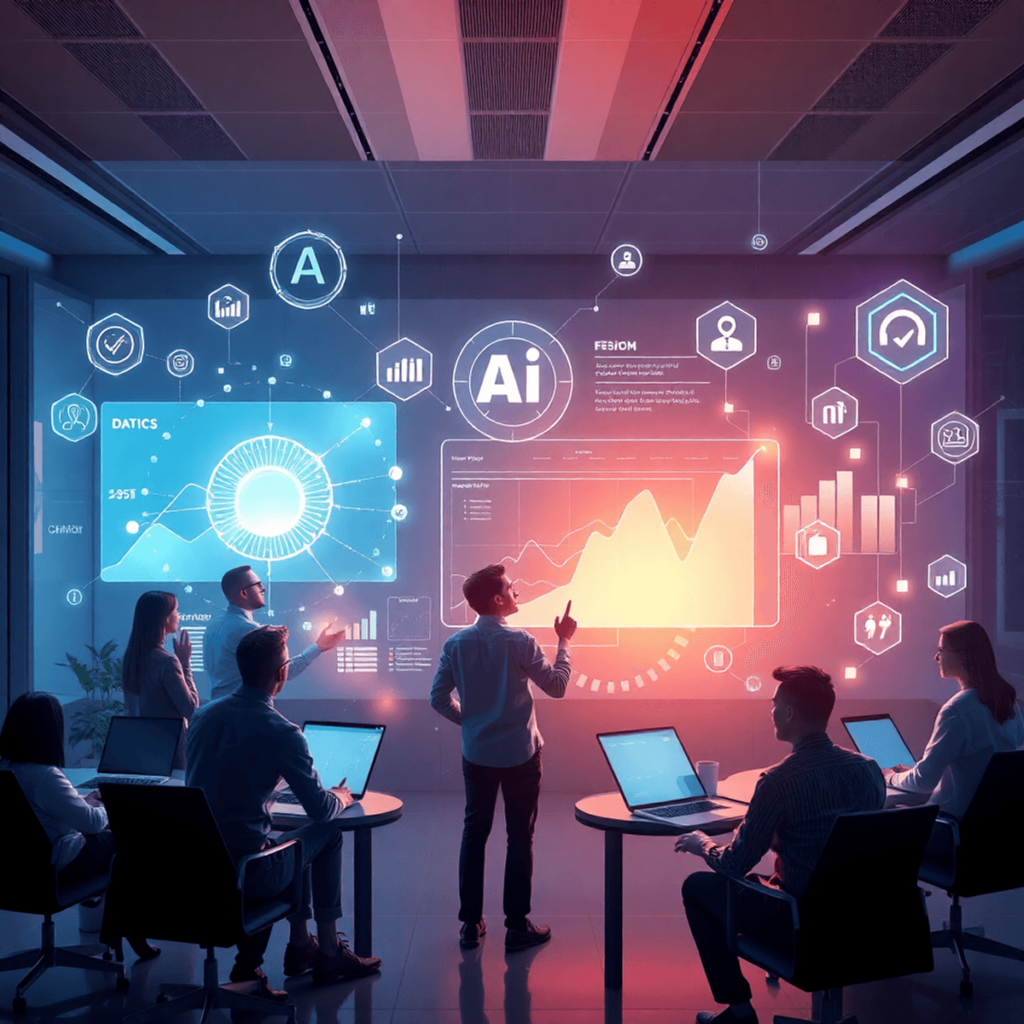

The world of artificial intelligence is changing quickly as we get closer to 2025-2026. We’re moving from small experiments to systems that are fully integrated and have a big impact on industries and how people use technology. These improvements aren’t just minor tweaks; they’re significant changes that are redefining how work gets done, decisions are made, and creativity flows.
Staying updated with the latest AI news trends for 2025 is important for several groups:
- Businesses looking to stay ahead of the competition by using intelligent automation and better data analysis.
- Developers creating advanced AI tools who need to know about new abilities and infrastructure.
- Enthusiasts wanting to understand how artificial intelligence will affect everyday life, society, and future technologies.
There are key themes driving this change:
- Moving from basic AI helpers to digital coworkers working together with humans.
- Making significant progress in healthcare and scientific research, allowing AI to do more than just diagnose problems.
- Combining quantum computing with AI to open up new ways of solving problems.
- Changing the way we set up our systems by focusing on hybrid environments and stronger security measures.
- Making it possible for more people to create and control agentic AI systems.
These factors come together to shape the future of artificial intelligence, which will have a major impact on various industries, research fields, and social structures. In this article, we’ll take a closer look at these important trends that will define the next chapter of AI.
1. The Evolution of AI Collaboration: From Simple Assistants to Digital Coworkers
The world of AI collaboration has changed significantly. It has moved from basic systems that only answer questions to more complex partnerships where humans and machines work together. In the past, AI tools mainly reacted to specific requests or did single tasks. But now, modern AI agents actively collaborate, blending smoothly into work processes and enhancing human abilities.
From Passive Tools to Active Partners
Early versions of AI worked as reactive assistants, giving information or carrying out commands without fully understanding the context. However, today’s advanced models grasp project objectives, track progress, and foresee requirements, allowing them to offer proactive support to human teams. This shift signifies a move from viewing AI merely as a tool to recognizing it as a digital coworker integrated into organizational workflows.
The Role of Digital Coworkers in Coordinating Workflows
Digital coworkers act as intelligent facilitators managing intricate workflows by:
- Coordinating tasks across various teams and systems, ensuring smooth transitions and minimizing delays.
- Serving as communication centers that consolidate inputs from diverse sources — documents, emails, project management platforms — to maintain awareness of the situation.
- Automating routine yet vital actions like scheduling meetings, tracking deadlines, and updating stakeholders without constant human oversight.
These abilities enable human workers to concentrate on making important decisions while depending on AI agents for operational accuracy and uniformity.
Amplifying Human Expertise and Transforming Problem-Solving
AI collaboration improves problem-solving by:
- Offering immediate insights derived from extensive data sets, allowing for quicker identification of problems and opportunities.
- Proposing alternative methods based on recognizing patterns across industries or fields previously unknown to individuals.
- Facilitating iterative brainstorming sessions where AI generates ideas or simulations that humans creatively refine.
This mutually beneficial relationship changes how obstacles are tackled — instead of replacing expertise, AI enhances its effectiveness through continuous interaction.
“Digital coworkers are not just assistants; they are collaborators who share cognitive workloads, freeing humans to innovate.”
Implications for Teams and Organizations
Businesses using digital coworkers see:
- Higher productivity due to smoother communication and less manual coordination.
- Greater flexibility as teams quickly adapt with AI-supported scenario planning.
- Improved employee satisfaction by offloading repetitive tasks while empowering creativity.
Human-AI teamwork redefines traditional roles, emphasizing complementary strengths rather than competition. The evolution of these partnerships will be crucial in shaping the future workplace environment.
2. Breakthroughs in Healthcare and Scientific Research: How AI is Changing These Fields
AI healthcare innovation is advancing rapidly, moving well beyond traditional diagnostic tools to more comprehensive roles including treatment planning and AI symptom triage. AI systems now assist clinicians by analyzing patient symptoms through sophisticated algorithms that prioritize urgency and recommend next steps, effectively acting as frontline triage assistants. This capability enhances patient outcomes by streamlining access to care and optimizing resource allocation.
Addressing Global Health Workforce Shortages
Addressing global health workforce shortages has become a critical application of AI. Many regions face acute deficits in healthcare professionals, and AI-powered virtual assistants help fill these gaps by supporting routine clinical tasks, monitoring chronic conditions remotely, and providing decision support for less experienced practitioners. This not only alleviates the burden on healthcare workers but also increases access to quality care in underserved areas.
Accelerating Discovery Cycles in Scientific Research
Scientific research AI is accelerating discovery cycles across a wide spectrum of disciplines:
- Climate Modeling: AI models integrate vast environmental datasets to improve the precision of climate forecasts and simulate intervention impacts, enabling better policy planning for climate resilience.
- Molecular Dynamics: Machine learning algorithms predict molecular interactions at unprecedented scales, speeding up drug discovery and materials science breakthroughs.
- Physics and Chemistry: AI enhances simulations of complex physical phenomena and chemical reactions, uncovering new fundamental insights that were previously computationally prohibitive.
- Biology: From genomics to cellular behavior analysis, AI tools automate data interpretation, facilitating faster hypotheses generation and experimental design.
In these areas, AI functions as both an analytical engine and a collaborative partner for researchers. It processes massive datasets beyond human capacity while suggesting novel patterns or hypotheses that guide subsequent experiments. Integration with laboratory automation systems transforms theoretical insights into rapid prototyping cycles.
The Feedback Loop Between Healthcare and Scientific Research
The ongoing synergy between healthcare innovation and scientific research driven by AI creates powerful feedback loops. Clinical data informs research models; research outcomes feed back into improved clinical protocols. As complexity grows, this dynamic interplay accelerates progress toward personalized medicine, sustainable environmental solutions, and deeper understanding of natural laws.
This expanding role of AI in healthcare and science illustrates its transition from a supportive technology to an essential driver of innovation with broad societal impact. New frontiers continue emerging as algorithms grow more sophisticated and data ecosystems become richer.
3. Quantum Computing Meets Artificial Intelligence: A New Frontier for Problem-Solving?
The integration of quantum computing AI is set to redefine computational capabilities, pushing the boundaries of what artificial intelligence can achieve. By 2025-2026, hybrid quantum-AI systems are expected to tackle problems that classical supercomputers alone cannot solve.
Hybrid Quantum-AI Systems: Synergy in Complexity
Combining Strengths
Quantum computers excel at handling vast combinatorial spaces and complex probability distributions, while AI algorithms provide adaptive learning and pattern recognition. Merging these technologies creates a powerful synergy where quantum processors handle intricate computations and AI guides problem-solving strategies.
Use Cases
Optimization Problems: Logistics, supply chain management, and financial modeling benefit from hybrid architectures solving multi-variable optimization more efficiently.
Drug Discovery: Quantum-enhanced AI accelerates molecular simulations, enabling faster identification of potential pharmaceuticals.
Materials Science: The ability to simulate atomic interactions on quantum hardware improves AI-driven materials design with unprecedented accuracy.
Expected Quantum Advantage by 2026
Quantum Advantage Defined
Achieving quantum advantage means solving specific computational tasks faster or more accurately than classical supercomputers can. By 2026, select applications—particularly those involving large-scale simulations and optimization—are projected to demonstrate this milestone.
Technological Progress Enablers
Logical Qubits and Error Correction: Advances in error-correcting codes and stable qubit architectures reduce noise, making quantum computations more reliable.
Topological Qubits: Developments like Microsoft’s Majorana-based topological qubits promise scalable and fault-tolerant quantum chips essential for practical AI integration.
AI News Highlights
Leading research institutions report breakthroughs combining quantum algorithms with machine learning models, showing promising results in speeding up training times and enhancing model generalization.
Partnerships between quantum hardware manufacturers and AI-focused companies are accelerating commercial deployment of hybrid systems.
Challenges on the Horizon
Hardware Limitations: Despite rapid progress, physical qubit coherence times and gate fidelities still impose constraints on current quantum devices’ scale and complexity.
Algorithmic Development: Designing quantum algorithms compatible with existing AI models requires new paradigms that can exploit entanglement and superposition while interfacing smoothly with classical components.
Integration Complexity: Seamlessly coordinating workflows across heterogeneous computing resources demands sophisticated orchestration software capable of balancing workloads between quantum processors, classical CPUs, GPUs, and AI accelerators.
Exploring this intersection between quantum computing and artificial intelligence opens transformative pathways for industries reliant on solving highly complex problems. The anticipated hybrid solutions by 2026 herald a new era where computational limits expand beyond classical confines.
4. Infrastructure Maturation and Security Enhancements: Building a Robust Foundation for AI Systems
The landscape of AI infrastructure evolution is undergoing a profound transformation, moving decisively away from a cloud-first approach to embrace hybrid cloud computing environments. This shift integrates the strengths of cloud platforms, on-premises data centers, and edge computing nodes into cohesive ecosystems tailored for AI workloads.
Hybrid Infrastructure Components
- Cloud Computing: Offers scalable resources and elastic capacity critical for training large AI models and handling peak demands.
- On-Premises Systems: Provide control over sensitive data and compliance with regulatory requirements, essential for industries like finance and healthcare.
- Edge Computing: Enables real-time inference and decision-making close to data sources, reducing latency for applications such as autonomous vehicles and industrial automation.
This multifaceted infrastructure allows organizations to optimize performance, cost, and security by allocating AI tasks to the most suitable environment. For example, data preprocessing might occur at the edge, model training in the cloud, while sensitive inference runs on-premises.
Advances in Infrastructure Intelligence and Efficiency
Smarter AI systems infrastructure leverages automated resource management powered by AI itself. Key developments include:
- Dynamic Workload Orchestration: Systems intelligently distribute computing tasks across hybrid environments based on workload characteristics and resource availability.
- Energy-Efficient Hardware Utilization: Specialized AI accelerators adjust operation modes dynamically to balance power consumption with performance needs.
- Cost Optimization Algorithms: Predictive analytics help organizations forecast demand spikes and optimize capacity provisioning to avoid overprovisioning expenses.
These advances contribute to building more sustainable AI infrastructures capable of scaling without prohibitive costs.
Strengthening Security in Hybrid Environments
Security enhancements are crucial as AI moves deeper into enterprise workflows. The complexity of hybrid architectures introduces challenges such as:
- Data Privacy Across Boundaries: Ensuring encrypted data transfers between cloud, edge, and on-premises components safeguards sensitive information.
- Identity and Access Management (IAM): Sophisticated IAM frameworks manage access rights not only for human users but also for autonomous AI agents operating within corporate networks.
- Threat Detection Powered by AI: Employing AI-driven anomaly detection systems helps identify malicious behaviors targeting critical infrastructure components.
Building trust in AI systems requires continuous monitoring combined with robust policies that adapt dynamically to emerging threats.
Real-World Example: Hybrid Infrastructure in Practice
A multinational manufacturing company employs hybrid architecture where sensor data is processed at factory edges to trigger immediate responses. Aggregated data streams then move securely to central cloud platforms for training predictive maintenance models. On-premises servers handle proprietary analytics ensuring compliance with local regulations. This setup maximizes operational efficiency while maintaining stringent security controls.
The maturation of infrastructure supporting artificial intelligence reflects a necessary foundation upon which sophisticated agentic systems can reliably operate. These developments pave the way toward seamless integration of AI capabilities across diverse environments and use cases.
5. How AI is Changing Software Development: A New Era in Coding?
AI has become more than just a tool for automating tasks in software development. It is now a game-changer, revolutionizing the way we write, review, and maintain code. With the help of AI code analysis, we can now gain a deeper understanding of complex codebases and uncover patterns that were once difficult to see.
What’s New in AI-Assisted Coding?
Here are some key developments in AI-assisted coding that are making a difference:
1. Understanding Code in Context
Unlike traditional methods that only look at small sections of code, AI models now analyze entire repositories. This allows them to understand how different files and modules are connected, leading to more relevant suggestions that align with existing design patterns.
2. Finding Bugs and Fixing Them Faster
AI goes beyond basic error detection by learning from past fixes across multiple repositories. It can recognize common vulnerabilities or logical errors, enabling early identification before the code is deployed.
3. Smart Suggestions for Developers
Instead of just completing code based on syntax rules, AI now provides recommendations based on the developer’s intent and the overall application context. This helps developers work more efficiently and encourages best practices without them having to think about it consciously.
4. Making Code Better Automatically
AI tools can propose changes to simplify complex functions, improve readability, or optimize performance. These suggestions are integrated into continuous integration pipelines, ensuring that code quality is continuously improved throughout the development process.
How This is Changing Software Engineering Culture
The rise of AI in software development is fostering a new culture where human developers and AI assistants work together as partners rather than just tool-users. Developers can now focus more on creative problem-solving and making important architectural decisions while routine tasks like writing and maintaining code are taken care of by AI.
Companies that have embraced this shift are seeing positive results:
- Development cycles are getting shorter because issues are being resolved faster.
- New team members are having better onboarding experiences thanks to AI-guided learning during code reviews.
- Technical debt is being reduced because quality checks powered by repository-wide intelligence are happening proactively.
Challenges We Need to Address
While there are many benefits to using AI for code analysis, there are also some challenges we need to be mindful of:
- We must ensure that developers trust the recommendations made by AI by being transparent about how they work.
- We should avoid tailoring suggestions too much towards specific coding styles that may not apply universally.
- We need to consider the security implications when third-party AI services analyze proprietary or sensitive codebases.
The growth of AI code analysis using repository intelligence marks a significant shift in how software engineering is done. By combining the skills of developers with those of intelligent systems, we can create an environment where software quality, maintainability, and innovation all flourish together.
6. The Rise of Agentic AI Systems: Super Agents and Democratized Creation Tools for All?
Agentic AI systems represent a significant advancement in artificial intelligence capabilities, transitioning from being passive tools to becoming autonomous entities capable of reasoning, planning, and executing complex tasks independently. These systems, commonly known as super agents, possess advanced cognitive abilities that enable them to function in various environments and seamlessly utilize multiple tools.
Super Agents Capabilities
- Reasoning and Planning: Super agents can analyze intricate problems by breaking them into manageable sub-tasks, devising strategies without constant human supervision. This capability enables them to tackle challenges that require long-term foresight and adaptability.
- Tool Usage Across Environments: Unlike traditional AI limited to specific datasets or domains, super agents dynamically select and employ various software tools, APIs, and data sources to fulfill objectives. For instance, they might integrate scheduling applications with communication platforms to autonomously coordinate team projects.
- Cross-Domain Functionality: These agents do not operate in isolation; instead, they leverage knowledge from different fields to enhance decision-making. This cross-pollination enriches outcomes in areas such as customer service automation, financial analysis, or supply chain optimization.
Democratization of AI Creation
The emergence of agentic AI aligns with efforts to make intelligent system design accessible far beyond specialized developers:
- Business Users as Creators: Intuitive no-code or low-code platforms empower professionals without programming backgrounds to build custom AI agents tailored to their workflows. This shift breaks down technical barriers limiting innovation within organizations.
- Customization at Scale: Enterprises can deploy personalized agents addressing unique operational needs—such as automating client onboarding processes or monitoring compliance—without heavy IT intervention.
- Collaborative Development Ecosystems: Open frameworks foster community contributions where users share templates, modules, and best practices for agent creation. This collaborative environment accelerates improvement cycles and broadens adoption.
Implications in the AI News Landscape
Agentic AI systems redefine how organizations implement intelligent automation:
- Enhanced autonomy reduces reliance on manual oversight while increasing efficiency.
- Democratized creation tools cultivate innovation among diverse user groups.
- The expanding capabilities of super agents signal a paradigm where AI acts as proactive collaborators rather than reactive assistants.
This evolution reflects a critical juncture in AI’s integration into everyday business processes and personal applications alike.
7. Open Source Trends Shaping the Future of AI: A Collaborative Approach to Innovation?
Open source AI models are becoming crucial in driving innovation through community collaboration and transparency. The landscape is shifting toward smaller, domain-specific multimodal reasoning models that combine multiple data types—such as text, images, and audio—to solve specialized problems with higher efficiency and accuracy.
Key aspects shaping this trend include:
- Specialized Model Development: These smaller models are designed to be easily tunable for particular industries or tasks. By focusing on specific domains—like legal analysis, medical diagnostics, or financial forecasting—they reduce complexity while improving performance. This modular approach allows organizations to deploy tailored AI solutions without the overhead of massive generalist models.
- Multimodal Reasoning Capabilities: Integrating multimodal inputs enables these AI systems to understand context more holistically. For example, an open-source model might analyze patient records (text), imaging scans (visual), and audio notes simultaneously to provide nuanced healthcare insights. This capability broadens the applicability of AI beyond traditional single-mode processing.
- Global Open-Source Ecosystems: The open-source community is increasingly globalized, with contributors and users spanning continents and cultures. This diversity fosters innovation through cross-pollination of ideas and accelerates development cycles. Projects benefit from localized expertise that enhances language support, cultural relevance, and compliance with regional regulations.
- Interoperability as a Competitive Factor: With numerous projects emerging worldwide, ensuring open standards and compatibility between different open-source AI tools becomes critical. Interoperability facilitates seamless integration into existing workflows and supports hybrid architectures combining various models and platforms. This trend encourages cooperative rather than siloed development.
Community-driven frameworks also emphasize transparency in training data sources, model biases, and evaluation metrics—promoting trustworthiness in deployed systems. Open collaboration accelerates the refinement of fine-tuning techniques and reinforcement learning strategies within these ecosystems.
The collective momentum behind global open-source AI development is democratizing access to cutting-edge technology. It empowers smaller organizations and individual developers to participate actively in shaping AI’s future instead of relying solely on large corporations’ proprietary solutions.
This collaborative foundation will serve as a launchpad for innovations that integrate effortlessly into diverse environments while maintaining adaptability across rapidly evolving use cases.
8. Physical AI and Robotics Innovations: Bridging the Virtual-Real Divide in Automation?
The world of physical AI sensing, acting, and learning is changing quickly as robotics trends for 2025 show a strong shift towards combining technology with the real world. Robots are no longer limited to working in controlled spaces; instead, they are increasingly engaging with complex and unpredictable environments.
1. Integration of Sensing, Acting, and Learning
Advanced robotics systems are combining perception (sensing), decision-making (learning), and execution (acting) into cohesive units capable of adapting on the fly. These robots use multi-modal sensors—such as LiDAR, cameras, tactile feedback, and auditory inputs—to construct rich models of their surroundings. This sensory data feeds into continuous learning algorithms that enable real-time adjustments to behavior without human intervention.
2. Autonomous Vehicles on Production Routes
One of the most visible applications of this trend is the use of autonomous vehicles in industrial settings. These vehicles operate within warehouses or factories, navigating complex layouts by interpreting sensor data to avoid obstacles and optimize their paths. By learning from ongoing operations, these vehicles can improve efficiency and reduce accidents caused by human error.
3. Collaborative Robots (Cobots)
In contrast to traditional automation methods that replace human workers, cobots are designed to work alongside humans. These robots are equipped with physical AI capabilities that allow them to sense human presence and adjust their actions accordingly. This collaboration has the potential to enhance productivity while maintaining safety standards in environments where humans and machines coexist.
4. Robotics in Unstructured Environments
Physical AI-enabled robots are also being deployed in areas where conditions are less predictable, such as agriculture fields or construction sites. Unlike traditional automation systems that struggle with variations in terrain or weather, these robots can adapt through their learning algorithms.
5. Human-Robot Interaction Advances
Advancements in physical AI are not only focused on what robots can do but also on how they communicate with humans. Non-verbal cues such as gestures or visual signals play a crucial role in ensuring smooth collaboration between people and robotic agents.
The combination of sensing, acting, and learning capabilities within robotics brings us closer to a future where machines powered by artificial intelligence go beyond being mere tools—they become partners assisting us across various tasks in the physical world.
9. Business Implications of Accelerating AI Adoption: Strategies for Success in a Competitive Landscape
The rapid growth of AI startups is changing the competitive dynamics within the tech ecosystem, growing faster than traditional SaaS companies. These startups use advanced AI technology to provide innovative solutions in various industries, attracting significant investment and market attention. Their ability to adapt quickly and focus on advanced AI applications makes them strong competitors against established companies.
Challenges for Businesses Adopting AI
Businesses adopting AI face complex challenges as they move beyond simple automation toward agentic systems—intelligent agents capable of autonomous reasoning, planning, and execution. This shift requires a complete redesign of organizational processes instead of just making small adjustments. Traditional workflows that rely on manual oversight or rule-based automation struggle to accommodate the flexible and context-aware nature of agentic AI.
Key Considerations for Organizations
Here are some key factors organizations need to think about when going through this transformation:
- Process Redesign:
- Agentic systems need to be integrated into workflows that support continuous learning, decision-making autonomy, and collaboration between multiple agents. Companies must create processes that empower these systems while still having human oversight when necessary.
- Skillset Evolution:
- Workforce roles are changing from simply carrying out tasks to supervising and coordinating AI agents. Training programs must equip employees with skills in governing AI, considering ethical implications, and interacting with humans and AI.
- Change Management Complexity:
- The introduction of agentic AI disrupts established corporate cultures and operational ways of doing things. Effective communication and leadership are crucial in promoting adoption and reducing resistance.
- Outcome-Oriented Metrics:
- Success metrics are shifting from measuring efficiency in inputs and outputs to focusing on business outcomes achieved through intelligent automation—such as speeding up innovation, improving customer experience, and reducing risks.
- Security and Compliance:
- Autonomous agents create new vulnerabilities that require strong security measures specifically designed for AI decision-making processes and data privacy regulations.
Strategies for Organizations
The fast-paced innovation in agentic systems calls for strategies that strike a balance between technological advancement and organizational flexibility. Here are some strategies organizations can consider:
- Investing in scalable infrastructure
- Building cross-functional teams
- Collaborating with emerging AI startups
These strategies will help companies position themselves to fully utilize the transformative power of artificial intelligence.
“Navigating the shift from automated tools to independent digital collaborators is not merely a technical challenge—it is a strategic imperative for businesses seeking sustainable competitive advantage in the AI era.”
This evolving landscape shows how business leaders must closely align their technology investments with agile execution models in order to take advantage of rapidly changing opportunities brought about by intelligent agents.
Conclusion
The direction of AI development toward integrated digital coworkers indicates a significant change in the future of artificial intelligence. These systems have evolved from being standalone tools to becoming collaborative partners that are deeply integrated into workflows across various industries. As their presence continues to grow, it is crucial to prioritize several key factors for successful and responsible implementation.
Key Considerations for AI Deployment
- Security: Protecting AI systems from vulnerabilities becomes crucial as these agents gain independence and access to sensitive information. Strong security measures must evolve alongside AI capabilities to prevent misuse, data breaches, and attacks.
- Trustworthiness: Building trust among users and organizations requires clear and understandable AI behaviors. Trustworthy AI follows ethical guidelines, fairness principles, and accountability measures that assure stakeholders of reliable decision-making.
- Infrastructure Efficiency: Efficient infrastructure that supports hybrid cloud, edge, and on-premises environments reduces operational costs while improving scalability and responsiveness. Optimizing resource management is essential as AI tasks become more complex and larger in size.
Democratization of Agentic Systems
The AI News landscape highlights a significant trend: democratizing AI agent creation beyond traditional developers. Business users gain unprecedented ability to design customized intelligent agents tailored to specific needs without deep technical expertise. This shift fosters innovation at all organizational levels and accelerates adoption by lowering barriers.
- Empowerment of non-technical users through intuitive interfaces
- Expansion of domain-specific applications leveraging agentic parsing and modular architectures
- Enhanced collaboration between human expertise and autonomous reasoning agents
These developments point toward an inclusive ecosystem where the benefits of AI permeate diverse sectors, driving productivity, creativity, and problem-solving capabilities.